
Your sales team isn't ignoring MQLs because they're lazy; they're ignoring them because your legacy scoring system is broken. Static, point-based rules have become a primary source of technical debt that creates constant friction between marketing ops and sales leadership. It's time to stop managing manual thresholds and start deploying AI powered lead scoring models for B2B that operate with autonomous precision. You already know that manual scoring feels like a losing game of whack-a-mole where fragmented data silos prevent any real visibility into buyer intent. We agree that the status quo is costing you predictable revenue and eroding trust across your organization.
This guide will help you master the shift from reactive point systems to high-octane AI models that drive measurable expansion. You'll learn how to replace fragmented workflows with a scalable, automated architecture designed for the 2026 GTM landscape. We're breaking down five specific AI-driven frameworks that align your operations, eliminate manual overhead, and maximize your sales-to-lead conversion rates. It's time to build a revenue engine that actually works. Results start here.
Key Takeaways
- Stop wasting time on manual point thresholds. Learn how machine learning identifies hidden revenue patterns that human-defined rules consistently miss.
- Unify your CRM and third-party intent data into a single source of truth. This architecture is the foundation for any scalable revenue engine.
- Deploy specific AI powered lead scoring models for B2B like the Rapid Response or Product-Qualified Lead frameworks. These models turn product usage into immediate expansion opportunities.
- Audit your marketing operations to eliminate technical debt. Clear data silos are mandatory for scaling your ARR without breaking your systems.
- Align sales and marketing through fractional leadership. A strategic GTM approach ensures your AI scoring is a driver of predictable growth rather than a technical experiment.
Beyond the Point System: Why Traditional Lead Scoring Fails in 2026
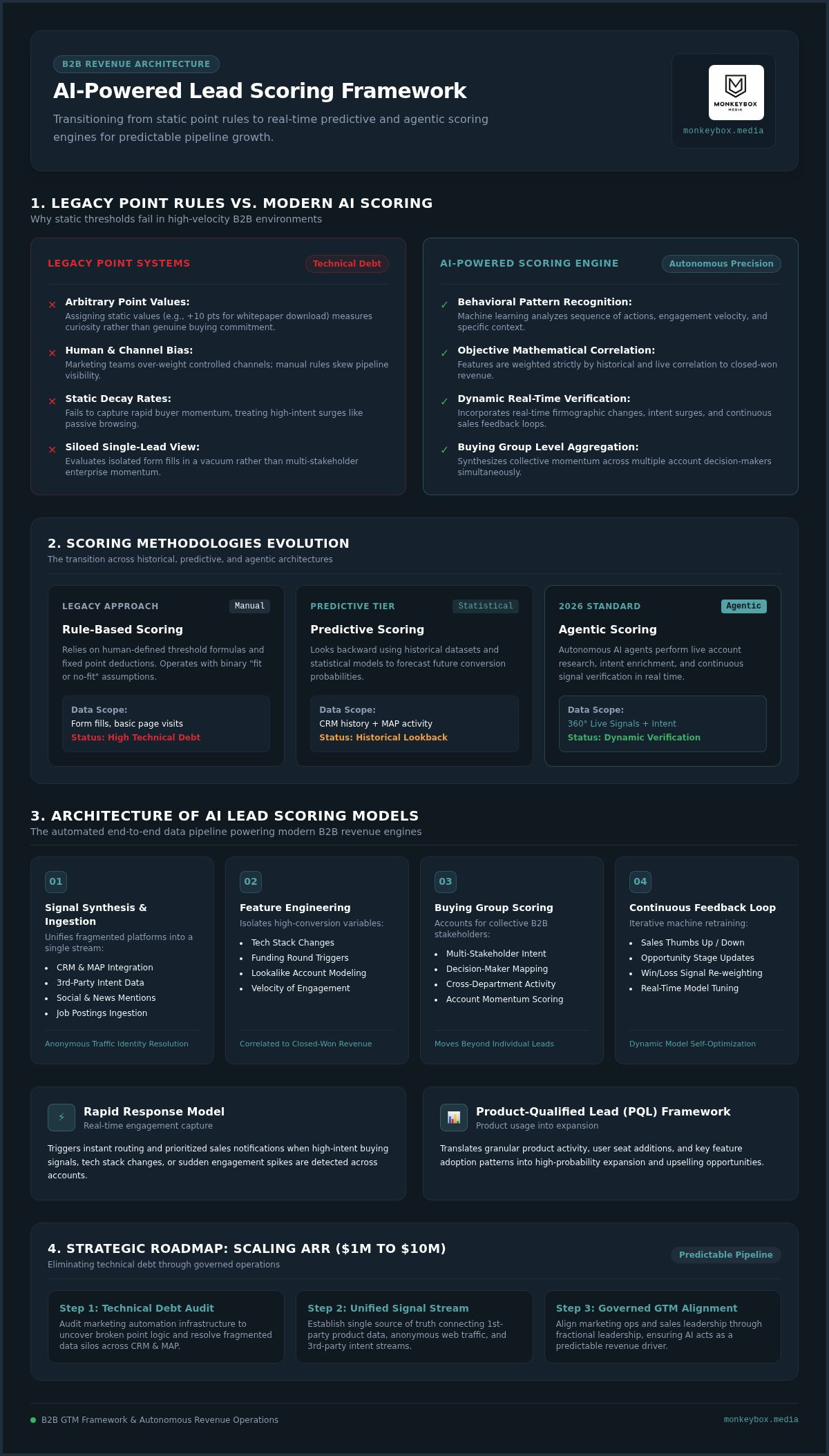
Traditional scoring is a strategic liability. It acts as a static map for a high-velocity battlefield. Most B2B organizations remain trapped in "Legacy Logic," where arbitrary point values create a false sense of security while hiding the truth about buyer behavior. This technical debt accumulates every time a marketing manager adds a manual rule to fix a temporary alignment issue. It's inefficient. It's slow. It destroys sales-marketing trust. High-performance teams are pivoting to AI powered lead scoring models for B2B to eliminate this friction. These systems identify complex behavioral patterns that human analysts consistently miss, moving beyond the binary "fit or no-fit" mentality. They analyze the sequence of actions, the velocity of engagement, and the specific context of every interaction.
The Failure of Manual Rule-Based Logic
Assigning 10 points for a whitepaper download is a meaningless metric. In a world of automated research and content saturation, a download signals curiosity, not commitment. Manual systems rely on fixed decay rates that fail to capture the explosive momentum of a serious buyer. Human bias also corrupts the data. Marketing teams often over-weight the specific channels they control, which skews the pipeline. This lack of objectivity turns lead scoring into a political tool rather than a revenue driver. Understanding the difference between traditional and predictive lead scoring is the first step toward reclaiming your pipeline's integrity. You cannot scale a $10M ARR engine on a foundation of "best guesses" and outdated spreadsheets.
The 2026 Standard: Predictive vs. Agentic Scoring
The distinction between predictive and agentic architectures defines the modern GTM strategy. Predictive scoring looks backward. It uses historical datasets to forecast future conversion. It's useful but limited by the quality of your past data. Agentic scoring represents the cutting edge. These systems utilize AI agents to perform autonomous research, enrichment, and validation in real-time. Agentic scoring is the intersection of autonomous research and predictive analytics. It doesn't just guess based on history; it verifies the current state of the account. Deploying AI powered lead scoring models for B2B allows for a level of granularity that manual systems simply cannot achieve. This shift from static fit to dynamic intent ensures your sales team spends every minute on leads with genuine momentum. It's about moving from guessing who might buy to knowing who is buying right now.
The Architecture of AI-Powered Lead Scoring Models
Infrastructure is the heartbeat of your GTM strategy. Building a high-performance scoring engine requires more than a simple API connection; it demands a sophisticated data architecture that unifies your CRM, Marketing Automation Platform (MAP), and third-party intent signals into a single, machine-readable stream. This is the foundation of AI powered lead scoring models for B2B. Unlike legacy systems that choke on siloed data, modern architectures prioritize "Feature Engineering." This is the process of isolating specific variables, such as technology stack changes or recent funding rounds, that actually correlate with closed-won revenue. Lookalike modeling is merely the starting point. The real value lies in the continuous feedback loop where sales feedback, specifically the "thumbs up" or "thumbs down" on lead quality, retrains the model in real-time. This iterative process ensures the system evolves alongside your market.
Data Ingestion and Signal Synthesis
Your model must process more than just form fills. High-octane systems ingest unstructured data like social signals, news mentions, and job postings to build a 360-degree view of account activity. Identity Resolution allows you to score anonymous web traffic before a lead identifies themselves. We're moving beyond "Lead" scoring and toward "Buying Group" scoring. This shift is essential because B2B decisions are never made in a vacuum. Capturing the collective momentum of multiple stakeholders within an account is what separates elite performers from the rest. If your infrastructure is currently a mess of disconnected silos, a marketing automation technical debt audit can identify the leaks in your revenue engine.
Choosing Your Model: Regression vs. Random Forest vs. Neural Networks
The mathematical framework you choose dictates the speed and accuracy of your insights. Logistic Regression is effective for simple, binary outcomes like "will they click or not." However, B2B journeys are rarely linear. This is where Random Forest models excel; they handle complex, non-linear paths by analyzing hundreds of decision trees simultaneously. McKinsey's analysis on B2B sales analytics highlights how these advanced systems route prospects with surgical precision, significantly increasing lead-to-opportunity rates. For qualitative data analysis, LLM-based scoring is the new standard. It allows the model to "read" sales notes or email transcripts to gauge sentiment and intent. Selecting the right model isn't a technical chore; it's a strategic GTM decision that defines your ability to scale.
5 Real-World Examples of AI Lead Scoring in Action
Theory is useless without execution. To move the needle on your ARR, you need specific, battle-tested frameworks that turn raw signals into revenue. Implementing AI powered lead scoring models for B2B allows you to move beyond basic demographics and into the world of behavioral momentum. These models aren't generic templates; they're precision instruments designed to solve specific GTM friction points. Whether you're managing a high-volume inbound funnel or a complex account-based motion, the following examples represent the elite standard for 2026 revenue operations. Each model addresses a unique stage of the buyer journey, ensuring no opportunity is left to chance.
The Intent-Driven Inbound Model
This model focuses on the "High-Fit, High-Intent" Rapid Response framework. It utilizes "Surge" data from third-party providers to identify accounts showing sudden interest in your category. If a prospect from a target account visits your pricing page three times within 24 hours, the system doesn't just send an alert. It triggers an automated "Fast Pass" to Sales, bypassing standard nurture tracks entirely. This architecture ensures your team engages while the intent is at its peak. It's about speed and relevance. By prioritizing these high-velocity signals, organizations eliminate the delay that typically kills inbound conversion rates.
The Account-Based Momentum Model
B2B deals are won by convincing groups, not individuals. This model aggregates individual engagement scores into a single "Account Heat Map." It tracks multi-touch attribution across different departments, identifying when a "Buying Committee" is forming. Momentum scoring prevents missing the "Active Buying Window" by detecting the subtle shift from individual curiosity to organizational consensus. When the IT Director, the CFO, and the VP of Operations all engage with your content in the same week, the model flags a buying group formation. This allows your sales leadership to pivot from a single-point contact strategy to a comprehensive account-based attack.
The Product-Led Growth (PLG) Scoring Model
For companies with a trial or freemium motion, the "Product-Qualified Lead" (PQL) model is essential. It scores leads based on in-app feature adoption and usage frequency rather than just marketing engagement. The system identifies the "Aha! Moment," the specific sequence of actions that correlates with long-term retention and enterprise potential. This model also serves as a "Churn-Predictive" tool for existing customers. If usage drops below a specific threshold, a customer success agent is notified immediately. It balances the high volume of free users with the high-value potential of enterprise expansion. Deploying AI powered lead scoring models for B2B within your product ensures your sales team only spends time on users who have already realized the value of your solution.
Implementation Roadmap: Scaling from $1M to $10M ARR
Scaling from $1M to $10M ARR is a structural challenge, not just a sales goal. You cannot reach the next level of professional maturity with a pipeline built on manual spreadsheets and gut feelings. Transitioning to AI powered lead scoring models for B2B requires a disciplined, multi-stage roadmap that prioritizes infrastructure over intuition. This isn't a "flip the switch" event. It's a methodical construction project. Start by running your AI model in "Shadow Mode" alongside your legacy system. This allows you to validate the AI's predictions against real-world outcomes before giving it control over your lead routing. Once the model proves its accuracy, you can begin the process of full automation, deploying AI agents to handle low-level qualification and enrichment. This frees your human talent for high-stakes closing. Precision is the only way forward.
Eliminating Marketing Automation Technical Debt
Dirty data poisons the well. If your CRM is a graveyard of duplicate records and outdated firmographics, your AI model will hallucinate. You must consolidate your MarTech stack to ensure a single source of truth before implementation. Audit your workflow automation for AI readiness by identifying where fragmented data silos exist. Technical debt is the silent killer of GTM velocity. To ensure your infrastructure is robust enough for the $10M leap, you need a marketing automation technical debt audit to clear the path for autonomous growth. Clean data is the fuel for your revenue engine. Without it, your AI is just an expensive guessing machine.
The "Reason Code" Strategy for Sales Adoption
Sales teams ignore black boxes. To build trust, every score must be accompanied by a "Reason Code" that explains the logic behind the number. If a lead receives a high score because the account "recently hired a new VP of Marketing" or "installed a competitor's technology," the SDR knows exactly how to tailor the outreach. This transparency transforms the AI from a mysterious algorithm into a strategic partner. Establish a tight feedback loop where Sales Development Reps (SDRs) provide qualitative data back to the Ops team. Training the model on "Closed-Lost" data is equally important. Identifying negative signals ensures the AI learns what a bad lead looks like. This prevents your team from chasing dead-end opportunities and keeps the focus on expansion. Trust is earned through transparency and results.
The Fractional CMO’s Role in Governed AI Growth
Implementing AI powered lead scoring models for B2B is a high-stakes strategic maneuver, not a simple software integration. Without executive-level oversight, even the most advanced machine learning models become expensive distractions that accumulate technical debt. A Fractional CMO acts as the "Bold Architect" of your revenue engine, ensuring every automated signal serves a larger GTM objective. This role is about more than just picking tools. It's about managing the aggressive transition from human-led workflows to agent-assisted marketing operations. You need a leader who can align these technical capabilities with long-term brand positioning and $10M ARR targets. Results require a commander, not just a technician.
Strategic Leadership vs. Technical Implementation
Many organizations make the mistake of hiring an agency for "AI agents" without a cohesive GTM strategy. This approach fails because technical implementation without strategic authority creates a "black box" that Sales will eventually ignore. Fractional leadership provides the sophisticated oversight required to bridge the gap between marketing ops and the executive suite. You gain access to veteran expertise at a fraction of the cost of a full-time hire. For a deeper look at this model, consult The Fractional CMO Agency Guide 2026. This framework ensures your AI powered lead scoring models for B2B are governed by logic that drives expansion rather than just activity.
Building the Infrastructure for Scalable Growth
Scalability requires a modular GTM roadmap that evolves as AI capabilities mature. A "No-Nonsense" approach to Marketing Ops focuses exclusively on the levers that move the needle on revenue. This means ruthlessly auditing every automated workflow to ensure it contributes to a higher sales-to-lead conversion rate. The Fractional CMO designs the system, oversees the construction of the data layer, and ensures the entire organization is aligned with the new reality of agentic scoring. It's about building a robust infrastructure that survives the shift from $1M to $10M ARR. If you are ready to overhaul your GTM and eliminate the friction in your funnel, explore our Fractional CMO and AI Automation services.. Strategic growth isn't an accident. It's an architecture.
Command Your Revenue Future
Legacy point-based systems are no longer just inefficient; they're a liability. To scale effectively in the 2026 landscape, your organization must transition to AI powered lead scoring models for B2B that prioritize real-time intent and buying committee momentum. This shift requires more than just new software. It demands a robust marketing operations infrastructure that ruthlessly eliminates technical debt and unifies fragmented data silos. Precision is the only option for leaders targeting the $10M ARR milestone.
Strategic growth happens when expert fractional CMO leadership meets high-octane workflow automation. By deploying autonomous AI agents and a modular GTM roadmap, you ensure your sales team focuses exclusively on high-value expansion opportunities. The architecture you build today defines your market position tomorrow. Stop managing manual thresholds and start architecting a system built for speed and scalability.
Build a Scalable B2B Revenue Engine with Monkeybox Media through expert AI agent implementation and strategic marketing operations that eliminate technical debt. It's time to stop guessing and start growing. Your next level of professional maturity is within reach.
Frequently Asked Questions
What is the difference between predictive and generative AI in lead scoring?
Predictive AI analyzes historical data to forecast conversion likelihood by finding patterns in what already happened. Generative AI, often used within agentic workflows, synthesizes qualitative information like sales notes or social posts to provide context. While predictive models give you a number, generative elements explain the logic behind the score. Combining both creates the most robust AI powered lead scoring models for B2B available in 2026.
How much data do I need to start using AI-powered lead scoring?
You don't need millions of records to begin. Most high-growth B2B firms start with a baseline of 500 to 1,000 historical conversions to train a reliable model. If your dataset is smaller, focus on high-intent signals and firmographic fit first. Quality trumps volume every time. Ensuring your data is clean and unified across your CRM is more critical than having a massive, disorganized database that poisons the model's output.
Can AI lead scoring work for small B2B teams with low lead volume?
Yes, it works by shifting the focus from volume to velocity and intent. Small teams benefit from AI by automating the research that would otherwise consume their limited time. Instead of scoring thousands of leads, the AI identifies the three accounts showing active buying signals right now. This allows a lean sales team to act with the precision of a much larger organization. It's about maximizing every single opportunity in your pipeline.
How do I explain AI lead scores to my sales team so they trust them?
Transparency is the only way to build trust. Replace the "black box" with clear "Reason Codes" that explain exactly why a lead received a specific score. If a lead is flagged, show the sales rep the specific triggers like a recent technology install or multiple pricing page visits. When reps see the logic behind the number, they stop questioning the data and start focusing on the outreach. Trust is a byproduct of consistent accuracy.
What are the best tools for implementing AI lead scoring in 2026?
The best stack combines your core CRM with specialized AI agents and marketing operations platforms. Look for tools that offer seamless identity resolution and real-time intent ingestion. In 2026, the focus has shifted toward agentic systems that research leads autonomously rather than just processing static form fills. Your choice should depend on your specific GTM strategy and the complexity of your buying journeys. A modular approach allows your infrastructure to evolve as your ARR grows.
How often should an AI lead scoring model be retrained?
Retraining should occur at least once per quarter to account for shifting market dynamics. However, high-velocity industries often require monthly updates to maintain peak accuracy. If you launch a new product or pivot your ICP, you must retrain the model immediately. Continuous feedback loops from sales are also essential. Every "closed-lost" deal provides critical negative signals that help the model refine its understanding of what a qualified lead looks like.
What happens if our data is currently messy or siloed?
Messy data is a primary source of technical debt that will kill your AI implementation. You must perform a comprehensive marketing operations audit to unify your silos before deploying any AI powered lead scoring models for B2B. Attempting to layer AI over broken infrastructure only accelerates your errors. Consolidating your CRM and MAP into a single source of truth is a mandatory first step. Clean data is the only foundation for a scalable revenue engine.
Is AI lead scoring compliant with GDPR and other data privacy laws?
Compliance is achievable through rigorous data governance and a focus on first-party intent signals. Modern AI models are designed to process data within the boundaries of GDPR and other privacy frameworks by utilizing anonymized signals and explicit consent. Ensure your AI agents are configured to respect "do not track" requests and data residency requirements. Working with a strategic partner helps you navigate these regulations without sacrificing the performance of your automated scoring systems.