
The model isn’t the starting point. The revenue workflow is. AI implementation for B2B marketing delivers value when it targets a real growth priority, not when it adds another disconnected pilot. A content assistant or AI agent can increase activity, but activity alone won’t fix slow lead follow-up, fragmented systems or unclear ownership.
B2B teams are right to weigh the risks. Poor data, inaccurate outputs and careless handling of customer information can erode trust as quickly as automation can save time. The answer isn’t to hold back or automate everything. It’s to build reliable workflows with people accountable for the decisions that matter.
This article sets out a practical framework for prioritising AI opportunities against go-to-market goals, checking whether your data and processes are ready, and assigning clear human oversight. You’ll also learn how to measure adoption, output quality, efficiency and commercial impact, so each implementation earns its place in the growth system. Start with the work that moves revenue, then scale what proves its value.
Key Takeaways
- Define AI implementation as accountable workflow design, not simply the purchase of another tool.
- Compare potential B2B marketing use cases by value, feasibility, data readiness, risk and review effort.
- Choose the right level of human involvement by assessing how repeatable a task is and what an error could cost.
- Build AI implementation for B2B marketing around clear ownership, from selecting a business objective to deciding whether to scale a pilot.
- Align go-to-market strategy, marketing operations and workflow execution so AI supports a connected growth system.
AI Implementation for B2B Marketing: What It Means Beyond Adding a Tool
Buying an AI application gives your team access to a capability. It doesn’t establish how that capability should support a business goal, fit an existing process or be checked before its output affects customers. Adopting an AI application gives a team a tool; implementing AI embeds it in an accountable workflow with an owner, a decision point and a measure of performance. That distinction is central to AI implementation for B2B marketing.
B2B marketing spans long customer journeys, multiple stakeholders and connected pipeline activities. An AI use case should map to a real point in that journey, such as researching target accounts or coordinating campaign operations, and fit the systems and team capacity already in place. An overview of artificial intelligence in marketing can help frame the range of applications, but the business case depends on how a chosen application works within your operation.
What counts as AI implementation in B2B marketing?
Start by defining the task, its business purpose and the point where a person must review or act. For lead research, specify which approved information sources the workflow can use, how findings should be recorded, who checks their relevance and where the result enters the sales or marketing process. Data quality, system access and process design all affect whether the workflow is usable. Human review keeps responsibility clear.
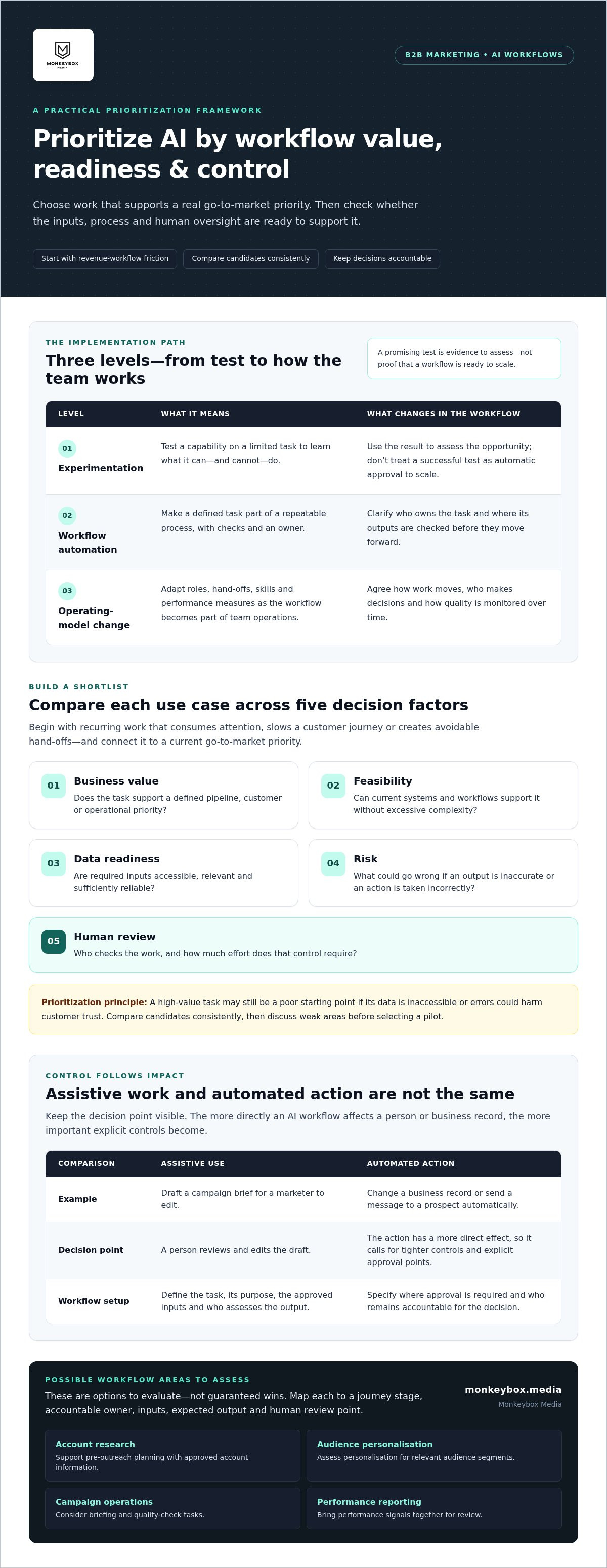
The work can then progress through three distinct levels:
- Experimentation: A team tests a capability on a limited task to learn what it can and can’t do.
- Workflow automation: A defined task becomes part of a repeatable process, with checks and an owner.
- Operating-model change: Roles, hand-offs, skills and performance measures adapt as the workflow becomes part of how the team works.
These stages aren’t interchangeable. A promising test is evidence to assess, not proof that a workflow is ready to scale. Automation can handle repeatable steps, while sustained change requires teams to agree on how work moves, who makes decisions and how quality is monitored.
Why AI projects stall before they create value
Projects often lose momentum when teams select a tool before agreeing on the business problem. Without a workflow owner, a pilot may lack the authority to change hand-offs or address poor-quality inputs. Weak data foundations can also produce outputs that need so much correction they add work instead of removing friction.
Disconnected pilots can leave teams juggling separate tools, inconsistent processes and unclear measures. Adoption depends on fitting the workflow to how people actually work, giving them the capability to use it responsibly and reviewing performance over time. Set a baseline, track quality and usage, and decide what evidence would justify adapting, stopping or expanding the workflow. That creates a route from experimentation to operational value without treating adoption as an outcome in itself. If you want support turning tools into structured growth drivers, visit AI Asset Man to see how specialized digital marketing and asset development can strengthen your execution.
Find the B2B Marketing Workflows Where AI Can Make a Difference
Start with friction in the revenue workflow, not the newest AI capability. Look for recurring tasks that consume team attention, slow a customer journey or create avoidable hand-offs. Then ask whether improving that task supports a current go-to-market priority. A use case that sounds impressive but has little connection to pipeline progression or customer experience is unlikely to deserve early investment.
Potential areas include account research before outreach, personalisation for relevant audience segments, campaign operations such as briefing and quality checks, and reporting that brings performance signals together. These are options to assess, not guaranteed wins. IBM’s overview of AI in marketing provides broader context; your shortlist should reflect your customer journey, systems and team capacity.
Prioritise use cases across the B2B customer journey
Map each candidate to a specific journey stage and document five things: the accountable owner, available inputs, required output, decision the output should inform, and point where a person reviews it. For example, an account-research workflow might support pre-engagement planning. Its owner could be a demand-generation lead, its inputs approved account information, and its output a summary for a marketer to assess before outreach.
Rank each use case by business value, feasibility, data readiness, risk and the level of human review it needs. Use a simple scorecard to compare candidates consistently, then discuss any weak area before choosing a pilot. A high-value task may still be a poor starting point if its data is inaccessible or errors could harm customer trust.
- Value: Does the task support a defined pipeline, customer or operational priority?
- Feasibility: Can current systems and workflows support it without excessive complexity?
- Data readiness: Are the required inputs accessible, relevant and sufficiently reliable?
- Risk: What could go wrong if the output is inaccurate or an action is taken incorrectly?
- Review needs: Who checks the work, and how much effort does that control require?
Keep assistive use distinct from automated action. Drafting a campaign brief for a marketer to edit leaves the decision with a person. Automatically changing a business record or sending a message to a prospect has a more direct effect, so it calls for tighter controls and explicit approval points.
Check feasibility before committing to a pilot
Before selecting a pilot, test the operating conditions. Confirm that source data is usable, system access is appropriate, the process is stable enough to map, and integration requirements are understood. Identify which outputs need verification and which actions must wait for approval. If ownership is unclear or the team can’t define a practical success measure, pause the use case. More tooling won’t fix an undefined workflow.
Prioritisation works best when marketing, sales and operations can see how a candidate supports shared goals and where accountability sits. To align workflow choices with wider growth priorities, explore B2B marketing operations.
Compare AI Approaches Without Losing Control of B2B Marketing
AI can produce inaccurate outputs, expose sensitive information or send an unsuitable message if a workflow lacks proportionate controls. The answer isn’t a blanket ban or unrestricted automation. Set the level of AI involvement according to the task’s variability, the consequences of an error, the review required and how repeatable the process is. Control should match the risk.
| Approach | Task variability | Consequence of error | Review effort | Repeatability |
|---|---|---|---|---|
| Human-led | High or unpredictable | Potentially significant | Human judgement throughout | Low or inconsistent |
| AI-assisted | Moderate, with clear boundaries | Managed through review before use | A person checks and edits the output | Useful for recurring tasks with varied inputs |
| Higher autonomy | Low, with defined rules and exceptions | Limited by controls and escalation paths | Monitoring, sampling and exception review | High and process-driven |
This comparison is a decision aid, not a maturity ladder. A repeatable task may still require human approval if it affects a prospect or customer. For AI implementation for B2B marketing, choose autonomy task by task, not through a single rule for the whole team.
When should a marketer assist, automate, or retain human ownership?
Use AI assistance for bounded work, such as producing a first draft or organising research, when a marketer can review the result before use. Consider automation only where inputs, rules, exceptions and escalation routes are clear. Keep human decision-making explicit when a task calls for strategic judgement or could materially affect a customer relationship. Efficiency matters, but so does accountability.
How do governance and data controls protect trust?
Build controls into the workflow, not just a policy document. Define who can access tools and data, which tools are approved, what information is genuinely needed and who checks outputs before consequential use. Make review responsibilities visible in the process. Before using personal data or supporting direct marketing, verify current UK data-protection and direct-marketing requirements against authoritative guidance and appropriate professional advice.
Prepare for mistakes before a workflow goes live. Name the person responsible for raising an incident, pausing the process and correcting an output or affected record. Set clear triggers, such as an inaccurate message or unexpected data handling, and record what happened so the workflow can be reviewed before it resumes. A practical control framework lets teams use AI with purpose while protecting customer trust.
Build an AI Implementation Roadmap for B2B Marketing
A roadmap turns a promising use case into a controlled business change. Keep the sequence visible, give each decision an owner and define what evidence will guide the next move. Choose a growth objective, scope a workflow, assign owners, capture a baseline, run a controlled pilot, review the evidence, then scale, adjust or stop. That is the operating discipline behind effective AI implementation for B2B marketing.
- Set the business objective. Identify the go-to-market priority the work should support, such as improving campaign operations or making a pipeline process more consistent. The business owner is accountable for the objective and its relevance to growth.
- Select and scope the workflow. Define the task, intended users, inputs, outputs and boundaries. The workflow owner maps the process and identifies review or approval points; the business owner confirms the scope serves the agreed priority.
- Check readiness and capture a baseline. Document current process performance and confirm that the required data and systems can support the pilot. The technical contributor assesses access and integration needs, while the workflow owner records how the task performs today.
- Design the controlled pilot. Write down instructions, permitted inputs, human checks, exception handling and escalation routes. The workflow owner leads operational design, with the technical contributor supporting system setup and the business owner approving the risk boundaries.
- Run and review the pilot. Monitor use, output quality, time or effort involved, and a business-relevant indicator tied to the original objective. The workflow owner gathers feedback, the technical contributor flags system issues, and the business owner leads the review.
- Make a scale decision. Continue only if the evidence supports the intended value and the controls remain workable. The business owner decides whether to expand, refine or stop; the workflow owner prepares process changes, and the technical contributor checks what broader adoption would require.
Set the pilot scope, baseline, and success criteria
Keep the pilot narrow enough to assess clearly. Specify who will use it, what problem it addresses and what remains outside its scope. Record a baseline before launch, then set review points and explicit conditions for continuing, adjusting or stopping. Assess quality and adoption alongside efficiency and business relevance. A faster task isn’t a success if its output needs extensive correction or fails to support the intended objective.
Prepare teams and systems for controlled rollout
Before launch, give users practical instructions on appropriate use, limitations, approval points and how to report an issue. Document who handles exceptions and who can pause the workflow if outputs or system behaviour fall outside agreed boundaries. Gather feedback as part of the review, not as an afterthought. Expand only when performance evidence supports the decision and the workflow’s operational controls remain effective.
For support connecting an AI roadmap to marketing priorities, explore Monkeybox Media’s AI implementation services.
How Monkeybox Media Connects B2B AI Implementation to Growth
AI implementation creates business value when strategic direction and workflow execution work as one system. A go-to-market objective sets the direction: it helps determine which customer journey or pipeline activity deserves attention, what should change and how progress will be assessed. Marketing operations translates that priority into processes, systems, ownership and adoption. AI is one part of that operating system, not the strategy itself.
Monkeybox Media connects these decisions for B2B organisations through fractional CMO leadership, go-to-market strategy, marketing operations, marketing automation and AI agents integrated into marketing workflows. The focus is on carrying a business priority into execution, rather than treating tool selection as the finish line. Fractional CMO leadership can align marketing direction with workflow ownership, giving strategic decisions a clear route into day-to-day operations. For more context on the leadership model, read this fractional CMO agency guide.
Align AI implementation with the B2B go-to-market plan
A clear growth objective gives the team a basis for sequencing work. If the priority is to improve how campaigns move from planning to launch, start by identifying where the current workflow creates friction, not by choosing the most advanced-looking AI feature. Marketing leadership can define the intended business contribution, while operational owners map hand-offs, inputs and decisions. This makes AI implementation for B2B marketing part of the go-to-market plan, with each workflow connected to a reason for doing it.
That connection also makes trade-offs easier to manage. A use case with a strong strategic fit may still need better data or clearer process ownership before it is ready. Marketing direction establishes what matters; marketing operations shows how to make the work practical and accountable.
Turn selected use cases into operating workflows
Marketing operations connects the moving parts: process design, existing systems, automation, team responsibilities and performance review. AI agents can support suitable workflows when their scope, inputs, decision boundaries and human oversight are defined. They’re one implementation component, not a substitute for the operating model around them. The aim is a workflow people can use, monitor and improve, with accountability clear when an exception or correction is needed.
- Strategy sets the business objective and go-to-market priority.
- Operations translates the priority into a workable process with ownership and controls.
- Automation and AI agents support appropriate steps within that process.
- Measurement helps the team assess adoption, quality, efficiency and business relevance.
For B2B teams connecting strategic priorities with practical execution, Monkeybox Media brings these capabilities together as a connected growth system. Explore Monkeybox Media’s approach to AI implementation to see how strategy, operations and automation can support your growth priorities.
Turn Your Next AI Priority into a Growth Move
The strongest next step isn’t to automate more. Choose one business priority and make it the anchor for your next AI decision. As go-to-market goals shift, review whether each workflow still supports the customer journey, whether teams can use it consistently and whether the evidence justifies further investment. Keep the plan responsive. That’s how AI implementation for B2B marketing can develop alongside the business instead of becoming a disconnected technology project.
Monkeybox Media brings together fractional CMO leadership and go-to-market strategy with marketing operations, automation and AI agents integrated into marketing workflows. This connects strategic direction to the practical work of putting suitable use cases into operation, with ownership and oversight built into the approach.
Bring your growth priority, the workflow you want to improve and the constraints your team needs to manage. Discuss your B2B AI implementation priorities with Monkeybox Media and take the next step with a plan grounded in your business objectives.
Frequently Asked Questions
How long does AI implementation for B2B marketing take?
There’s no fixed timeframe; it depends on the workflow’s complexity, data condition, system access and approval requirements. A contained task using accessible information may be assessed faster than a workflow involving several platforms or teams. Set the schedule around readiness and review points, not a promised launch date. Allow time to test typical and unusual cases, gather user feedback and resolve issues before deciding whether the workflow is ready for broader use.
Can AI implementation work with an existing CRM?
Yes, it can work with an existing CRM if the chosen process can access the necessary records and return information in a usable way. First map which fields the workflow reads or changes, who has permission to approve changes, and how duplicate or incomplete records will be handled. Test with sample or appropriately controlled records before using live data. The CRM doesn’t need replacing by default, but its configuration can shape what’s feasible.
What data should B2B marketers avoid entering into public AI tools?
Avoid entering identifiable prospect or customer details, confidential commercial information, login credentials, contract terms, unpublished pricing and internal strategy unless your organisation has approved the tool and the data use. Even a prompt that seems harmless can include sensitive context when combined with names, account details or campaign plans. Use synthetic or redacted examples for testing, and follow your organisation’s data-handling rules. Check tool settings and terms before submitting business information.
Does AI-generated marketing content harm SEO?
AI-assisted content doesn’t automatically make a page useful or trustworthy. The practical risk is publishing material that is inaccurate, generic, unoriginal or poorly matched to what the intended reader needs. Have a subject-matter expert check claims, add genuine B2B insight and make sure the page answers a clear audience question. For teams refining their broader organic search and digital presence, digital agencies like Social: Managed. emphasize that human-reviewed, high-value content is essential to protecting search visibility. Review the finished content as an editorial asset, not just a generated draft. Strong quality and reader value should guide publication.
Do B2B marketers need to disclose AI-generated content?
Disclosure depends on the content, audience and rules that apply to the channel or market, so don’t assume one rule covers every use. For content reaching EU audiences, the EU AI Act transparency obligations have applied since 2 August 2026, including disclosure for AI-generated content. UK teams should assess their specific context and check current legal, platform and advertising guidance before publishing. Be especially careful with synthetic media or content that could mislead an audience.
Who should own AI implementation in a B2B marketing team?
A senior marketing leader should be accountable for the business objective, while the person responsible for the selected workflow owns its day-to-day use and quality. A technical contributor can assess system access and integration needs, with data protection, security or legal colleagues involved where relevant. For example, a campaign workflow might have a marketing operations owner and a marketing leader accountable for its business purpose. Clear roles prevent decisions from falling between teams.