
Scaling a B2B organization by simply increasing headcount is a relic of the past. In 2026, the linear relationship between payroll and performance has collapsed. Most marketing leaders are currently suffocating under the weight of fragmented tech stacks and inconsistent execution. It's a systemic failure. Deploying AI agents for marketing is no longer a luxury; it's the fundamental requirement for survival in a high-velocity economy. You know the frustration of watching high-value strategic plans dissolve into manual busywork that fails to move the needle. The friction is real. The overhead is unsustainable.
This article provides the 2026 Agentic Operations Blueprint to solve these bottlenecks permanently. You'll discover how to transition from manual workflows to a scalable, agent-led infrastructure that drives aggressive B2B growth. We'll outline how AI agents for marketing function as the new operational backbone for elite organizations. You'll gain a roadmap for agentic implementation that reduces overhead and builds a truly autonomous marketing infrastructure. Integrating AI agents for marketing is the only way to reach the next level of professional maturity. It's time to lead.
Key Takeaways
- Transition from the linear headcount model to an agentic growth model that scales through compute rather than payroll.
- Master the three-layer architectural stack of LLM, RAG memory, and spec-driven tooling to move beyond basic chatbots into autonomous execution.
- Deploy AI agents for marketing to automate complex lead enrichment and orchestrate multi-channel GTM campaigns with precision.
- Prevent costly "AI debt" by auditing existing technical friction and standardizing CRM data before implementing autonomous workflows.
- Treat agentic implementation as a strategic leadership challenge, utilizing a Fractional CMO to architect a high-performance hybrid workforce.
The End of Manual Marketing: Why 2026 is the Year of the Agent
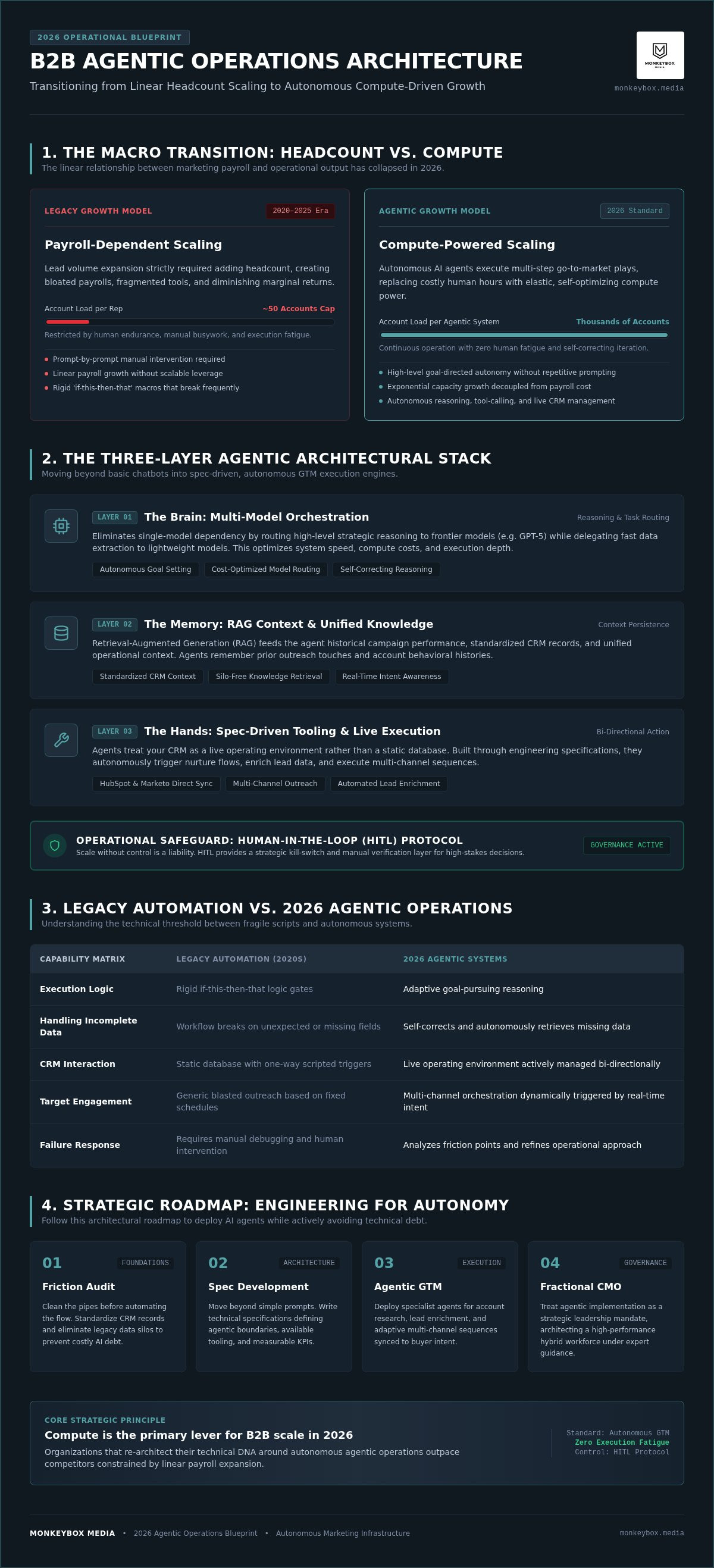
The old model is broken. For decades, B2B growth followed a predictable, painful path: to increase lead volume, you increased headcount. This linear growth model is a trap that leads to bloated payrolls and diminishing returns. In 2026, the industry has reached a definitive tipping point. We've moved past the era of experimental tools into the age of the agentic growth model. This shift replaces expensive human hours with scalable compute power. Unlike the static bots of the past, AI agents for marketing are autonomous entities capable of executing multi-step workflows without constant human intervention. They don't just answer questions; they complete jobs.
Agentic Marketing Operations is the autonomous execution of strategic GTM plays.
The Shift from Prompting to Autonomy
The transition from 2025 to 2026 marked a fundamental change in how we interact with intelligence. Last year was about "prompting" machines to generate text or images. Today, we set high-level goals. Modern AI agents for marketing possess reasoning capabilities that allow them to navigate complex B2B sales cycles independently. They can identify a target account, research the decision-makers, and orchestrate a multi-channel outreach sequence based on real-time intent data. These systems are self-correcting. If a specific tactic fails to yield a conversion, the agent analyzes the friction point and adjusts its approach. The era of the simple macro is over. We're now building self-optimizing engines.
Economic Drivers of the Agentic Transition
The financial reality of the UK market has made this transition mandatory. The cost of specialized marketing talent has surged, while the "cost per task" for agentic execution has plummeted. Consider the economics. A human lead-gen specialist might manage fifty accounts effectively; an agentic infrastructure handles thousands with zero fatigue. However, the biggest barrier isn't the technology itself. It's technical debt. Companies still struggling with siloed data and broken legacy automations cannot support autonomous agents. You must clean the pipes before you can automate the flow. High-performing organizations are aggressively auditing their infrastructure to ensure it can support an agent-led workforce. They aren't just buying software; they're re-architecting their entire operational DNA for a world where compute is the primary lever for scale.
- Linear Growth: Revenue increases only when payroll increases.
- Agentic Growth: Revenue scales through autonomous systems and compute power.
- Infrastructure First: Success depends on a clean, integrated tech stack.
Defining the Agentic Stack: How AI Agents Differ from Simple Automation
Legacy automation is a rigid, if-this-then-that logic gate. It breaks the moment a lead provides an unexpected response or a data field is missing. Agentic operations are different. AI agents for marketing are dynamic systems that possess reasoning, memory, and the ability to use tools. They don't just follow a sequence; they pursue an objective. This requires a sophisticated architectural stack that moves beyond the simple API connectors of the 2020s. We define this through three critical layers: the Brain, the Memory, and the Hands.
Building these systems requires spec-driven development. You aren't just writing a prompt. You're architecting a technical specification that defines the agent's boundaries, available tools, and success metrics. This engineering-first approach ensures that your agentic workforce behaves predictably within your existing B2B stack. Whether they are updating records in HubSpot or triggering complex nurture flows in Marketo, these agents treat your CRM as a live environment to be managed rather than a static database. To ensure total alignment, we implement a Human-in-the-Loop (HITL) protocol. This provides a strategic kill-switch and review layer for high-stakes decisions. Scale without control is a liability. Control is the foundation of sophisticated marketing operations.
The Brain: Multi-Model Orchestration
In 2026, relying on a single large language model is a strategic error. High-performance agents utilize multi-model orchestration to balance cost, speed, and reasoning depth. An agent might use GPT-5 for complex strategic reasoning but route simpler data extraction tasks to a smaller, faster model like Claude 4. This model routing ensures your infrastructure remains cost-efficient while maintaining elite performance levels. It also provides a layer of redundancy. If one provider experiences latency, the system automatically shifts the workload. Data privacy is maintained through localized model instances and strict encryption protocols, ensuring your proprietary GTM data never leaks into public training sets.
The Memory: RAG and Brand Context
An agent without memory is just a chatbot with a short attention span. We use Retrieval-Augmented Generation (RAG) to ground agents in your specific brand ecosystem. This creates a single source of truth that includes your product specifications, case studies, and internal brand guidelines. RAG prevents AI hallucinations in technical B2B content by forcing the agent to reference specific, verified documents before generating an output. This ensures that every piece of communication, from a LinkedIn message to a technical white paper, is factually accurate and aligned with your unique value proposition. Memory turns a general AI into a specialized expert for your business.
- The Brain: Reasoning and decision-making via multi-model routing.
- The Memory: Contextual grounding through RAG and proprietary data.
- The Hands: Execution through API-driven tooling and CRM integration.
Strategic Use Cases: Deploying Specialist Agents Across the B2B Funnel
The deployment of AI agents for marketing is not a generalist play. It is a strategic assembly of specialists. In 2026, high-growth B2B organizations no longer rely on all-in-one tools that perform mediocre tasks. Instead, they deploy modular agents designed for specific operational outcomes. The Research & Enrichment Agent acts as your front-line intelligence officer. It identifies Ideal Customer Profiles (ICPs) with surgical precision and scores leads based on live behavioral data. No manual spreadsheets. No outdated lists. This agent ensures your pipeline is fueled by high-intent prospects before a human ever sees a record.
Beyond lead identification, the Content Strategist Agent has evolved. It has moved from "writing blogs" to orchestrating multi-channel GTM campaigns. It ensures narrative consistency across every touchpoint. Simultaneously, the Technical SEO Agent maintains structural integrity through autonomous site auditing and structured data implementation. It fixes crawl errors in real-time. Finally, the Performance Ops Agent manages the capital. It reallocates budgets across channels based on granular attribution data. It optimizes for revenue, not just vanity metrics. This is systemic efficiency in action.
Top-of-Funnel: Autonomous Demand Gen
Top-of-funnel operations now thrive on autonomous demand generation. Agents manage LinkedIn outreach and trigger personalized video prospecting at scale. They handle the initial inbound qualification without human intervention. They filter the noise. This allows your sales team to focus exclusively on high-intent conversations. By removing the manual burden of prospecting, you are Scaling B2B Revenue with Strategic Authority. These systems don't just find leads; they cultivate them through persistent, intelligent engagement.
Middle-of-Funnel: Hyper-Personalized Nurture
Middle-of-funnel nurture has transitioned from static sequences to dynamic journey orchestration. Agents now create bespoke whitepapers for individual high-value accounts on the fly. They monitor real-time intent signals. If a prospect engages with a specific technical topic, the agent pivots the entire email sequence to match that interest. The era of the generic drip campaign is dead. We now use autonomous sequencing to deliver the exact information a buyer needs at the precise moment they need it. This level of personalization was impossible with human-only teams. Today, it is the standard for B2B excellence.
- Research & Enrichment: Real-time ICP validation and lead scoring.
- Content Orchestration: Unified GTM narratives across all channels.
- Performance Ops: Autonomous budget reallocation for maximum ROI.
- Technical SEO: Self-healing site audits and schema deployment.
Avoiding the 'AI Debt' Trap: Engineering Your Workflow for Autonomy
Adding intelligence to a broken system only accelerates the chaos. You can't layer autonomous agents over a fragmented tech stack and expect growth. This is the "AI Debt" trap. Before deploying AI agents for marketing, you must perform a ruthless audit of your existing infrastructure. Identify the legacy automations that fail under pressure. Clean the data that clogs your pipelines. If your CRM is a graveyard of inconsistent fields and duplicate records, your agents will hallucinate their way into a GTM disaster. We use a Pilot-Optimize-Scale methodology to ensure every agentic implementation is grounded in operational reality. It's about building a foundation that can actually support the weight of autonomous execution. Scaling is a choice. Efficiency is the requirement.
Step 1-2: Workflow Mapping and Data Cleanse
Engineering for autonomy begins with a total documentation of manual tasks. If a human can't explain the logic behind a workflow, an agent can't execute it. We map every touchpoint to identify processes ripe for takeover. Simultaneously, you must normalize your CRM fields. Agents require structured, "clean" data to read the state of your business accurately. This isn't just basic data entry. It's about ensuring your lead scoring, account tiering, and intent signals follow a unified standard. We shift the focus from "hours saved" to "pipeline generated" as the primary KPI for this stage. Don't automate a mess. Fix the mess, then automate.
Step 3-5: Integration, HITL, and Scaling
The final phase connects your agents to an API-first marketing stack. This allows for seamless data flow between your intelligence layer and execution tools. However, autonomy does not mean lack of oversight. We establish Human-in-the-Loop (HITL) approval gates for high-stakes outputs, such as financial reallocations or direct client communications. This maintains brand safety while allowing the system to run at 90% autonomy. Finally, we monitor for model drift. Agents aren't "set and forget" tools; they require retraining on fresh GTM data to stay sharp as market conditions shift. Build your AI agent implementation roadmap on a foundation of technical integrity to avoid the debt trap.
- Audit First: Identify and kill broken legacy automations before adding AI.
- Data Integrity: Standardize CRM inputs to prevent agent hallucinations.
- HITL Protocol: Use human approval gates for high-stakes strategic decisions.
- Drift Monitoring: Retrain agents regularly to maintain alignment with market shifts.
Scaling with Intelligence: The Fractional CMO’s Role in Agentic GTM
Deploying AI agents for marketing is not a software purchase. It is a fundamental leadership challenge. Most B2B organizations fail here because they treat agentic implementation as a technical plugin rather than a strategic overhaul. In 2026, the Fractional CMO acts as the primary architect of the hybrid workforce. This role bridges the gap between high-level GTM vision and the mechanics of agentic execution. We don't just add tools; we re-engineer the operational DNA of the company. By delegating the repetitive grunt work of data enrichment and campaign orchestration to autonomous systems, we liberate human talent. This allows your team to focus on high-stakes strategy and creative empathy. Empathy cannot be commoditized. Execution can. Strategic leadership is the only way to turn compute power into market share.
From Execution to Oversight
The role of the marketing manager has fundamentally shifted. In an agentic world, task execution is a commodity. Strategic positioning is the new competitive moat. We train teams to stop doing tasks and start managing agents. This requires a transition from being a practitioner to being an orchestrator. If an agent can execute a multi-channel play in seconds, the manager’s value lies in the quality of the goal-setting and the precision of the logic. Oversight is the new execution. You aren't just running a department; you're commanding a digital fleet. This shift requires a new set of management skills focused on logic auditing and performance optimization.
The Monkeybox Approach to AI Automation
Our methodology integrates AI directly into the marketing operations engine. We focus on reducing headcount friction while simultaneously increasing output velocity. We build the infrastructure that allows AI agents for marketing to operate with high autonomy and zero hallucination. This isn't about replacing humans; it's about amplifying their strategic reach. We provide the blueprint for a scalable, autonomous GTM engine that drives measurable B2B growth. It's time to stop managing manual workflows and start leading an intelligent infrastructure. High-stakes growth requires high-level architecture. Scale your B2B growth with Monkeybox Media.
- Strategic Architecture: Designing systems where humans lead and agents execute.
- Output Velocity: Increasing campaign frequency without increasing headcount.
- Empathy Focus: Reclaiming human time for high-value relationship building.
- Operational Integrity: Ensuring every agentic workflow is grounded in GTM reality.
Architecting Your Autonomous Future
Linear growth has reached its expiration date. In 2026, the competitive advantage belongs to those who replace manual bottlenecks with autonomous infrastructure. Success requires a ruthless commitment to clean data, a sophisticated multi-model stack, and a leadership-first approach to implementation. AI agents for marketing are no longer experimental tools; they are the fundamental components of a scalable B2B engine. By transitioning from task-based management to agentic oversight, you unlock a level of operational velocity that was previously impossible. The manual era is over.
Monkeybox Media bridges the gap between high-level GTM vision and technical execution. We provide the Fractional CMO leadership and strategic frameworks necessary to build a robust, hybrid workforce. Our expertise in sophisticated marketing operations ensures your transition to autonomy is seamless and results-driven. Don't let legacy debt limit your expansion. Automate your GTM strategy with Monkeybox Media. The era of the agent is here. Build for it today.
Frequently Asked Questions
What is the difference between a chatbot and an AI agent for marketing?
A chatbot is a reactive interface designed for simple retrieval; an AI agent for marketing is an autonomous entity that executes multi-step strategic jobs. While chatbots wait for a prompt, agents proactively use tools to navigate your CRM and outreach channels. They possess reasoning capabilities that allow them to handle edge cases without human intervention. You aren't just building a help desk; you're deploying a digital workforce that completes complex B2B workflows independently.
How much does it cost to implement AI agents in a B2B marketing team?
Implementation costs depend on the complexity of your existing tech stack and the number of workflows you intend to automate. You should view this as an investment in infrastructure rather than a recurring software subscription. Costs typically involve the initial architectural setup, model routing configurations, and data cleansing projects. By shifting budget from linear headcount to scalable compute, most B2B organizations find the long-term operational overhead significantly lower than traditional hiring models.
Can AI agents actually integrate with my existing CRM like HubSpot or Salesforce?
Modern AI agents for marketing are designed to be API-first, allowing them to integrate seamlessly with HubSpot, Salesforce, and Marketo. They don't just talk to your CRM; they manage it. An agent can read lead intent signals, update record properties, and trigger sophisticated nurture sequences based on real-time data. This creates a bidirectional flow of intelligence that ensures your sales and marketing data remains synchronized without manual entry or human oversight.
Will AI agents replace my marketing team members?
Agents don't replace people; they evolve their roles. Human talent is liberated from the repetitive manual tasks that stifle creativity and strategic growth. Your team shifts from being practitioners who do tasks to commanders who orchestrate agents. This hybrid workforce allows your best people to focus on high-level relationship building and creative empathy. The goal is to increase your total output velocity without needing to expand your payroll linearly.
How do I ensure AI agents stay on-brand and don’t hallucinate?
We prevent hallucinations by grounding agents in a Retrieval-Augmented Generation (RAG) framework. This forces the agent to reference your specific brand guidelines, product specs, and case studies before generating any output. By providing a Single Source of Truth in the agent's memory, we ensure every communication remains factually accurate and aligned with your unique voice. Human-in-the-Loop protocols provide an additional layer of safety for high-stakes strategic content and financial reallocations.
What is "Agentic Technical Debt" and how do I avoid it?
Agentic Technical Debt refers to the accumulation of broken legacy automations and fragmented data silos that prevent autonomous systems from functioning. You avoid this by performing a comprehensive audit of your marketing operations before implementation. Clean the pipes before you turn on the flow. Standardizing your CRM data and documentation ensures that your agents have a clear map to follow. Don't layer intelligence over a mess; fix the infrastructure first.
Do I need a technical background to manage AI agents?
You don't need to be a software developer to lead an agentic team, but you must be a strategic architect. Managing agents requires a deep understanding of B2B GTM logic and goal-setting rather than technical coding skills. The role of the marketing leader is to define the specs and audit the outcomes. Monkeybox Media provides the leadership frameworks necessary to help non-technical executives command these sophisticated systems with total confidence and precision.
How long does it take to see ROI from agentic marketing operations?
Most B2B organizations see a measurable return on investment within the first three to six months. ROI manifests through reduced operational drag, lower cost-per-task, and a massive increase in campaign volume. By removing the human bottleneck from lead enrichment and outreach, you accelerate your pipeline velocity immediately. The primary gain is scalability. You gain the ability to execute complex GTM plays at a frequency that was previously impossible without a massive increase in headcount.