
More automation won’t fix lead nurturing if your system can’t distinguish a meaningful buying signal from routine activity. AI-powered lead nurturing systems move B2B prospects towards sales only when the right signal triggers relevant follow-up and someone owns what happens next.
If leads receive generic messages, sales and marketing disagree about readiness, or automation creates activity without showing its pipeline impact, the problem isn’t a lack of email sequences. It’s a broken connection between data, decisions and action.
This guide shows you how to build a workflow that links buyer behaviour to timely follow-up and a defined point for human sales involvement. You’ll learn how to agree on readiness criteria, use AI without losing control, and measure whether nurturing contributes to pipeline progression. We’ll start with the operating foundations, then connect signals to actions, ownership and measurement, so you can build a system that moves the right prospects forward.
Key Takeaways
- AI-powered lead nurturing systems combine data, decision rules, content and feedback to adapt follow-up beyond fixed email schedules.
- Capture, standardise and interpret buyer signals before deciding what action to take.
- Choose between fixed rules, AI-assisted decisions and human judgement based on variability, risk and data quality.
- Agree on lead readiness, routing and follow-up ownership with sales before launching a pilot.
- Measure nurturing against pipeline progression, then expand what works in line with sales capacity and go-to-market priorities.
What AI-Powered Lead Nurturing Systems Actually Do for B2B Teams
AI-powered lead nurturing systems use connected buyer and account data to prioritise prospects, select relevant follow-up and adapt decisions as new signals arrive, rather than sending every contact through the same fixed email schedule. They help turn marketing activity into a decision-support process that moves business buyers towards an informed sales conversation.
A system is more than an AI tool or a sequence of messages. It connects data about engagement, rules for interpreting it, relevant content, the channel used to deliver it and feedback about what happened next. If one link is unreliable, the system may act on incomplete or misleading information. Build the operating structure before adding complexity.
A B2B setup may bring together:
- Data: CRM records, campaign engagement and relevant account activity.
- Decision logic: agreed criteria for prioritisation, routing and next steps.
- Content and delivery: useful messages or tasks sent through appropriate channels.
- Feedback: sales outcomes and prospect responses that inform future decisions.
AI can help identify patterns, recommend a next action or adjust a priority when new information appears. It cannot reliably infer every buyer’s intent from a click or form completion. Sales teams still need to assess context, validate fit and handle complex conversations. Use AI to focus attention, not to remove accountability.
How AI nurturing differs from a fixed email sequence
A fixed sequence sends messages after preset delays, even if a prospect’s circumstances have changed. Signal-led nurturing can respond when someone requests a product demonstration, returns to a relevant resource or shows a different pattern of engagement. Scoring and recommendations can then adapt as CRM or marketing data is updated, while unusual or high-stakes interactions go to a person for review.
One content download, for example, may signal early research rather than sales readiness. Before handing the contact to sales, consider the account’s fit, previous conversations and the buyer’s stated needs. Automation should show why it recommends an action, not disguise a weak assumption as a decision.
Which B2B prospects and buying groups it supports
B2B purchases often involve several stakeholders with different questions. At one account, a technical evaluator might read an integration guide while a budget holder attends a webinar and a department lead revisits a service page. Each person has distinct activity; taken together, their engagement may suggest broader account interest.
A useful system keeps contact-level activity distinct but connects relevant signals at the account level. It should not treat every interaction as equal or assume that the whole buying group is ready. This approach reflects the mix of human research and AI-supported lead identification discussed in the LeadGenius Wikipedia article on AI in sales. For example, a supplier assessing a business account could use engagement from procurement, operations and IT contacts to guide coordinated follow-up, while leaving the final judgement to sales.
How an AI-Powered Lead Nurturing System Turns Signals into Follow-Up
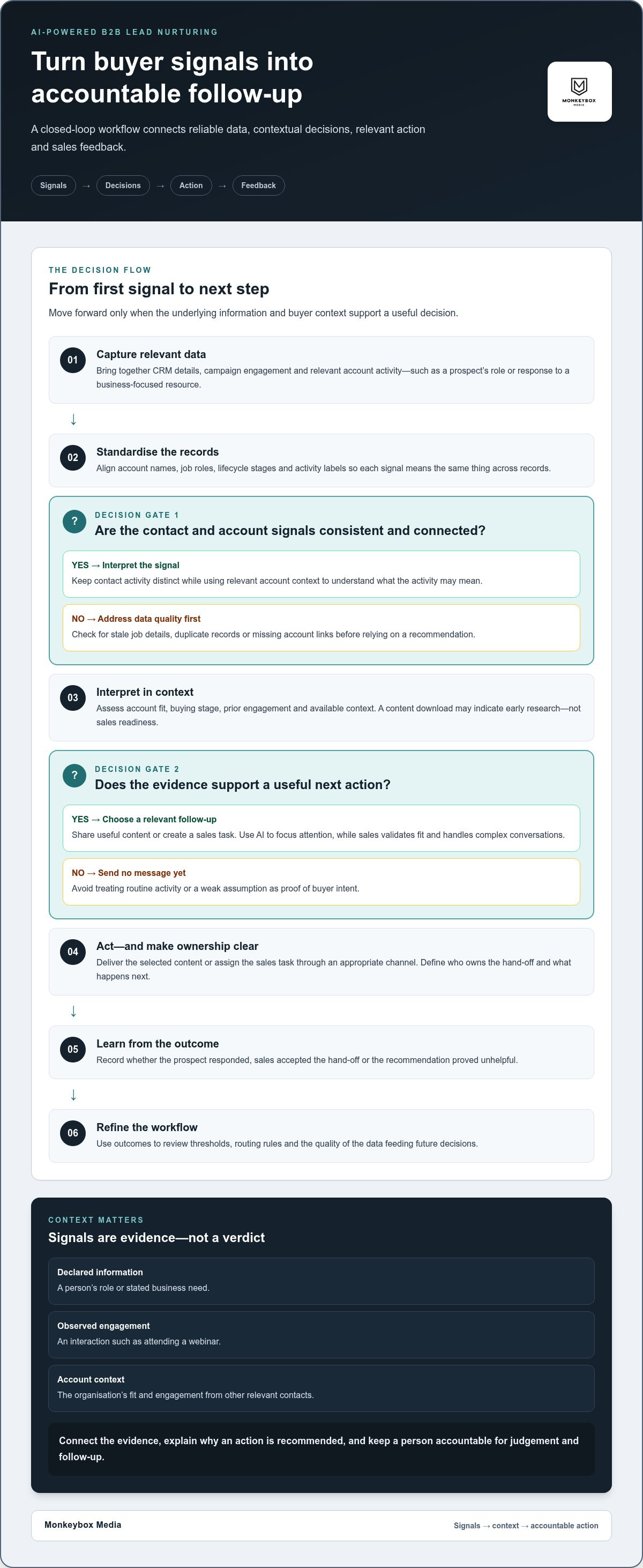
Buyer signals are contextual evidence that helps a team decide whether to engage, what to offer next or whether to wait. A signal is useful only when the system can connect it to a trustworthy contact or account record, interpret its meaning and assign a clear next action.
Build the workflow as a closed loop, with named owners for data quality, decision rules and sales follow-up. AI-powered lead nurturing systems can identify patterns across CRM and marketing engagement data, but your team must define which patterns warrant action and review whether that action helped move an opportunity forward.
- Capture: Bring relevant CRM details and marketing engagement into the workflow, such as a prospect’s stated role or response to a business-focused resource.
- Standardise: Align account names, job roles, lifecycle stages and activity labels so that each signal has a consistent meaning across records.
- Interpret: Assess the signal against account fit, buying stage, prior engagement and available context. Keep contact activity distinct from account-level evidence.
- Act: Choose a relevant next step: share useful content, create a sales task or send no message yet.
- Learn: Record whether the prospect responded, sales accepted the hand-off or the recommendation proved unhelpful.
- Refine: Use those outcomes to review thresholds, routing rules and the quality of the data feeding the workflow.
From first-party data to useful buyer signals
Declared information, such as a person’s role or stated business need, differs from observed engagement, such as attending a webinar. Account context adds another layer, including the organisation’s fit with the target market and engagement from other relevant contacts. Each signal answers a different question. None offers a complete picture on its own.
Stale job details, duplicate records and missing account links can distort recommendations. A resource view might reflect early research, while a request to discuss a specific business requirement may call for faster follow-up. Marketing operations should own data definitions and quality checks, with sales input on which signals are useful in practice. Context determines meaning.
From prioritisation to coordinated action
Suppose a contact at a well-matched business account requests a conversation about a relevant capability. The system could create a sales task that includes the trigger and account context, giving the owner a useful opening rather than a generic message. A lower-confidence recommendation, such as one ambiguous interaction, can go to review or trigger no outreach.
Make ownership explicit: marketing maintains the workflow and its logic; the assigned sales owner acts on accepted tasks and records the outcome. The teams can then review whether a signal led to a useful conversation, adjust weak thresholds and improve routing. This operating discipline is central to marketing operations and automation support that connects data, workflow design and sales action.
AI Nurturing Versus Static Automation: What Should Your B2B System Handle?
Adding AI doesn’t automatically make nurturing more relevant. Weak input data, unclear decision criteria or a message that doesn’t fit the buying situation can lead AI to scale the wrong action. The practical choice isn’t AI or automation. It’s deciding which tasks need consistent rules, which benefit from pattern recognition and which require human judgement.
Assign work according to variability, risk, data confidence and the amount of context required:
| Approach | Best suited to | Variability and data confidence | Risk and context |
|---|---|---|---|
| Fixed rules | Predictable routing, administrative confirmations and stable nurture journeys. | Low variability; clear, reliable trigger data. | Low risk; decisions need consistent, transparent handling. |
| AI-assisted decisions | Summarising engagement patterns or recommending content and review priorities. | More variable activity; enough relevant data to support a useful recommendation. | Moderate risk; recommendations need safeguards and a clear explanation. |
| Human-led judgement | Complex sales conversations, ambiguous intent and sensitive account situations. | High variability or incomplete, conflicting signals. | Higher reputational impact; decisions depend on relationship and business context. |
The categories can work together. A fixed rule might route a record, AI might summarise recent account activity, and a sales owner might decide whether to make contact. Make the hand-off visible so a recommendation doesn’t silently become an action.
Where fixed workflows remain the right choice
Keep stable, repeatable processes simple. If someone completes a form and the correct next step is an administrative confirmation, a straightforward trigger is usually easier to understand and maintain than an AI-generated decision. The same applies when a lead meets a clearly defined routing condition. Explicit rules help marketing and sales understand why the workflow acted and review its logic consistently.
Fixed journeys also suit predictable timing and content, such as sharing related business resources after a known interaction. Don’t introduce AI just to label a workflow as intelligent. Added complexity should solve a specific problem.
Where AI assistance can improve relevance
AI can help when a team needs to interpret varied activity across several touchpoints. It might summarise engagement from multiple contacts at one account, suggest a business resource that fits a prospect’s apparent interests or flag an account for review. Treat these as recommendations, not proof of buying intent. Set boundaries around the data used, the actions available and the situations that require human approval.
Escalate low-confidence signals, conflicting activity and outreach with meaningful reputational risk to a person. This keeps AI-powered lead nurturing systems responsive without handing over decisions that require context. Use rules for repeatability, AI for supported recommendations and people for judgement.
How to Implement and Measure AI-Powered Lead Nurturing
Build the operating foundation before switching on new decision logic. AI-powered lead nurturing systems need reliable records, shared definitions and an accountable sales hand-off. Without them, automation can accelerate inconsistent decisions. Start with a controlled workflow, establish a baseline and expand only when the evidence supports it.
Pipeline progression is a stronger measure than activity alone because it shows whether nurturing helps qualified prospects move towards a sales opportunity, not just whether messages were sent or opened. Opens, clicks and workflow volume can help diagnose engagement, but they don’t prove commercial contribution on their own.
Build the foundation before activating AI
Audit CRM fields, lifecycle stages, consent records and integration reliability. Look for duplicate contacts, missing account links and inconsistent definitions that could distort prioritisation. Before making claims about UK GDPR or PECR requirements, check current ICO guidance and assess how it applies to the organisation’s processes. Keep the compliance review grounded in current guidance, not assumptions.
Then document the operating rules with marketing and sales. Define what qualifies as ready for sales, which signals affect prioritisation, who owns each routed task and what should happen when a recommendation is uncertain. Specify escalation paths and the information a sales owner needs to act. Clear ownership prevents leads from sitting between teams.
Pilot, review and improve the system
Choose one audience or journey with a specific business objective, such as improving follow-up consistency after a defined B2B interaction. Record the current baseline using the same definitions you’ll use during the pilot. Keep the scope focused so the team can distinguish workflow effects from unrelated changes in campaign activity or sales capacity.
Review the pilot on an agreed cadence and track a balanced set of measures:
- Engagement indicators: Delivery, opens and clicks, interpreted in context rather than treated as outcomes.
- Operational quality: Routing accuracy, time to sales follow-up, unworked tasks and recommendations sent for review.
- Progression: Movement from nurtured contact or account to sales-accepted status, qualified opportunity and subsequent pipeline stages.
- Experience signals: Sales feedback, negative responses and opt-out patterns that may reveal poor timing or irrelevant messaging.
Agree how marketing and sales will record acceptance, rejection and follow-up outcomes in the CRM. If sales rejects a hand-off, capture a consistent reason, such as poor fit, insufficient context or premature timing. This helps distinguish a weak signal from a routing or data problem. Review attribution carefully: nurturing may support progression alongside other marketing and sales activity, so don’t assign it sole credit without a defensible method.
Expand only when the workflow is understood, hand-offs are recorded and the measures show a credible contribution to progression. Add audiences or decision complexity in controlled steps, reviewing the effect after each change. Monkeybox Media’s marketing operations and automation services connect workflow design with sales accountability and measurement.
Make Lead Nurturing Part of a Connected B2B Growth System
Nurturing earns its place when it supports a defined go-to-market priority, not simply because a team has an automation platform to fill. Positioning shapes the problems and value your messages should address. Demand generation brings the right accounts into view. Sales capacity determines which prospects the team can follow up effectively, while revenue goals clarify the commercial progress the system should support.
Start with a practical framework: identify target accounts, understand their buying stages, then define the next commercial outcome nurturing should help advance. That might mean helping an account clarify a business problem, equipping a buying group to assess a solution or preparing a qualified conversation for sales. Then agree how marketing creates and delivers relevant engagement, how sales handles accepted opportunities, and how marketing operations governs data, routing and reporting.
Align nurturing with go-to-market priorities
Marketing and sales need a shared view of which audiences matter, what readiness means and what follow-up the business can deliver. If sales capacity is focused on a particular market or offer, nurturing should reinforce that focus rather than create a queue of poorly matched tasks. Fractional CMO leadership can connect these decisions to broader growth priorities; the fractional CMO agency guide explores how strategic leadership supports B2B growth.
Make the operating agreement explicit. Marketing owns the audience strategy and engagement plan; sales defines useful hand-off context and records what happens next; operations maintains the workflow, data definitions and reporting. The exact division will vary by organisation, but every signal and resulting action needs an owner. Otherwise, nurturing can optimise engagement while leaving commercial follow-up disconnected.
Use this framework to review your current go-to-market plan. Identify where nurturing supports the buyer journey and where it creates activity without a clear next step. Align first. Automate second.
Turn the operating model into an implemented system
Strategic leadership sets priorities, resolves trade-offs and keeps marketing, sales and operations aligned as the plan evolves. Marketing operations translates those decisions into governed workflows: defined triggers, approved content paths, clear routing, documented exceptions and reporting that connects engagement with progression. Working with GenAI consultancies like Navo Inc., organisations can integrate AI agents into those workflows to support appropriate tasks, while people retain ownership of business decisions.
This is how AI-powered lead nurturing systems become part of the growth engine rather than a disconnected campaign layer. Review the system against positioning, demand generation, sales capacity and revenue goals as those priorities change. If the audience shifts or sales follow-up cannot keep pace, adjust the workflow before adding more volume.
Monkeybox Media provides fractional CMO leadership, go-to-market strategy, marketing operations and AI automation for B2B organisations. Explore Monkeybox Media’s strategic approach to B2B growth systems.
Set the Next Growth Priority
The next step isn’t to automate more activity. Choose one growth priority your team needs to advance, then make nurturing accountable for supporting it. That focus gives leaders a basis for deciding what to improve, what to leave alone and where AI-powered lead nurturing systems can contribute without outrunning the strategy.
When the path from go-to-market priorities to day-to-day execution isn’t clear, fractional CMO and go-to-market strategy leadership can help establish direction. Marketing operations, automation and AI agent implementation can translate that direction into B2B workflows your teams can govern and improve.
Build for deliberate growth. Talk to Monkeybox Media about building a B2B lead-nurturing system with strategic direction, and turn your next priority into a practical operating plan.
Frequently Asked Questions
What is an AI-powered lead nurturing system?
An AI-powered lead nurturing system helps a B2B team use prospect and account information to guide follow-up decisions. For example, if a finance leader and a technical evaluator from the same organisation engage with different resources, the system can surface that pattern for review. It supports coordinated communication; it doesn’t know a buyer’s intentions with certainty or replace the conversations needed to confirm fit and need.
How is AI lead nurturing different from marketing automation?
Marketing automation carries out actions based on configured triggers and rules, such as sending a follow-up after a form submission. AI can add analysis or recommendations where activity is less predictable, such as summarising a contact’s recent interactions for a sales owner. A team can use both: automation handles dependable tasks, while AI supports decisions that benefit from pattern recognition. Neither approach makes a message relevant unless its content fits the buyer’s situation.
Can AI nurture leads without first-party data?
It can make recommendations using other available information, but limited first-party data usually means less evidence about a prospect’s actual interests or relationship with your business. A sensible starting point is to use only the information needed for a defined business purpose, such as a prospect’s role and response to a relevant resource. Avoid treating inferred interests as confirmed facts. Keep recommendations cautious and let people validate important assumptions before outreach.
Is AI-powered lead nurturing compliant with UK GDPR and PECR?
It can be designed to support compliance, but using AI doesn’t make a process compliant by default. The appropriate approach depends on the personal data involved, how it’s used, who receives communications and which channels are used. Before launch, assess the processing and marketing activity against current ICO guidance on UK GDPR and PECR. Document decisions, keep data use proportionate and involve a qualified privacy professional where the assessment raises questions.
How often should an AI lead-nurturing system contact a prospect?
There’s no universal contact frequency that suits every B2B audience or buying stage. Set limits by channel and journey, then consider the prospect’s recent activity, previous messages and stated preferences before scheduling another touch. For example, suppress a routine nurture email if a sales conversation is already under way. Review negative replies and opt-out patterns alongside engagement to spot when the cadence feels excessive or the content is no longer useful.
What happens if an AI system scores a lead incorrectly?
A mistaken score should trigger review, not an irreversible decision. Keep the evidence behind recommendations visible, and give sales a way to correct an inaccurate classification with a reason, such as outdated job information or a misleading interaction. Check whether the error came from the data, scoring inputs or workflow design. If a pattern emerges, adjust the rules and review affected records before relying on the score again.
Can AI lead nurturing work for a small B2B team?
Yes. A small team can start with a narrow use case that solves a specific bottleneck, such as preparing a concise account-engagement summary before a scheduled sales review. Keep the process manageable: define the intended outcome, assign one person to oversee it and preserve a clear route for human judgement. Avoid building a complex journey before the team has established which information it can maintain and what follow-up it can realistically deliver. Alternatively, sector-focused businesses such as accounting practices often turn to managed growth specialists like Ape-X Generation to deploy a done-for-you marketing and pipeline system without stretching internal capacity.