
The era of scaling your GTM headcount to match your revenue targets is officially dead. In 2026, growth isn't a human capital problem; it's an architecture challenge driven by AI powered marketing operations. You've likely felt the friction of siloed data preventing accurate attribution and the crushing weight of legacy automation systems that demand more maintenance than they provide value. It's a common trap. Most leaders realize their current manual lead routing and fragmented workflows are the primary bottlenecks holding back their $10M ARR trajectory. You need a system that outpaces the market without adding more seats to the payroll.
This article provides the definitive blueprint to help you transition from manual labor to a sophisticated agentic infrastructure. We'll dismantle the technical debt in your current outbound stack and replace it with a high-velocity machine. You'll gain a clear roadmap for AI-agent integration that drives predictable revenue through automated orchestration. It's time to stop managing people and start architecting a leaner, more aggressive growth engine that scales on command.
Key Takeaways
- Eliminate the technical debt of manual workflows by transitioning to an agentic infrastructure that manages the entire lead-to-revenue lifecycle autonomously.
- Learn to scale your GTM efforts exponentially using AI powered marketing operations that prioritize compute-driven efficiency over expensive headcount additions.
- Deploy a self-updating intelligence layer that moves your CRM from a static database to a proactive engine capable of real-time segmentation and personalization.
- Execute a high-velocity implementation roadmap that starts with a rigorous infrastructure audit and moves quickly to automating high-impact tasks like lead routing.
- Leverage fractional CMO leadership to provide the strategic oversight necessary for re-engineering your marketing stack without disrupting current revenue flow.
The End of Static Infrastructure: Why AI-Powered Marketing Operations is Mandatory in 2026
In 2026, the divide between hyper-growth firms and stagnating incumbents is defined by a single factor: the architecture of their GTM engine. AI powered marketing operations is no longer a futuristic experiment; it's the foundational requirement for B2B survival. We define this as the deployment of autonomous agents and predictive models to manage the entire lead-to-revenue lifecycle. Relying on manual oversight in 2026 isn't just slow. It's a strategic liability that builds compounding technical debt with every lead that enters your system.
The shift is fundamental. Traditional "automated" marketing relied on rigid, human-defined rules. If a prospect clicks a link, then send an email. This logic is too brittle for the modern buyer journey. The cost of inaction is immense. Every missed signal and every delayed follow-up drains your ARR. You aren't just losing leads; you're losing the ability to compete at the speed of the market.
From Workflow Automation to Intelligent Orchestration
Linear triggers have hit their ceiling. While legacy systems wait for a specific action to fire a pre-set response, autonomous AI agents operate with reasoning. They don't just follow a path; they build it. By leveraging artificial intelligence in marketing, these agents identify subtle behavioral patterns that humans simply cannot track at scale. They recognize when a prospect's intent shifts before a form is ever filled. Agentic MOps is the strategic commander of the revenue engine, making real-time adjustments to maximize conversion without human intervention.
The Hidden Technical Debt in Your Current Stack
Your 2022 HubSpot or Marketo configuration is likely your biggest bottleneck. These setups were designed for a world of static data and manual list building. In 2026, this creates "Ghost Leads"—prospects who fall through the cracks because your manual routing logic can't keep pace with high-velocity signals. This friction kills momentum. AI powered marketing operations solves this by eliminating the hand-off delays and data silos that plague legacy stacks. If your infrastructure requires a human to "check the box" before a lead moves, you've already lost the race. Stop patching old workflows. Start building for autonomous scale.
The Anatomy of the Agentic Marketing Stack
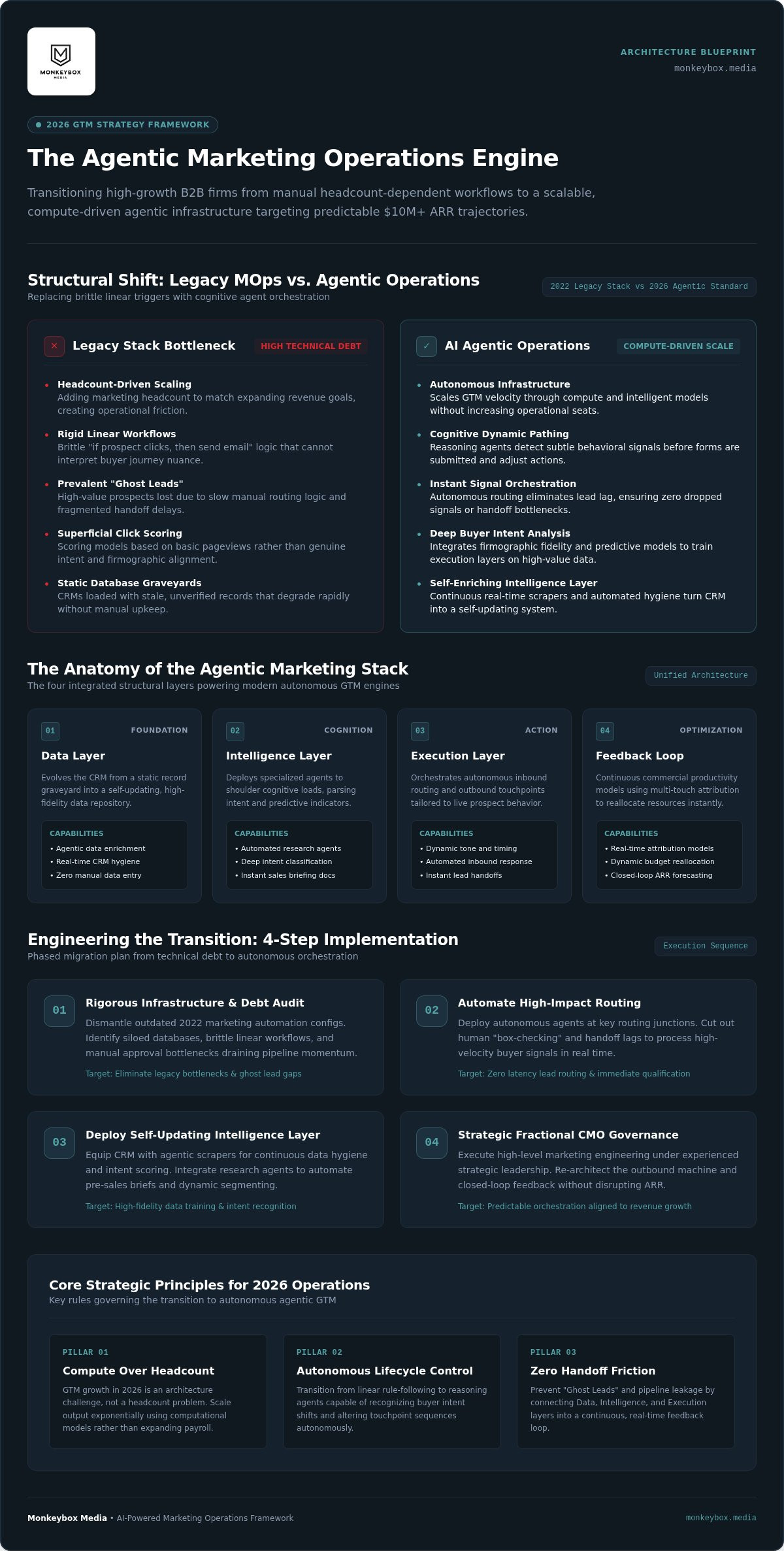
Building a 2026 GTM engine requires more than just a collection of SaaS subscriptions. It demands an integrated, multi-layered architecture where AI powered marketing operations acts as the central nervous system. This isn't about "plug-ins." It's about a structural overhaul across four critical layers. Data. Intelligence. Execution. Feedback. Each must function as a modular component of a single, cohesive machine.
The Data Layer has evolved from a static graveyard of records into a self-correcting, AI-enriched environment. The Intelligence Layer deploys specialized agents to handle the cognitive load of segmentation and intent analysis. The Execution Layer automates the actual touchpoints through autonomous outbound and inbound response systems that adapt their tone and timing based on prospect behavior. Finally, the Feedback Loop uses real-time attribution and predictive models to reallocate budgets instantly across channels. A recent McKinsey analysis on AI-powered marketing and sales highlights how this transformation drives commercial productivity by automating the complex orchestration between these layers. It turns marketing from a cost center into a high-velocity revenue generator.
Autonomous Data Enrichment and Hygiene
Manual data entry is a relic. In this new framework, agentic scrapers and enrichment models maintain CRM integrity in real-time. Lead scoring has shifted from tracking superficial "clicks" to analyzing deep buyer intent and firmographic fit. This ensures your AI models are trained on high-fidelity data. It prevents the "garbage in, garbage out" cycle that destroys traditional automation. High-integrity data is the fuel for your growth. Without it, your agents are flying blind.
AI Agents as the New Middle Management
The Intelligence Layer introduces "Research Agents" that prepare high-stakes B2B sales briefs in seconds. These agents don't just find data; they synthesize it. They coordinate between marketing and sales, ensuring GTM execution is seamless and devoid of the usual friction. This shift toward AI powered marketing operations allows organizations to scale revenue without the traditional burden of high-headcount operations teams. You can achieve elite output with a lean, specialized core. If your current stack lacks this orchestration, it might be time to evaluate a more strategic GTM approach that prioritizes autonomous systems. Move beyond tools. Build a system that thinks.
Legacy MOps vs. AI-Driven Operations: A Strategic Comparison
The legacy model of marketing operations is a house of cards held together by manual labor and duct-tape integrations. In contrast, AI powered marketing operations represents a shift from linear, headcount-dependent growth to exponential, compute-driven expansion. While traditional GTM strategies require hiring more coordinators to handle increased lead flow, an agentic framework scales by simply allocating more processing power. This transition isn't just about speed. It's about moving from a reactive state, where decisions are based on last month's performance, to a proactive state where autonomous systems adjust campaigns in real-time.
Leaders must adopt a strategic framework for AI marketing strategy to navigate this shift effectively. This move replaces broad, segment-based personalization with hyper-relevant, individual-based engagement at a scale humans cannot replicate. The operational cost profile also transforms. You move from high fixed labor costs that eat your margins to a scalable technology investment that increases in efficiency over time. It's the difference between a system that breaks under pressure and one that thrives on it.
Eliminating the 'Pajama-Time' Documentation
Most MOps professionals spend their evenings in "pajama-time," manually documenting workflows and cleaning reports. AI agents eliminate this administrative burden by automatically recording every system change and generating real-time performance dashboards. This frees your strategic leaders to focus on high-level GTM planning instead of tool maintenance. The ROI of Time in AI-powered operations is the quantifiable value of reclaiming elite talent from low-level administrative tasks to drive aggressive market expansion.
Predictive Capacity Planning for B2B SaaS
Spreadsheets are the enemy of scale. Manual modeling fails to account for the complex variables of a high-velocity B2B funnel. AI powered marketing operations uses predictive models to forecast lead volume and sales capacity requirements with precision. This prevents the "Growth Plateau" where sales teams are either overwhelmed by low-quality leads or starving for pipeline. By automating infrastructure scaling, you ensure your GTM engine is always right-sized for your current revenue targets. AI forecasting outpaces manual modeling because it learns from every historical touchpoint, identifying patterns a human analyst would overlook. Stop guessing your capacity. Start architecting it.
Engineering the Transition: The 4-Step AI Implementation Roadmap
Transitioning to AI powered marketing operations isn't a "flip the switch" event. It's a calculated re-engineering of your entire GTM stack. We follow a modular 4-step framework to move from fragmented manual labor to an autonomous machine. This roadmap ensures you don't just add new tools to a broken foundation. You build a new foundation entirely. Each phase is designed to minimize risk while maximizing the velocity of your revenue engine.
- Step 1: The Infrastructure Audit. We begin by identifying the specific technical debt and data silos that act as friction points in your current engine.
- Step 2: The Pilot Agent. We deploy an autonomous agent to a high-impact, low-risk workflow. Lead routing is often the best starting point for immediate ROI and operational clarity.
- Step 3: Stack Consolidation. Once the pilot succeeds, we replace redundant legacy tools with agentic platforms that communicate natively and share a unified data layer.
- Step 4: Scale and Iterate. We deploy AI agents across the full GTM lifecycle, from initial market research to post-sale account expansion.
Phase 1: Auditing for AI-Readiness
Before you deploy a single agent, you must interrogate your data. Is your CRM health sufficient to train a model, or is it riddled with "Dirty Data" that will cause your agents to hallucinate? You need to assess your team's current capabilities. Do you have the systems architects required to oversee an agentic stack, or just tool administrators who manage settings? If your foundation is cracked, your AI will fail. We look for high-fidelity signals and eliminate the noise that prevents 2026-level scale.
Phase 2: Winning with Micro-Automations
Massive project failure usually stems from over-scoped initial phases. We prioritize "Small Wins" through micro-automations to build internal buy-in. Deploying an AI-SDR assistant or an autonomous Content-Ops agent provides immediate proof of concept without disrupting the entire organization. These wins build the momentum needed for a total AI powered marketing operations overhaul. We measure success through hard metrics like speed to lead and data enrichment accuracy. If you're ready to stop the manual grind and start the engineering process, it's time to build your GTM strategy for 2026. Focus on the architecture. The results will follow.
Strategic Leadership for the AI Era: The Fractional CMO Advantage
Deploying AI powered marketing operations is not a task for a technical specialist. It is a leadership mandate that requires executive-level strategic oversight. In 2026, the complexity of an agentic stack means you cannot simply "set and forget" your GTM engine. You need a Bold Architect who understands how to pull the right levers to drive aggressive expansion. A Fractional CMO bridges the critical gap between high-level GTM strategy and the granular mechanics of AI execution, ensuring your technology serves your revenue goals rather than creating more friction.
Monkeybox Media acts as your strategic partner in this transition. We don't just suggest tools. We design the entire infrastructure. This involves balancing the visionary roadmap with the practical realities of automated orchestration. By integrating AI agents into your core workflows, we eliminate the need for bloated middle management and replace it with a high-velocity machine that operates with precision. We oversee the construction of every mile of your growth roadmap, ensuring your systems are robust, scalable, and results-oriented. Our methodology focuses on building the $10M ARR roadmaps that traditional agencies fail to deliver.
Scaling to $10M ARR and Beyond
Breaking through the mid-market growth ceiling requires a fundamental shift in how you view your marketing team. In 2026, the most competitive firms are not those with the highest headcount, but those with the most efficient agentic infrastructure. Utilizing AI powered marketing operations allows you to scale revenue without the traditional burden of linear hiring costs. You can maintain a lean, elite core of strategic thinkers while autonomous agents handle the heavy lifting of lead routing and data enrichment. For a deeper dive into this model, consult our resource on The Fractional CMO Agency Guide 2026: Scaling B2B Revenue with Strategic Authority.
Your Next Move: From Strategy to Execution
Waiting for "perfect data" is a strategic error that will leave you behind your competitors. The market moves too fast for hesitation. You need a partner who can both design the engine and oversee its construction. Monkeybox Media provides the Fractional CMO leadership required to navigate the complexities of the 2026 digital economy. We help you move from fragmented vision to a fully automated reality. It's time to stop managing manual workflows and start architecting your hyper-growth. Scale your B2B infrastructure with Monkeybox Media today and claim your position at the top of the market.
Architecting Your 2026 Growth Engine
The transition to AI powered marketing operations is no longer a choice for B2B leaders; it's the only path to sustainable hyper-growth. By dismantling legacy technical debt and deploying an agentic infrastructure, you replace manual friction with automated precision. This evolution allows your organization to scale beyond the $10M ARR ceiling without the traditional burden of high fixed labor costs. Success in this era depends on a clear implementation roadmap and the strategic authority to execute it.
Monkeybox Media brings the expertise in B2B GTM strategy and advanced AI agent implementation needed to build this machine. We specialize in scaling B2B SaaS firms to $10M+ ARR through structural excellence. Scale your B2B infrastructure with Monkeybox Media's Fractional CMO services and start building the future of your revenue engine today. You have the blueprint. Now, it's time to build.
Frequently Asked Questions
What exactly is AI-powered marketing operations?
AI powered marketing operations is the architectural shift from manual, rule-based workflows to an autonomous system driven by agentic reasoning. This framework leverages predictive models and self-correcting agents to manage the entire B2B lead-to-revenue lifecycle with precision. Instead of humans pulling every lever, the system identifies intent signals and executes GTM maneuvers independently. It ensures your infrastructure scales with compute power rather than human headcount, driving hyper-growth through automated orchestration.
How do AI agents differ from standard marketing automation?
Standard automation relies on rigid "if-this-then-that" triggers that break under complexity. AI agents operate with reasoning capabilities and the ability to recognize subtle behavioral patterns. They don't just follow a pre-defined path; they build the most efficient route to conversion in real-time. This shift from static workflows to intelligent orchestration allows for proactive adjustments that legacy automation systems simply cannot execute without constant manual intervention and oversight.
Is our data 'clean' enough for AI-powered operations?
Most legacy CRMs contain significant "Dirty Data" that can lead to agentic hallucinations if left unaddressed. However, waiting for perfect data is a strategic error. An effective transition includes deploying autonomous enrichment agents that clean, scrape, and validate your records in real-time. This self-correcting data layer ensures your AI models are trained on high-fidelity signals, turning your database into a high-octane growth engine that supports your $10M ARR roadmap.
What is the expected ROI of implementing AI in MOps?
The ROI of AI powered marketing operations is measured by the exponential increase in commercial productivity and the total elimination of high fixed labor costs. By replacing manual lead routing and administrative documentation with autonomous agents, you reclaim elite talent for high-level strategy. Organizations see a dramatic improvement in speed to lead and pipeline velocity. You achieve a leaner, high-velocity machine that scales revenue without the traditional burden of linear headcount expansion.
Will AI-powered operations replace my marketing team?
AI doesn't replace your marketing team; it replaces the low-level administrative burden that prevents them from doing high-value work. Your elite talent moves from being tool administrators to being strategic architects of the revenue engine. The goal is to eliminate manual data entry and "pajama-time" documentation. This allows a lean core of strategic thinkers to manage a massive, automated infrastructure that previously required a high-headcount operations team to maintain.
How long does it take to transition to an AI-agentic stack?
A full transition typically follows a modular 4-step roadmap to minimize risk while maintaining momentum. While a complete overhaul of a complex stack can take several months, you can see "small wins" within weeks by deploying pilot agents for specific workflows like lead routing. This phased approach allows you to build internal buy-in and validate the architecture before scaling across the entire GTM lifecycle. It's about engineering the transition rather than forcing it.
What are the biggest risks of AI in marketing operations?
The primary risk is building AI on top of a broken, legacy foundation without executive-level strategic oversight. Without a clear roadmap, you risk creating more technical debt or deploying agents that hallucinate due to poor data integrity. This is why implementation requires a Bold Architect who understands both the vision and the granular mechanics of execution. Partnering with a Fractional CMO ensures the technology serves your revenue goals rather than complicating your stack.
Can AI-powered MOps help with B2B attribution?
Yes, autonomous agents are uniquely qualified to solve the attribution gap that plagues manual systems. They track multi-channel touchpoints and identify subtle intent signals that humans often miss in a complex buyer journey. By integrating real-time feedback loops, the system can automatically reallocate budgets to the highest-performing channels based on actual conversion data. This provides the predictable revenue and clear visibility needed to scale your B2B SaaS infrastructure with absolute confidence.