
What if your best differentiator isn’t distinctive to buyers at all? A B2B brand positioning strategy works when it reflects what the right buyers value, gives them a clear reason to choose you, and supports that choice with evidence. Without those elements, your message can sound like every competitor’s.
If sales, marketing, and leadership describe your audience, offer, or value differently, another round of copywriting won’t solve the problem. Positioning needs a shared foundation in buyer evidence, not internal assumptions. It should make your value easier to understand and give every team a consistent way to communicate it.
This guide explains how to research your market, choose a credible position, and express it in language buyers can remember. You’ll learn the core elements of useful B2B positioning, how to test strategic choices against buyer needs, and how to carry those choices into go-to-market planning and day-to-day marketing workflows. The goal is a position your business can prove, activate, and sustain across buyer touchpoints.
Key Takeaways
- Separate positioning from brand identity, messaging, value propositions, and taglines so each element has a clear role.
- Build a B2B brand positioning strategy around buyer-relevant differences, not wording that merely sounds distinctive.
- Use customer interviews, win-loss insights, sales feedback, and market evidence to understand what buyers value.
- Test whether target buyers understand, value, and believe your position before rolling it out widely.
- Turn approved positioning into practical guidance that aligns your website, sales materials, campaigns, and internal teams.
What a B2B brand positioning strategy defines and why buyers need it
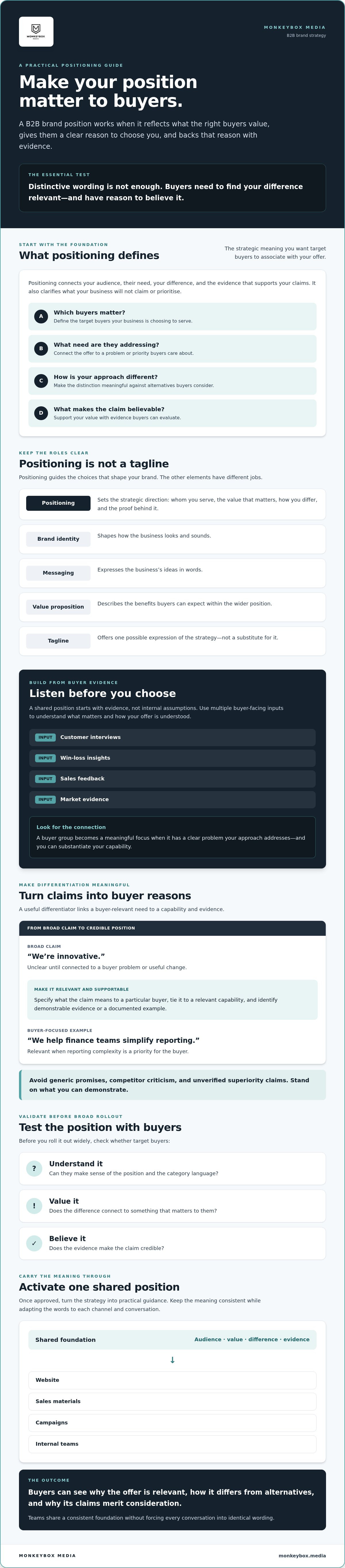
A B2B brand positioning strategy defines the meaning a business wants target buyers to associate with its offer, relative to the alternatives they could choose. It sets the direction for whom the business serves, which buyer need it addresses, how its approach differs, and what evidence supports its claims. In short, it gives the market a clear reason to see the business as relevant and credible.
Positioning is a strategic choice, not a design treatment. Brand identity shapes how a business looks and sounds. Messaging expresses its ideas in words, while a value proposition describes the benefits buyers can expect. Positioning guides all of these elements. For an overview of the foundations, including segmentation and targeting, see Positioning in marketing.
How B2B positioning differs from a slogan or value proposition
A positioning decision connects four questions: Which buyers matter? What alternatives do they consider? What value is relevant to them? What proof makes that value believable? It also clarifies what the business will not claim or prioritise. Those choices shape the go-to-market plan.
A value proposition communicates buyer benefits within that wider position. A tagline is narrower still. It’s one possible expression of the strategy, not the strategy itself. A memorable phrase cannot make up for unclear audience choices or unsupported claims.
Why complex B2B buying groups need a clear position
In a B2B purchase, stakeholders may assess the same offer through different lenses. A senior leader might focus on business outcomes, while an operational lead considers implementation and a finance stakeholder examines risk or resource use. The people involved and their priorities vary by organisation and purchase.
A shared position gives marketing, sales, and leadership a consistent foundation without forcing every conversation into identical wording. Teams can address different concerns while reinforcing the same audience, value, and evidence. This helps buyers understand how the offer relates to their needs, how it differs from alternatives, and why its claims merit consideration.
Without that foundation, each team may describe a different offer or rely on broad promises competitors can make too. A disciplined B2B brand positioning strategy aligns the meaning first, then lets each channel and stakeholder conversation express it in a way that fits.
How B2B brand positioning creates meaningful differentiation
A differentiator matters only if buyers care about it and can believe it. Distinctive wording may attract attention, but it won’t give buyers a meaningful reason to choose your business unless it connects to their needs. A strong B2B brand positioning strategy identifies where that connection exists and supports the claim with credible evidence.
Potential sources of difference include the category you compete in, the buyers you prioritise, the problem you address, your approach to solving it, and the proof behind your claims. These choices work together. Focusing on a specific buyer group is not distinctive by itself. It becomes more meaningful when that group has a clear problem your approach addresses and you can substantiate your capability.
Choose a relevant category and competitive frame
Category language sets expectations. It helps buyers understand what kind of offer you provide and which alternatives to consider. Joining a familiar category can make your offer easier to place, while reframing the market may help explain a genuinely different approach. Neither is automatically better. Ask buyers how they interpret the terms in interviews and sales conversations. You can also explore foundational B2B marketing core concepts when aligning market choices with buyer behaviour.
Separate defensible differentiation from generic claims
“High quality”, “innovative”, and “a true partner” are weak differentiators without context. Specify what the claim means to a particular buyer, connect it to a relevant capability, and identify evidence that supports it. Avoid relying on competitor criticism or unverified superiority claims. Your position should stand on what you can demonstrate.
A differentiator earns buyer attention when it addresses a relevant need and rests on credible proof.
| Claim | Buyer relevance | Supporting evidence |
|---|---|---|
| “We’re innovative.” | Unclear until it is tied to a buyer problem or useful change. | Name a demonstrable capability or documented example. |
| “We help finance teams simplify reporting.” | Relevant if reporting complexity is a priority for the target buyer. | Explain how the approach works and provide substantiated client evidence where available. |
Use this comparison to pressure-test each proposed differentiator. Can a target buyer recognise its relevance? Can your team support it with evidence? If either answer is no, sharpen the claim or leave it out. Organisations connecting a validated position with go-to-market planning may also consider B2B go-to-market strategy support as one option for translating strategic choices into execution.
How to build a B2B brand positioning strategy from buyer evidence
A robust B2B brand positioning strategy starts with evidence, not a workshop room’s favourite phrase. Use a structured process to turn buyer insight into a strategic choice. Keep confirmed observations separate from assumptions that still need testing.
- Define the scope. Decide which offer, buyer group, market, and business decision the positioning must address. A position for one audience may not fit every segment.
- Gather buyer evidence. Bring together customer interviews, win-loss insights, sales feedback, and existing market evidence. Look for patterns across sources instead of treating a single comment as proof.
- Map the alternatives. Ask what buyers compare you with, including other providers, internal processes, and doing nothing. These alternatives reveal the real context for their decision.
- Choose the position. Select the audience, relevant need, category or frame, and distinctive value that best fit the evidence and your business’s capabilities.
- Substantiate the choice. Connect each important claim to proof buyers can assess, such as a demonstrable capability or relevant documented evidence. Mark gaps rather than filling them with assumptions.
- Document the decision. Record the position, supporting evidence, exclusions, assumptions, and questions that need further testing. This gives teams a consistent reference and makes it easier to revisit the decision.
This sequence is a disciplined way to make a positioning decision, not a formula that guarantees a particular market response.
Research buyers, buying triggers, and alternatives
Explore who is involved, what urgent problem prompts evaluation, what outcome matters, and why a buyer might consider changing. Ask open questions such as, “What were you using before?” and “What would you have done if you hadn’t chosen a provider?” Record buyers’ actual words, then compare them with sales and leadership perspectives. Repeated phrases are useful signals. Disagreements are prompts for investigation, not details to smooth over.
Keep an evidence log with separate labels for observed and hypothesis. An interview may confirm that teams struggle to coordinate reporting, while the belief that they prefer a particular delivery model remains untested. This distinction prevents internal interpretation from being mistaken for buyer fact.
Choose and document the positioning decision
Capture the decision in a short internal statement: for a defined audience with a relevant need, the business offers distinctive value in a chosen category or frame, supported by specified proof. Treat this as a decision tool, not polished external copy. It should help teams make consistent choices in go-to-market planning and clarify what the business will not claim or prioritise.
List the assumptions, excluded audiences or needs, and evidence gaps alongside the statement. Assign open questions for further research or testing. Clear documentation keeps the position grounded and gives the organisation a practical basis for deciding what to validate next.
How to test B2B positioning before rolling it out
Before embedding a position across your website, sales materials, and campaigns, check whether intended buyers understand it, see its relevance, and believe the evidence behind it. Testing can reveal unclear language or weak assumptions while changes are still manageable. It informs iteration, but it doesn’t guarantee market acceptance.
Use more than one method. Structured buyer interviews can show how people interpret a position, while message comparisons help identify which version communicates the intended value more clearly. Sales feedback adds context from live conversations. Where appropriate, controlled campaign tests can compare responses to alternative messages while keeping the audience and other conditions as consistent as possible.
Questions that reveal whether buyers understand the position
Ask buyers to explain the offer and its relevance in their own words, rather than asking only whether they like the wording. Then explore which alternatives they associate with it, whether the claimed difference matters to their needs, and what evidence would make the claim credible. Invite them to point out anything that raises concern. Their explanations often expose gaps that a simple positive reaction can miss.
Signals that positioning needs another iteration
Look for recurring confusion about whom the offer serves, what it does, which category it belongs in, or why its value is distinctive. Compare those findings with actual sales objections and repeated deal feedback. A mismatch may point to a positioning issue, but it may also reflect how the message was delivered. Before changing the strategic choice, check whether teams used the approved language consistently.
Measure understanding alongside commercial signals
Track leading indicators such as message comprehension, perceived relevance, recall of the claimed difference, and the quality of qualified sales conversations. Review these alongside appropriate commercial measures, such as the progression of relevant opportunities, rather than treating one campaign result as decisive. A message comparison can show which version performed better under its test conditions, but it doesn’t prove that positioning alone caused the difference. Audience, channel, timing, and execution can all influence results.
Use your findings to refine the language, strengthen the proof, or revisit the underlying choice. If buyers understand the message but don’t value the difference, rewriting alone won’t fix the problem. A B2B brand positioning strategy earns its place through evidence gathered and interpreted with discipline.
If you’re ready to connect tested positioning with market execution, explore B2B go-to-market strategy support.
Activating B2B positioning across go-to-market execution
A positioning decision creates value when teams can use it in real buyer interactions. Translate the approved position into practical guidance for your website, sales conversations, campaigns, and enablement materials. The goal isn’t to repeat the same sentence everywhere. It’s to make each touchpoint reinforce the same audience, value, and credible proof.
Turn the positioning decision into usable messaging
Build audience-specific message pillars around one strategic position. For each audience, clarify the need to address, the relevant benefit, and the evidence that supports it. Give teams approved examples and clear boundaries around claims they shouldn’t make. This lets a sales conversation respond to a stakeholder’s concern without drifting into a different promise.
Then review existing content and materials. Check the website, campaign copy, sales decks, and enablement resources for contradictions, dated assumptions, and generic phrases that could describe any provider. Prioritise the assets buyers rely on to understand the offer and prepare for a conversation. A focused review makes inconsistencies visible before they spread into new work.
Keep the position connected to strategic execution
Marketing, sales, and leadership need a shared reference for the target audience, approved claims, supporting proof, and language to use. Assign an owner to maintain that reference, gather buyer and sales feedback, and review it when market conditions or business priorities change. Marketing operations and automation workflows can help carry approved messages through customer touchpoints. Teams still need to check that templates, sequences, and campaign assets reflect the current position.
Connect positioning to go-to-market planning by using it to guide choices about audiences, channels, campaigns, and sales enablement. This doesn’t replace a full GTM plan. It gives that plan a clear strategic foundation. Organisations considering executive-level marketing leadership can explore this Fractional CMO agency guide for a related perspective.
A B2B brand positioning strategy should stay active: document it, apply it, and revisit it against new evidence. If your organisation needs strategic leadership to connect positioning with execution, you can explore Monkeybox Media as a potential partner for B2B marketing support, including fractional CMO leadership and GTM strategy.
Make your position clear, credible, and consistent
A strong B2B brand positioning strategy is more than a sharper line of copy. It’s a clear market choice grounded in buyer evidence, distinguished by value that matters, and supported by proof your team can stand behind.
Build from what buyers say and do, not what your organisation assumes. Test whether they understand the position, recognise its relevance, and trust the evidence. Then turn the strategic decision into practical guidance so marketing, sales, and leadership communicate a consistent meaning across the buyer journey.
Positioning becomes more useful when it shapes go-to-market decisions and stays connected to real buyer feedback. If your team needs strategic leadership to connect that direction with execution, explore strategic B2B marketing support from Monkeybox Media, including fractional CMO leadership and GTM strategy.
Choose a position you can prove, put it to work, and keep refining it as you learn. Your next clear step can start with better evidence.
Frequently Asked Questions
What is a B2B brand positioning strategy?
A B2B brand positioning strategy defines the meaning a business wants target buyers to associate with its offer. It clarifies whom the business serves, which need it addresses, how buyers compare alternatives, and what makes the offer relevant. It also identifies the proof supporting its claims. This strategic foundation guides decisions and messaging. It isn’t the same as a tagline, visual identity, or finished campaign copy.
Why is brand positioning important in B2B?
Brand positioning helps B2B buyers understand whether an offer fits their needs, how it differs from alternatives, and why its claims merit consideration. Buyers may weigh potential value alongside perceived risk, and stakeholders can bring different priorities to an evaluation. A clear position gives marketing, sales, and leadership a shared reference for addressing those priorities and making consistent go-to-market decisions, instead of relying on conflicting descriptions of the offer.
How do you create a B2B brand positioning strategy?
Start by defining the audience and scope, then gather evidence about buyer needs, decision criteria, and alternatives. Compare customer interviews and win-loss insights with sales feedback and existing market evidence. Choose a relevant category or frame and a difference your business can substantiate. Document the audience, need, value, proof, assumptions, and evidence gaps. Test whether buyers understand and believe the position, refine it, then translate the decision into practical team guidance.
What is the difference between brand positioning and a value proposition?
Positioning establishes the place a business wants to occupy in a target buyer’s mind relative to relevant alternatives. A value proposition explains the benefits and value a buyer can expect from an offer. They should reinforce one another, but serve different purposes: positioning sets strategic context, while the value proposition expresses a reason to choose. For example, positioning may define the audience and competitive frame. The value proposition can then state the benefit relevant to that audience.
How can a B2B company differentiate itself from competitors?
Start with what target buyers value and the alternatives they consider, including existing processes or taking no action. Look for a difference rooted in a relevant capability, approach, or outcome, then support it with evidence buyers can assess. Replace a broad claim such as “customer-focused” with a specific explanation of how your team addresses a buyer’s stated need. Avoid unsupported comparisons. Criticising competitors doesn’t prove your own value.
How do you measure whether B2B positioning is working?
Check whether intended buyers understand the message, see its relevance, and trust the supporting proof. Structured interviews, sales feedback, message comparisons, and campaign tests can reveal confusion or stronger responses. Track these leading indicators alongside suitable commercial measures, such as the quality of qualified conversations. Interpret results carefully: changes may reflect audience, channel, timing, or execution as well as positioning. Don’t attribute an outcome to positioning alone without appropriate evidence.
How often should a B2B company revisit its brand positioning?
Revisit positioning when buyer needs, competitive alternatives, your offer, or market conditions materially change. Persistent buyer confusion or repeated feedback that the stated difference isn’t valuable can also signal a need to reassess. Set a regular review process, but don’t change direction after every short-term campaign result. Compare sustained buyer and sales evidence with the assumptions behind the current position, then adjust only when the evidence supports a change.