
A polished journey map can still fail if it doesn’t change how teams work. B2B customer journey mapping creates value when it reflects real buying behaviour and guides the hand-offs, decisions and follow-up that shape the customer experience.
Buying groups move across channels and decision stages, while marketing and sales may define progress and qualification differently. The result can be a map built on internal assumptions, with friction hidden between teams and no clear owner for what happens next.
This practical guide shows you how to build a credible B2B customer journey map using customer and prospect evidence. You’ll identify stakeholder needs, map key interactions, expose hand-off gaps and turn findings into owned experiments with measurable outcomes. You’ll also learn how to connect the map to go-to-market priorities and operational workflows, so it becomes a tool for improving conversion and customer experience rather than just a workshop artefact.
Key Takeaways
- Separate account progress, stakeholder needs, touchpoints and internal ownership to show where buying decisions move forward or stall.
- Use B2B customer journey mapping to distinguish observable buyer behaviour from reported needs and internal assumptions.
- Build and validate the map with input from marketing, sales, customer success, service and operations.
- Prioritise journey gaps by their impact, then assign an owner and a practical next step to each improvement.
- Track a focused set of customer, process and commercial indicators. Use CRM and marketing automation to support visibility, not to define buyer progress.
What B2B customer journey mapping reveals about complex buying decisions
B2B customer journey mapping creates an evidence-based view of how people in an organisation experience a decision over time: what they need, what they do, which interactions they encounter and where progress becomes difficult. It gives teams a shared way to examine the buying experience and supports the broader purpose of customer journey mapping (CJM): making interactions and friction visible.
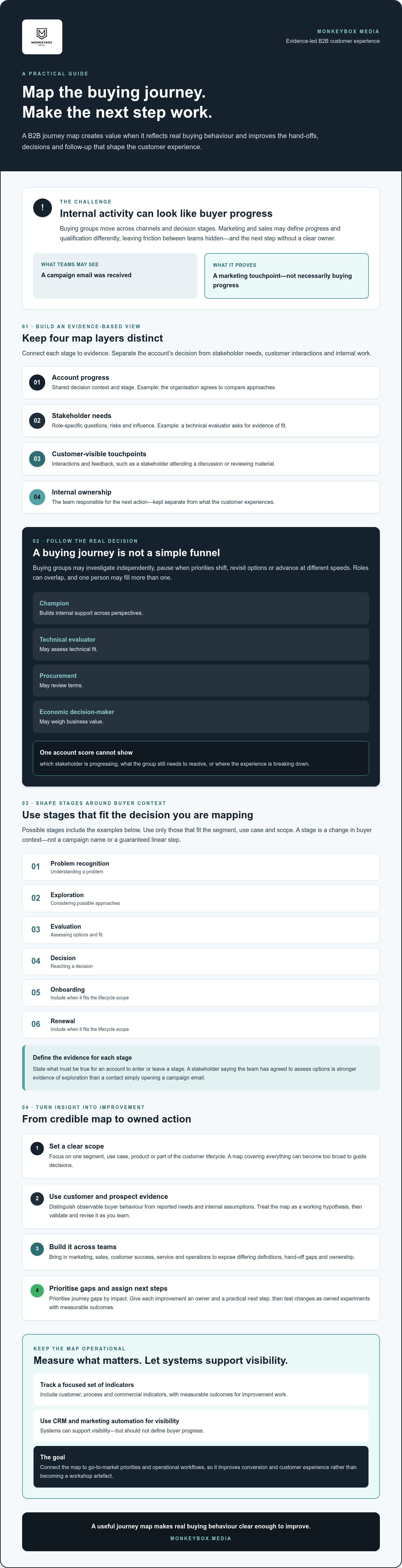
A journey map isn’t an internal funnel, campaign calendar or sales process. Those describe how your organisation plans and manages activity. The map starts with the customer’s context, including the questions they’re trying to answer and the people involved. It can then show how internal processes and hand-offs affect the experience. That distinction matters: a prospect receiving a campaign email is a marketing touchpoint, but it doesn’t prove the buying group is closer to a decision.
What does a B2B customer journey map include?
A useful map connects each stage to the evidence behind it. For every stage, capture stakeholder roles, goals, questions, customer-visible touchpoints, barriers and available evidence. Keep external interactions separate from internal actions such as lead routing, sales follow-up or service escalation. This makes hand-off gaps visible without presenting internal activity as customer progress.
Set a clear scope before mapping. Focus on one segment, use case, product or part of the customer lifecycle. A map covering every audience and interaction at once often becomes too broad to guide decisions. Treat each stage as a change in buyer context, such as moving from understanding a problem to evaluating possible approaches, rather than assigning stages by campaign name.
Why is a B2B journey different from a simple funnel?
A funnel suggests orderly movement towards a sale. Real buying groups may investigate independently, pause when priorities shift, revisit options or advance at different speeds. One stakeholder may test usability while another assesses technical fit, procurement reviews terms and an economic decision-maker weighs business value. The champion has to build internal support across those perspectives.
Roles can overlap, and one person may fill more than one. The map should capture the questions and barriers that matter to each participant, rather than assume one contact speaks for the whole account.
An account’s journey cannot be reduced to one lead score. A score can’t show which stakeholder is progressing, what the group still needs to resolve or where the experience is breaking down.
Treat the map as a working hypothesis, not a universal route or fixed truth. Use customer and prospect evidence to shape it, then validate and revise it as you learn. The goal isn’t to draw a perfect line. It’s to make real buying behaviour clear enough to improve.
How to model buying groups, stages, and touchpoints without flattening the journey
A useful map needs two views at once: what the account is deciding and what each stakeholder needs to move forward. In B2B customer journey mapping, stages should reflect observable shifts in buyer context, not internal campaign labels. IBM’s overview of the evolution of the customer journey map offers context for thinking about how journeys span interactions and channels.
Which stages belong in a B2B customer journey map?
Start with the organisation’s actual decision process. Problem recognition, exploration, evaluation, decision, onboarding and renewal can be useful stages, but include only those that fit the segment, use case and scope you’re mapping. Define what must be true for an account to enter or leave each stage, then note what evidence would support that judgement. A stakeholder saying the team has agreed to assess options is stronger evidence of exploration than a contact simply opening a campaign email.
Keep account progress separate from the needs and interactions that shape it. A comparison table makes those distinctions visible:
| Map layer | What to record | Example signal |
|---|---|---|
| Account progress | Shared decision context and stage | The organisation agrees to compare approaches |
| Stakeholder needs | Role-specific questions, risks and influence | A technical evaluator requests evidence of fit |
| Touchpoints | Customer-visible interactions and feedback | A stakeholder attends a discussion or reviews material |
| Internal ownership | Team responsible for the next hand-off | Sales coordinates follow-up with the relevant specialist |
Mark uncertain signals as assumptions, not facts. Validate them through customer conversations and observed buying behaviour before using them to set stage definitions or trigger workflows.
How should a map represent multiple B2B stakeholders?
Show shared account milestones alongside separate role-based lanes. A user may focus on daily usability; a champion may need a persuasive internal case; a technical evaluator may test compatibility; procurement may examine terms; and the economic decision-maker may weigh business value. Their questions can emerge at different times, and one person’s progress doesn’t establish consensus across the group.
Mark where each role enters, influences a decision or needs internal agreement. For example, an account might be evaluating options while procurement has not yet joined the process. That’s not a neat, single-file progression. It’s a signal to clarify who needs what and which team owns the next hand-off.
For organisations aligning journey stages with go-to-market priorities and team responsibilities, B2B go-to-market strategy support may help turn the map into a coordinated operating view.
How to find journey friction and prioritise the gaps that matter
A map becomes useful when it shows where customers lose time, confidence or momentum, and what evidence supports that conclusion. In B2B customer journey mapping, don’t treat one CRM field or anecdote as the whole story. Combine customer and prospect interviews, sales and service observations, CRM records, win-loss insights, customer feedback and relevant marketing engagement data where available.
What evidence should inform a B2B journey map?
Speak with customers and prospects across different roles and journey stages. A champion’s account of the decision may differ from a technical evaluator’s, while a recent customer can explain which hand-offs worked or failed in practice. Ask about specific events: what they were trying to do, what information they needed, what happened next and where they had to repeat themselves.
Compare those accounts with operational evidence. Sales objections can reveal unresolved concerns; service questions may expose unclear expectations after purchase; CRM records can show delays or missing hand-off details. Marketing engagement data can help identify interactions, but it won’t explain a buyer’s motivation on its own.
Label each finding so readers can distinguish:
- Observed behaviour: what a customer did or a team directly witnessed.
- Customer-reported need: what someone said they wanted, feared or found difficult.
- Internal assumption: an unverified belief about what customers think or do.
For important findings, record the evidence source, date, sample limitations and confidence. If external research informs a hypothesis, verify its original context and keep its provenance visible. A search-grounding link, such as this supporting research reference, isn’t a substitute for direct customer evidence.
How do you identify and rank journey friction?
Look for unclear messaging, repeated information requests, stalled decisions and hand-offs with no obvious owner. Compare the intended experience with what customers actually report before proposing a fix. A process may appear complete in the CRM while the buyer is still waiting for an answer.
Rank each gap by customer impact, how often it appears, commercial relevance and your ability to address it. Don’t claim that a touchpoint caused a delay just because the two coincide, and don’t assume missing CRM activity means nothing happened. The record may simply be incomplete.
Prioritise friction when credible evidence shows meaningful customer or commercial impact and a clear owner can act on it.
How to create and validate a B2B customer journey map step by step
A reliable B2B customer journey mapping process moves from evidence to action. Start with one manageable pilot journey, such as a priority segment evaluating a specific use case. Don’t try to map every product, audience and lifecycle stage at once. The aim is a map teams can validate and use, not a sprawling diagram.
How do you build the first draft and validate it?
Begin with a clear question: where does this segment encounter friction between recognising a need and reaching a decision? Involve marketing, sales, customer success, service and operations. Each team sees different interactions and hand-offs. Use a workshop to compare perspectives and challenge assumptions, not to substitute internal consensus for customer evidence.
Build the map through six steps:
- Scope: Choose the segment, use case and journey question.
- Research: Gather customer and prospect input alongside relevant team observations and records.
- Draft: Lay out stages, stakeholder needs, touchpoints, barriers and internal owners. Label evidence separately from assumptions.
- Validate: Check key moments with customers and internal teams. Investigate conflicting interpretations instead of smoothing them over.
- Prioritise: Select friction points with credible evidence and a practical path to improvement.
- Assign ownership: Name the person or team responsible for each action and hand-off.
For example, a draft might suggest that an evaluation stalls because technical questions go unanswered. Validate that with buyers and the teams involved before changing the process. The cause could be unclear information, a delayed response or a different concern entirely. Revise the map to reflect what the evidence supports.
How do you turn mapping findings into an action plan?
Translate the highest-priority gaps into specific changes, accountable owners and review dates. If buyers repeat the same information to sales and service, define who captures it, who can access it and who ensures it reaches the next team. Give each improvement a measure suited to the problem, then review whether the experience has changed.
Assign a cross-functional owner to hand-offs that span teams. Marketing operations and automation may support visibility or consistent follow-up, but they can’t replace clear responsibility or customer validation. A pilot lets you test those changes before extending the map to other segments or lifecycle stages.
Strategic leadership can help connect journey findings to go-to-market priorities and team responsibilities. Read this fractional CMO agency guide for more on that role. For support translating journey insights into coordinated marketing systems, explore strategic marketing support.
How to operationalise the journey map with metrics, systems, and accountable owners
A map earns its place when it changes what teams measure, who acts and how they coordinate. Operationalising B2B customer journey mapping means linking each priority stage to a small set of meaningful indicators, clear ownership and a review process. Focus on whether the customer experience is improving, not how much activity your systems record.
Which metrics show whether journey improvements are working?
Choose measures that match the friction you’re addressing. If buyers wait for a response, track the response gap. If decisions stall between stages, monitor stage progression using agreed entry and exit definitions. If onboarding is the issue, measure completion of the relevant customer milestones. Pair customer indicators with process and commercial measures when they help explain the result.
Before making a change, record a baseline and define how you’ll assess movement. Document the data source, measurement window, owner and attribution limitations. For example, a change in stage progression may coincide with a new follow-up process, but that alone doesn’t prove the process caused the change. Use customer feedback and team observations to add context.
System activity shows what your teams recorded; evidence of customer progress shows what buyers understood, decided or completed.
When can marketing operations or automation support the map?
CRM and marketing automation can make relevant context visible to the teams responsible for a hand-off. They can support consistent routing, reminders and follow-up once the process is clear. Automation won’t repair an unclear stage definition or an unowned task. Confirm the responsible team, decision rules and exception handling first, then automate repeatable steps that genuinely support the journey.
Set a cadence to review owners, data definitions, performance and changes in customer evidence. A regular monthly review may suit an active pilot; choose a rhythm your teams can sustain and adjust it when the journey or priorities change. Record decisions and map revisions so teams know what changed, why it changed and who is accountable for the next action.
Some findings will point beyond a single workflow. If the map exposes misalignment between go-to-market priorities, team responsibilities and operating processes, a strategic review can help determine what needs to change. Monkeybox Media’s fractional CMO leadership, GTM strategy and marketing operations expertise may support that work. These services provide strategic and operational input, not a guaranteed result. Keep the evidence, owners and measures connected, and the map can guide ongoing decisions rather than sit unchanged after the workshop.
Make the journey map drive the next move
A strong B2B customer journey mapping programme doesn’t end with a diagram. It gives teams an evidence-based view of buying group needs, friction points and hand-offs, then turns those insights into owned changes. Start with a focused journey, validate what customers experience and choose measures that show whether the change is helping.
Keep the map current by reviewing its assumptions, data definitions and ownership as the journey evolves. Use CRM and marketing automation to support visibility and consistent hand-offs, not as substitutes for customer evidence. The result is a practical operating tool that connects customer experience with go-to-market priorities.
Monkeybox Media provides fractional CMO leadership and B2B go-to-market strategy, alongside marketing operations, marketing automation and AI agent implementation. These capabilities can support teams translating journey insights into coordinated workflows and accountable execution, without promising a guaranteed outcome.
Contact Monkeybox Media to connect your B2B growth strategy with accountable execution. Start with the evidence, align the people responsible and make the next improvement measurable. Your map can become a catalyst for progress.
Frequently Asked Questions
What is B2B customer journey mapping?
B2B customer journey mapping is the process of documenting how an organisation and its stakeholders experience a buying or customer relationship over time. A map captures stages, needs, interactions and barriers, then compares the intended experience with available customer evidence. It should also identify evidence sources, assumptions and internal owners. Treat it as a working model to validate and update, not a fixed account of every buyer’s path.
How do you create a B2B customer journey map?
Start by selecting a customer segment and defining the question your B2B customer journey mapping project needs to answer. Research customer and prospect experiences, then draft the stages, stakeholder needs, touchpoints, barriers and internal hand-offs. Label evidence separately from assumptions. Validate the draft with customers and relevant teams, prioritise the friction that matters most, and turn each chosen improvement into an action with an owner, measure and review date.
Who should be involved in B2B customer journey mapping?
Involve the teams that shape or observe the journey, including marketing, sales, customer success, service and relevant operations colleagues. Include customers and prospects in research and validation; an internal workshop can surface useful questions, but it can’t confirm what buyers experience. Select participants who understand the journey in scope, and appoint one person to resolve conflicting interpretations, maintain the map and coordinate updates as new evidence emerges.
How is a B2B customer journey map different from a sales funnel?
A sales funnel usually describes how an organisation tracks prospects through internal qualification and sales stages. A journey map focuses on customer goals, questions, interactions and barriers, including experiences that don’t fit neatly into those stages. The two views can inform each other, but they aren’t interchangeable. Define journey stages using observable customer context, then connect relevant signals to internal processes without assuming a recorded sales stage captures the whole buying experience.
How often should a B2B customer journey map be updated?
Review the map when customer evidence, products, routes to market or internal processes change. Set a regular review cadence that fits how quickly your business and customer experience evolve, and update individual sections when credible new evidence emerges. Record what changed and why, so teams can follow the logic behind revisions. Don’t redraw the map simply because someone has a new opinion; validate changes before treating them as customer behaviour.
What happens if a B2B journey map is based on assumptions?
An assumption-based map can send teams towards the wrong friction, prompt ineffective process changes and create false confidence about the buyer experience. Mark assumptions clearly, then prioritise testing those that could change important decisions. Use interviews, observed interactions, customer feedback and relevant system data to check them. If evidence is incomplete, record that limitation and treat proposed improvements as hypotheses to test, rather than presenting them as established customer needs.
Can marketing automation improve the B2B customer journey?
Marketing automation can support timely, consistent communications and make agreed hand-offs easier for teams to manage. It can’t resolve unclear positioning, missing customer insight or ownership gaps on its own. First identify the customer need and define the process, including who is responsible and how exceptions will be handled. Then decide whether automation fits. Review customer responses and exceptions to ensure automated messages stay relevant rather than adding noise to the journey.