
More marketing activity won’t fix a strategy that isn’t connected to revenue. If campaigns, systems and sales priorities are pulling in different directions, a B2B marketing advisor should do more than offer recommendations. They should help turn strategic direction into coordinated execution.
You may need experienced marketing leadership, but not another full-time executive. A strategy deck alone won’t solve the problem if your team lacks the systems, ownership or measurement to put it into action. The right partner connects those pieces and makes the next move clear.
This article explains what a B2B marketing advisor should deliver and how to assess whether their approach fits your growth stage and internal capacity. You’ll learn how to evaluate support across positioning, go-to-market priorities, marketing operations and measurement, and how to distinguish useful strategic guidance from disconnected activity. We’ll also cover how to define responsibilities and next steps, so your team can move from advice to measurable execution with confidence.
Key Takeaways
- Clarify whether your business needs strategic guidance, campaign delivery or senior marketing leadership before choosing a support model.
- Trace growth priorities from business goals and target segments through positioning, funnel performance and team capacity.
- Compare an advisor, consultant, agency and fractional CMO by ownership, delivery capacity, leadership access and fit with your internal team.
- Use a clear evaluation process to define the problem, agree scope, assess relevant experience and set meaningful measures.
- See how a B2B marketing advisor can connect GTM direction with marketing operations, automation and AI-enabled workflows.
What does a B2B marketing advisor do, and when does your business need one?
A B2B marketing advisor connects business goals to marketing priorities and decisions. They help leadership determine where marketing should focus, why those priorities matter and how to assess progress. As a form of management consulting, the work brings an external perspective to organisational performance and business objectives.
Advisory, delivery and executive leadership are related but distinct. Strategic advice shapes choices such as target markets, positioning and go-to-market priorities. Hands-on campaign delivery turns an agreed plan into assets and activity. Executive marketing leadership sets direction across the function, aligns teams and takes ongoing responsibility for decisions. Some engagements combine these roles, but the scope should make clear who owns each one.
Consider outside guidance when positioning is unclear, go-to-market progress has stalled, marketing and sales teams are working to different priorities, or reporting tracks activity without showing its business relevance. These signs often point to a system-level issue, not simply a need for more campaigns.
What outcomes should a B2B marketing advisor influence?
The advisory remit should connect marketing choices to business objectives, such as building qualified pipeline, entering a market or supporting revenue growth. That means examining whether positioning speaks to target buyers, how demand generation attracts and develops opportunities, how sales feedback shapes the approach, and whether measurement gives leaders useful signals.
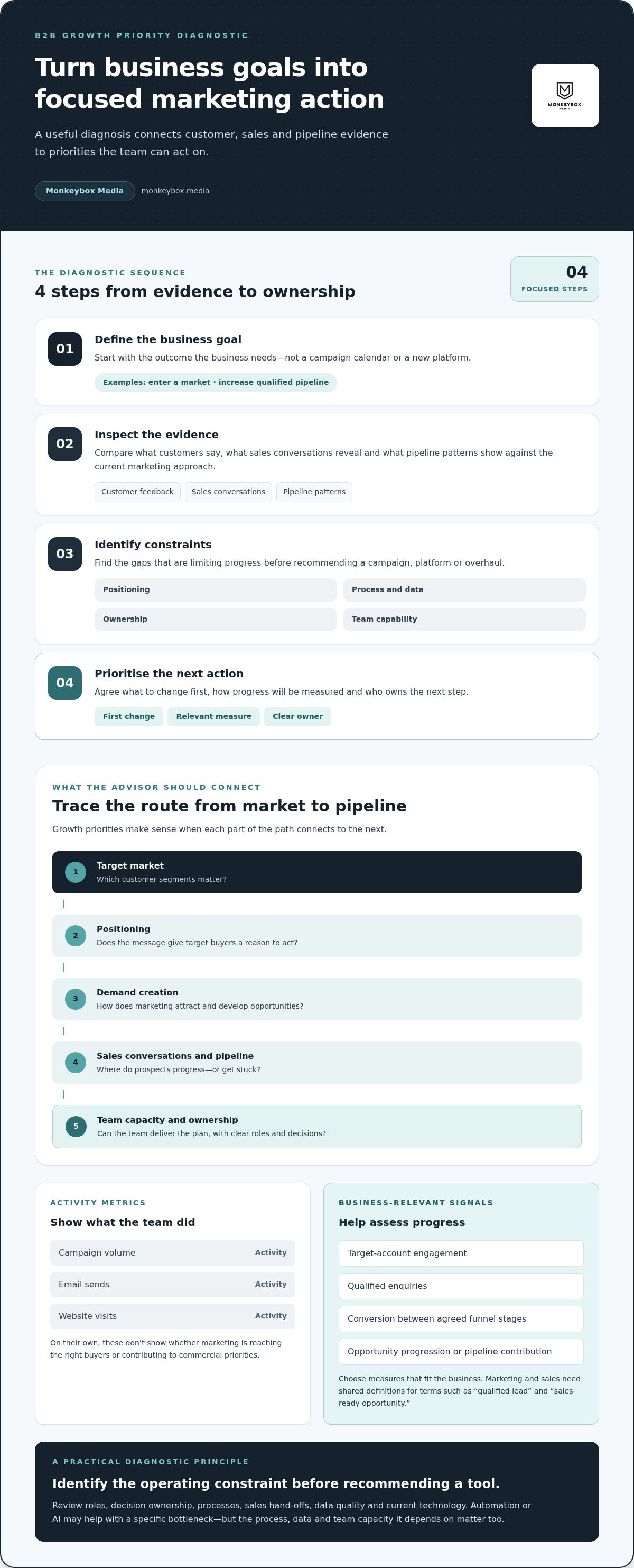
Separate strategic outcomes from activity metrics. Campaign volume, email sends and website visits show what the team did. On their own, they don’t establish whether marketing is reaching the right buyers or contributing to commercial priorities. A sound plan defines relevant measures and review points without promising results that depend on your market, offer and execution.
When is external marketing advice the right move?
An experienced outside perspective can help when leaders need to set priorities, challenge assumptions or align teams, but don’t yet need another full-time executive. An advisor can work alongside an existing marketing team, clarify decisions and connect its work to business goals. The scope should reflect your growth priorities, internal capability and the decisions that need senior direction.
Quick distinction: If the strategy and priorities are clear but a specific campaign needs delivery, you may need execution support. If the challenge is deciding what to do, why it matters and how marketing fits the wider growth plan, advisory input is more relevant. For ongoing senior leadership, explore this fractional CMO agency guide.
What should a B2B marketing advisor assess before setting your growth priorities?
A useful assessment starts with the business goal, not a campaign calendar or a new platform. A B2B marketing advisor should work through a clear sequence: what the company needs to achieve, which customer segments matter, whether the positioning gives those buyers a reason to act, how prospects move through the funnel, and whether the team can deliver the plan.
A B2B marketing diagnosis turns customer, sales and pipeline evidence into a short list of growth priorities the team can act on.
Keep the diagnostic focused:
- Define the goal: Specify the business priority, such as entering a market or increasing qualified pipeline.
- Inspect the evidence: Compare customer feedback, sales conversations and pipeline patterns with the current marketing approach.
- Identify constraints: Find gaps in positioning, process, data, ownership or capability that limit progress.
- Prioritise action: Decide what to change first, what to measure and who owns the next step.
How should an advisor connect marketing activity to revenue goals?
Trace the route from target market and positioning to demand creation, sales conversations and pipeline. If the right prospects engage but few progress to sales discussions, examine message fit, qualification and the hand-off. If conversations happen but opportunities don’t advance, sales feedback may reveal unmet buyer needs or unclear value.
Measures might include target-account engagement, qualified enquiries, conversion between agreed funnel stages, opportunity progression or pipeline contribution. No single metric suits every business. Marketing and sales need shared definitions, especially for terms such as “qualified lead” and “sales-ready opportunity”, so they interpret performance consistently.
Which systems and capabilities belong in the assessment?
Review team roles, decision ownership, campaign processes, sales hand-offs, data quality and the marketing technology already in use. A platform may contain useful information but still fail to support reliable reporting if teams define stages differently or record activity inconsistently. Identify the operating constraint before recommending a tool.
Automation or AI may help with a specific bottleneck, such as a repetitive hand-off or workflow step. Assess each opportunity against the process, data and team capacity it depends on. The diagnosis should produce prioritised decisions, not an indiscriminate technology overhaul. For support connecting GTM priorities with marketing operations and implementation, explore Monkeybox Media’s B2B marketing support.
B2B marketing advisor vs agency, consultant, or fractional CMO: which model fits?
The right model depends on the gap you need to close. Do you need sharper priorities, specialist expertise, more campaign capacity or sustained senior leadership? A B2B marketing advisor may help set direction, but titles can overlap. Compare actual responsibilities, decision rights, work products and continuity, not the label alone.
| Model | Strategic ownership | Delivery capacity | Leadership access | Internal-team fit and continuity |
|---|---|---|---|---|
| Advisor | Guides priorities and key decisions | Usually limited campaign delivery; may guide implementation | Senior input at agreed points | Works best when an internal team can execute; continuity depends on the engagement |
| Consultant | Solves a defined strategic or specialist problem | Produces analysis, recommendations or a scoped work product | Access focused on the project or expertise | Fits a team needing targeted knowledge; engagement often ends with the agreed scope |
| Agency | May advise within its delivery remit | Provides campaign and channel execution capacity | Varies by team and engagement | Extends internal capacity; continuity follows the delivery relationship |
| Fractional CMO | Provides ongoing executive marketing direction | Aligns teams and oversees execution, often through internal or external resources | Regular leadership involvement | Fits organisations needing sustained senior ownership without a full-time executive |
These are typical distinctions, not fixed boundaries. An advisor might provide implementation guidance, while a consultant may help shape strategy. Define who makes decisions, who does the work and what outputs the engagement must produce. If your organization is evaluating scoped advisory models in specialized operational areas, explore Project-based consulting fees for travel management and digital transformation to see how defined consulting scopes and structures are established.
When does an advisor model fit better than agency delivery?
An advisor model is a stronger fit when the immediate challenge is diagnosis, prioritisation or senior decision support, rather than a shortage of people to run campaigns. If your team has the skills and capacity to execute, an advisor can help it focus on the right work and resolve competing priorities. The scope can include reviewing plans or guiding implementation without taking on full campaign delivery. Conversely, if your organisation primarily requires full-scale media and creative campaign execution, click here to explore full-service agency capabilities.
When should a business consider fractional marketing leadership?
Consider fractional leadership when direction needs to continue beyond occasional recommendations. A fractional CMO provides an ongoing cadence for strategy, team alignment and execution, with responsibility shaped by agreed decision rights. The distinction is practical: choose based on how often leaders need input, how much authority the role requires and whether implementation needs active oversight. For a defined challenge, advice may be enough. For sustained cross-functional direction, leadership may be the better fit.
How to evaluate a B2B marketing advisor before committing
Choose an advisor through a structured evaluation, not a polished proposal alone. Confirm that they understand your business problem, can work within your team’s reality and will make accountability clear from the start.
- Define the business problem. State the decision or constraint you need help with, such as refining a go-to-market approach, clarifying marketing priorities or improving how teams interpret pipeline performance. A specific problem makes proposals easier to compare.
- Agree the scope. Set the advisor’s responsibilities, stakeholder access, decision rights and expected work products. Specify whether the role is to recommend, guide implementation or lead decisions, and clarify what remains with your team.
- Inspect relevant experience. Look for work related to comparable business models, growth challenges or complex B2B buying journeys. Assess how clearly the advisor explains the starting problem, decisions made, execution and lessons learned.
- Set measures and review points. Agree success measures that fit the objective and available data, then establish how progress, blockers and changes in direction will be reviewed.
What evidence demonstrates relevant B2B advisory capability?
Useful examples show the reasoning behind the work, not just a headline result. Ask how the situation was diagnosed, which priorities changed, how sales and marketing worked together, and what the team learned. Compare the context with your own rather than treating every case as directly transferable. Distinguish documented outcomes from broad claims, and don’t rely on guarantees or metrics without definitions and context.
Also assess strategic clarity and communication. Can the advisor explain trade-offs in plain language, challenge assumptions constructively and adapt recommendations to your team’s capacity? Relevant experience matters, but so does the ability to turn it into decisions your organisation can own.
How should scope, accountability, and measurement be agreed?
Record the business objective, responsibilities, deliverables, stakeholder access and decision-making authority before work begins. Choose leading indicators, such as progress on agreed positioning or process changes, alongside lagging indicators tied to the objective, such as qualified pipeline. The right measures depend on your strategy and data quality.
Set a review rhythm to assess decisions, progress, blockers and required adjustments. Use the same definitions across marketing and sales, and name who owns each action. That structure keeps advice connected to execution.
Proposal comparison checklist:
- Is the business problem and intended outcome specific?
- Are responsibilities, decision rights and deliverables explicit?
- Does the experience show relevant B2B context and learning?
- Are measures defined, realistic and tied to available evidence?
- Do communication, team fit and review cadence suit how you operate?
To connect strategic guidance with implementation, explore B2B marketing advisory support.
How Monkeybox Media connects B2B marketing advice with execution
Strategic recommendations create value when teams can put them into practice. Monkeybox Media connects fractional CMO leadership and B2B go-to-market planning with marketing operations, automation and AI agent implementation. The focus is a joined-up growth system: clear priorities, workable processes, defined ownership and measurement that helps leaders make informed decisions.
The engagement follows the organisation’s needs rather than starting with a predetermined campaign or technology project. First, align on growth priorities and constraints. Then shape a plan, operationalise the agreed work and review progress against relevant measures. This keeps infrastructure in service of strategy, not the other way round.
What does strategy-to-execution alignment look like?
GTM priorities need to translate into practical choices: which audience to focus on, how teams communicate the value proposition, what happens when a prospect engages and how progress is tracked. Marketing operations connects those decisions to processes, systems, responsibilities and measurement. That structure can reduce friction between strategic direction and the team’s day-to-day work.
Automation and AI agents can support defined workflows where there is a clear business need, such as reducing repetitive steps or helping teams manage routine processes. Start with the workflow constraint and intended outcome. Technology follows the operating requirement; it doesn’t replace the strategy.
What should happen in the first stage of an engagement?
The first stage is about understanding the organisation before shaping the work. That means examining objectives, current priorities, team responsibilities, existing systems and the constraints affecting execution. Leadership and relevant team members should share their perspectives, so the plan reflects both business direction and operational reality.
From there, priorities and responsibilities can be set around the organisation’s capacity. The plan should make clear what happens first, who owns each action and how progress will be reviewed. This creates a practical bridge from senior direction to implementation, while leaving room to adjust as evidence develops.
If your business needs a B2B marketing advisor who can connect strategic leadership with operational execution, discuss your B2B marketing priorities with Monkeybox Media.
Turn strategic direction into your next growth move
The right B2B marketing advisor connects business goals to clear priorities, accountable ownership and measures that help your team make better decisions. Choose the support model that fits the leadership you need, the work your team can deliver and the capability gaps holding progress back.
For growth to move beyond recommendations, strategy and operations must work together. Fractional CMO leadership and B2B go-to-market planning can set direction, while marketing operations, automation and AI agent implementation help put agreed priorities into practice.
If your marketing activity feels disconnected from commercial goals, make the next step a focused conversation about the challenge you need to solve. Discuss your B2B marketing priorities and explore how strategic leadership and execution can align with your organisation’s needs.
With clear priorities and the right support, your team can move forward with purpose.
Frequently Asked Questions
What does a B2B marketing advisor do?
A B2B marketing advisor connects business goals to marketing priorities and decisions. They assess areas such as target segments, positioning, go-to-market plans, sales alignment and measurement, then help leadership decide where to focus. Depending on the agreed scope, they may provide recommendations, guide implementation or support senior decision-making. Their role is to make marketing choices clearer and more aligned with business objectives, not simply to increase campaign activity.
When should a B2B company hire a marketing advisor?
Hire a marketing advisor when the company needs clearer priorities or an experienced outside perspective on a growth challenge. Common signals include unclear positioning, stalled go-to-market progress, disconnected marketing and sales teams, or reporting that tracks activity without informing decisions. An advisor can complement an existing team when it has delivery capacity but needs direction. If the strategy is clear and only a defined task needs completing, execution support may be a closer fit.
What is the difference between a B2B marketing advisor and a fractional CMO?
A B2B marketing advisor typically helps assess challenges, set priorities and inform specific decisions. A fractional CMO provides ongoing executive-level marketing leadership, aligning strategy, teams and execution over an agreed cadence. The roles can overlap, so compare responsibilities, decision rights, continuity and expected work products rather than relying on titles. Choose advisory support for focused strategic guidance; consider fractional leadership when the business needs sustained senior ownership of its marketing direction.
How do I choose the right B2B marketing advisor?
Start by defining the business problem and the decisions you need help making. Then compare proposed scope, relevant B2B experience, communication style, implementation capability and fit with your team. Look for examples that explain the original challenge, the decisions taken and what was learned, rather than relying on uncontextualised claims. Agree responsibilities, decision rights, deliverables, review cadence and measures upfront so everyone knows what the work covers and how progress will be assessed.
Can a B2B marketing advisor help with marketing automation?
Yes. An advisor can assess whether automation supports the business’s marketing priorities and identify workflows where it may reduce manual effort or improve consistency. Start with the process and constraint, such as a slow lead hand-off, then consider the systems, data and ownership needed to address it. Monkeybox Media connects marketing operations and automation with B2B strategy, and implements AI agents within marketing workflows where they support defined business needs.
How should a B2B marketing advisor measure success?
Measure success against the agreed business objective, using indicators that reflect both progress and outcomes. For example, a go-to-market initiative might track whether priority segments are engaging, alongside relevant pipeline measures. Define terms such as “qualified lead” consistently across marketing and sales, and confirm that the data is reliable enough to use. Review measures regularly to identify progress, blockers and adjustments. No single metric fits every business or advisory engagement.
Should a B2B marketing advisor implement the strategy as well?
That depends on the scope, internal capability and level of implementation support the business needs. An advisor may focus on recommendations and decision support, guide an internal team through execution or take on a broader role when implementation is included. Make ownership clear: specify who delivers each action, which systems or processes are in scope and how progress will be reviewed. Monkeybox Media connects fractional CMO leadership and GTM planning with marketing operations, automation and AI agent implementation.