
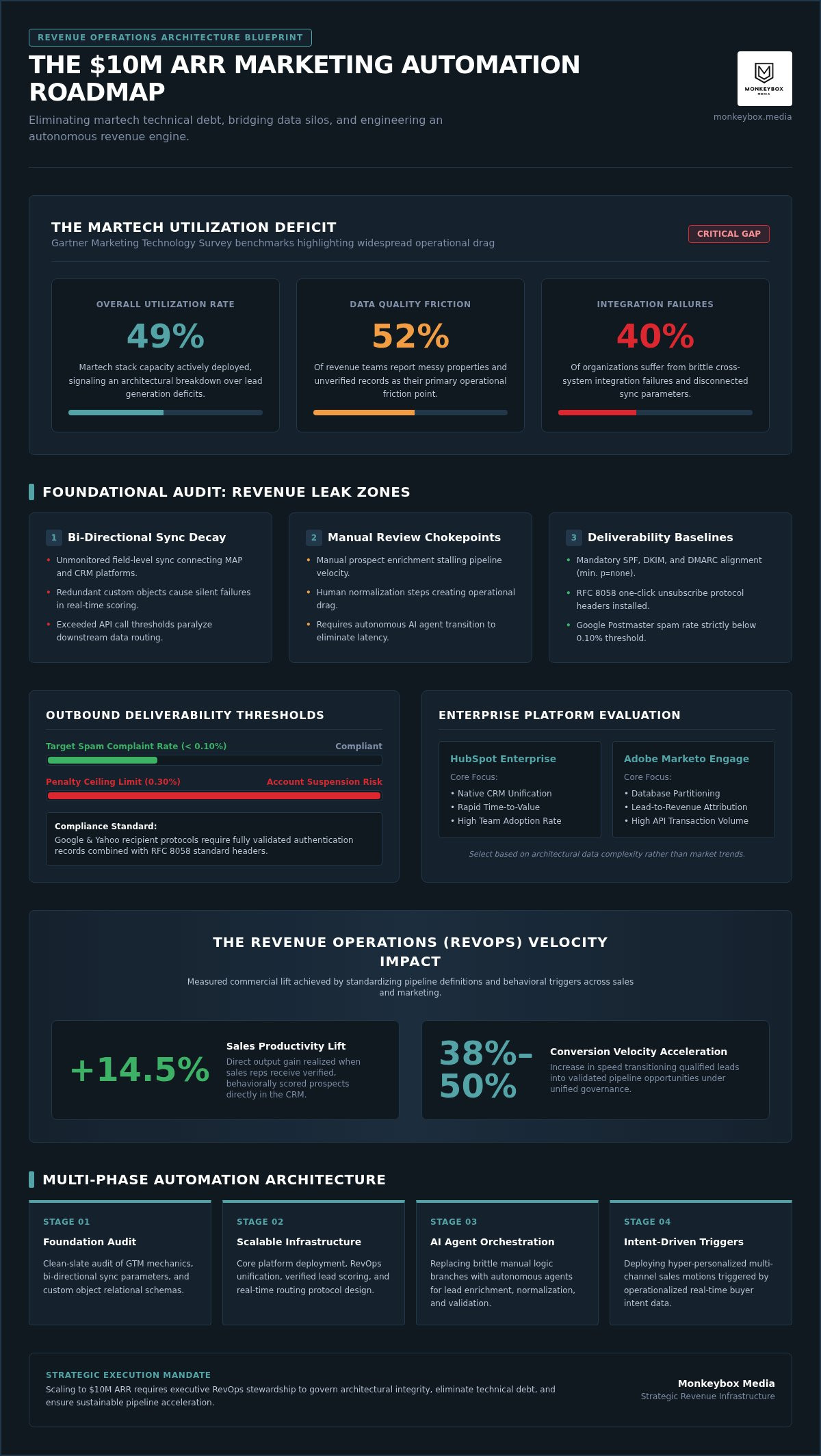
Gartner's Marketing Technology Survey reveals that overall martech utilization has collapsed to just 49%. If your pipeline is stalling, you don't have a lead generation deficit; you have an architectural breakdown. Building the bridge from early traction to sustainable scale requires an executive-led B2B marketing automation roadmap designed to eliminate brittle integrations, align your go-to-market motions, and turn disconnected software into an aggressive revenue engine.
You already feel the daily drag of data silos, messy CRM properties, and high manual workloads that turn routine lead qualification into an operational bottleneck. Technical debt is actively draining your team's velocity. To fix this, you must stop treating automation as a tactical IT checklist. In this guide, you will master the strategic architecture required to scale operations through AI-driven automation, unified data governance, and autonomous agent workflows. Here is the concrete 2026 blueprint to strip away friction and engineer your $10M ARR infrastructure.
Key Takeaways
- Eradicate the hidden technical debt draining your pipeline velocity by anchoring your go-to-market execution to a structured B2B marketing automation roadmap.
- Architect an objective lead scoring and real-time routing protocol across platforms like HubSpot Enterprise or Marketo that your sales reps will actually trust.
- Replace fragile, manual logic branches by integrating autonomous AI agents directly into lead enrichment, qualification, and operational workflows.
- Operationalize verified buyer intent data to deploy hyper-personalized, multi-channel sales triggers without multiplying your team's manual workload.
- Bridge the critical execution gap by deploying fractional CMO leadership to govern your revenue infrastructure and protect long-term automation ROI.
Auditing the Foundations: Eliminating Technical Debt and Operational Friction
Most enterprise software expansions stall because leadership treats automation as a tooling acquisition instead of structural engineering. A true B2B marketing automation roadmap operates as an architectural blueprint for your revenue engine, explicitly defining how data, trigger logic, and handoffs interact across the entire buyer journey. When mid-market companies push toward the $10M ARR mark, the legacy shortcuts that fueled initial survival transform into hidden killers of expansion.
According to Gartner's research, data quality is cited by 52% of revenue teams as their primary operational friction point, closely followed by cross-system integration failures at 40%. The resulting drag isn't abstract. It shows up as orphaned fields, conflicting routing logic, and sales reps cherry-picking unverified records. In 2026, scaling revenue requires an aggressive, clean-slate audit of your go-to-market mechanics to eliminate technical debt before layering on advanced orchestration.
The Technical Debt Audit: Where Your Revenue Leaks
Begin by diagnosing the structural fault lines between your core systems:
- Bi-directional sync decay: Trace the field-level sync parameters connecting your marketing automation platform and CRM. Inconsistent updates, redundant custom objects, and untracked API thresholds generate silent failures in real-time scoring.
- Manual verification bottlenecks: Identify every stage where a human manually enriches, normalizes, or reviews incoming prospect data. These operational choke points should be immediately transitioned to autonomous AI agents to preserve pipeline velocity.
- Outbound infrastructure breakdown: Deliverability standards now enforce strict technical baselines. Senders transmitting to Google and Yahoo accounts must maintain fully aligned SPF, DKIM, and DMARC configurations (minimum
p=none), RFC 8058 one-click unsubscribe headers, and a Google Postmaster spam complaint rate strictly under 0.10%, never reaching the 0.30% penalty ceiling.
Aligning GTM Strategy with Operational Reality
Building for $10M ARR requires a "Bold Architect" mindset: design your infrastructure for where your company needs to be in twenty-four months, not the ad-hoc workflows sustaining you today. Operational roadmaps must directly serve high-level commercial targets, translating broad go-to-market priorities into rigid, automated processes.
Stop measuring vanity engagement metrics. True revenue architecture tracks operational integrity through concrete KPIs: lead-to-opportunity conversion velocity, sales-accepted lead (SAL) routing compliance, end-to-end multi-touch pipeline attribution accuracy, and system-wide data freshness. Align these operational controls directly to executive oversight, and your automation roadmap becomes a compounding growth engine rather than a compounding technical liability.
Phase 1: Building the Scalable Marketing Infrastructure
Selecting your core platform is an architectural commitment, not a simple software purchase. Mid-market teams scaling toward $10M ARR regularly outgrow entry-level tooling and face a clear operational split. HubSpot Marketing Hub Enterprise excels when your priority is native CRM unification, rapid time-to-value, and unified team adoption. Adobe Marketo Engage serves complex enterprise architectures requiring custom database partitions, deep lead-to-revenue attribution modules, and heavy API transaction volumes. Choose the engine that reflects your data complexity, not industry hype.
A functional B2B marketing automation roadmap bridges the traditional fault line between marketing and sales through shared Revenue Operations (RevOps). RevOps unifies pipeline metrics under a single governance model, eliminating conflicting definitions of pipeline velocity. When lead qualification triggers are rooted in clear behavioral data, sales productivity lifts by 14.5%, driving a 38% to 50% increase in conversion velocity from qualified lead to pipeline opportunity.
Standardising the Data Layer
Garbage data paralyzes advanced automation. High-velocity operations require strict data hygiene protocols before feeding records into predictive models or outbound workflows:
- Custom object architecture: Model your CRM to mirror your commercial reality. Track parent-child account hierarchies, multi-product entitlements, and account-level buying committees using clean relational schema.
- Automated normalization gates: Force standardization across job titles, employee headcounts, and geographic territories at point-of-capture. Eliminate free-text inputs that pollute pipeline reporting.
- Unified identity resolution: Tie anonymous web intent, form fills, and outbound touches to a persistent company record, establishing a true single source of truth.
Engineering the Lead-to-Revenue Funnel
Static scoring models fail because they rely on vanity interactions like ebook downloads. Build a dynamic matrix that scores both demographic fit and verified intent. When account engagement spikes across high-value pages, trigger automated, real-time routing directly into your sales reps' execution queues.
Replace rigid drip sequences with adaptive nurture paths powered by real-time behavioral signals. Integrating first-party engagement data ensures outbound plays match the buyer's actual evaluation stage rather than a generic schedule. If you are auditing your stack to support this velocity, partnering with specialized experts for marketing ops and automation leadership ensures your systems are engineered for scale without costly rebuilds down the road.
Phase 2: Deploying AI Agents and Workflow Orchestration
Brittle if/else logic trees cannot handle modern enterprise buyer journeys. While 81% of martech leaders report piloting or deploying AI agents, 45% admit their out-of-the-box vendor implementations fail due to disconnected data foundations. A resilient B2B marketing automation roadmap moves past basic autoresponders and static branching. Instead, it embeds autonomous AI agents directly into your operational core to qualify accounts, normalize inputs, and trigger contextual actions at machine speed.
To successfully execute this transition, follow five concrete deployment steps:
- Target operational choke points: Isolate repetitive, data-heavy tasks such as unstructured form enrichment, inbound routing triage, and secondary CRM deduping.
- Anchor the knowledge base: Train agents exclusively on internal product documentation, ideal customer profile (ICP) parameters, objection-handling libraries, and strict brand guidelines.
- Implement compliance controls: Under Article 50 of the EU AI Act enforceable as of August 2026, automated conversational systems must explicitly disclose machine interaction to end users. Engineer these disclosures and audit logs directly into agent logic.
- Establish a human-in-the-loop buffer: Route early agent outputs through marketing operations teams for validation before granting autonomous CRM write permissions.
- Activate programmatic execution: Connect verified agents directly to outbound triggers, pipeline routing engines, and account scoring mechanisms.
Deploying AI Agents for Complex Workflows
Stop forcing human growth specialists to waste cycles on low-value manual research. AI agents excel at cross-referencing firmographic databases, verifying active hiring trends, and summarizing executive changes within target accounts before passing records downstream. Marketers shift into "Strategic Commanders," governing agent rules, inspecting edge-case failures, and optimizing systemic output rather than assembling individual campaigns by hand.
Workflow Orchestration: The 2026 Competitive Edge
Autonomous orchestration links your marketing automation engine, CRM, and communication channels into a dynamic execution framework. Rather than waiting on scheduled batch syncs, modern infrastructure relies on event-driven middleware to trigger immediate multi-channel sales actions the moment high-intent behavior surfaces.
This operational model transforms your content supply chain. An agent identifies surging topical interest across target enterprise accounts, generates modular messaging variants aligned with existing positioning, and pushes those assets directly into sales outbound cadences. Friction disappears. Your B2B marketing automation roadmap scales operational throughput exponentially without swelling marketing payroll.
Phase 3: Data Integrity and Multi-Channel Personalisation at Scale
The era of blanket email broadcasts is over. Deliverability restrictions and executive ad fatigue have permanently broken the traditional batch-and-blast playbook. High-growth organizations approaching $10M ARR survive by shifting to always-on, situational engagement. This operational posture listens for buyer activity across channels, synthesizes context in real time, and serves tailored touchpoints without requiring manual intervention from sales reps or campaign managers.
Your B2B marketing automation roadmap must transform personalisation from a superficial cosmetic trick into deep situational relevance. Inserting a company name token into a generic template fools nobody. Real personalisation adapts messaging based on the target account's technical maturity, current vendor stack, and documented operational friction points. When your automation architecture dynamically reacts to these signals, outbound turns from unsolicited noise into a timely, high-value intervention.
Intent-Based Automation: The New Standard
Intent-based automation serves as the operational bridge between cold, ignored outreach and high-velocity closed-won revenue.
Executing this requires uniting multiple intent data streams directly within your automation core:
- Third-party topic spikes: Ingest external intent feeds to flag when target accounts actively research specific business challenges or competitor categories.
- First-party site telemetry: Track anonymous enterprise visitors using reverse-IP lookup, mapping repeated visits to high-intent product pages against your target account tiers.
- Automated warm outbound plays: The second an account crosses an aggregate intent threshold, automatically assign the buying committee, enrich verified contact profiles, and trigger a multi-channel sequence tailored to the exact topic they researched.
Scaling Personalisation Without Losing the Human Touch
High scale does not justify hollow messaging. By embedding dynamic content modules across your website and outbound sequences, your marketing infrastructure automatically swaps case studies, value propositions, and pain-point positioning to match the reader's vertical and seniority.
Maintain rigorous narrative guardrails. Dynamic modules must pull from a centralized, pre-approved messaging framework to ensure absolute brand consistency across every programmatic touchpoint. Scale your pipeline without compromising message precision by working with Monkeybox Media for advanced GTM strategy and marketing automation that converts raw intent into predictable revenue.
Strategic Execution: Why Fractional Leadership Drives Automation ROI
Most automation strategies don't fail from software deficiencies. They fail from an executive leadership void. Mid-market companies often delegate system setup to junior coordinators or external platform administrators who lack go-to-market authority. Predictably, the implementation devolves into a disjointed collection of tactical email triggers rather than a scalable revenue infrastructure. An enterprise-grade B2B marketing automation roadmap demands senior commercial oversight to bridge high-level corporate growth targets with low-level execution mechanics.
With corporate CMO tenures averaging just 4.1 years, boards are increasingly avoiding the friction, lengthy onboarding delays, and hefty payroll liabilities of full-time executive hires to oversee operational modernization. A seasoned Fractional CMO enters as a dedicated architect. They command cross-functional alignment across marketing, sales, and RevOps, ruthlessly pruning technical debt and vendor bloat while designing an operational framework built for long-term velocity.
The ROI of Flexible Strategic Leadership
Engaging fractional marketing leadership injects deep domain expertise directly into your operations without bloated executive overhead. Full-time executives often spend their first two quarters evaluating team dynamics; a fractional leader audits infrastructure on day one, sets strict operational SLAs, and deprecates redundant tooling draining your budget.
This leadership model constructs an agile marketing operations unit by pairing autonomous AI agents with specialized technical experts. To explore the broader impact of this high-impact executive model, review The Fractional CMO Agency Guide 2026: Scaling B2B Revenue with Strategic Authority.
Next Steps: Launching Your 2026 Automation Roadmap
Execution requires rapid momentum. Launch your 2026 infrastructure deployment through an aggressive 90-day implementation sprint designed for immediate, measurable impact:
- Days 1–30 (Foundation and Data Audit): Map the complete customer lifecycle, audit deliverability health, standardize CRM schema, and eliminate orphaned workflow automations.
- Days 31–60 (Core Routing and RevOps Alignment): Implement objective behavioral scoring, configure real-time inbound routing queues, and establish strict sales-acceptance SLAs.
- Days 61–90 (Agent Deployment and Intent Activation): Deploy autonomous AI agents for inbound enrichment, integrate dynamic intent data feeds, and activate situational nurture sequences.
Stop letting legacy operational debt drag down your go-to-market performance. Ready to engineer your revenue engine? Book a strategic audit with Monkeybox Media to establish a scalable foundation that drives measurable ARR expansion.
Architecting Your Path to $10M ARR
Scaling past operational plateaus isn't solved by adding more point solutions to an already chaotic tech stack. Sustainable velocity demands an executive-governed B2B marketing automation roadmap that replaces manual lead processing with autonomous AI-agent workflows, enforces clean data normalization, and synchronizes sales triggers in real time. When you eliminate legacy friction, you transform marketing operations from a cost sink into an aggressive, compounding growth engine.
Building this infrastructure requires proven go-to-market frameworks and seasoned leadership capable of directing both high-level strategy and granular execution. Don't let technical debt stall your momentum. Partner with battle-tested operators who specialize in marketing ops modernization and agentic automation. Take full control of your revenue architecture: Secure your Fractional CMO and build your 2026 roadmap today to unlock predictable, high-margin expansion.
Frequently Asked Questions
What is a B2B marketing automation roadmap?
A B2B marketing automation roadmap is an architectural blueprint that connects your data schema, go-to-market workflows, and sales handoffs into a unified revenue engine. It eliminates ad-hoc campaign setup by establishing clear technical standards for lead scoring, account routing, and data hygiene. Rather than simply acquiring software, this roadmap ensures every operational asset directly supports measurable pipeline expansion and revenue velocity.
How long does it take to implement a full marketing automation strategy?
A complete deployment takes approximately 90 days to establish the core operational baseline. Month one focuses on data schema cleansing, deliverability hardening, and CRM deduplication. Month two deploys behavioral scoring logic, RevOps routing SLAs, and pipeline tracking. The final thirty days integrate autonomous AI agents and intent-triggered plays. Continuous testing and architectural optimization then run indefinitely as your pipeline scales.
Do we need a full-time Marketing Ops specialist for this roadmap?
Not during the initial build or growth stages. Scaling organizations often waste budget hiring junior full-time operators who lack cross-functional authority. Partnering with a Fractional CMO and specialized marketing ops consultants gives you immediate enterprise-grade architectural design without executive payroll overhead. This hybrid approach pairs strategic leadership with specialized AI agents, letting your team execute high-level plays without ballooning internal headcount.
What is the biggest mistake companies make with B2B automation?
The primary failure point is treating automation as an isolated software purchase rather than an executive-led architectural discipline. Organizations routinely layer new point solutions over broken data schemas, orphaned CRM fields, and unaligned sales handoffs. This misstep amplifies technical debt instead of driving efficiency. Automation only accelerates growth when built on clean data layers and strictly enforced RevOps governance.
How do AI agents differ from traditional marketing automation?
Traditional automation depends on brittle, static logic trees that break whenever buyer behavior deviates from a rigid path. Autonomous AI agents evaluate unstructured intent signals, verify account criteria in real time, and dynamically tailor next actions. They actively research prospect accounts, normalize incoming data, and orchestrate situational sales plays across channels without requiring human campaign managers to rebuild manual branching logic.
Can marketing automation help us scale from $1M to $10M ARR?
Yes, because it provides the operational leverage required to scale pipeline without linearly expanding your payroll. Transitioning through the $10M ARR inflection point collapses manual outbound and founder-led sales motions. Executing a disciplined B2B marketing automation roadmap standardizes qualification, accelerates inbound response times, and empowers your commercial team to focus exclusively on closing high-value opportunities.
What tools are essential for a 2026 B2B marketing stack?
A modern revenue engine requires four architectural pillars. First, a robust core platform such as HubSpot Enterprise or Marketo Engage tied to a normalized CRM. Second, first-party and third-party intent intelligence engines. Third, event-driven middleware or reverse-ETL tooling to sync data instantly. Finally, autonomous AI agents deployed directly across workflow nodes to execute programmatic qualification, data hygiene, and personalized nurture delivery.
How does technical debt affect marketing automation ROI?
Unchecked technical debt acts as an immediate operational tax on your revenue. Duplicate records, unverified contact data, and misaligned scoring triggers result in missed follow-up windows and sales rep distrust. Neglecting technical domain authentication standards triggers domain blacklisting and catastrophic inbox deflection. Removing this structural friction is the fastest way to double your automation output without increasing spend.