
Infrastructure is the ceiling of your growth. You cannot out-market a broken engine, yet many B2B leaders try to scale on a foundation of crumbling workflows and fragmented data silos. If your team spends more time duct-taping automation than closing deals, you aren't running a department; you're managing a digital graveyard. A comprehensive B2B marketing infrastructure audit is the only way to identify exactly where your capital is leaking. It's the mandatory prerequisite for survival in an era where 96% of marketers are already deploying AI to outpace the competition.
You've likely felt the friction of accumulated technical debt as your platform costs climb while your attribution remains a guessing game. It's a common frustration for high-stakes decision-makers who value efficiency over fluff. This framework eliminates that bloat and transforms your stack into a lean, high-velocity marketing machine. We'll show you how to purge manual workloads and secure the clean data required for executive-level decision making. This 2026 checklist provides the exact roadmap to transition from fragmented systems to an AI-ready growth engine.
Key Takeaways
- Break through the ARR ceiling by redefining your infrastructure as a unified growth engine rather than a collection of disconnected tools.
- Conduct a rigorous B2B marketing infrastructure audit to purge redundant software costs and map the complete data journey from lead to revenue.
- Future-proof your operations by transitioning from basic macros to autonomous AI agents that handle high-frequency, low-value manual tasks.
- Implement a systematic inventory and flowcharting framework to visualize your lead lifecycle and eliminate accumulated technical debt.
- Prioritize strategic leadership over software acquisitions to ensure your infrastructure roadmap is driven by GTM goals rather than tool features.
Why Your Current Infrastructure is the Ceiling on Your ARR
Infrastructure is the silent engine of your revenue. It encompasses your data architecture, automation logic, and the integration layer between sales and marketing. Modern Business-to-business (B2B) marketing requires more than a CRM with a few email templates. It demands a unified ecosystem where every touchpoint is tracked and every workflow is optimized. Without this, you're operating with a "Leaky Bucket." Poorly configured systems drain your ad spend through mismanaged leads, broken attribution, and missed follow-ups. You can't scale a mess. High-velocity markets don't forgive technical inefficiency.
Growth-stage companies often hit a wall during the transition from founder-led to system-led growth. Founders drive early traction through sheer force of will and personal networks. Scaling to $10M ARR requires a fundamental shift in mindset. You must replace individual heroics with repeatable, automated processes that function without manual oversight. A rigorous B2B marketing infrastructure audit reveals the specific bottlenecks preventing this evolution. It transforms your operations from a liability into a strategic asset. Systems don't get tired. They don't forget to follow up. They provide the structural integrity required for aggressive expansion.
The High Cost of Marketing Technical Debt
Technical debt in a marketing stack looks like complex automation chains held together by hope and manual spreadsheet uploads. These workarounds kill your team’s ability to scale. They force high-value talent to perform low-value data entry and troubleshooting. Marketing technical debt is the cumulative cost of choosing easy fixes over scalable systems. Every "quick fix" creates a friction point that slows down your entire GTM motion. It's a tax on every campaign you launch. You pay for it in lost time and missed opportunities.
Why 2026 Demands an Infrastructure-First Approach
The market has shifted from volume-based noise to precision-based operations. 2026 demands a foundation that can support autonomous AI agents and real-time data processing. Traditional audits fail because they look at tools in isolation. They ignore the modern requirements of AI readiness and cross-platform data integrity. Infrastructure is the foundation for predictable revenue. If your data is dirty, your AI is useless. A B2B marketing infrastructure audit ensures your engine is built for the high-velocity demands of the current digital economy. It prepares your stack for the integration of AI agents that replace manual workflows. This is about structural integrity.
Auditing the Core Tech Stack: Eliminating Tool Bloat and Data Silos
Most B2B organizations suffer from a bloated tech stack that creates more friction than revenue. A rigorous B2B marketing infrastructure audit identifies the redundant subscriptions and underutilized features draining your operational budget. It isn't enough to simply list your tools. You must evaluate every platform based on its direct contribution to the bottom line versus the manual effort required to maintain it. If a tool isn't driving growth or saving significant time, it's a "Zombie" that needs to be purged. High-performance teams prioritize a lean, integrated ecosystem over a collection of disconnected shiny objects.
Mapping the data journey from the first digital touchpoint to closed-won revenue is the most critical phase of this process. You need to visualize how information flows between your advertising platforms, marketing automation, and CRM. If your APIs and connectors are misconfigured, your data silos will deepen. This leads to a "garbage in, garbage out" scenario where your sales team lacks the context needed to close high-value deals. Establishing a Single Source of Truth (SSOT) is a non-negotiable requirement for scalable growth in 2026. If you're struggling to unify these systems, our marketing operations experts can help align your stack with your GTM goals.
The MarTech Consolidation Framework
Effective consolidation requires a systematic approach to evaluating ROI. You should utilize a five-step martech audit framework to inventory, score, and decide the fate of every tool in your arsenal. This process uncovers hidden costs and identifies where operational friction is slowing down your campaigns. The goal is to maximize the utility of your core platforms while eliminating anything that creates data fragmentation. Structural integrity is the priority. Every tool must serve the system, not the other way around.
Data Governance and Attribution Accuracy
Your attribution reports are likely providing a distorted view of reality. Broken tracking pixels and inconsistent lead-source tagging lead to wasted ad spend and poor strategic decisions. A comprehensive B2B marketing infrastructure audit must include a deep dive into your data governance protocols. You need to verify that every lead is correctly attributed to its original source and that every conversion event is tracked accurately across the funnel. Fixing these foundational issues is the only way to achieve executive-level clarity. Data hygiene isn't a one-time event; it's a continuous requirement for maintaining a high-velocity growth engine.
AI Readiness: Assessing Your Automation Infrastructure for 2026
The 2026 standard for high-growth organizations has shifted from passive automation to active autonomy. Simple macros and "if-then" logic are no longer sufficient to maintain a competitive edge. Your B2B marketing infrastructure audit must now evaluate your capacity to deploy autonomous AI agents that don't just follow rules, but make decisions. This transition from "Marketing Automation" to "Marketing Autonomy" requires a fundamental rethink of how your tools interact. It's about moving beyond scheduled blasts to real-time, agentic responses that mirror human intelligence at scale.
Effective AI integration starts with rigorous workflow mapping. You must identify high-frequency, low-value manual tasks that currently bottleneck your team. Many organizations fail here because their AI cannot actually see their data. Prompt engineering is a cosmetic fix if your agents lack deep access to your CRM and intent signals. A thorough B2B martech capabilities audit ensures your infrastructure supports the heavy data processing required for these advanced systems. Without structural transparency, your AI is flying blind.
Identifying Opportunities for AI Agent Integration
Start by auditing your outbound email and lead scoring systems. These are the primary candidates for AI agent integration. Traditional BDR and SDR roles are being redefined as AI agents take over manual research and initial outreach. These agents can synthesize LinkedIn data, recent news, and financial reports to craft hyper-personalized messages in seconds. The goal is to move from "AI-enabled" tools that still require human prompts to "AI-driven" operations where agents manage the entire top-of-funnel lifecycle. This isn't just an efficiency gain. It's a total transformation of your GTM velocity.
The Infrastructure Requirements for AI Agents
Clean data is the only fuel that powers effective AI. If your database is cluttered with duplicates or outdated records, your autonomous agents will produce hallucinations and damage your brand reputation. Security and compliance are equally critical. You must audit how AI handles sensitive customer data to ensure you don't breach privacy regulations while seeking efficiency. AI readiness is the structural ability to execute workflows without human intervention. Your B2B marketing infrastructure audit must verify that your tech stack is robust enough to trust these agents with your revenue-generating processes. Structural integrity is the prerequisite for autonomy.
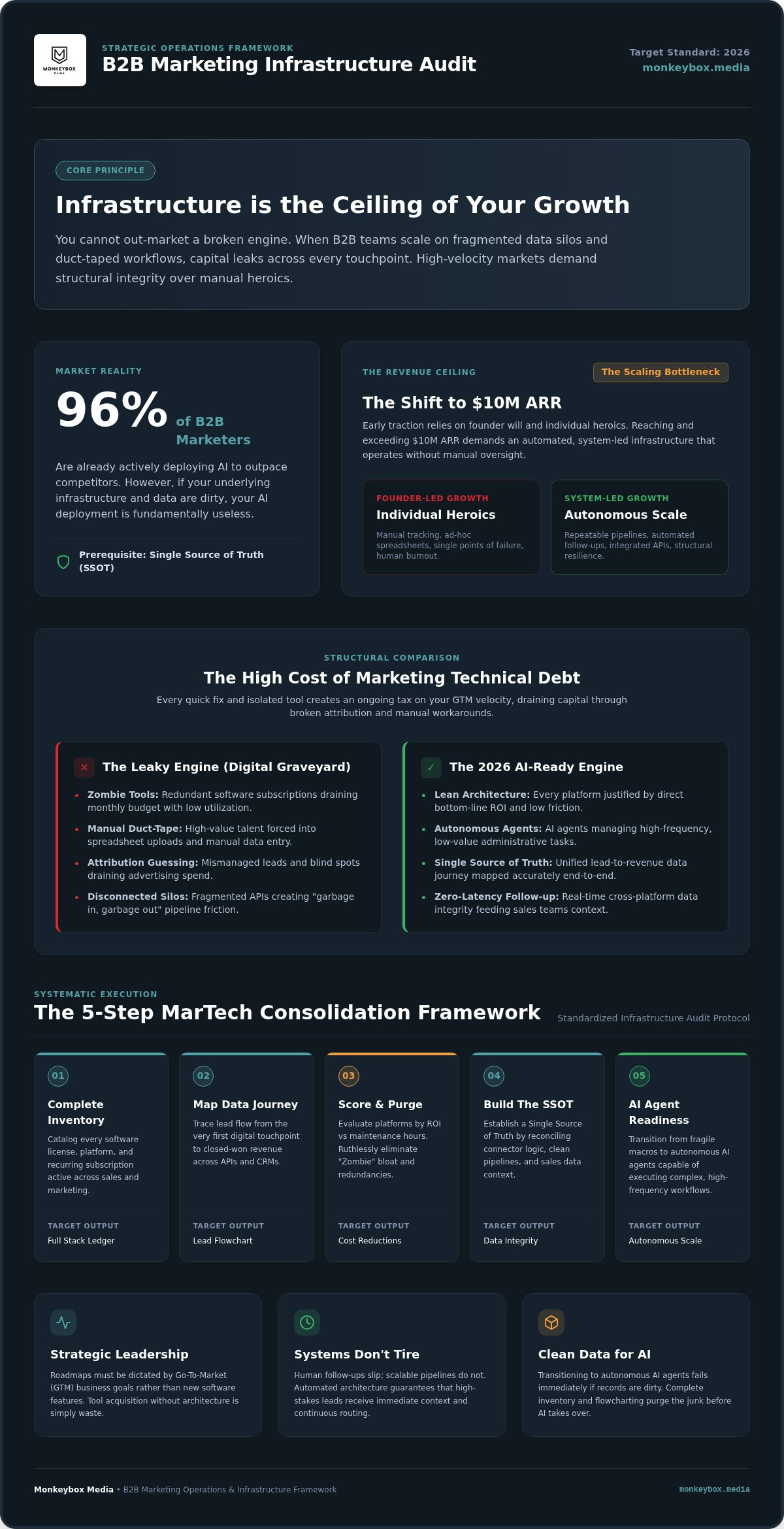
The Step-by-Step B2B Infrastructure Audit Framework
Scaling from $1M to $10M ARR isn't a matter of luck; it's a matter of engineering. A B2B marketing infrastructure audit requires a methodical teardown of your current systems to ensure they can handle the weight of aggressive growth. You must approach this framework with the mindset of an architect, not a mechanic. We aren't just fixing leaks; we're reinforcing the foundation for a high-velocity revenue engine.
- Step 1: Inventory. Document every tool, login, and cost centre. You cannot optimize what you haven't accounted for. Identify redundant seats and hidden API costs.
- Step 2: Flowcharting. Visualise the lead and data lifecycle. Map how a prospect moves from an initial ad click to a closed-won opportunity. Identify where data drops or syncs fail.
- Step 3: Stress Testing. Identify where the system breaks under 10x volume. If your lead processing slows down when campaign traffic spikes, your infrastructure is a bottleneck.
- Step 4: Gap Analysis. Compare your current state to $10M ARR requirements. Determine if your current stack supports the advanced AI agents and attribution models required for elite performance.
- Step 5: Prioritisation. Rank fixes by revenue impact versus effort. Focus on the structural repairs that unlock the most velocity first.
The Infrastructure Scorecard
System health is measured by three primary metrics: Uptime, Sync Speed, and Data Accuracy. If your CRM sync takes hours instead of seconds, your sales team is working with stale information. Assign a Scalability Score to your setup by grading each core tool on its ability to integrate with autonomous agents. High-growth firms often leverage a fractional CMO agency to provide the strategic leadership necessary to oversee this scorecard and drive the roadmap forward.
Turning Audit Findings into a GTM Roadmap
A B2B marketing infrastructure audit is only valuable if it leads to action. Translate technical gaps into strategic priorities that the board can understand. Instead of discussing API latency, talk about lost sales velocity. Set a clear 90-day timeline for your infrastructure overhaul. This roadmap should be the North Star for your marketing ops team, moving them from reactive firefighting to proactive system building. If you're ready to stop guessing and start scaling, request your infrastructure roadmap today to begin the transformation.
Executing the Fix: Why Strategic Leadership Trumps Tool-Fixing
Buying more software won’t save a broken strategy. Many B2B leaders fall into the "Tool-First" trap; they believe a premium CRM subscription or a new automation platform will magically fix revenue bottlenecks. It won't. Software is an accelerator. If your underlying logic is flawed, you're simply accelerating your failure. A B2B marketing infrastructure audit uncovers the cracks, but strategic leadership is what seals them. You need an architect to design the system before you hire mechanics to maintain it. Structural integrity is the only path to sustainable expansion.
The transition from audit findings to actual growth requires clear ownership. While Marketing Operations (Marketing Ops) is essential for maintaining the engine day-to-day, they shouldn't be the ones defining the roadmap. Ops teams are often too close to the technical debt to see the exit. Leadership must bridge the gap between high-level GTM strategy and technical execution. This ensures that every tool in your stack serves a specific revenue-generating purpose. Scaling with confidence is only possible when you know your systems are robust enough to handle a 10x increase in lead volume without breaking. It provides the peace of mind required for aggressive market moves.
The Fractional CMO Advantage for Infrastructure
An outside perspective is essential for identifying the technical debt that internal teams have grown to accept as "normal." A fractional CMO brings a specialized focus on structural integrity and expansion. They identify redundant subscriptions and integration gaps that full-time hires might overlook due to internal bias or departmental silos. This approach reduces overhead while increasing operational sophistication. You get the strategic authority of a seasoned leader without the long-term commitment of a traditional executive hire. It is a methodical, high-velocity solution for organizations serious about reaching the next level of professional maturity.
Next Steps: From Audit to Market Dominance
The first 90 days following a B2B marketing infrastructure audit are critical. This period is dedicated to purging "Zombie" tools, unifying data silos, and deploying the AI agents identified in your roadmap. The goal is a "Zero-Waste" marketing engine where every dollar spent is tracked, attributed, and optimized. This structural clarity allows you to move with strategic urgency. You stop guessing and start dominating. If you're ready to rebuild your foundation and prepare for AI-driven scale, Book your strategic B2B audit with Monkeybox Media. The roadmap to market dominance starts with a clean engine.
Architect Your Growth Engine for 2026
Infrastructure isn't a cost center; it's the structural integrity of your revenue engine. You've identified the technical debt draining your ad spend and mapped the transition from manual workflows to autonomous AI agents. Now, the choice is between incremental fixes and a total structural overhaul. A rigorous B2B marketing infrastructure audit provides the clarity needed to purge tool bloat and establish a single source of truth for your data. It's the mandatory first step for any organization serious about scaling beyond the $10M ARR ceiling.
Strategic growth requires more than just software. It demands a specialized partner to design a system that works while you sleep. Monkeybox Media delivers fractional CMO leadership and specialized expertise in AI agent workflow automation to transform your fragmented stack into a high-velocity machine. We've proven this methodology by scaling B2B SaaS organizations through the most complex GTM transitions. Don't let your current systems dictate your future limits. Secure your B2B Marketing Infrastructure Audit and start building for the future today. The market moves fast. Make sure your engine can keep up.
Frequently Asked Questions
What is included in a B2B marketing infrastructure audit?
A comprehensive audit covers your entire technical ecosystem, data architecture, and automation logic. We examine CRM configuration, API integration health, and the readiness of your systems for AI agent deployment. The process includes a deep dive into data hygiene and attribution accuracy to identify redundant tool spend. You receive a complete inventory of every system driving your revenue engine. It is a total teardown of your stack.
How long does a full marketing operations audit take for a $5M ARR company?
A thorough audit typically spans two to four weeks for an organization at this scale. This timeline allows for a rigorous investigation of cross-departmental data silos and complex automation workflows. The first week focuses on tool inventory and documentation. Subsequent weeks involve stress testing and gap analysis to ensure your engine can handle 10x volume. Efficiency is the priority. We move at the speed of your growth.
Can we conduct a marketing infrastructure audit internally?
Internal teams can document their own tools, but they often lack the objectivity to identify systemic technical debt. Teams frequently build manual workarounds that they perceive as normal rather than inefficient. An external B2B marketing infrastructure audit provides a specialized perspective that internal staff cannot replicate. Outside experts bring experience from multiple high-growth environments. They see the bottlenecks your team has learned to ignore.
What are the signs that our marketing infrastructure is failing?
High manual workloads and fragmented data are the primary indicators of a failing system. If your team spends hours on spreadsheet uploads or if your attribution reports don't match sales reality, your engine is broken. Other signs include climbing platform costs without a corresponding increase in ROI. You might also notice lead drop-off at critical integration points. These failures create an invisible ceiling on your ARR expansion.
How often should a B2B company audit its marketing tech stack?
Perform a rigorous audit at least once a year or during major GTM shifts. The digital economy moves too fast for static systems. Annual reviews ensure you aren't paying for "Zombie" tools or outdated automation logic that drains your budget. You should also trigger an audit when transitioning to a fractional CMO model or implementing AI agents. Regular maintenance prevents the accumulation of technical debt. Constant optimization is mandatory.
What is the difference between a marketing audit and an infrastructure audit?
A standard marketing audit evaluates brand messaging and campaign performance. An infrastructure audit examines the plumbing and power lines of your revenue engine. It focuses on data integrity, API connectivity, and automation scalability. One looks at what you're saying; the other looks at the machine that delivers the message. You cannot scale high-performing content on a broken technical foundation. You can learn more about optimizing the creative front-end of your digital ecosystem to complement these technical improvements. Structural integrity is the differentiator. It's the engine vs. the paint.
Professional audit fees vary based on the complexity of your tech stack and the depth of the required analysis. Most high-growth organizations view this as a strategic investment rather than a simple expense. The cost is often offset by the immediate identification of redundant software subscriptions and the elimination of manual labor costs. You're paying for specialized expertise that unlocks scalable growth. Value is measured by the ARR ceiling you break.
Will an audit disrupt our current lead generation activities?
A professional B2B marketing infrastructure audit is designed to be non-intrusive. We observe and document your live systems without breaking existing workflows or interrupting active campaigns. Most of the work occurs in the background through read-only access and stakeholder interviews. Any necessary fixes are scheduled and executed during low-traffic periods to ensure zero downtime. Your current lead generation continues while we design the roadmap for its future expansion.