
Your MarTech stack isn't an asset. For most scaling firms, it's a bloated, expensive liability that leaks revenue through every unmapped lead route and siloed data set. You recognise the friction. Lead routing is broken, attribution is a guessing game, and your internal team is too buried in the daily grind to ever actually optimise the machine. It's a high-stakes bottleneck that stalls growth while technical debt compounds. Every month of inaction represents thousands of pounds in wasted subscription fees and lost opportunities.
This guide reveals whether hiring an in-house B2B marketing operations specialist or partnering with a specialist agency is the strategic lever your organisation needs to liquidate that debt and build a high-velocity revenue engine. We'll break down the 2026 hiring landscape, compare loaded employment costs against fractional models, and show you how to architect a system that scales. Discover how to transform your fragmented workflows into a clean, automated infrastructure that turns data into predictable revenue. It's time to stop patching leaks and start building for expansion.
Key Takeaways
- Reframe marketing operations as strategic infrastructure rather than a tactical support role to unlock scalable growth.
- Identify why the modern B2B marketing operations specialist must master AI agent orchestration to maintain a competitive edge.
- Compare the "single point of failure" risk of in-house hires against the scalable, collective intelligence of a specialist agency.
- Learn how to conduct an infrastructure audit to eliminate technical debt and stop revenue leakage across your stack.
- Define the North Star metrics that ensure your operational investments translate directly into measurable revenue acceleration.
Beyond the Job Title: Why Marketing Operations is Your Revenue Engine
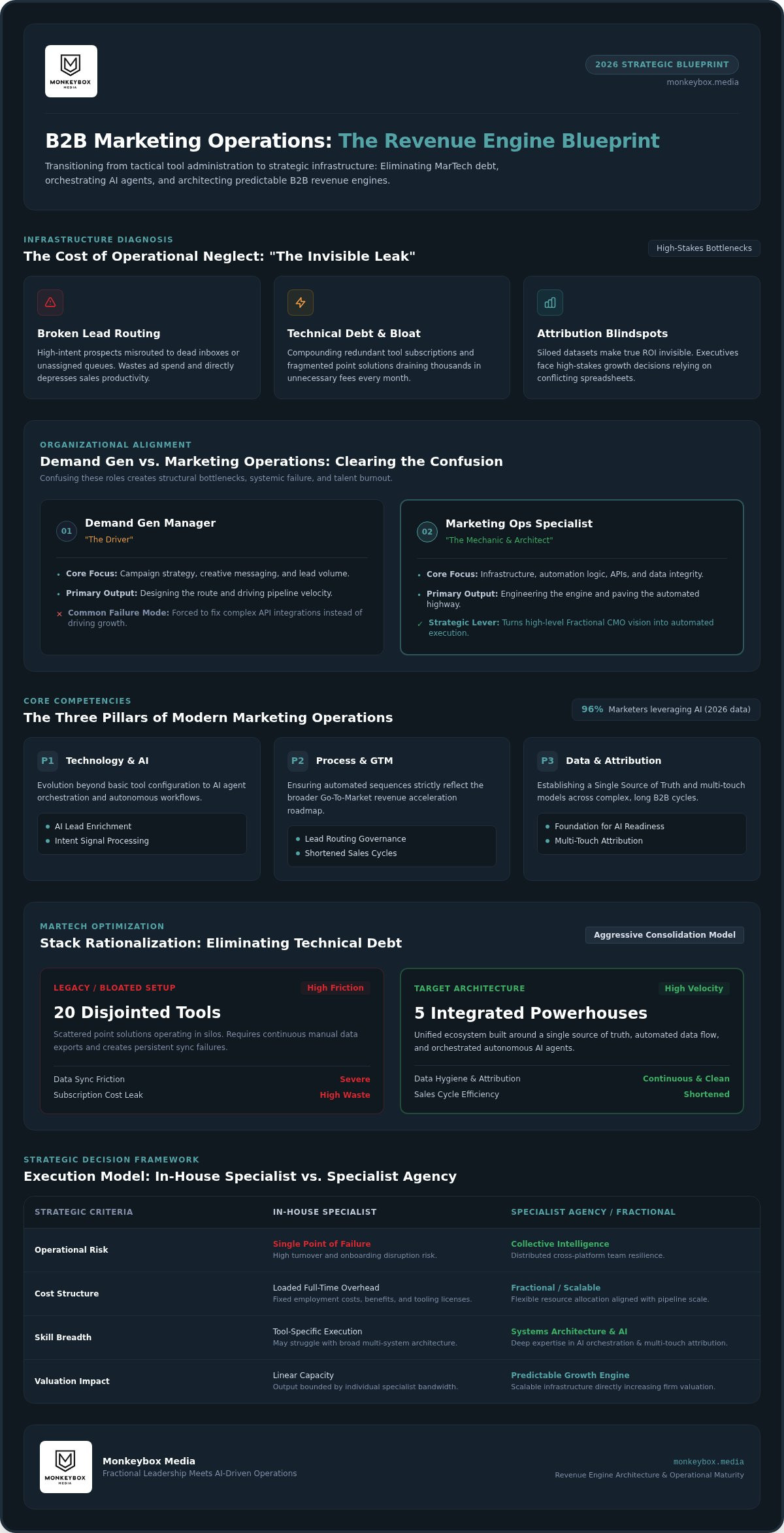
Marketing operations is not a back-office function. It's the central nervous system of your growth strategy. In 2026, the B2B marketing operations specialist has evolved from a tactical tool administrator into a strategic architect. They don't just manage software; they engineer the revenue engine. This shift from "tactical execution" to "strategic infrastructure" defines the difference between companies that struggle to hit targets and those that scale effortlessly. Without this structural focus, Marketing management becomes an exercise in chaos. You see the symptoms everywhere: data silos that hide the truth, broken attribution that makes ROI invisible, and lead leakage that forces sales to scavenge for scraps. For B2B SaaS companies, operational maturity is a direct driver of valuation. Investors don't just buy your current revenue; they buy the predictability of your growth machine.
The Cost of Operational Neglect
Neglect has a heavy price tag. Technical debt in your automation platforms doesn't just slow you down; it drains your budget through redundant subscriptions and inefficient workflows. We call it the "Invisible Leak." When poor lead routing sends a hot prospect to a dead inbox, you lose more than a deal; you kill sales productivity. A clean data ecosystem is the only way to provide executives with the clarity needed for high-stakes decision-making. Build the foundation. Stop the bleed.
Marketing Ops vs. Demand Gen: Clearing the Confusion
Confusing these roles is a recipe for burnout. A Demand Gen manager is the driver focused on the race. The B2B marketing operations specialist is the mechanic who ensures the car can actually handle the speed. Asking a campaign manager to fix complex API integrations leads to systemic failure and talent churn. This specialist provides the technical backbone required to execute a Fractional CMO vision. They turn high-level strategy into a functional, automated reality. One designs the map. The other builds the road.
The Specialist Skillset: Data, Infrastructure, and AI Integration
The B2B marketing operations specialist is the master of three non-negotiable pillars: technology, process, and data. In 2026, mere tool proficiency is obsolete. High-performance organisations don't need a "HubSpot expert" who simply clicks buttons. They need a systems thinker who builds frameworks. This role has shifted toward AI agent orchestration and workflow automation. It's about designing a self-optimising ecosystem where AI agents handle the heavy lifting of lead enrichment and intent signal processing. With 96% of marketers now leveraging AI according to 2026 industry data, the ability to orchestrate these autonomous agents is the new baseline for success. This isn't just about efficiency. It's about structural integrity.
Strategic GTM alignment is the heartbeat of operational design. If your operations don't mirror your go-to-market strategy, your stack is just a collection of expensive silos. The specialist ensures that every automated sequence and data point serves the broader mission of revenue acceleration. They build the machine that executes the vision. They don't just ask "how do we use this tool?" but "how does this tool accelerate the path to revenue?"
The Modern MarTech Stack Architect
Stack bloat is a silent profit killer. The modern specialist focuses on aggressive consolidation. They move organisations from twenty disjointed tools to five integrated powerhouses. Their job is to vet and implement AI-driven marketing tools that actually deliver ROI rather than just adding complexity. Every piece of software must serve the customer journey. If it doesn't shorten the sales cycle, it doesn't belong in the stack. For firms looking to reclaim their budget and streamline performance, integrating advanced marketing automation is the first step toward operational dominance.
Data Hygiene and Revenue Attribution
Data is the fuel for your revenue engine. The B2B marketing operations specialist acts as the "Single Source of Truth," ensuring that executive teams aren't arguing over conflicting spreadsheets. They build multi-touch attribution models that finally bring clarity to complex, long-cycle B2B sales. Without accurate attribution, you're flying blind. You can't scale what you can't measure.
Data hygiene is the foundational layer of AI readiness. If your data is fragmented or dirty, your AI agents will hallucinate and fail. The specialist maintains the structural purity of your database. They ensure that every record is enriched, every lead is routed correctly, and every pound spent is accounted for. This is how you build a scalable, predictable revenue machine. Robust systems beat individual talent every time.
The Great Debate: In-House Specialist vs. Marketing Ops Agency
Hiring a single B2B marketing operations specialist is often the default move for scaling firms. It is also one of the riskiest. When you hire for headcount, you are betting your entire revenue infrastructure on a single point of failure. If that individual leaves, your documentation, logic, and system integrity walk out the door with them. This creates a cycle of operational debt that stalls momentum and leaves your stack in disarray. Contrast this with the collective intelligence of an agency model. You aren't buying a person. You are buying a battle-tested framework and a bench of experts who have solved your specific problems dozens of times across different environments.
The total cost of ownership is the metric that actually matters. A top-tier specialist in the UK commands a significant salary. When you add benefits, pension contributions, and recruitment fees, the loaded cost often exceeds the investment required for a high-level agency retainer. Speed to value is the final differentiator. A new hire spends months onboarding and learning the business. An agency deploys proven GTM frameworks in weeks. In the fast-moving B2B landscape of 2026, waiting six months for a system to be built is a luxury you cannot afford. Talent is also migrating. The most elite Ops professionals are moving toward specialist consultancies to work on high-impact projects, leaving the in-house talent pool increasingly shallow.
When to Hire In-House
Dedicated internal teams make sense at significant scale, typically once a firm surpasses £50M ARR. At this level, the complexity of highly bespoke, custom-coded environments requires the deep, daily context that only an internal team can provide. However, retention remains a massive hurdle. The talent market for a B2B marketing operations specialist is incredibly tight. Finding someone who can both code a complex integration and design a high-level strategy is rare. If you find them, keeping them in a single-product environment is even harder.
The Case for the Fractional/Agency Model
Choosing a fractional model gives you a multi-disciplinary team for the price of one hire. You get the strategist to design the roadmap and the technician to build it. This eliminates the learning curve cost by leveraging pre-built, battle-tested GTM frameworks. Agencies also prevent operational myopia. By bringing cross-industry insights, they identify bottlenecks you've become blind to. They don't just maintain your machine. They upgrade it. This model provides the scalability you need without the overhead of a permanent department, and many firms find that partnering with a digital specialist like Web Media Grp. allows them to scale their web presence alongside their operational infrastructure.
Selecting a B2B marketing operations specialist is a high-stakes decision that dictates your revenue ceiling. You aren't looking for a "user" for your CRM; you are looking for an architect who can design a resilient, high-velocity machine. The selection process must be rigorous and unsentimental. Start by conducting a comprehensive marketing infrastructure audit to identify the technical debt currently stalling your progress. This audit reveals the gaps in your data flow and the redundancies in your stack. Once the debt is mapped, define your North Star metrics. A true specialist doesn't just move "activity" markers; they move lead velocity, attribution accuracy, and revenue. If they can't explain how their work impacts the bottom line, they aren't the right partner.
The final filter is AI competency. 2023 was the year of generative text; 2026 is the year of AI agent orchestration. Your partner must be building for the future, not patching the past. Since 96% of marketers are now using AI for efficiency, a specialist who isn't integrating autonomous agents into your workflows is already obsolete. They must demonstrate how they will use these tools to eliminate manual data entry and accelerate the buyer's journey. Efficiency is the only metric that matters in a high-growth environment.
Vetting for Strategic Alignment
Never hire an Ops specialist who doesn't ask about your GTM strategy within the first ten minutes. Technical skill is useless if it's misaligned with your market approach. Use the "Tool-Agnostic Test" during interviews. Ask them to explain a complex lead routing process without mentioning a specific brand of CRM or automation software. If they can't describe the logic without relying on tool-specific jargon, they are a technician, not a strategist. You need someone who understands the revenue side of marketing. To ensure your systems are built for scale, you should audit your operational maturity before committing to a long-term hire.
The 90-Day Roadmap for a New Ops Function
Success in marketing operations requires a structured rollout. Your first 30 days must focus on the audit and "Quick Wins," specifically identifying and fixing lead leaks that are costing you deal flow today. Month two is dedicated to infrastructure hardening and data consolidation. This is where you liquidate technical debt and ensure your data is clean enough for AI readiness. By month three, the focus shifts to scaling. You should be deploying AI automation and predictive reporting that allows your executive team to see the future of the pipeline, not just the history of the spend. This methodical progression transforms a chaotic stack into a predictable revenue engine.
The Monkeybox Advantage: Fractional Leadership Meets AI-Driven Operations
Monkeybox Media doesn't just fill a seat. We architect the future of your revenue. Most organisations treat the search for a B2B marketing operations specialist as a hunt for a glorified tool administrator. This is a strategic error that leads to fragmented systems and stalled growth. We provide the "Strategic Commander" perspective, integrating high-level Fractional CMO leadership with the granular technical execution required to dominate your market. We don't just manage your stack. We weaponise it. This synergy ensures your GTM strategy is never throttled by technical limitations or siloed data. It moves your organisation from a state of constant repair to a state of aggressive expansion, ensuring every pound of marketing spend is accounted for and every lead is capitalised on instantly.
The 2026 landscape demands more than simple automation. We deploy sophisticated AI agents that autonomously orchestrate complex B2B workflows across your entire funnel. These agents handle lead enrichment, intent signal processing, and predictive routing with a level of precision that human teams simply cannot replicate. This isn't a replacement for strategy; it's the high-octane engine that powers it. By offloading high-volume technical tasks to autonomous systems, your strategic leadership can focus on high-value growth initiatives and market positioning. The result is a high-velocity revenue engine that drives market dominance while your competitors are still struggling with manual data entry and broken attribution models.
Beyond Headcount: Buying a Growth Engine
Our model provides the structural stability of a permanent hire with the operational speed and agility of an elite strike team. When you partner with us, you get the collective intelligence of specialists who have seen every possible failure point in the B2B revenue chain. We transform your existing technical debt into a competitive advantage by restructuring your infrastructure for maximum throughput. In one recent engagement, we liquidated years of accumulated automation errors in under 60 days, turning a leaking pipeline into a predictable revenue stream. We don't just solve problems; we build the frameworks that prevent them from recurring. This is the difference between maintaining a business and scaling an empire.
Ready to Scale Your Operations?
Stop fixing. Start building. If your current marketing infrastructure feels like a liability rather than an asset, it's time to stop looking for a single B2B marketing operations specialist to save the day. You need a robust framework that doesn't break as you grow. We invite you to initiate a strategic infrastructure audit to identify exactly where your revenue is leaking and how to plug those gaps permanently. We provide the roadmap and the mechanics to build it. It is time to reclaim your budget and accelerate your path to market leadership. Don't hire a specialist. Implement a system.
Architecting Your Revenue Dominance
The window for manual, fragmented marketing operations is closed. In 2026, scaling a B2B SaaS firm from £1M to £10M+ ARR requires more than just a B2B marketing operations specialist; it requires a robust, AI-driven infrastructure. You've seen how technical debt and broken lead routing leak revenue. You understand that the shift toward AI agent implementation and workflow automation is the only way to maintain a competitive edge. The choice between a solo hire and an elite fractional team isn't just about cost; it's about speed, scalability, and strategic GTM leadership.
Stop managing tools and start building a machine. We provide the technical execution and strategic authority needed to turn your operational mess into a high-velocity revenue engine. Our experts specialise in eliminating technical debt and deploying autonomous systems that drive market dominance. We combine high-level strategy with the mechanics of execution to ensure your growth never hits a ceiling.
Scale your B2B engine with a Strategic Marketing Operations Partner and secure your growth trajectory today. Your future revenue engine is ready for construction.
Frequently Asked Questions
What exactly does a B2B marketing operations specialist do daily?
Daily, the specialist monitors lead flow, troubleshoots API breaks, and audits data hygiene. They ensure that your automation logic remains intact while refining lead scoring models. Much of their time involves technical stack maintenance and building new automated sequences to support active campaigns. They act as the bridge between marketing strategy and technical reality, ensuring every digital touchpoint is tracked and every lead is enriched before reaching sales.
How much should I expect to pay for a top-tier Marketing Ops specialist in the UK?
A top-tier specialist in the UK for 2026 typically commands a salary between £65,000 and £95,000. When you factor in loaded costs like National Insurance, pension contributions, and recruitment fees, the total investment often exceeds £110,000 annually. Senior-level architects or VPs can reach significantly higher figures. This high entry price is why many scaling firms opt for fractional models that provide senior expertise at a fraction of the full-time employment cost.
Can a Fractional CMO handle my marketing operations as well?
A Fractional CMO provides the high-level strategy, but they usually require a technical specialist for implementation. While a Fractional CMO understands the architecture, their value lies in GTM strategy and leadership. They design the roadmap, while the Ops specialist builds the road. At Monkeybox Media, we integrate these functions to ensure your strategic vision isn't throttled by technical gaps. Strategy without execution is just a hallucination; you need both to scale.
What is the difference between Marketing Ops and Revenue Ops (RevOps)?
Marketing Ops focuses exclusively on the marketing funnel, while RevOps aligns Sales, Marketing, and Customer Success. RevOps is the holistic approach to the entire revenue lifecycle, ensuring data flows seamlessly from the first ad click to the final contract renewal. Marketing Ops is a critical component of this larger ecosystem. If your organisation only fixes the marketing stack without considering the sales handoff, you aren't doing RevOps; you're just silo-building.
When is the right time for a B2B SaaS startup to hire their first Ops specialist?
The right time to hire is when manual processes begin to stall your lead velocity. For most B2B SaaS startups, this happens post-Seed or early Series A, once you've achieved product-market fit and started aggressive outbound activity. If your sales team is complaining about lead quality or your attribution is a mystery, you've already waited too long. You need a B2B marketing operations specialist to build the foundation before the scale breaks your machine.
What are the most important certifications for a Marketing Ops specialist to have?
Focus on platform-specific certifications like HubSpot Architect, Salesforce Administrator, or Marketo Certified Expert. In 2026, certifications in AI orchestration and workflow automation platforms like Workato or Zapier are equally critical. These credentials prove technical proficiency, but they don't replace strategic thinking. Look for specialists who combine these badges with a deep understanding of GTM frameworks and revenue logic. A certified technician who doesn't understand your business model is a liability.
How do AI agents change the role of marketing operations in 2026?
AI agents transform the role from manual execution to strategic orchestration. Instead of manually enriching leads or building individual email triggers, the B2B marketing operations specialist now manages autonomous agents that handle these tasks at scale. This shift allows the specialist to focus on high-level system design and predictive modelling. With 96% of marketers already using AI, the role is now about managing a digital workforce rather than performing repetitive administrative tasks.
How do I measure the ROI of my marketing operations function?
Measure ROI through lead velocity, attribution accuracy, and stack efficiency. A successful Ops function should visibly shorten your sales cycle and reduce the cost per acquisition by eliminating lead leakage. If your sales team is closing deals faster because they have better data, that's your ROI. You should also see a significant reduction in technical debt and software waste. If you can't point to a cleaner, faster revenue engine, your Ops function is failing.