
More growth activity can make a B2B revenue problem harder to solve. When marketing campaigns, sales initiatives and new tools compete for budget and leadership attention, adding another programme may create motion without improving results. A revenue growth strategy B2B teams can execute starts by finding the constraint limiting revenue, rather than treating every symptom as a priority.
It’s frustrating when marketing and sales work hard but their activity doesn’t consistently translate into pipeline and revenue. The answer isn’t always more leads, content or automation. Growth depends on identifying where the system is breaking down and aligning teams around the right next move.
This article explains how to diagnose your highest-impact growth constraint, choose coordinated levers and turn strategy into accountable execution. You’ll learn how to assign clear owners, track useful indicators and adapt as performance changes. From strategic direction to the marketing operations and automation that support delivery, the focus is on building a growth system that can scale, not another list of disconnected initiatives.
Key Takeaways
- Build a revenue growth strategy B2B around choices that connect target customers, value, routes to market and execution.
- Assess how positioning, demand generation, sales conversion and retention interact before deciding which growth lever to prioritise.
- Match possible responses to evidence of the constraint, and weigh trade-offs rather than assuming one approach fits every business.
- Turn priorities into an execution plan with clear ownership, measurable indicators and regular opportunities to learn and adapt.
- Choose growth support based on the leadership, capabilities and implementation your next stage requires, including whether fractional CMO leadership is a fit.
Revenue Growth Strategy B2B Starts by Finding the Real Constraint
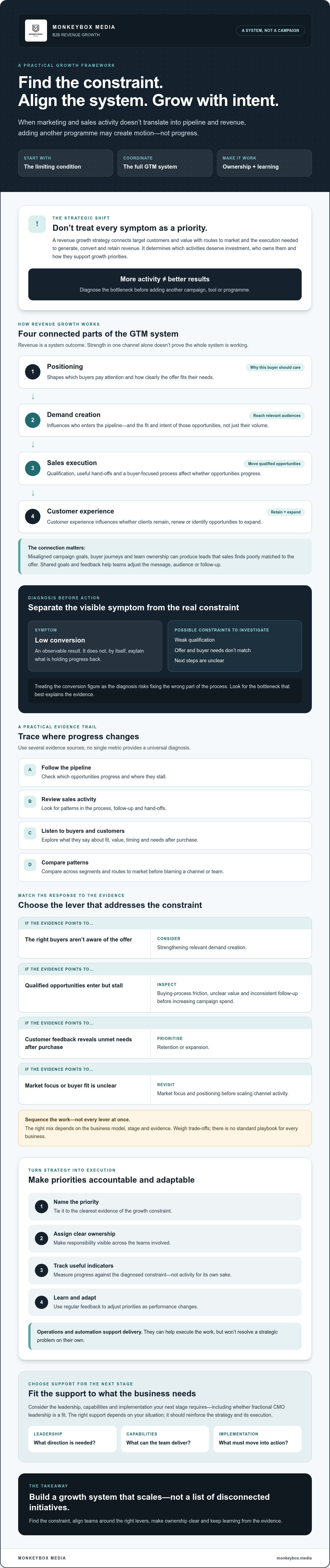
A B2B revenue growth strategy connects target customers and value propositions with routes to market and the execution needed to generate, convert and retain revenue. It’s broader than a campaign plan. A campaign activates a specific activity, while strategy determines which activities deserve investment, who owns them and how they support the business’s growth priorities.
Revenue is a system outcome. Positioning shapes which buyers pay attention, demand creation influences who enters the pipeline, sales execution affects whether qualified opportunities progress, and customer experience influences renewal and expansion. Strong results in one channel don’t prove the whole system is working. A revenue growth strategy B2B leaders can act on connects these parts and directs resources towards the constraint with the clearest evidence.
That means making deliberate choices about market focus, differentiation, demand generation, sales execution and customer expansion. A Go-to-market strategy provides a framework for aligning customers, the company and competition with how an offer reaches the market. The right mix depends on your business model, stage and evidence, not a standard playbook. Marketing operations and automation can support execution, but they won’t resolve a strategic problem on their own.
What a B2B revenue growth strategy connects
Strategy turns market choices into operating priorities. For example, a firm targeting a narrow group of complex accounts may need positioning that speaks to those buyers’ specific needs, focused demand creation and a sales process built around multiple decision-makers. That requires coordinated investment and clear ownership across teams, not an isolated channel plan.
Set priorities based on the evidence. A business with strong demand but stalled opportunities may need to examine sales execution before increasing campaign spend. Another may need to sharpen its market focus first. The sequence matters.
How to tell a growth symptom from a constraint
A symptom is an observable result; a constraint is a condition limiting progress. Low conversion, for instance, could reflect weak qualification, a mismatch between the offer and buyer needs, or unclear next steps. Treating the conversion figure as the diagnosis risks fixing the wrong part of the process.
Trace the pattern through customer feedback, pipeline stages and sales activity. Check which opportunities progress, where they stall and what buyers say about fit, value and timing. Compare patterns across segments and routes to market before blaming a channel or team. No single metric provides a universal diagnosis. The goal is to find the bottleneck that best explains the evidence.
How B2B Growth Levers Work Together Across the GTM System
Each growth lever influences what happens next. Positioning defines why a particular buyer should care, while demand generation puts that message in front of relevant audiences. Together, they shape the fit and intent of opportunities entering the pipeline, not just its volume. If positioning attracts the wrong accounts, more campaign activity can increase noise without improving sales outcomes.
Sales execution turns relevant opportunities into commercial outcomes. Clear qualification, useful hand-offs and a buying process that addresses customer needs help keep deals moving. After the sale, customer experience influences whether clients remain, renew or identify opportunities to expand. A revenue growth strategy B2B needs to connect these stages, so teams can see how decisions in one part of the GTM system affect results elsewhere.
Disconnected GTM activities weaken strategic execution because they optimise individual tasks without aligning the buyer journey, team ownership and shared revenue priorities. A campaign that generates leads, for example, may appear successful while sales finds those leads poorly matched to the offer. Shared goals and feedback loops expose the gap and help teams adjust the message, audience or follow-up.
Choose growth levers that match the diagnosed constraint
Match the intervention to the evidence. If the right buyers aren’t aware of the offer, strengthen relevant demand creation. If qualified opportunities enter the pipeline but stall, inspect the buying process for friction, unclear value or inconsistent follow-up. If customer feedback points to unmet needs after purchase, prioritise retention or expansion. The aim isn’t to activate every lever at once, but to sequence the work around the constraint.
Treat data, process and technology as enabling infrastructure
CRM data can give marketing and sales a shared view of accounts and opportunities, but only when teams agree on stage definitions, required fields and data ownership. Without consistent governance, the same pipeline report can mean different things to different teams. Establish the rules first, then use the system to support decisions.
Marketing automation can deliver repeatable workflows, such as routing enquiries or coordinating follow-up. It supports a chosen strategy; it doesn’t create buyer demand by itself. AI agents may assist with defined workflow tasks, but teams should select use cases carefully, check outputs and retain human oversight where judgement matters.
When strategy and implementation need to move together, B2B go-to-market strategy and marketing operations can be considered as connected capabilities rather than isolated projects.
Compare B2B Revenue Growth Strategies by Constraint, Evidence and Trade-Off
The right growth response depends on what the evidence shows, not which channel or technology is receiving attention. Use the comparison below to frame what to investigate. Treat a proposed cause as a hypothesis until customer, pipeline and sales evidence supports it. A revenue growth strategy B2B should account for deal complexity, sales cycle and customer segment before resources are committed.
| Possible constraint | Response to investigate | Evidence to check and trade-off |
|---|---|---|
| Not enough relevant opportunities | Review demand generation and audience focus | Check lead and opportunity fit by segment and source. More activity may take time to produce useful learning and can add volume without improving relevance. |
| Buyers don’t understand the offer | Test positioning and message clarity | Look for recurring customer questions, objections and reasons for lost opportunities. Changing positioning requires alignment across marketing and sales. |
| Qualified deals stall or fall through | Investigate conversion and the sales process | Examine stage progression, hand-offs and buyer feedback. Process changes depend on sales adoption and may take longer to assess in complex, lengthy sales cycles. |
| Customers don’t renew or expand | Explore retention and customer expansion | Review renewal patterns, customer feedback and unmet needs by segment. Progress depends on post-sale ownership and a credible fit between customer needs and the offer. |
| Teams struggle to execute consistently | Improve operational efficiency and workflow | Identify manual steps, unclear ownership and unreliable data. Process and system changes require clear definitions, implementation capacity and ongoing governance. |
These are starting points, not diagnoses. Low lead volume alone doesn’t prove demand generation is the problem; the audience, offer or qualification criteria may be misaligned. Likewise, a stalled deal may reflect buying-group complexity rather than weak sales execution. Separate what you can observe from what you still need to validate.
When to invest in leadership, operations or automation
If teams lack a clear growth direction, have competing priorities or don’t have an accountable senior owner, strategic leadership may be the first need. Fractional CMO leadership can be an option when the business needs senior marketing ownership, though it won’t suit every stage or situation. If priorities are clear but workflows, data or systems block delivery, focus on marketing operations or implementation instead.
Automation is a poor first move when process ownership, definitions or hand-offs remain unclear. Automating a flawed workflow can make inconsistency faster, not fix it. First agree what should happen, who owns each step and what information teams need. Then assess whether marketing automation or AI agents can support repeatable work, with appropriate human oversight.
Turn a B2B Growth Strategy into a Measurable Execution Plan
A strategy becomes useful when teams can act on it, measure progress and make decisions based on what they learn. Build the plan around a small number of priorities tied to the diagnosed constraint. A revenue growth strategy B2B should make clear what changes, who owns it and what evidence will show whether the approach is working.
- 1. Set a baseline. Review customer feedback, pipeline stages, sales outcomes and retention patterns relevant to the chosen constraint. Record data gaps and agree how each measure is currently defined.
- 2. State the hypothesis. Frame the priority as a testable explanation, such as: “If we improve qualification for this customer segment, more suitable opportunities will progress to the next stage.” Keep the hypothesis distinct from confirmed evidence.
- 3. Assign ownership and dependencies. Name one accountable decision owner, the supporting teams and any dependencies, such as agreed qualification criteria or reliable CRM fields. Clarify who will gather evidence and who can change course.
- 4. Choose measures and milestones. Pair a leading indicator, such as the share of opportunities meeting agreed qualification criteria, with a commercial outcome, such as closed revenue or renewals. Set near-term learning milestones separately from longer-term outcomes that may take more time to assess.
- 5. Review and adapt. Schedule a regular review that fits the company’s decision cycle. Decide in advance what evidence would support continuing, adjusting or stopping the activity.
Build the plan around hypotheses, owners and milestones
Each priority needs a clear line from constraint to action to measure. If the hypothesis concerns qualified pipeline, for example, define “qualified” consistently across marketing and sales before tracking movement. Then identify who is responsible for changing the process and what evidence is needed to test the assumption. This creates accountability without mistaking an early signal for a proven commercial result.
Review performance and adapt without chasing noise
Measures need named owners, shared definitions and a regular review cadence so teams can interpret performance and act on it. Use CRM and marketing operations data as decision support, not unquestioned truth. Check for missing fields, inconsistent stage updates or changes in how records are classified before drawing conclusions. If evidence is incomplete, address the gap and keep the decision appropriately cautious.
For support aligning strategic priorities with execution, explore how Monkeybox Media supports B2B growth strategy.
Choose the B2B Growth Support That Fits Your Next Stage
The right support model depends on the gap you need to close. A revenue growth strategy B2B won’t move from plan to results if the organisation lacks the leadership, specialist capability or implementation capacity to deliver it. Choose support around the work required, while keeping strategic and commercial accountability inside the business.
- Internal leadership: Best suited when experienced leaders have the time, authority and cross-functional reach to set priorities and align teams. Internal ownership can strengthen continuity, but capability gaps or competing responsibilities may limit execution.
- Specialist support: Useful when a defined need calls for focused expertise, such as marketing operations, automation or GTM strategy. Clarify how recommendations will connect to internal decision-makers and who will carry the work forward.
- A blended model: Combines internal ownership with external strategic direction or specialist implementation. This can fit when a business has people to execute but needs additional leadership, or has a clear direction but lacks specific delivery capacity.
Decide whether the gap is strategic leadership or execution capacity
Start by identifying what’s missing. If priorities conflict, teams lack a shared direction or no senior leader owns marketing’s contribution to growth, fractional CMO leadership may provide strategic direction. It isn’t right for every organisation. If the strategy is clear but workflows, data or systems prevent consistent delivery, marketing operations or marketing automation may be more relevant. Some businesses need both.
External support should strengthen internal accountability, not replace it. Your leaders still need to own commercial goals, customer understanding, product decisions and the choices that shape the business. No partner or technology can substitute for product-market fit. Agree decision rights and responsibilities before work begins.
Prepare for a focused growth strategy conversation
Bring a concise view of the constraint, the evidence behind it, current priorities and known support gaps. Include customer feedback, pipeline stage definitions and any data or process limitations that could affect implementation. This gives prospective partners a clearer basis for discussion than a broad request to “drive growth”.
Ask how recommendations will translate into accountable owners, operating processes and measures. Clarify what your team will retain, what specialist support will deliver and how both sides will review progress. The aim is a workable partnership with clear responsibilities, not a hand-off of the growth challenge.
Ready to assess the support your next stage calls for? Discuss your B2B growth priorities with Monkeybox Media.
Turn Your Growth Priorities into Coordinated Action
A scalable revenue growth strategy B2B starts with the constraint your evidence points to, not another disconnected initiative. Align positioning, demand, sales and customer expansion around a small set of priorities, then give each one a clear owner, useful measures and a regular review.
The support model matters too. Fractional CMO leadership and strategic go-to-market planning can provide senior direction when ownership is the gap. Marketing operations, automation and AI agent implementation can strengthen execution when the strategy is clear and teams need effective systems behind it.
Bring your customer evidence, pipeline definitions, priorities and operational gaps into the next conversation. Discuss your B2B growth priorities with Monkeybox Media to identify the next practical move. Build with focus, learn from the evidence and keep momentum moving.
Frequently Asked Questions
What is a B2B revenue growth strategy?
A B2B revenue growth strategy is a set of choices about which customers to serve, how to create and capture value, and how teams will execute. It connects market focus, positioning, demand generation, sales and customer outcomes to measurable priorities. Unlike a campaign calendar, it guides investment, assigns ownership and helps leaders decide what the organisation should do next as evidence and business needs evolve.
How do you create a revenue growth strategy for a B2B company?
To build a revenue growth strategy B2B teams can execute, start with customer, pipeline and revenue evidence, then identify the most consequential constraint. Form a testable hypothesis and choose a response that fits the evidence. Assign an accountable owner, define measures and coordinate marketing, sales and customer teams. Review progress consistently, separating early learning from commercial outcomes, and adjust priorities when new evidence changes the diagnosis.
What are the main drivers of B2B revenue growth?
Potential drivers include reaching better-fit customers, clarifying positioning, generating relevant demand, improving sales conversion, retaining customers and expanding existing relationships. These are options to investigate, not a universal checklist. For example, a business with suitable opportunities that stall may need to examine conversion, while customer evidence could point to retention. Prioritise the driver most closely connected to the constraint, business model and available evidence.
How do you measure a B2B revenue growth strategy?
Measure a B2B growth strategy by connecting indicators to its specific hypothesis. Track relevant leading indicators alongside commercial outcomes, and define each measure consistently across marketing, sales and customer teams. Give every measure an owner and review it at a cadence that supports decisions. No single metric proves a strategy is working; interpret results alongside customer context, sales-cycle timing and data quality before changing direction.
Why do B2B growth strategies fail?
B2B growth strategies can stall when priorities aren’t grounded in customer evidence, too many initiatives compete for resources or nobody owns execution. Fragmented marketing, sales and customer processes can make performance difficult to assess, while inconsistent metric definitions obscure what’s changing. Automation won’t resolve unclear decisions by itself. Set shared priorities, clarify accountability and agree how progress will be measured and reviewed before scaling activity.
Should a B2B company invest in marketing automation to grow revenue?
A B2B company should consider marketing automation when a defined, repeatable workflow needs more consistent execution and the supporting process and data are fit for purpose. Automation can support tasks such as routing enquiries or coordinating communications, but it isn’t a growth strategy on its own and can’t guarantee revenue. Diagnose the constraint first, clarify workflow ownership and measures, then assess whether automation is the right implementation choice.
When should a B2B company consider a fractional CMO?
A B2B company can consider a fractional CMO when it needs senior marketing leadership, strategic direction or go-to-market oversight and is assessing its leadership model. Before choosing support, clarify the outcomes expected, decision rights and how the role will work with internal teams. Fractional leadership may help connect strategy with execution, but suitability depends on the organisation’s needs, internal capabilities and readiness to act on the plan.