
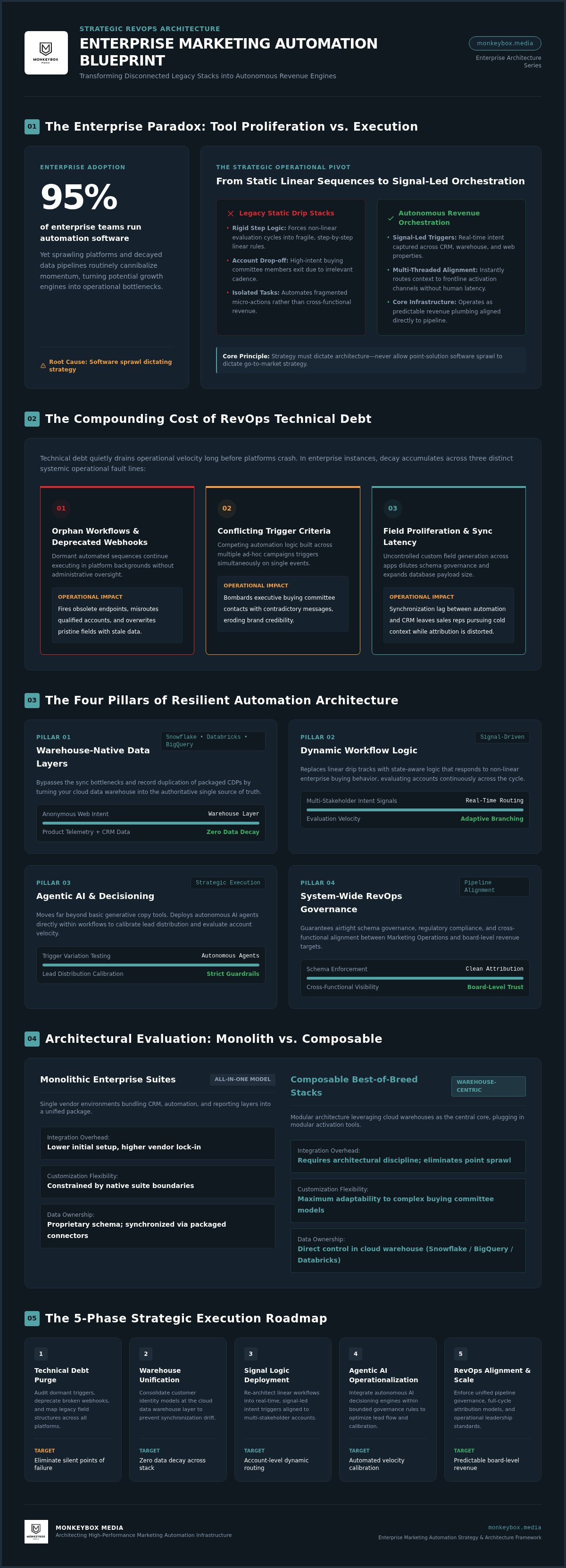
Most enterprise tech stacks aren't growth engines; they're operational bottlenecks. While 95% of enterprise teams run automation software, sprawling platforms and decayed data pipelines routinely cannibalize momentum. Strategy must dictate architecture, never software sprawl. If you're trying to execute an enterprise marketing automation strategy that scales pipeline velocity without breaking existing systems or bloating headcount, you've hit the defining operational hurdle of 2026.
You already know the frustration: disconnected tools, duplicate triggers, and mounting technical debt that isolates Marketing Ops from board-level revenue goals. Tacking on more point solutions won't fix structural fractures. You need an engine built to withstand scale.
This blueprint hands you the exact framework to architect, govern, and scale an enterprise marketing engine that turns complex pipelines into predictable revenue. We will break down how to establish a unified data foundation, operationalize autonomous AI agents within strict governance protocols, and build airtight RevOps alignment across every buyer touchpoint.
Key Takeaways
- Shift from disconnected point solutions to core revenue infrastructure to eliminate technical debt and bridge the gap to enterprise pipeline goals.
- Compare monolithic suites against composable architectures to determine which model maximizes customization while minimizing long-term integration overhead.
- Execute a 5-phase enterprise marketing automation strategy designed to purge legacy workflows and establish clean data foundations without disrupting live revenue operations.
- Operationalize autonomous AI agents across complex buying committees within ironclad regulatory and governance frameworks.
- Build resilient RevOps alignment and operational leadership to guarantee bulletproof pipeline attribution and cross-functional velocity.
Deconstructing Enterprise Marketing Automation: Why Legacy Stacks Fail in 2026
Most enterprise software architecture reflects organizational history rather than strategic intent. As platforms multiplied over the last decade, companies accumulated point solutions to address isolated tactical problems. While foundational marketing automation originally aimed to streamline scheduled emails and lead capture forms, modern enterprise scale demands an orchestrated ecosystem uniting unified data pipelines, dynamic logic, and predictive decision engines. Legacy setups fail precisely because they automate fragmented tasks instead of orchestrating cohesive revenue operations. Patching disconnected systems won't fix structural fractures. Execution requires a comprehensive enterprise marketing automation strategy built on architectural discipline.
The Shift from Static Workflows to Autonomous Revenue Orchestration
Linear drip sequences collapse under the weight of modern B2B buying dynamics. Enterprise accounts involve multi-stakeholder committees navigating non-linear evaluation cycles across digital and human touchpoints. When an enterprise attempts to force these multifaceted journeys into rigid, step-by-step logic, high-intent accounts drop off. Signal-led orchestration captures real-time intent events across your CRM, data warehouse, and web properties, instantly routing context directly to frontline activation channels. Autonomous enterprise marketing automation in 2026 is an intelligent operational system that dynamically aligns unified account intelligence with multi-threaded engagement to accelerate pipeline velocity without human latency.
The Compounding Cost of Marketing Operations Technical Debt
Technical debt quietly drains operational output long before systems crash. Over time, enterprise instances fill with silent failure points that distort pipeline visibility and erode team execution. These systemic breakdowns typically manifest across three operational fault lines:
- Orphan Workflows and Deprecated Webhooks: Dormant sequences continue running in the background, firing obsolete webhooks, misrouting leads, and overwriting critical fields with stale data.
- Conflicting Trigger Criteria: Competing automation logic causes multiple campaigns to fire simultaneously, bombarding executive buying committee members with redundant messaging.
- Field Proliferation and Sync Latency: Uncontrolled custom field creation dilutes schema governance, causing synchronization lags between the automation layer and CRM that stall outbound sales motions.
When contact records fragment across platforms, sales teams pursue outdated context while marketing reports inflated attribution. This operational drift directly compromises pipeline velocity. Reclaiming lost momentum requires treating your automation platform as mission-critical revenue infrastructure rather than an administrative messaging tool.
The Four Pillars of Modern Enterprise Marketing Automation Architecture
High-growth revenue engines do not run on fragmented marketing software. They operate on unified architecture. A resilient enterprise marketing automation strategy rests on four operational pillars: clean data ingestion, dynamic workflow logic, agentic intelligence, and system-wide governance. When these four layers synchronize, go-to-market teams transform unpredictable pipelines into scalable revenue operations.
Warehouse-Native Data Layers and Unified Customer Profiles
Packaged CDPs frequently duplicate records and introduce synchronization latency that ruins real-time targeting. Modern enterprises bypass these bottlenecks by adopting warehouse-native architectures running directly on Snowflake, Databricks, or BigQuery. This setup transforms your cloud data warehouse into the single source of truth. By resolving identity across anonymous web traffic, product telemetry, and CRM data at the warehouse layer, your frontline activation tools execute against unified account histories with zero data decay.
Agentic AI and Dynamic Decisioning Engines
Basic generative copy tools generate noise; agentic AI systems execute strategy. Modern automation deploys autonomous AI agents directly into revenue workflows to continuously evaluate account velocity, test trigger variations, and calibrate lead distribution. Scalability requires strict boundaries. Enterprise architectures must enforce deterministic guardrails and human-in-the-loop review thresholds. This balances algorithmic agility with regulatory compliance and brand protection.
Account-Based Experience (ABX) and Buying Group Mapping
Individual lead scoring is obsolete in enterprise sales cycles involving multi-member buying committees. Modern workflow logic aggregates cross-channel engagement signals across stakeholders within target accounts to build an accurate committee dossier:
- Intent Aggregation: Unifies research behavior across technical evaluators, procurement managers, and C-suite executives into a composite account score.
- Dynamic Surge Routing: Alerts sales representatives within minutes when account activity spikes, delivering complete engagement context directly into their workflow.
- Contextual Orchestration: Adjusts digital touchpoints based on pipeline stage, preventing conflicting messages from reaching active opportunities.
Executing this level of synchronization demands rigorous RevOps discipline. Partnering with a vetted fractional CMO agency gives revenue leaders the executive oversight required to align technical workflows with overarching pipeline targets. If your current stack suffers from legacy debt, partnering with dedicated marketing operations and automation experts ensures your architecture scales cleanly without derailing live deals.
Architectural Comparison: Monolithic Suites vs Composable Best-of-Breed Stacks
Every enterprise marketing automation strategy reaches an architectural fork in the road: double down on a monolithic all-in-one suite or engineer a composable best-of-breed ecosystem. Neither choice is inherently superior. The right decision hinges on your organizational maturity, available technical resources, and go-to-market complexity. Choosing incorrectly triggers years of technical friction, bloated licensing costs, and stalled pipeline velocity.
The Monolithic Enterprise Platform Dilemma
Monolithic suites bundle email engines, campaign management, landing pages, and lead scoring into a unified user interface under a single vendor contract. Setup friction is lower upfront. Procurement teams love the consolidated billing, and non-technical marketers navigate the shared interface easily. Growth exposes rigid boundaries. Monolithic platforms develop features slowly, gate critical capabilities behind expensive tier upgrades, and lock organizations into inflexible proprietary data schemas. When an enterprise attempts to implement custom attribution modeling or dynamic multi-stakeholder routing across long deal cycles, monolithic engines become operational bottlenecks.
The Composable Modern Marketing Stack
A composable stack treats software modularly. Instead of forcing your pipeline operations into a single vendor's closed ecosystem, this architecture decouples the primary functional layers: a centralized cloud data warehouse, reverse ETL synchronization pipelines, specialized automation engines, and best-in-class attribution tools. Agility is unmatched. Operational teams replace or upgrade individual components without tearing down the entire infrastructure. This architectural freedom introduces operational overhead. A composable system demands rigorous data engineering oversight and disciplined RevOps governance to avoid integration breakdowns.
Evaluate both operating models across three critical business dimensions before committing budget:
- Operational Velocity: Monoliths launch standard campaigns quickly out of the box. Composable stacks require upfront engineering setup but deliver vastly superior long-term campaign adaptability.
- Customization and Multi-Entity Support: Monolithic architectures struggle with complex account hierarchies and disparate regional business units. Composable models handle bespoke account modeling effortlessly.
- Total Cost of Ownership (TCO): Monolithic costs concentrate in rigid, escalating subscription fees. Composable stacks spread spend across infrastructure licensing, pipeline management tools, and specialized technical headcount.
If your B2B sales cycle involves straightforward buyer journeys and limited technical support, a monolithic platform maintains operational simplicity. When managing intricate buying committees across extended enterprise sales motions, composable architecture delivers the resilience required to outpace competitors.
How to Build and Execute Your Enterprise Automation Strategy in 5 Phases
Executing an enterprise marketing automation strategy without a phased operational roadmap risks breaking live pipelines and corrupting data integrity. You cannot swap out critical infrastructure in a single weekend. Systemic transformation demands phased milestones that safeguard deal velocity while methodically eliminating technical debt across five execution stages.
Phase 1 & 2: Infrastructure Audit, Data Cleansing, and Journey Architecture
Phase 1 starts with a comprehensive operational audit. Catalog every active automation, deprecated webhook, and unmapped custom field across your CRM and marketing engines. Deprecate redundant rules systematically. Phase 2 defines account lifecycle definitions and builds standardized data schemas to replace broken routing logic:
- Systemic Data Purge: Remove orphaned contact records, merge conflicting account hierarchies, and establish standardized field properties across every integrated application.
- Lifecycle Milestone Mapping: Define unambiguous criteria for each buying stage, from initial anonymous account identification through procurement and ongoing contract expansion.
- Operational Trigger Mapping: Link specific intent thresholds directly to operational CRM actions, guaranteeing every high-value signal prompts an immediate downstream response.
Phase 3 & 4: Logic Orchestration, Sales Alignment, and Controlled Rollout
Phase 3 establishes operational alignment across GTM functions. Define rigid Service Level Agreements (SLAs) between Marketing Operations and Sales. For example, mandate that buying group surge alerts require sales rep outreach within 30 minutes. Build automated notification tasks directly in the sales view. Phase 4 initiates a controlled deployment. Rather than rolling out global changes across every territory, launch the new architecture in a single business unit. Implement automated QA monitors to validate webhook payloads and verify lead routing accuracy under live operating conditions before scaling across the broader enterprise.
Phase 5: Agentic Workflow Deployment and Attribution Governance
Phase 5 operationalizes advanced machine intelligence directly inside validated workflows. Deploy autonomous AI agents to monitor buying committee velocity, calculate account engagement scores, and optimize outbound delivery timing. Pair these agents with multi-touch attribution models to track exact pipeline influence down to specific touchpoints. Establish monthly operational governance reviews to audit schema integrity and retrain decision models.
Executing this roadmap without specialized operational leadership leads to costly platform missteps and delayed pipeline gains. Consult with Monkeybox Media's GTM and marketing operations team to architect, govern, and execute an enterprise-grade automation engine that accelerates predictable revenue growth.
Scaling Operational Excellence: Governance, Team Design, and Strategic Leadership
Software cannot compensate for an absence of strategic command. Even the most sophisticated tooling degrades when handed to teams lacking operational governance and architectural discipline. An enterprise marketing automation strategy is only as effective as the leadership directing its execution. Translating complex pipelines into predictable enterprise revenue demands aligning specialized technical talent with executive-level business objectives.
Structuring an Agile Marketing Operations and Automation Team
Marketing operations can no longer operate as an ad-hoc help desk fulfilling random campaign tickets. High-velocity enterprises structure their operations around three specialized core functions:
- Systems Architecture and Integration: Governs core infrastructure, maintains warehouse-native synchronization pipelines, and audits API stability across the tech stack.
- Data Governance and Compliance: Enforces data cleanliness, oversees field schema standardization, and maintains strict regulatory compliance across jurisdictions.
- Workflow Engineering and Orchestration: Builds advanced account routing logic, deploys trigger criteria, and monitors automated buyer journeys.
High-growth organizations centralize architectural standards while decentralizing day-to-day campaign deployment to regional business units. This model maintains systemic integrity while preserving tactical speed. Managing autonomous AI agents alongside legacy platforms requires operations professionals skilled in prompt validation, decision thresholds, and dynamic scoring logic.
Accelerating Enterprise Scale with Monkeybox Media
Assembling a full in-house operational team takes quarters of costly recruiting. Monkeybox Media solves this bottleneck immediately. Providing fractional CMO guidance, dedicated marketing operations consulting, and production-ready AI agents, Monkeybox Media bridges the gap between high-level GTM strategy and frontline technical execution.
Strategic fractional leadership audits bloated systems, purges technical debt, and aligns your automation engine directly with RevOps pipeline milestones. You gain the strategic clarity of an executive revenue leader paired with hands-on systems expertise, bypassing common platform implementation failures.
Tired of wrestling with fractured systems and stalled deal velocity? Take command of your revenue infrastructure. Re-engineer your enterprise marketing automation strategy with Monkeybox Media to unlock ruthless operational efficiency and scale predictable enterprise pipeline.
Turn Architectural Discipline into Predictable Revenue
Enterprise growth doesn't happen by stacking disjointed software onto decaying data foundations. Scaling a complex pipeline demands an enterprise marketing automation strategy engineered around unified warehouse data, dynamic account-level orchestration, and autonomous AI agents governed by strict RevOps alignment. When your underlying architecture supports multi-stakeholder buying groups rather than isolated leads, operational friction vanishes and revenue velocity accelerates across every touchpoint.
Executing this transformation requires seasoned strategic vision. Backed by a national track record of building high-performance B2B revenue infrastructure, Monkeybox Media provides the fractional CMO leadership, marketing operations architecture, and AI workflow integration necessary to eliminate technical debt permanently. Stop letting fragmented systems dictate your growth ceiling. Partner with Monkeybox Media to engineer your enterprise marketing automation engine and turn complex buyer journeys into your strongest competitive advantage.
Frequently Asked Questions
What is the primary difference between standard and enterprise marketing automation?
Standard marketing automation focuses on linear lead capture and basic drip campaigns for individual prospects. Enterprise systems orchestrate multi-stakeholder journeys across complex buying committees and multi-entity business units. An enterprise marketing automation strategy requires warehouse-level data synchronization, custom governance protocols, and bi-directional CRM integration to handle intricate pipeline stages. It treats automation as foundational revenue infrastructure rather than an isolated campaign messaging tool.
How do AI agents integrate into an existing enterprise marketing automation strategy?
AI agents connect directly via APIs to act as dynamic decision engines rather than static workflow builders. Instead of relying solely on predetermined branching rules, agents analyze account telemetry, evaluate engagement velocity across buying groups, and trigger tailored interventions in real time. They operate within deterministic guardrails and strict governance boundaries, allowing revenue operations teams to accelerate pipeline progression without sacrificing systemic brand control.
Can an enterprise marketing automation overhaul be completed without disrupting active campaigns?
Yes, structured execution protects active pipeline momentum. A successful overhaul implements a parallel-run architecture, maintaining legacy triggers while systematically auditing fields, deprecating orphan workflows, and building modern schemas in a staging environment. Migrations then roll out in controlled cohorts across specific business units or customer tiers. This phased approach validates webhook integrity and data synchronization under live operating conditions before full decommissioning.
What happens if our marketing data remains siloed across disparate platforms?
Data silos generate operational drift that directly damages pipeline conversion. When product usage, digital engagement, and CRM records live in isolation, automation triggers misfire and attribution models collapse. Sales representatives pursue stale leads with outdated context while high-intent enterprise accounts receive conflicting, duplicate messaging. This lack of architectural cohesion creates severe technical debt, increases customer acquisition costs, and blinds revenue leadership to actual pipeline health.
How much internal technical support is required to maintain a composable automation stack?
Maintaining a composable stack requires dedicated technical capabilities, specifically around data warehouse modeling, reverse ETL configuration, and API management. Organizations without in-house systems architects often partner with specialized marketing operations consultants or fractional revenue leaders. This hybrid model maintains high-velocity custom workflows and reliable data pipelines without saddling the organization with full-time engineering overhead during the architectural buildout.
Is warehouse-native marketing automation better than an integrated CDP?
Warehouse-native platforms solve the sync lag and data duplication inherent to packaged CDPs. By running directly on your central cloud warehouse, they query the single source of truth without requiring proprietary data copies. Packaged CDPs still provide faster turnkey deployment for marketing teams lacking technical resources, but warehouse-native architectures offer superior customization, lower total cost of ownership, and zero data decay for multi-entity enterprises.
How does an enterprise marketing automation strategy improve sales and marketing alignment?
It enforces objective pipeline mechanics that bridge the gap between marketing initiatives and closed revenue. By tracking aggregated account activity across buying committees, the system triggers actionable alerts directly in sales reps' daily interfaces when key accounts surge. Clear operational SLAs ensure sales prioritizes marketing-surged accounts within defined windows, transforming disjointed cross-departmental operations into a unified RevOps engine focused entirely on pipeline velocity.