
Replacing your marketing stack can give technical debt a fresh interface without fixing the cause. Fixing B2B marketing technical debt starts with how work gets done: disconnected platforms, fragile integrations and manual steps can undermine campaign delivery and make performance harder to trust. The challenge is to resolve those faults without disrupting revenue-generating campaigns or reporting.
That concern is justified. A rushed migration can carry old problems into new systems, while unclear ownership allows recurring process failures to persist. The better approach is to make targeted changes around live work, not rebuild for the sake of change. This playbook shows you how to identify the systems and workflows creating the most operational drag, then prioritise fixes by business impact, risk and effort.
You’ll learn how to diagnose data and process issues, assign clear ownership and sequence remediation to improve execution and measurement with less disruption. You’ll also see how GTM priorities should guide the work, why marketing operations connects diagnosis to repeatable delivery, and where automation or AI agents can help once the underlying data and processes are sound. Fix the operating model first. Then make the technology support it.
Key Takeaways
- Distinguish accumulated technical debt from routine maintenance and deliberate short-term workarounds.
- Trace how local fixes in CRM, automation and analytics can affect lead routing and reporting elsewhere.
- Choose between targeted repair, process redesign, consolidation and migration based on the problem each approach can solve.
- Make fixing B2B marketing technical debt manageable by ranking issues against revenue relevance, operational risk, recurrence and effort.
- Use documented definitions, named owners and regular reviews to keep system changes aligned with GTM priorities.
What B2B marketing technical debt looks like in day-to-day operations
B2B marketing technical debt is the accumulated impact of system, data and process compromises that make future work slower, less reliable or riskier. It often starts with a quick fix: a manually updated field, a one-off integration or a campaign workflow built to meet an urgent deadline. That compromise may solve an immediate problem. When it becomes part of normal operations, it can add work every time a campaign launches, a lead moves through the funnel or a report is prepared.
The idea builds on the broader concept of technical debt, explored in What is technical debt?, but marketing debt extends beyond technology. A scheduled platform update is ordinary maintenance. A temporary spreadsheet workaround is not automatically debt if it has an owner, a clear purpose and an end point. A deliberate trade-off can also be sensible when the team understands and accepts its limits. Debt accumulates when compromises go undocumented, persist without review or make essential work increasingly dependent on fragile steps.
In practice, the symptoms are operational. Two teams may keep separate campaign lists because their systems don’t share consistent records. A connector may pass some lead fields but fail when a lifecycle stage changes, leaving someone to correct records by hand. Reports can disagree because teams use different definitions for a qualified lead or campaign influence. Even a small campaign change may take days if nobody knows which automation, field or integration depends on it. The drag compounds.
How marketing technical debt differs from a technology backlog
A backlog records work that someone might complete; debt increases the effort or risk attached to future work. A missing dashboard enhancement may be deferred without damaging current reporting. By contrast, a faulty field mapping that assigns leads to the wrong segment is a live defect. Imagine a new enquiry form that requires staff to copy details into the CRM. If that handoff becomes the standard route, every campaign depends on manual entry, making errors and delays part of the process. For organisations looking to ensure front-end touchpoints and lead-capture channels are engineered cleanly from day one, learn more about PurpleCow Digital to explore their strategic website design and development services.
The warning signs B2B teams should recognise
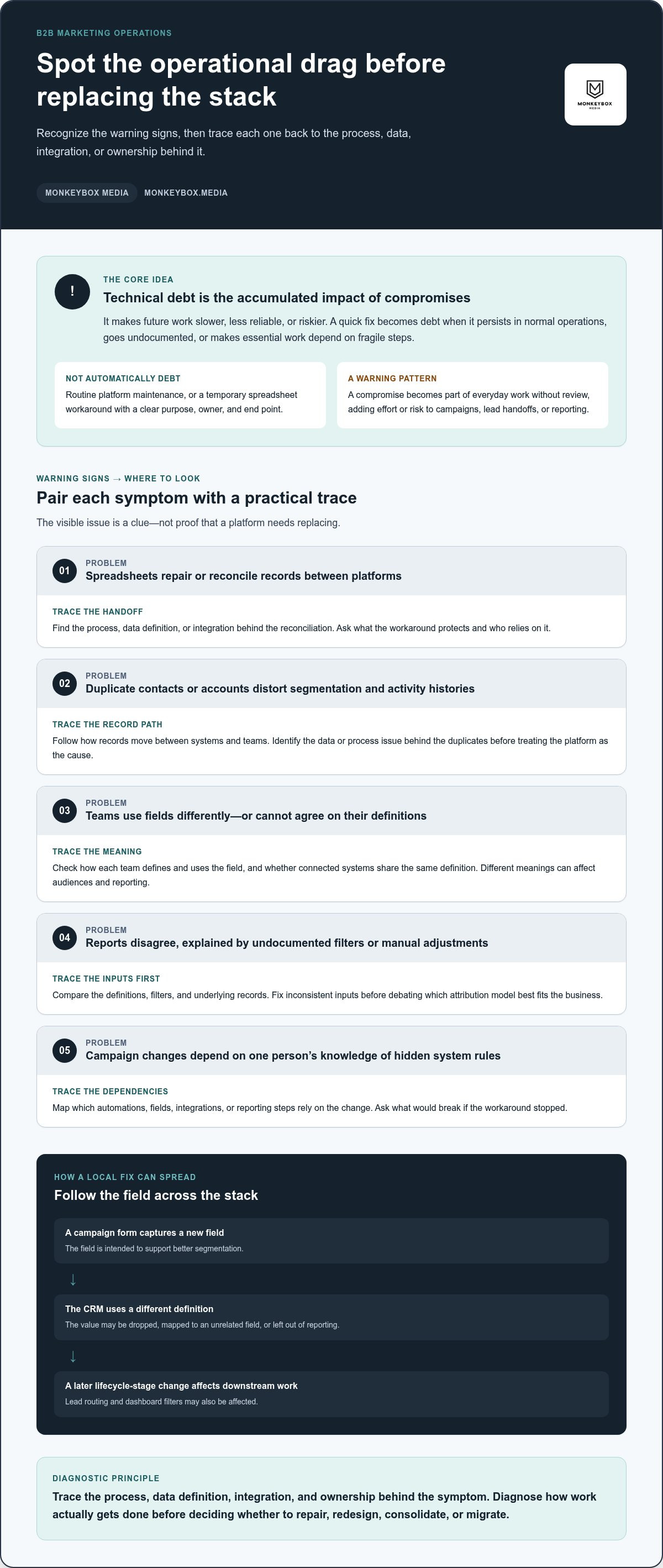
Look for repeated workarounds and inconsistencies, not just old software. Common signals include:
- Spreadsheets used to repair or reconcile records between platforms.
- Duplicate contacts or accounts that distort segmentation and activity histories.
- Fields with unclear definitions, or different teams using the same field in different ways.
- Reporting discrepancies that staff explain through undocumented filters or manual adjustments.
- Campaign changes that rely on one person’s knowledge of hidden system rules.
These clues point to where to investigate: the process, data definitions, integration or ownership behind the symptom. They don’t prove that a platform needs replacing. Trace what the workaround protects, who relies on it and what would break if it stopped. That diagnosis gives fixing B2B marketing technical debt a practical starting point, grounded in how work actually gets done.
Where B2B marketing technical debt accumulates across the stack
Technical debt rarely sits neatly inside one platform. It builds at the joins between systems, data and teams. A CRM may hold the customer record, marketing automation may manage campaign engagement, analytics may report performance, and sales may rely on a separate follow-up process. If definitions and handoffs between them don’t align, a local fix can create problems elsewhere.
Consider a campaign form that captures a new field for better segmentation. If the CRM doesn’t use the same definition, the value may be dropped, mapped to an unrelated field or left out of reporting. A later change to lifecycle stages can then affect lead routing and dashboard filters. Undocumented dependencies make marketing execution slower and less reliable because teams can’t see which downstream processes a change may disrupt. The cross-functional patterns behind this are also explored in How marketing teams generate technical debt.
Data and measurement debt across CRM and analytics
CRM and analytics debt often starts with competing definitions. Marketing may treat a lead as qualified at one point in the journey, while sales uses a different threshold. Duplicate fields with similar names can store overlapping information, and teams may disagree about which platform is the source of truth. The result is more than untidy data: it can change which audience receives a campaign and how pipeline is interpreted.
Measurement depends on the same foundations. Without shared UTM conventions, campaign traffic may appear under inconsistent source or medium values. If reporting credits a particular touchpoint with influence but the underlying records are incomplete, the output can look precise while telling a misleading story. That’s a data-quality problem, separate from the strategic question of which attribution model best fits the business. Fix the inputs and definitions before debating the model.
Integration and workflow debt between GTM teams
Follow a campaign from capture to action: a prospect submits a form, the record enters the CRM, a sales owner receives it, follow-up happens, and activity flows into reporting. Dependencies can form at every handoff. An undocumented API may pass only some fields; a manual export may be the only way to reconcile records; an unclear owner may leave errors unresolved. A small change to a form or lifecycle rule can then affect sales follow-up and campaign measurement at the same time.
- CRM records: conflicting fields, lifecycle stages or source-of-truth rules.
- Marketing automation: dependencies between campaign workflows and shared data.
- Analytics and integrations: inconsistent tracking, incomplete data transfers and reporting assumptions.
- Campaign workflows: handoffs that depend on manual checks or undocumented team knowledge.
Map the flow, not just the tools. A marketing operations review can connect system changes to GTM workflows. Monkeybox Media’s marketing operations support helps teams assess dependencies and align improvements with execution priorities.
Why replacing the marketing stack rarely fixes technical debt by itself
New software can provide better capabilities, but it won’t automatically repair inconsistent data, unclear ownership or an undefined process. If teams migrate the same field rules, manual workarounds and reporting assumptions into a new platform, the debt moves with them. Fixing B2B marketing technical debt means identifying the root cause first, then choosing the smallest change that resolves it without creating greater operational risk.
There are four broad options. They’re not mutually exclusive: a team might redesign a workflow before consolidating tools, for example. Compare each option against the problem, the change impact and who will own the result.
| Approach | Root cause it addresses | Disruption and dependencies | Ongoing ownership |
|---|---|---|---|
| Targeted repair | A defect or drifted configuration in a platform that still meets requirements. | Usually contained, but connected fields, reports or workflows still need impact checks. | An owner maintains the corrected configuration and monitors the affected process. |
| Process redesign | Unclear, duplicated or unnecessarily complex ways of working. | Can change team handoffs even if the technology stays the same. | Teams agree definitions, responsibilities and the approved process. |
| Consolidation | Overlapping tools or fragmented responsibilities across the stack. | Requires dependency mapping and a plan for functions or data that will move. | Named owners govern the remaining platforms and their shared processes. |
| Migration | Documented requirements the current platform cannot meet. | Broadest transition scope, including data, integrations, workflows, reporting and user adoption. | Accountability covers the new platform and the transition of connected operations. |
When targeted remediation is the stronger first move
Start with a repair when the core platform supports the business requirement but its configuration or governance has drifted. For example, if a lead-routing rule fails because a field uses inconsistent values, correct the definition and mapping before replacing the CRM. Test the diagnosis on a contained workflow or data issue, then check downstream effects. Document dependencies first: a field may also feed a campaign segment, sales queue or management report.
When consolidation or migration deserves consideration
Consider a wider change when the current setup has a persistent capability gap, relies on unsupported dependencies or conflicts with essential operating requirements. Build the case around documented needs, not frustration with an awkward interface. Compare the full transition scope, including data mapping, integration changes, workflow redesign, reporting continuity and ownership, with the risks of maintaining the existing setup. Replacement is appropriate when requirements exceed the platform’s capabilities, but it still needs a business case.
A disciplined review keeps the decision grounded: define the required outcome, identify the root cause, map affected processes and compare the available interventions. When designing or rearchitecting setups, teams often consult agencies like The Palm Group to build digital communication systems optimized for business revenue. Marketing operations connects that analysis to practical stack optimisation, while GTM priorities determine which constraints matter most. Choose the intervention that resolves the cause and leaves a clear owner behind. Don’t rebuild by default.
How to prioritise and fix B2B marketing technical debt
A useful remediation plan turns scattered complaints into a controlled sequence of decisions. Start with the work people do, not a list of tools to replace. Connect each issue to its cause, business consequence and dependencies. This makes fixing B2B marketing technical debt a prioritisation exercise, not a race to clear every backlog item.
- Inventory: Capture recurring failures, manual steps, data defects and reporting gaps across key marketing workflows.
- Trace dependencies: Map which systems, teams, fields and reports rely on the affected process.
- Assess impact: Establish what the issue disrupts, such as lead follow-up, campaign delivery or confidence in performance data.
- Prioritise: Compare revenue relevance, operational risk, recurrence and implementation effort.
- Remediate: Assign an accountable owner, define the change and plan testing around live work.
- Monitor: Check whether the change reduces manual effort, errors, delays or uncertainty, and watch for new side effects.
Fix issues first when they combine strong business impact, high risk and frequent recurrence, while accounting for the effort and dependencies involved. Use qualitative ratings such as high, medium or low rather than false precision. An issue that repeatedly delays a revenue-critical handoff may outrank a more visible but low-impact reporting enhancement. Separate urgent controls, such as containing a faulty routing rule, from broader improvements that can be planned and tested on the roadmap.
Build a debt register with business context
For each issue, record the affected process and systems, accountable owner, observed symptoms, known dependencies and business consequence. Mark verified details separately from assumptions that still need investigation. Group symptoms that may share a root cause, such as several reports using different definitions for one lifecycle stage. This keeps the register focused on causes, not an endless list of disconnected fixes.
A concise entry might state that lead records arrive without a campaign source, identify the form and CRM fields involved, and name the reporting process affected. If the cause is uncertain, say so. Separating evidence from hypothesis helps the team choose the next diagnostic step instead of treating a guess as a requirement.
Sequence changes without disrupting active GTM work
Before implementation, agree who owns the change across marketing, sales, operations and technical stakeholders. Set the scope, test the affected journey, document rollback needs and schedule work around campaign commitments. For changes to shared data or routing, validate representative records and confirm downstream reporting before a wider release. After launch, track the original symptom and review whether the fix created new work elsewhere.
Strong marketing operations connect diagnosis to controlled implementation, while GTM priorities determine which fixes move first. Work with Monkeybox Media on marketing operations to structure system optimisation and remediation planning.
Build a B2B marketing operating model that keeps technical debt from returning
Remediation holds when teams change how they make and govern marketing decisions, not just the systems themselves. Without shared definitions, accountable owners and a clear route for approving changes, workarounds can quietly return. A field gets repurposed, an integration changes without downstream review, or a team recreates a manual fix because nobody knows the agreed process. The operating model should make the reliable route easier to follow than the workaround.
Set ownership and governance for marketing systems
Assign decision rights for core data definitions, integrations, access and workflow changes. Keep documentation lightweight but useful: record what a process does, which systems depend on it, who owns it and where to escalate a failure. Review recurring exceptions for root causes rather than treating repeated manual corrections as normal work. Clear governance gives teams a route to resolve issues before they become embedded.
- Definitions: Agree what key fields and lifecycle stages mean, and who can approve changes.
- Dependencies: Maintain a current view of connected systems and critical workflow logic.
- Change control: Record the reason, owner and affected processes for material changes.
- Exceptions: Review repeat workarounds and decide whether to fix, document or retire them.
Use quarterly system reviews to test whether the stack still supports current GTM priorities. Don’t make the review a tool-by-tool maintenance exercise. Start with the operating plan: which segments, routes to market and campaign motions matter now? Then assess whether the data, systems and handoffs support them. A change in sales coverage, for example, may make an old routing rule less useful even if the technology still works as configured.
Connect remediation to strategic marketing leadership
GTM priorities determine which technical constraints matter most to business performance. Executive marketing leadership can set direction and trade-offs; marketing operations can translate those priorities into system changes, clear ownership and repeatable execution. For more context on the leadership role, explore this fractional CMO agency guide.
That connection keeps fixing B2B marketing technical debt tied to business outcomes rather than isolated platform tasks. A fractional CMO can help establish the strategic sequence, while marketing operations connects diagnosis to implementation and ongoing governance. Review changes against agreed measures such as fewer manual corrections, clearer reporting or more dependable handoffs. Introduce automation or AI agents only when the underlying process and data are sound; otherwise, new capability can reinforce the same weak foundations.
If recurring system issues are slowing execution, work with Monkeybox Media on a focused marketing technical debt remediation roadmap. Align the work to your GTM priorities, define accountable owners and build a practical path from diagnosis to sustainable operations.
Turn the next marketing change into a stronger foundation
The next campaign, system update or change to your GTM plan is an opportunity to improve how marketing work gets delivered. Before it begins, agree what success requires, who owns the decision and how you’ll know the change is working. That discipline helps prevent quick fixes from becoming permanent dependencies.
Fixing B2B marketing technical debt is not a one-off clean-up. It’s an operating capability: strategic leadership sets priorities, marketing operations translates them into practical improvements, and AI agents can support suitable workflows once data and processes are ready. The result is a more deliberate way to adapt without letting avoidable complexity dictate the pace of execution.
If you’re ready to move from recurring workarounds to a prioritised plan, work with Monkeybox Media to build a focused plan for fixing your B2B marketing technical debt. Start with the constraint that matters most, then create momentum from there.
Frequently Asked Questions
What is technical debt in B2B marketing?
Technical debt in B2B marketing is the future effort or risk created by accumulated shortcuts in systems, data or processes. For example, a team might keep an old campaign field because changing it could affect existing reports. The debt becomes harder to manage as more activity depends on that field. It’s distinct from routine upkeep: the key question is whether a past compromise makes future marketing work less reliable or more difficult.
How do you identify technical debt in a marketing technology stack?
Look for repeated exceptions that teams have to explain or repair. Compare a sample of campaign records from form submission through CRM entry and reporting. Note where values disappear, require manual correction or mean different things to different teams. Ask staff to document any step that only works because someone remembers a hidden rule. These checks help distinguish an isolated error from a recurring dependency worth investigating.
How should a B2B marketing team prioritise technical debt?
Prioritise issues by the business process they affect, how often they recur, the risk of leaving them unresolved and the effort needed to address them. For example, an issue that delays follow-up for an active campaign may take precedence over a dashboard enhancement that can wait. Record assumptions separately from verified causes, then choose an owner and review date for each planned fix. This keeps fixing B2B marketing technical debt focused on actionable work.
Does marketing technical debt always mean you need to replace your platform?
No. A platform may still meet requirements even if its configuration, data conventions or workflows need repair. Test a targeted change first when the suspected cause is contained, such as a field mapping affecting one campaign journey. A replacement becomes worth evaluating when documented business requirements exceed the current platform’s capabilities. Include connected processes, data and reporting in that assessment, not just the software’s features.
How can marketing technical debt affect lead management and reporting?
It can cause lead details to be lost, misclassified or delayed as they move between marketing and sales. For instance, inconsistent lifecycle values may put similar prospects into different follow-up queues. Reporting can also misstate campaign contribution if source data is incomplete or teams apply different definitions. Check a small set of records across the full journey, then compare system output with what teams actually did.
Who should own B2B marketing technical debt remediation?
One accountable lead should coordinate remediation, while ownership of individual changes sits with the people responsible for the affected process or system. Marketing, sales, operations and technical stakeholders may all need decision rights for different parts. A fractional CMO can connect remediation choices to marketing and GTM priorities; marketing operations can coordinate stack optimisation and implementation. Make escalation routes clear so recurring issues don’t remain between teams.
Can AI fix marketing technical debt?
AI can support suitable workflows, but it can’t decide which data definition the business should use or resolve unclear process ownership by itself. Automating a poorly designed handoff may simply make the same problem happen faster. First establish accurate inputs, a defined process and an accountable owner. Then assess whether an AI agent can support a specific workflow, with a way to review its output and respond when it fails.