
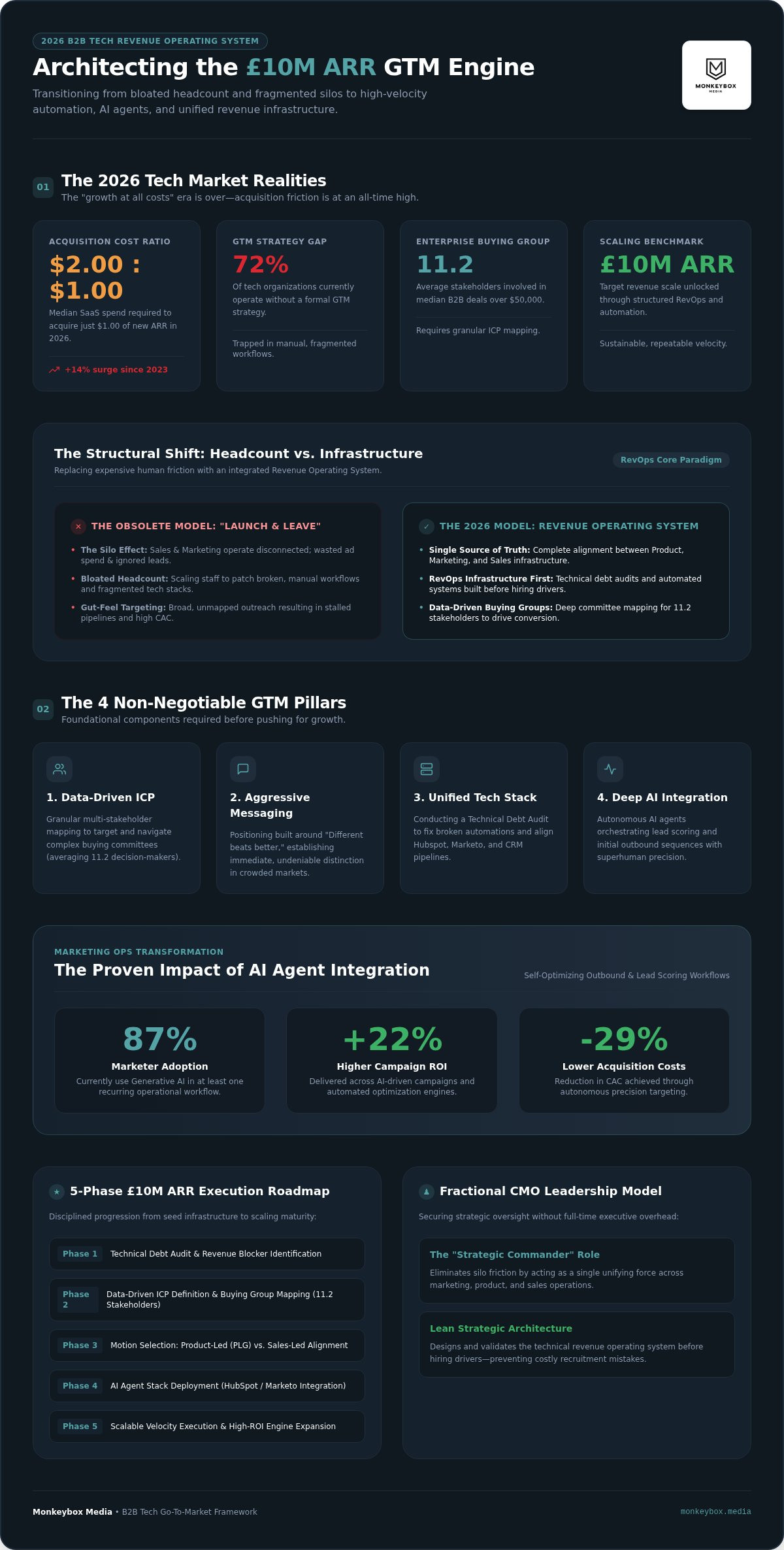
In 2026, the median SaaS company spends $2.00 to acquire just $1.00 of new annual recurring revenue. This 14% surge in acquisition costs since 2023 is a silent killer for scaling firms. If your pipeline is stalling despite high activity, you aren't alone; 72% of organizations are still operating without a formal GTM strategy for tech companies. Most are buried under fragmented marketing stacks and inefficient, manual workflows that drain resources. You know the "growth at all costs" era is over. Now, it's about efficient, high-velocity execution.
This guide promises to hand you the framework required to build, launch, and scale a B2B tech revenue engine in the 2026 landscape. We'll move beyond theory to master the mechanics of repeatable growth. You'll learn how to achieve total alignment between product and sales while leveraging AI agents to slash operational friction. We're breaking down the shift from bloated headcounts to lean, fractional leadership models that drive £10M ARR. It's time to stop guessing and start architecting. Let's build your revenue engine.
Key Takeaways
- Transition from a "launch-and-leave" mindset to a robust revenue operating system that aligns product, marketing, and sales into one high-velocity machine.
- Deploy a modern GTM strategy for tech companies by integrating AI agents and data-driven ICPs to slash acquisition costs and eliminate manual friction.
- Identify the optimal growth motion for your business by analyzing the strategic trade-offs between Product-Led and Sales-Led models.
- Execute a disciplined, 5-phase roadmap designed to audit technical debt and build a scalable automation infrastructure for reaching £10M ARR.
- Leverage the Fractional CMO model to secure elite strategic leadership and oversee complex execution without the overhead of a full-time executive hire.
Beyond the Launch: Why Tech GTM Strategy Requires a Revenue Operating System
In the 2026 tech economy, a launch isn't a victory; it's a starting gun. Most firms treat their go-to-market strategy as a static document, a relic of a "launch-and-leave" mindset that fails the moment it hits market friction. This approach is obsolete. A true GTM strategy for tech companies is a living revenue operating system. It demands total alignment between your product, marketing, and sales infrastructures. When these systems don't talk, growth stalls. You can't afford to treat GTM as a project with an end date. It's the core architecture of your business.
Tactical marketing focuses on top-of-funnel noise. Strategic revenue operations focus on the entire lifecycle. GTM is a continuous feedback loop between market signals and technical execution.
The High Cost of GTM Fragmentation
Fragmentation is the silent killer of scale. When sales and marketing operate in silos, the result is a disjointed customer experience and a bloated CAC. Sales teams ignore marketing leads because they lack context. Marketing teams optimize for volume while sales starves for quality. This friction creates the "silo effect," where disconnected systems lead to massive wasted ad spend and stalled pipelines. Fragmentation is the primary enemy of any GTM strategy for tech companies. You need a "Strategic Commander" to unify these fronts. Without centralized oversight, your GTM isn't a strategy; it's a collection of expensive accidents. Efficiency requires a single source of truth across the entire organization.
The 2026 Shift: From Headcount to Infrastructure
Throwing bodies at a broken process doesn't scale. In 2026, scaling headcount is no longer the primary lever for growth. Modern tech companies win through Revenue Operations (RevOps). This function treats the revenue process as a technical stack to be optimized, not a human problem to be managed. It's about building the infrastructure first. By prioritizing automation and system integrity over recruitment, you create a repeatable engine. This shift requires high-level strategic leadership to design the roadmap before you hire the drivers. Fixing technical debt in your automation systems is the first step toward maturity. The goal is a lean, high-velocity machine that performs regardless of who is in the seat. Strategic execution beats raw manpower every time.
The 2026 Tech GTM Framework: Integrating AI Agents and Marketing Ops
A winning GTM strategy for tech companies in 2026 rests on four non-negotiable pillars: a data-driven Ideal Customer Profile (ICP), aggressive messaging, a unified technical stack, and deep AI integration. Before you push for growth, you must conduct a Technical Debt Audit. Scaling on top of broken automation or fragmented data is a recipe for expensive failure. You can't build a skyscraper on a swamp. This audit identifies the revenue blockers that stall pipelines, ensuring your infrastructure is ready for high-velocity execution. For a deeper dive into these foundational elements, consult our 2026 B2B Go-To-Market Strategy Guide.
Your ICP cannot be based on gut feel. In 2026, the median B2B buying group for deals over $50,000 averages 11.2 stakeholders. You need granular data to map these complex committees. This precision allows you to allocate resources where they actually convert, rather than spraying and praying across a vague market segment. A precise GTM strategy for tech companies demands that you know exactly who is in the room before you even send the first email.
Building the AI-Powered Marketing Stack
AI is no longer a luxury; it's a core component of Marketing Ops. Currently, 87% of marketers use Generative AI in at least one recurring workflow. AI agents now handle lead scoring and initial outbound sequences with superhuman precision, freeing your team for high-level strategy. When you integrate these agents into platforms like HubSpot or Marketo, you create a self-optimizing engine. Research shows that AI-driven campaigns can deliver a 22% higher ROI and 29% lower acquisition costs. This isn't just about speed; it's about structural integrity. If you're looking to optimize your engine, consider how a strategic audit of your marketing automation can eliminate friction and technical debt.
Positioning and Messaging for Market Dominance
In a crowded market, "better" is a weak argument. "Different" is a strategy. Your messaging must cut through the noise by addressing the specific technical robustness of your product. Buyers consume an average of 13.4 pieces of content before contacting sales, and 67% of that journey is self-directed. Engineering conversions requires meticulous customer journey mapping. Every touchpoint must reinforce your unique value proposition. Your positioning shouldn't just describe what you do; it should dictate how you win. It must reflect a deep understanding of the buyer's technical environment and their specific pain points. Precise messaging converts; generic fluff dies.
Choosing Your Motion: Product-Led Growth vs. Enterprise Sales-Led
Selecting a sales motion isn't a preference; it's a cold financial calculation. In 2026, a GTM strategy for tech companies succeeds or fails based on the alignment between product friction and Annual Contract Value (ACV). Product-Led Growth (PLG) thrives where the software sells itself through low-friction, self-serve onboarding. Conversely, Sales-Led Growth (SLG) remains the dominant choice for complex, high-ACV enterprise deals where stakeholders demand high-touch validation. The 2026 standard for firms scaling toward £10M ARR is the Hybrid Motion. This framework uses PLG to capture the mid-market while deploying SLG to hunt whales. It creates a diversified revenue stream that balances volume with high-margin contracts.
The data dictates the strategy. Self-serve models in 2026 carry a median CAC of $187, while sales-assisted deals jump to $412. For enterprise deals exceeding $100,000 ACV, the cost of acquisition can skyrocket between $5,000 and $250,000. You must choose the motion that your margins can actually sustain. Don't build a high-touch sales team for a low-margin product. Your sales cycle length should dictate your resource allocation. Long cycles require deep pockets and a robust SLG engine. Short cycles demand a frictionless PLG machine.
When to Deploy a Product-Led Motion
PLG is about speed and viral loops. It requires a product that delivers immediate value without a human gatekeeper. Marketing automation serves as the backbone of this motion, nurturing freemium users through automated triggers and AI-driven nudges. You aren't managing people here; you're managing a system. Success is measured by Time-to-Value (TTV) and the generation of Product Qualified Leads (PQLs). If your users don't reach their "aha moment" within the first session, your PLG engine is broken. Efficiency is the only metric that matters.
The Enterprise Sales-Led Playbook
Enterprise deals are a different beast entirely. With the median buying group now at 11.2 stakeholders for deals over $50,000, you need a coordinated Account-Based Marketing (ABM) strategy. This isn't about volume; it's about precision. Your Sales Development Reps (SDRs) must be perfectly aligned with your Marketing Ops to ensure a seamless transition from lead to opportunity. Brand authority and executive-level positioning are your primary levers. In this high-stakes environment, your GTM strategy for tech companies must project the image of a seasoned partner. You're selling a strategic transformation, not just a tool.
The 5-Phase Execution Roadmap: Scaling from Seed to £10M ARR
Scaling isn't a linear climb. It's a series of controlled explosions. Most tech firms fail because they attempt to scale before they have validated their foundation, leading to a catastrophic collapse of the revenue engine. Your GTM strategy for tech companies must evolve through five distinct phases to reach the £10M ARR milestone. This roadmap replaces generic 12-week plans with specific scaling milestones that prioritize structural integrity over superficial growth. You don't just launch; you execute a sequence of technical and strategic maneuvers designed for maximum velocity.
Phase 1-2: Setting the Foundation
Phase 1 begins with a Diagnostic and Technical Debt Audit. You cannot build a high-performance engine on a fractured chassis. This phase identifies the revenue blockers, such as misaligned CRM data or broken lead-routing logic, that bleed capital. Once identified, Phase 2 focuses on the Infrastructure Build. Here, you deploy your automation stack and AI agents to handle the heavy lifting of lead scoring and outbound orchestration. Consolidating your stack is critical. Every redundant tool is a friction point. For a detailed breakdown of this preparatory phase, see our guide on High Growth GTM Planning: The 2026 Strategic Roadmap to £10M ARR. If you're ready to identify your own blockers, you should audit your revenue engine before the next push.
Phase 3-5: Scaling for Velocity
Phase 3 is Market Entry and Messaging Validation. You are testing your thesis against real-world friction. Use market signals to pivot your messaging in real-time. Don't fall in love with your first draft; fall in love with what converts. Once the message resonates, move to Phase 4: Demand Generation Ramp. This is where you scale your outbound and inbound engines simultaneously. You aren't just looking for MQLs anymore. You're looking for pipeline velocity. High-velocity execution requires a "Strategic Commander" to oversee the transition from Phase 3 to Phase 5. Fractional leadership provides this oversight without the bloat of a full-time executive hire.
Phase 5 is Operational Optimization. This is the final refinement for long-term scalability. You are no longer building; you are tuning. Success in this phase is measured by ARR growth and the efficiency of your unit economics. By the time you hit Phase 5, your GTM strategy for tech companies should be a repeatable, self-optimizing machine. You've moved beyond the "growth at all costs" mindset and into the realm of elite, predictable performance. The roadmap is clear. Now, execute.
Fractional CMO Leadership: Executing GTM Without the Full-Time Overhead
Founder-led growth has a hard ceiling. To break through the £1M ARR barrier, you must transition from a product-first mentality to a market-dominant operation. This shift requires a "Strategic Commander" who can oversee the high-velocity execution of your revenue engine. For companies in the £1M to £10M ARR scale-up phase, hiring a full-time, C-suite executive is often a premature financial burden. The Fractional CMO model provides the elite strategic authority you need without the bloated overhead of a traditional hire. You get a seasoned expert to design the roadmap while your team focuses on the mechanics of delivery. Efficiency is the only priority.
The ROI of a fractional leader in this bracket is undeniable. Instead of committing to a massive salary and equity package, you invest in targeted strategic oversight. This model allows you to deploy capital into your demand generation ramp and technical infrastructure rather than executive compensation. A fractional CMO ensures your GTM strategy for tech companies remains agile, data-driven, and focused on pipeline velocity. For a comprehensive look at how this model transforms B2B revenue, consult The Fractional CMO Agency Guide 2026: Scaling B2B Revenue with Strategic Authority. Strategic leadership is the lever that moves the world.
Strategic Authority vs. Tactical Execution
Founders are often the best at building products but the worst at building markets. Delegation is not a sign of weakness; it is a tactical necessity. A fractional CMO acts as the "Bold Architect," designing a system where every marketing dollar is tied to a measurable revenue outcome. At Monkeybox Media, we bridge the gap between high-level vision and granular marketing operations. We don't just provide advice; we integrate AI agents and advanced automation into your existing workflows. This ensures that your GTM strategy for tech companies is backed by a robust, technical foundation. We build the engine so you can drive the growth.
The Roadmap to £10M ARR
The journey from a technical product to market dominance is a sequence of calculated moves. You have seen how a revenue operating system replaces static launch plans and how AI agents slash acquisition costs. You understand the choice between PLG and SLG motions and the 5-phase roadmap required for scale. Now, you must decide if your current infrastructure can handle the pressure of the 2026 landscape. Don't wait for the engine to fail. You should audit your infrastructure before your next big push. Secure your future by choosing to book a GTM diagnostic session today. The roadmap is built. The machine is ready. It is time to execute.
Architect Your Revenue Engine for Market Dominance
The 2026 landscape doesn't reward participation; it rewards structural integrity and technical precision. You've seen that a successful GTM strategy for tech companies is no longer a one-time event but a continuous revenue operating system. By integrating AI agents into your marketing operations and selecting a high-velocity sales motion, you eliminate the friction that kills most scale-ups. You don't need a massive payroll or a bloated executive team to hit your next milestone. You need a strategic commander who can navigate technical debt and build a resilient roadmap to £10M ARR.
The machine is ready for construction. If you're serious about high-velocity growth and operational efficiency, it's time to bridge the gap between strategic vision and granular execution. Leverage fractional CMO leadership and AI-native systems to dominate your market before the competition catches up. Secure Your Strategic GTM Roadmap with Monkeybox Media today. Your future revenue engine is waiting. Let's build it together.
Frequently Asked Questions
What is the difference between a GTM strategy and a marketing plan?
A GTM strategy is a comprehensive revenue operating system that aligns product, sales, and marketing for a specific market entry. In contrast, a marketing plan focuses strictly on channel execution and brand awareness. While a marketing plan might detail your social media spend, your GTM strategy for tech companies defines the entire unit economic model and technical infrastructure. It's the difference between a tactical skirmish and a full-scale campaign architecture.
When should a tech company hire a Fractional CMO for GTM strategy?
You should hire a Fractional CMO when you reach the £1M ARR mark and founder-led sales become a bottleneck. At this stage, you need the "Strategic Commander" persona to design a repeatable engine. Hiring a full-time executive often drains too much capital early on. A fractional leader provides the necessary strategic authority to oversee complex automation and AI agent integration while maintaining a lean, high-velocity operation.
How long does it take to see results from a new GTM strategy?
Expect to see foundational shifts within the first 30 days as technical debt is audited and removed. Measurable revenue momentum typically materializes within 90 to 120 days. This timeline accounts for the integration of new AI agents and the validation of your messaging thesis. Speed depends on your willingness to fix broken infrastructure before attempting to scale. Growth is a sequence of technical maneuvers, not a single event.
What are the most common GTM mistakes for B2B tech startups?
The most fatal mistake is scaling headcount before validating your revenue operating system. Many startups hire sales reps to solve a messaging problem, which only increases their acquisition costs. Another common error is ignoring the technical debt in their marketing stack. A successful GTM strategy for tech companies requires a message-first approach followed by a robust automation build. Don't throw raw manpower at a broken, manual process.
Can AI agents replace a marketing team in a GTM strategy?
AI agents do not replace your team; they amplify your execution capacity. These tools currently save the average marketer 6.1 hours per week by automating lead scoring and initial outbound sequences. By offloading manual friction to AI, your human talent can focus on high-level strategy and complex stakeholder management. AI-driven campaigns deliver a 22% higher ROI, but they still require a Bold Architect to design the underlying framework.
How do you calculate the ROI of a GTM strategy overhaul?
ROI is calculated by tracking the improvement in your LTV:CAC ratio and the shortening of your payback period. With the median SaaS company spending $2.00 to acquire $1.00 of new ARR, any reduction in this cost directly impacts your bottom line. You must measure pipeline velocity and the conversion rates of your AI-powered workflows. A successful overhaul should move you toward the industry benchmark of a 3:1 LTV:CAC ratio.
What role does marketing operations play in a GTM strategy?
Marketing operations acts as the central nervous system of your revenue engine. It manages the technical stack, data integrity, and the deployment of AI agents. Without strong operations, even the best strategy will fail during execution. Operations ensures that your product, marketing, and sales systems are perfectly aligned. It turns a visionary roadmap into a functional, scalable machine that delivers predictable growth without manual intervention.
How does GTM strategy change for enterprise vs. SMB targeting?
Enterprise GTM focuses on Account-Based Marketing for complex buying committees that now average 11.2 stakeholders. This motion requires high-touch engagement and brand authority. SMB targeting, however, thrives on low-friction Product-Led Growth and heavy automation. While enterprise deals demand a sales-led playbook, SMB success is built on self-serve models and rapid time-to-value. Your motion must match your contract value to maintain healthy unit economics.