
The traditional linear pipeline is dead, and treating customer acquisition like an assembly line is quietly bleeding your budget dry. You already feel the friction across your revenue operations. Customer acquisition costs continue to climb, high-scoring leads vanish the moment they transition between marketing qualification and sales acceptance, and disconnected tools choke reporting with dirty attribution data. It's frustrating, and it's expensive. Real B2B marketing funnel optimization isn't about pumping more ad spend into a leaky sieve; it's about engineering an adaptive revenue architecture that converts modern buyers at scale.
If you're ready to eliminate systemic drop-offs, this guide delivers the blueprint. You'll discover how to diagnose hidden pipeline leaks, align marketing automation directly with sales execution, and deploy intelligent workflows that aggressively accelerate lead-to-opportunity velocity. Here is your operational framework for turning fragmented touchpoints into predictable, compounding revenue.
Key Takeaways
- Execute a rigorous 5-step diagnostic audit on historical pipeline data to pinpoint hidden friction points across complex, non-linear buyer journeys.
- Master modern B2B marketing funnel optimization by replacing low-converting gated forms with high-intent category education and technical validation frameworks.
- Deploy advanced marketing automation and autonomous AI agents to power real-time account enrichment, buying group mapping, and dynamic lead scoring.
- Accelerate lead-to-opportunity velocity by eliminating operational silos between demand generation and sales acceptance.
- Establish a permanent revenue operating model anchored by executive marketing leadership and high-cadence cross-functional pipeline reviews.
What Is B2B Marketing Funnel Optimization in Modern GTM Architecture?
True B2B marketing funnel optimization is not a cosmetic exercise in tweaking button colors or buying more ad impressions. It is the systematic engineering of your revenue infrastructure to maximize pipeline velocity and capital efficiency. For decades, legacy organizations relied on a rigid, sequential purchase funnel model to herd prospects through predefined steps. That model failed. Today, treating pipeline growth as a numbers game focused strictly on top-of-funnel traffic creates bloated databases and burned capital. Without downstream conversion velocity, vanity metrics simply mask massive structural leakage between initial demand capture and actual sales qualification.
The Reality of Modern Non-Linear B2B Buying Journeys
Enterprise buyers don't move in straight lines. Buying committees now involve complex stakeholder groups conducting independent digital research, consulting peer networks, and vetting vendors long before requesting a demo. Traditional gated lead magnets, like generic PDF whitepapers, collect little more than unverified contact details from low-intent browsers. High-growth operators eliminate these friction points, focusing instead on establishing category authority across self-directed research channels where decisions actually happen.
Key Core Metrics Defining Funnel Health and Velocity
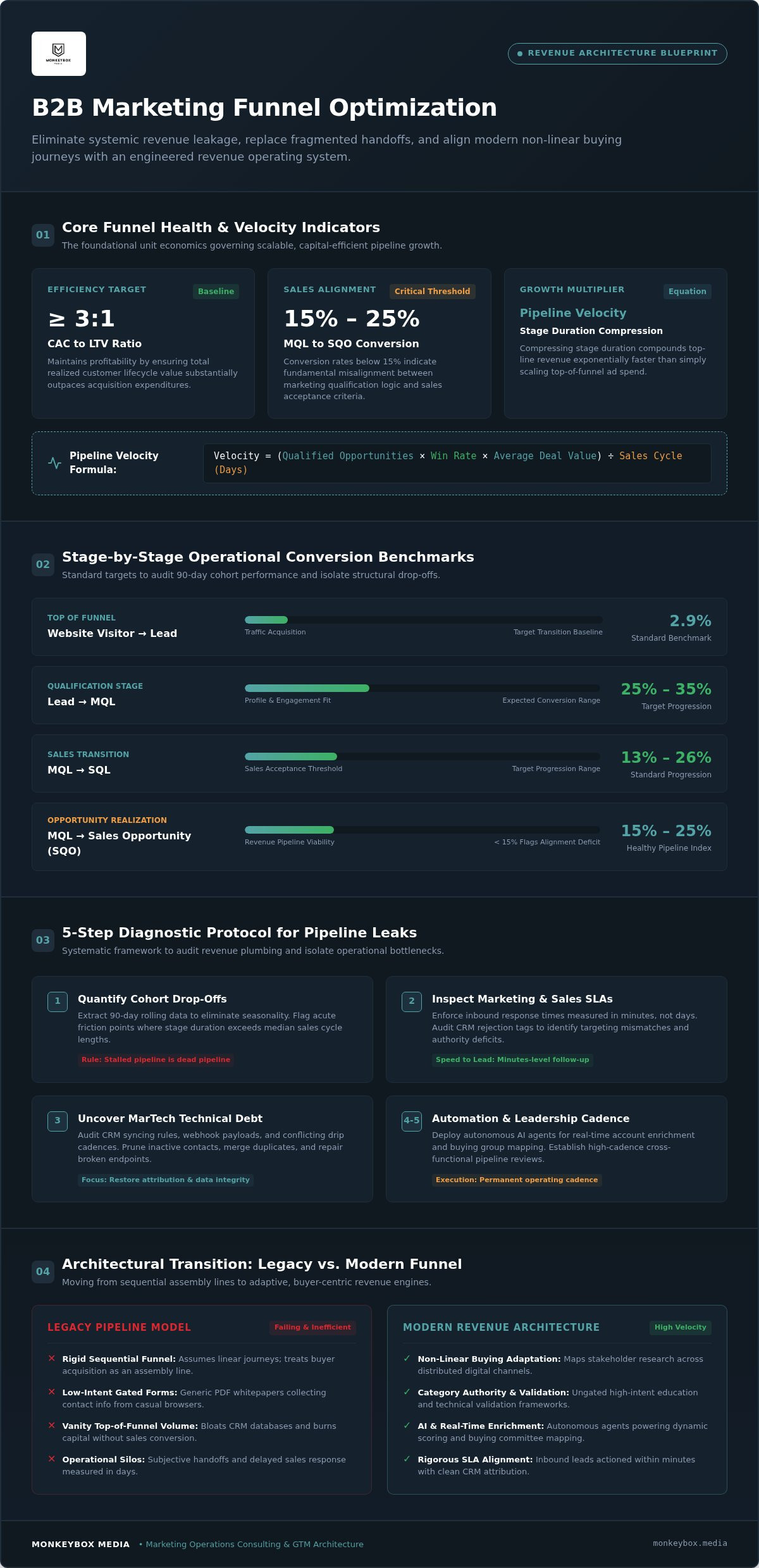
Rigorous B2B marketing funnel optimization requires looking past vanity volume and tracking the unit economics that govern true pipeline health. Three operational metrics dictate whether your engine scales or stalls:
- CAC to LTV Ratio: Maintain at least a 3:1 ratio to ensure customer acquisition remains profitable against total realized lifecycle revenue.
- Pipeline Velocity: Calculated as (Number of Qualified Opportunities × Win Rate × Average Deal Value) ÷ Sales Cycle Length in days. Compressing stage duration compounds revenue faster than scaling top-of-funnel spend.
- MQL to SQO Conversion: Benchmark this critical transition point. If fewer than 15% to 25% of your qualified marketing leads convert into legitimate sales opportunities, qualification criteria and sales alignment are fundamentally broken.
How to Audit Your B2B Marketing Funnel: A 5-Step Diagnostic Protocol
Buying another software subscription won't fix a broken conversion engine. Most growth stalls stem from poor architectural design rather than tool limitations. To execute meaningful B2B marketing funnel optimization, you must conduct an objective forensic audit of your revenue plumbing. This diagnostic framework maps every touchpoint from initial discovery to closed-won revenue, identifying exactly where buyer momentum dies.
Step 1: Quantifying Stage-by-Stage Conversion Drop-Offs
Extract cohort data across rolling 90-day windows to strip out seasonal pipeline noise. Plot your actual stage conversions against standard operational targets: benchmark visitor-to-lead rates at 2.9%, lead-to-MQL transitions between 25% and 35%, and MQL-to-SQL progression between 13% and 26%. Any stage deviating negatively from these baselines highlights acute friction. Watch for deals idling past your median sales cycle length. Stalled pipeline is dead pipeline.
Step 2: Inspecting Marketing and Sales SLA Definitions
Subjective handoffs destroy revenue predictability. Audit your mutual Service Level Agreements to ensure inbound prospects receive follow-up within minutes, not days. Establish strict, mutually agreed criteria separating marketing qualified leads from sales accepted opportunities. Next, inspect your CRM rejection tags. If sales reps frequently disqualify leads citing poor fit or lack of authority, your top-of-funnel targeting and qualification logic are delivering misaligned contacts.
Step 3: Uncovering Technical Debt in MarTech Workflows
Bloated technology stacks generate silent operational friction. Audit your CRM syncing rules, webhook payloads, and attribution parameters to catch silent failure points. Many organizations suffer from conflicting automation sequences, firing simultaneous drip cadences that alienate target buyers. Prune inactive contacts, merge duplicate records, and fix broken API endpoints to restore data integrity. If your team lacks the internal bandwidth to untangle these operational bottlenecks, engaging expert marketing operations consulting can quickly expose hidden technical debt and restore clean data flow.
Complete your diagnostic protocol with two final operational milestones:
- Step 4: Mapping Buying Committee Touchpoints: Track multi-stakeholder participation across key accounts, confirming your collateral engages technical evaluators, economic buyers, and executive sponsors alike.
- Step 5: Prioritizing the Remediation Roadmap: Rank identified leaks using an effort-versus-impact matrix. Fix high-volume handoff friction between MQL and sales acceptance before pouring additional resources into top-of-funnel acquisition.
Tactical Funnel Optimization: Engineering Conversion Across Every Stage
Diagnosing structural leaks is step one; engineering precision conversion pathways across every lifecycle phase is what drives aggressive pipeline expansion. Modern B2B marketing funnel optimization abandons passive touchpoints and actively equips buyers to build internal consensus. Here is how you optimize each stage of the commercial journey.
Top-of-Funnel (TOFU): Capturing High-Intent Demand
Gated eBooks fail because high-intent buyers refuse to trade direct contact information for entry-level primers. Tear down those friction gates. Distribute foundational technical guides openly to maximize category authority across evaluating teams. Replace static forms with interactive assessment tools that deliver immediate diagnostic benchmarks while capturing qualified account data. Align paid search and paid social campaigns exclusively with active, problem-solving search queries rather than broad vanity impressions.
Middle-of-Funnel (MOFU): Accelerating Buying Committee Consensus
Enterprise evaluations stall when internal champions struggle to convince cross-functional peers. Deploy detailed architecture teardowns and direct vendor comparison matrices that validate technical fit and mitigate deployment risk. Configure automated marketing workflows to trigger tailored collateral when prospects hit specific consumption thresholds. Engage both technical evaluators and economic buyers through synchronized multi-threading sequences before deals lose forward momentum.
Bottom-of-Funnel (BOFU): Compressing Deal Velocity and Sign-Off
Remove friction right at the finish line. Provide instant self-service booking links directly to senior solutions architects, cutting out scheduling delays. Arm internal champions with pre-packaged executive business cases and measurable financial models. Publish security architecture documentation, compliance certifications, and procurement checklists transparently to clear administrative hurdles weeks faster.
| Funnel Stage | Traditional Funnel Tactics | Modern High-Velocity Strategy |
|---|---|---|
| TOFU | Gated lead-magnet PDFs and generic impression targeting. | Ungated category education and interactive diagnostic tools. |
| MOFU | Generic email drip blasts based on arbitrary calendar schedules. | Behavior-triggered multi-threading and technical validation guides. |
| BOFU | Manual rep outreach and gatekept security documentation. | Transparent procurement packs and custom ROI business cases. |
Scaling Funnel Velocity with Marketing Automation and AI Agents
Manual qualification cannot keep pace with enterprise buying cycles. To achieve peak B2B marketing funnel optimization, growth leaders must replace rigid, static drip logic with event-driven automation and autonomous systems. Routing prospects based on real-time behavioral signals compresses sales cycles and ensures sales reps spend their hours exclusively on validated pipeline.
Deploying Autonomous AI Agents in Demand Generation Workflows
Autonomous AI agents transform inbound qualification from a reactive queue into real-time account acceleration. Rather than forcing reps to spend hours researching accounts manually, AI agents ingest intent surges across external networks, identify missing members of the buying group, and verify technical requirements. These agents compile instant pre-meeting account dossiers directly onto account executive calendars and execute conversational qualification workflows the moment high-value enterprise accounts touch your site.
Advanced Marketing Automation Architecture and Lead Routing
Static drip sequences burn prospect goodwill. Modern funnel engines run dynamic, multi-pathway nurture branches that adapt automatically to account tier, industry vertical, and role-based concerns. Instant webhook routing passes enriched contact intelligence directly into CRM stages, eliminating manual lead assignment delays entirely. When an enterprise account that previously stalled suddenly re-engages with your technical specs or pricing pages, automated alerts trigger immediate, context-rich rep outreach.
Maintaining Data Integrity and Mitigating MarTech Drift
Sophisticated revenue engines break down quickly without relentless data hygiene. Deploy automated validation webhooks to intercept and flag records with missing firmographic fields or invalid email syntax before they pollute your CRM. Build unified attribution frameworks that track non-linear buyer journeys across touchpoints without muddying primary pipeline attribution. Mastering this technical orchestration requires experienced operational leadership. Discover how strategic executives audit and scale this infrastructure in The Fractional CMO Agency Guide 2026: Scaling B2B Revenue with Strategic Authority.
Ready to eliminate routing delays and modernize your pipeline infrastructure? Deploy advanced marketing automation and AI agents with Monkeybox Media to engineer a high-velocity revenue engine that scales.
Building the Operating Model: Executive Marketing Leadership and Execution
Sustainable B2B marketing funnel optimization isn't a quarterly sprint or a one-time campaign. It's a permanent operational discipline. Chasing temporary traffic spikes produces erratic revenue curves and burns capital on unfocused activity. Sustainable scalability requires an institutionalized operating rhythm that bridges marketing operations, sales leadership, and financial accountability into a unified revenue engine.
Establishing Revenue Operations Governance and Cadence
Organizational silos kill conversion velocity. High-performing organizations run a weekly revenue council where marketing and sales leadership evaluate pipeline health side by side. Instead of debating lead quantities, this group audits stage velocity, sales acceptance rates, and stage stagnation. Establishing clear governance ensures problems get solved before they hurt performance:
- Weekly Pipeline Reviews: Analyze rolling 30-day and 90-day stage conversion benchmarks to catch negative conversion anomalies instantly.
- SLA Accountability: Review inbound response times and pipeline rejections to ensure both teams meet their operational commitments.
- Change Management Protocols: Enforce rigorous testing environments before deploying new automation workflow triggers or modifying CRM routing schemas.
The Fractional Leadership Advantage in Funnel Modernization
Engineering modern revenue architecture demands seasoned executive vision, but recruiting a full-time enterprise CMO often introduces lengthy search cycles and heavy executive overhead. Deploying fractional CMO leadership gives scaling companies immediate access to veteran go-to-market strategy and operational expertise. An experienced fractional executive cuts through cross-departmental politics, audits existing marketing operations, and aligns technical automation directly with boardroom revenue targets. When led with strategic authority, ongoing B2B marketing funnel optimization transforms fragmented touchpoints into a predictable, compounding engine for enterprise growth.
Transform Your Revenue Architecture for Predictable Scale
Scaling enterprise revenue requires moving past outdated, linear lead capture. True B2B marketing funnel optimization isn't a surface-level fix; it's an integrated operational discipline. By diagnosing stage leakage through forensic auditing, equipping complex buying committees with targeted collateral, and enforcing joint sales-marketing governance, you eliminate friction and accelerate deal flow across every channel.
Executing this transformation demands specialized operational power. Monkeybox Media specializes in architecting high-impact marketing operations, advanced automation workflows, and hands-on deployments of autonomous AI agents within your revenue engine. Backed by veteran fractional CMO leadership, we bridge the gap between strategic demand generation and sales acceptance. You don't have to let qualified pipeline stall in operational gridlock. Scale your revenue infrastructure with Monkeybox Media and build an agile growth engine engineered to dominate.
Frequently Asked Questions
What is the difference between a B2B marketing funnel and a B2B sales pipeline?
The marketing funnel encompasses the entire buyer awareness and consideration journey, whereas the sales pipeline tracks qualified opportunities through specific deal stages toward closed revenue. The funnel measures how effectively you educate accounts and capture intent across multi-stakeholder groups. The pipeline measures deal velocity, contractual milestones, and closing mechanics once an opportunity is formally accepted. Both systems must integrate seamlessly to prevent qualified buyers from falling through operational cracks.
How often should an enterprise B2B marketing funnel be audited?
Enterprise teams should conduct a rigorous diagnostic audit every quarter, supplemented by weekly operational reviews of stage velocity and conversion rates. A quarterly cadence isolates macro trends across 90-day buyer cohorts while removing seasonal anomalies. Weekly cross-functional check-ins between marketing operations and sales leadership allow you to catch routing failures, webhook drops, and sudden conversion dips before they derail quarterly revenue projections. Never treat auditing as an annual afterthought.
What are the most common signs of revenue leakage in a B2B funnel?
High customer acquisition costs combined with sharp drop-offs between marketing qualification and sales acceptance represent the clearest indicator of funnel leakage. Other warning signs include sales cycles lingering past your historical median, high percentages of opportunities marked closed-lost due to stalled consensus, and repetitive CRM data sync errors. When sales reps consistently complain about lead quality, the breakdown almost always lies in flawed qualification criteria or siloed tech handoffs.
How do AI agents improve B2B marketing funnel conversion rates?
Autonomous AI agents elevate B2B marketing funnel optimization by executing real-time account enrichment, identifying unmapped buying committee members, and instantly qualifying inbound enterprise leads. Instead of forcing prospects through slow, manual triage queues, AI agents evaluate intent surges across the web and deliver actionable dossiers directly to sales reps. This eliminates latency, personalizes engagement at the moment of peak interest, and keeps high-value opportunities moving forward.
Can B2B marketing funnel optimization succeed without replacing our CRM?
Yes, successful B2B marketing funnel optimization rarely requires ripping and replacing your underlying CRM. Most pipeline bottlenecks stem from poor architectural design, redundant automation sequences, and misaligned qualification definitions rather than the database itself. You can achieve dramatic velocity gains by auditing integration logic, cleaning dirty data, deploying intelligent routing webhooks, and optimizing your marketing automation platform on top of your existing CRM infrastructure.
What is the role of a fractional CMO in B2B marketing funnel optimization?
A fractional CMO provides high-level go-to-market strategy, governance, and architectural oversight without the commitment and expense of a full-time executive hire. They establish cross-functional alignment between sales and marketing, design robust marketing operations infrastructure, and direct the deployment of automation systems. This senior executive leadership ensures your conversion engine aligns directly with corporate revenue milestones and eliminates wasted spend across your pipeline.
How do we measure the ROI of marketing funnel optimization efforts?
Measure optimization ROI by tracking improvements in pipeline velocity, customer acquisition cost efficiency, and marketing-originated closed-won revenue. Look specifically at compressed sales cycle lengths, higher conversion rates from marketing qualified lead to sales accepted opportunity, and reduced friction in procurement handoffs. When your revenue engine is properly tuned, overall pipeline throughput accelerates, and your revenue per opportunity scales faster than customer acquisition spending.