
The wrong leadership model can leave a marketing team busy but without clear priorities, ownership or sales alignment. The job title won’t fix that. The mandate will. If you’re weighing up an interim marketing director UK businesses might appoint during a transition or growth phase, start by defining the gap you need to close.
You may already know senior marketing leadership is missing. What’s less clear is whether you need a full-time, fixed-term leader to take charge, a fractional CMO for focused strategic direction, or a permanent hire to build long-term capability. Choose the model that matches the work, authority and time commitment required, rather than defaulting to the most familiar title.
This guide offers a practical framework for defining the mandate, assessing candidates against measurable outcomes and choosing the right model. It also covers how to set priorities, strengthen marketing operations and plan a handover that keeps work moving. Start by clarifying the leadership gap and how marketing needs to support growth.
Key Takeaways
- Choose an interim marketing director UK appointment based on the change the business needs, not the title alone.
- Compare interim, fractional and permanent leadership by duration, workload, decision-making authority and who will own the work internally.
- Evaluate candidates separately on strategic judgement, B2B context, executive communication and their ability to lead delivery.
- Ask for evidence linking marketing priorities to pipeline, revenue or other agreed commercial measures.
- Before hiring, define the mandate, confirm decision rights, agree measures and build a practical handover plan around the data available.
What an Interim Marketing Director in the UK Is Hired to Change
An interim marketing director is brought in to lead a defined period of change, not simply to keep the marketing calendar full. The mandate might be to stabilise a team after a leadership departure, reset go-to-market priorities or restore ownership of execution during a growth transition. Interim management describes this broader model of temporarily appointing experienced leadership to address organisational change.
An interim marketing director is a time-bound senior leader accountable for a specific marketing mandate; a permanent director is hired to own the function as an ongoing part of the organisation. That distinction should shape the role from day one. The leader might set positioning, focus demand generation and align marketing with sales, while campaign production and specialist tasks remain with the existing team or other providers.
Be specific about the level of execution leadership required. Strategic decision-making means choosing priorities, allocating resources and setting direction. Campaign delivery turns those choices into activity, while day-to-day specialist execution covers tasks such as building assets or managing channels. One person may oversee all three, but the mandate should state what they’re accountable for and what the team must deliver.
What authority should an interim marketing director have?
Responsibility without decision rights creates delays. Agree the leader’s access to the CEO and commercial leaders, their role in budget decisions, and their authority to set team priorities. Define whether they can approve plans or only recommend them. This distinguishes an accountable leadership remit from an advisory-only assignment. Also establish who owns approvals, sales alignment and key decisions once the engagement ends.
Which business situations call for interim marketing leadership?
An interim appointment may fit when a leadership vacancy needs covering before a permanent search concludes, or when a strategic reset needs a senior owner. For example, a business repositioning its offer may need focused decisions about target segments, messaging and demand generation. Interim leadership can also help when execution has stalled because priorities or ownership are unclear. An isolated performance issue, however, may need a narrower fix rather than an executive appointment.
For an interim marketing director UK search, define the change required before assessing candidates. If the business needs senior strategic direction and execution oversight without a full-time appointment, a fractional CMO may be another model to consider. The right choice depends on the mandate, authority and continuity required, not the title alone.
Interim Marketing Director vs Fractional CMO vs Permanent Hire
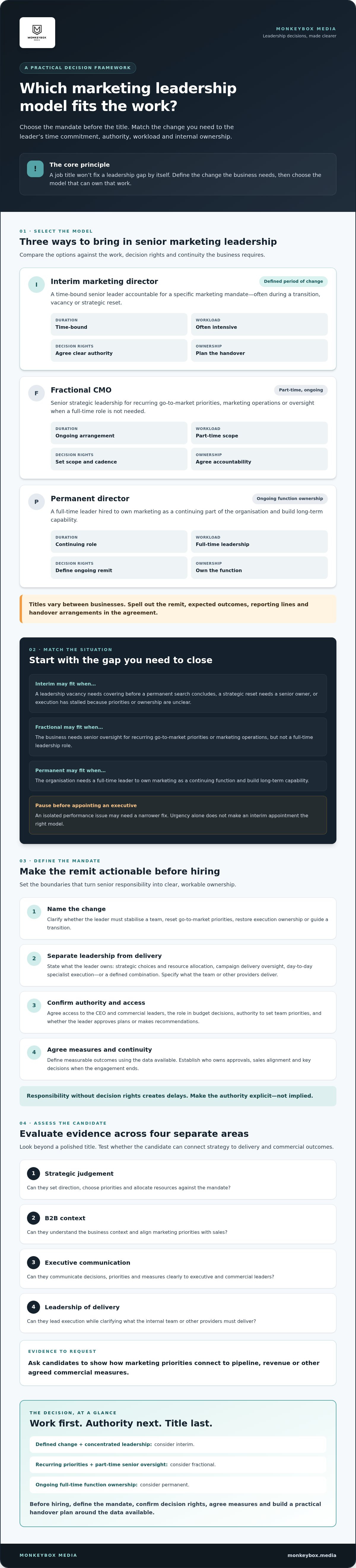
Choose the engagement model by matching the work to the leadership capacity available. An interim director typically takes on a time-bound, often intensive remit tied to a transition or defined change. A fractional CMO provides senior strategic leadership on a part-time, ongoing basis. A permanent hire makes sense when the organisation needs a full-time leader to own marketing as a continuing function.
Compare the options across five dimensions: duration, continuity, workload, decision rights and internal ownership. An interim leader may hold substantial authority for a defined period, while a fractional leader’s working cadence and scope need to fit recurring priorities. A permanent director offers ongoing ownership, but requires a continuing full-time role. Titles vary between businesses, so spell out the remit, expected outcomes, reporting lines and handover arrangements in the agreement. Resources such as the HBR Guide to Better Recruiting and Hiring can support a more structured hiring process.
When does an interim appointment fit better than a fractional CMO?
Consider an interim appointment when the business needs a temporary executive with clear authority and a defined transition point, such as covering a vacancy or leading a time-bound strategic reset. The key test is whether the work requires concentrated leadership and regular involvement, rather than ongoing guidance at an agreed cadence. Define who will take ownership when the assignment ends. Don’t assume urgency alone makes an interim appointment the right model.
When is fractional marketing leadership the stronger fit?
Fractional support can suit a business with recurring go-to-market priorities, marketing operations needs or a requirement for senior oversight, but without a full-time leadership role. Agree the scope, working cadence, decision rights and measures of accountability upfront. Monkeybox Media provides fractional CMO leadership, B2B go-to-market strategy and marketing operations support, not conventional interim placements. For a deeper model comparison, read the fractional CMO agency guide.
When should you choose a permanent hire?
Make a permanent appointment when senior marketing ownership is an enduring business requirement, the workload calls for full-time leadership and the organisation is ready to support that role over the long term. This model can build continuity across planning, team development and commercial alignment. If the need is temporary or still being defined, a permanent job description may lock the business into the wrong structure.
For an interim marketing director UK search, document the mandate and how authority will transfer at the end. If the requirement is ongoing strategic direction and execution oversight on a part-time basis, explore fractional CMO support as a separate option.
How to Evaluate an Interim Marketing Director Candidate
Assess candidates against the mandate, not the polish of their presentation. Separate four capabilities: strategic judgement, relevant B2B experience, executive communication and the ability to lead delivery. A strong strategist should explain how they’d prioritise positioning, go-to-market activity and team capacity. A strong delivery leader should show how those choices become owned work, practical workflows and clear measures.
Measurable outcomes matter more than impressive titles because they show whether a candidate can connect marketing decisions to commercial progress. Ask for examples linking priorities to pipeline, revenue or another agreed business measure. Probe what the candidate personally owned, what others delivered and how results were tracked. A credible answer explains the context and trade-offs, not just the headline outcome.
Test their judgement under real operating constraints too. What would they do if data is incomplete, resources are limited or sales leaders resist a proposed change? Look for a clear diagnosis, explicit assumptions and a practical approach to building alignment. The Institute of Interim Management offers further context on the interim management profession, but professional standards or affiliations should complement, not replace, evidence of fit for your brief.
Questions to ask before appointing an interim marketing leader
Ask each candidate the same questions so you can compare how they think, not just how they present.
- What would you examine first to understand our market, funnel, team and current priorities?
- How would you align marketing plans with sales capacity and wider commercial objectives?
- How would you decide what to stop, continue or change if the available data is incomplete?
- How would you transfer knowledge, document decisions and maintain momentum after the assignment?
Listen for a discovery process that checks data quality before setting targets. The candidate should explain how they’d work with sales and leadership, identify decision-makers and turn findings into priorities. Vague promises to “drive growth” aren’t a plan.
How to check strategic fit and execution capability
Review examples that match the actual mandate, such as repositioning, go-to-market planning, team direction or improving marketing operations. Ask the candidate to explain their choices, including how they assigned ownership, improved measurement and managed workflows. Where possible, validate claims with references and clarify the candidate’s direct contribution. A polished deck is not proof.
For an interim marketing director UK appointment, agree what evidence you’ll use to judge progress before the engagement starts. Confirm which measures are available, who owns them and how often the leadership team will review them. This creates a fair test of performance and gives the incoming leader a clear operating brief.
Set the Mandate, Measures and First-Phase Plan Before Hiring
A clear brief turns the leadership gap into a decision-ready mandate. Before appointing an interim marketing director UK candidate, work through four steps:
- Diagnose the need. State what has changed, what is blocked and why the business needs senior marketing leadership now.
- Define authority. Set the reporting line, decision rights, budget involvement and expectations for alignment with sales and other commercial leaders.
- Agree measures. Confirm business priorities and available data before choosing baseline measures. Separate leading indicators, such as agreed milestones for positioning work or campaign readiness, from lagging outcomes, such as pipeline contribution or revenue.
- Plan the handover. Name who will own ongoing decisions, workflows and reporting when the assignment ends. Document what knowledge and materials must transfer.
Success measures must match the agreed mandate and the baseline the business can reliably establish. Don’t promise a commercial outcome before confirming the data, decision-making authority and time horizon needed to assess it. If the CRM or reporting is incomplete, make data quality an early workstream rather than treating uncertain figures as a dependable starting point.
What belongs in the interim marketing director brief?
Give candidates the context they need to judge the assignment accurately: business priorities, immediate challenges, reporting line and decision-making boundaries. Document team capacity, agency relationships, existing marketing systems and known constraints, such as gaps in measurement or limited delivery resource. Then specify expected outputs, access to leadership and data, review cadence, and an explicit exit or transition plan. A precise brief reduces scope drift.
How should the first 30, 60 and 90 days be structured?
Use these as planning checkpoints, not guaranteed deadlines or universal performance targets. The pace will depend on the mandate, available evidence and internal capacity.
- First 30 days: diagnose the current position, test assumptions and align leadership on priorities.
- By 60 days: sequence the agreed work, assign owners and begin execution against confirmed measures.
- By 90 days: review progress, assess evidence and adjust scope or priorities if the original assumptions no longer hold.
At each checkpoint, give leaders a clear view of decisions made, work completed, risks and next actions. That makes the plan useful, not just presentable. If your brief points to ongoing strategic direction rather than a traditional interim appointment, explore fractional CMO and go-to-market strategy support.
Choose the Right UK B2B Marketing Leadership Partner
The right choice follows from the mandate you’ve defined. If the business needs a temporary executive with substantial authority through a specific transition, assess interim candidates against that remit. If marketing leadership is an ongoing, full-time requirement, a permanent hire may provide the continuity the business needs. If the priority is recurring strategic direction without a full-time role, fractional leadership may be a better fit.
Whichever model you choose, connect strategy to execution. The leader should turn business priorities into owned work, establish measures that reflect available evidence and leave a workable handover. A plan that depends on one person’s knowledge is fragile. Clarify who will own the priorities, workflows and decisions after the engagement changes or ends.
When Monkeybox Media’s fractional CMO services may fit
Monkeybox Media provides fractional CMO leadership and B2B go-to-market strategy. Its marketing operations and marketing automation expertise can support the systems and workflows needed to carry an agreed strategy forward. This may suit a business seeking continuing senior direction rather than a full-time or conventional interim appointment. Confirm the engagement model, scope, cadence and accountability directly with the company. Monkeybox Media should not be treated as an interim placement provider.
What to prepare before discussing your requirements
A focused first conversation starts with the facts you have, not perfect reporting. Bring:
- The business goal: State the commercial priority the marketing function needs to support.
- The current team structure: Outline responsibilities, capacity and where ownership is unclear or missing.
- The urgent decision: Identify the marketing choice that needs senior direction first.
- Available evidence: Share relevant pipeline measures, systems and known data gaps, along with operational constraints.
This information helps establish whether fractional CMO support matches the need or whether the business requires a different leadership model. Be direct about the level of authority, execution oversight and continuity expected. Then discuss the fit, scope and practical next steps with Monkeybox Media before deciding whether its services align with your requirements.
For a business searching for an interim marketing director UK, the priority is not to force every requirement into a particular service model. Match the appointment to the change required, the time commitment and the decision rights needed. Then make sure the strategy can be executed, measured and handed over clearly.
Turn the Leadership Gap Into a Clear Growth Plan
The right marketing leader is the one whose mandate matches the change your business needs. Before hiring, define the authority required, choose interim, fractional or permanent leadership based on duration and workload, and agree how progress will be measured against available data. Build in a practical handover so priorities and ownership continue beyond the appointment.
An interim marketing director UK appointment can suit a defined leadership gap or transition, while ongoing strategic direction may call for a different model. Monkeybox Media’s core services include fractional CMO leadership and B2B go-to-market strategy, supported by marketing operations, automation and AI implementation that connect strategic direction to execution. Confirm the right scope and engagement model before proceeding.
If your requirement is senior B2B marketing direction rather than a conventional interim placement, discuss your B2B marketing leadership requirements. Bring your business goal, team structure and most urgent marketing decision. With a clear mandate and the right operating model, you can move forward with focus and build momentum that lasts.
Frequently Asked Questions
What does an interim marketing director do?
An interim marketing director provides time-bound senior leadership against an agreed business mandate. They may set priorities, align marketing with sales, lead the team and oversee execution, but the exact remit depends on the organisation’s needs. Before appointing someone, define their decision-making authority, reporting line and expected deliverables. Agree how progress will be measured and who will take ownership of ongoing work when the engagement ends.
When should a UK business hire an interim marketing director?
Consider hiring an interim marketing director UK businesses can appoint when a leadership gap or defined transition creates an immediate need for senior accountability. First assess the urgency, scope, internal capability and likely duration of the requirement. A temporary appointment may suit a specific period of change, while an ongoing need may call for a permanent hire or fractional leadership. Choose the model that matches the work, rather than treating every marketing challenge as an executive vacancy.
What is the difference between an interim marketing director and a fractional CMO?
An interim marketing director is generally engaged for a defined temporary mandate, while a fractional CMO provides senior marketing leadership on a part-time or flexible basis. However, titles aren’t standardised, so compare the proposed scope, time commitment, authority and accountability. Clarify who owns decisions and execution, how leadership continuity will work, and what happens at the end of the engagement. Select the model based on the work required, not the label alone.
How do I assess an interim marketing director candidate?
Assess strategic judgement, relevant B2B experience, team leadership and evidence of commercial impact. Ask how the candidate would diagnose your situation, set priorities, align marketing with sales and report progress against agreed measures. Request examples that show their personal contribution, then check references and test their approach against your actual mandate. A polished presentation can help explain a candidate’s thinking, but it can’t replace verifiable examples, sound judgement and clear accountability.
How long should an interim marketing director stay?
An interim marketing director should stay for the period required to deliver the agreed mandate and complete a workable handover. There’s no universal engagement length: duration depends on the reason for appointment, the work involved and the organisation’s capacity to take ownership. Set review points and exit conditions in advance, including what must be transferred. Reassess the scope as evidence emerges, rather than extending the engagement automatically or ending it before the business is ready.
Can a fractional CMO replace an interim marketing director?
Sometimes, if the requirement is ongoing senior direction rather than a defined temporary executive appointment. A fractional CMO may fit recurring B2B go-to-market priorities or marketing operations needs without assuming a full-time role. Monkeybox Media provides fractional CMO leadership and GTM strategy, not conventional interim placements. Compare the authority, time commitment, scope and transition requirements before deciding whether fractional support fits. Confirm the specific engagement model and scope with the provider.
What should an interim marketing director brief include?
An interim marketing director brief should set out the business context, reason for the appointment, priority outcomes, decision rights and reporting line. Describe the current team, systems, available resources and known constraints, including gaps in data. Specify access requirements, how progress will be reviewed and who approves key decisions. Finally, document the exit or transition plan: what knowledge, workflows and responsibilities must transfer, and who will own them after the engagement ends.