
What if your marketing automation platform isn’t the problem, but the strategy connecting it to sales? A marketing automation consultant UK businesses choose should do more than configure workflows. They should connect your data, customer journeys and sales processes to the growth goals that matter.
It’s a familiar frustration: tools sit underused, marketing and sales work from different assumptions, and nobody clearly owns the data or performance. Implementation can quickly become a technical project without commercial direction. More automation won’t fix that. A sharper operating model will.
This guide shows you how to assess a consultant’s strategic, technical and operational responsibilities, and how consultant-led support compares with agency and in-house options. You’ll learn to define the right scope, align automation with your B2B go-to-market strategy and set practical measures of progress. The aim is a connected system your team can run, improve and link to measurable growth, not another platform rollout that stalls after launch.
Key Takeaways
- Recognise when fragmented data, weak lead handoffs or unclear reporting call for specialist support.
- Set expectations beyond platform setup, including workflow design, clear ownership, team adoption and ongoing optimisation.
- Compare consultant-led support, agency delivery and an in-house hire against your need for strategic direction, implementation and knowledge transfer.
- Use a marketing automation consultant UK engagement plan to define decision owners, milestones, dependencies and baseline measures.
- Connect automation priorities to your B2B go-to-market strategy, customer journeys and sales alignment before expanding workflows or introducing AI agents.
When does a UK B2B business need a marketing automation consultant?
A marketing automation consultant aligns marketing technology, data and workflows with commercial goals. They address the gap between what a platform can do and what the organisation needs it to do, from diagnosing broken lead journeys to improving how marketing activity is measured. A marketing automation consultant UK businesses engage should start with the operating problem, not a preferred tool or a list of features.
Common signals include customer and prospect data split across systems, lead handoffs that depend on manual messages, platform features nobody uses, and reports that show activity without explaining its contribution to pipeline. For example, if sales receives leads without consistent qualification details, the problem may be the definitions and handoff process rather than the automation platform. Adding software rarely fixes unclear positioning, inconsistent processes, missing ownership or weak measurement. It can make those problems harder to see.
Consultancy creates value when it aligns systems, teams and workflows around measurable business objectives. A consultant can also help determine whether you need a defined optimisation project or broader strategic marketing leadership. If the goal is to improve a specific workflow, such as lead routing or nurture logic, focused automation support may fit. If priorities, positioning and go-to-market direction are unsettled across the business, the challenge may call for senior marketing leadership alongside operational expertise.
What does a marketing automation consultant actually do?
The work begins with diagnosis: reviewing workflows, data structures, integrations and the needs of the teams using them. This shows where information is lost, duplicated or delayed, and which process changes could address the root cause. For a useful grounding in the discipline’s functions, see Marketing Automation on Wikipedia.
Strategic advice sets the objectives, priorities and system design. Platform configuration puts that design into operation; campaign execution is a separate activity that can be scoped according to the engagement. The scope should follow business objectives, such as improving lead follow-up or reporting, rather than a platform’s available features.
What signals show your B2B operation is ready for support?
Look for recurring manual work, unreliable attribution and inconsistent lead qualification. These are operational signals, not just inconveniences. If a prospect’s status differs between marketing and sales, or the team cannot trace what happens after a form submission, disconnected processes are creating friction across the buyer journey.
Unclear ownership compounds the problem. Without named responsibility for data definitions, workflow decisions and performance reviews, teams can’t confidently adopt changes or improve them over time. A consultant can help map those responsibilities and identify the decisions the business needs to make before changing its automation setup.
What should a marketing automation consultant deliver beyond implementation?
A strong engagement doesn’t end when workflows are switched on. It connects commercial priorities to system design, gives teams clear operating rules and establishes how performance will be reviewed. A marketing automation consultant UK business engages should leave more than a configured platform: the team should understand what runs, why it runs and who owns the next improvement.
Expect work to move through diagnosis, strategy, design, implementation, adoption and optimisation. That means documenting workflows, data definitions, decision ownership and marketing-to-sales handoffs. For example, define what qualifies a lead for sales review, which fields must accompany the handoff and how sales feedback returns to marketing. The Digital Marketing Institute's Guide to Marketing Automation provides useful background on how automation can reduce manual tasks, but the right workflows still depend on your operating model.
From marketing objectives to automation architecture
Start with the audience, buying journey, lifecycle stages and commercial priorities. If the business needs to nurture multiple stakeholders through a long B2B buying process, that should shape the workflow, data requirements and connections between systems. Architecture follows strategy, not the other way round.
Agree which customer and prospect information teams need, where it should live and how it moves between marketing and sales. Then design workflows and integrations around those decisions. This prevents platform features from dictating processes that don’t fit how the business goes to market.
Implementation, adoption, and measurement
Delivery may cover configuration, migration planning, testing, documentation and team enablement. Before workflows go live, set baseline measures and define how each will be calculated. Depending on the objective, measures could include lead response time, progression between lifecycle stages, conversion rates, pipeline quality or the manual effort involved in a process. These measures support assessment; they don’t guarantee a particular result.
Assign internal owners for data definitions, workflow approvals, sales feedback and performance reviews. The consultant can design, guide and build capability, while your team retains the decisions and context needed to run the system. That balance reduces dependency and makes adoption part of delivery, not an afterthought.
Set a regular review cadence to check whether workflows are behaving as intended, identify friction and prioritise adjustments. Compare results with the agreed baseline, document changes and share learning across marketing and sales. Explore Monkeybox Media’s B2B marketing automation support to see how implementation connects with marketing operations and broader growth priorities.
How should you compare a marketing automation consultant in the UK?
The right engagement model depends on the gap you need to close. Compare who will own the strategy, who will implement it, how your team will build capability and what happens after launch. A platform specialist may know the tools inside out, but platform familiarity alone doesn’t show whether they can connect workflows to sales processes or commercial measures.
| Factor | Consultant-led support | Agency delivery | In-house hire |
|---|---|---|---|
| Strategic ownership | Can bring focused expertise or senior direction, depending on scope. | May combine planning with delivery across a broader team. | Can build ongoing internal ownership and organisational context. |
| Implementation depth | Suited to defined projects or specialist input, depending on capacity. | May offer a wider delivery team for multiple workstreams. | Builds hands-on capability inside the business over time. |
| Flexibility | Can be scoped around a specific need or leadership gap. | Can coordinate broader delivery, shaped by the agreed engagement. | Focused on the organisation’s priorities and workload. |
| Knowledge transfer | Should leave documented decisions and practical guidance. | Should define how processes and knowledge pass to the client team. | Knowledge stays close to the business, with continuity depending on the role. |
| Ongoing optimisation | Can advise or support reviews as agreed in the scope. | Can provide continuing delivery and review capacity. | Can manage iteration as an ongoing internal responsibility. |
Consultant, agency, or in-house specialist: which model fits?
A focused consultant can address a defined capability gap, such as redesigning lead workflows, or provide strategic direction when the team needs experienced guidance. An agency may fit a broader delivery requirement involving several areas of execution. An in-house specialist suits organisations ready to invest in sustained internal ownership and build automation expertise into daily operations.
These models can also work together. Fractional CMO leadership connects automation decisions with go-to-market priorities, while marketing operations expertise translates those priorities into workable systems. Choose the model around the work and accountability required, not the label.
Which questions reveal strategic and technical competence?
Use a prospective engagement discussion to test how the work will connect to business needs. Ask:
- How would you link proposed workflows to our buying journey, sales process and commercial objectives?
- How will you assess data quality, integrations and the impact of migration before changes go live?
- What testing, documentation and team enablement will be included?
- Who will own workflow decisions, reporting definitions and post-launch reviews?
- How will we measure progress, and what knowledge will our team retain?
Look for answers grounded in relevant B2B experience, systems thinking and clear measurement, not a catalogue of platform features. The best-fit marketing automation consultant UK businesses can work with is one whose proposed approach makes responsibilities, evidence and next steps explicit.
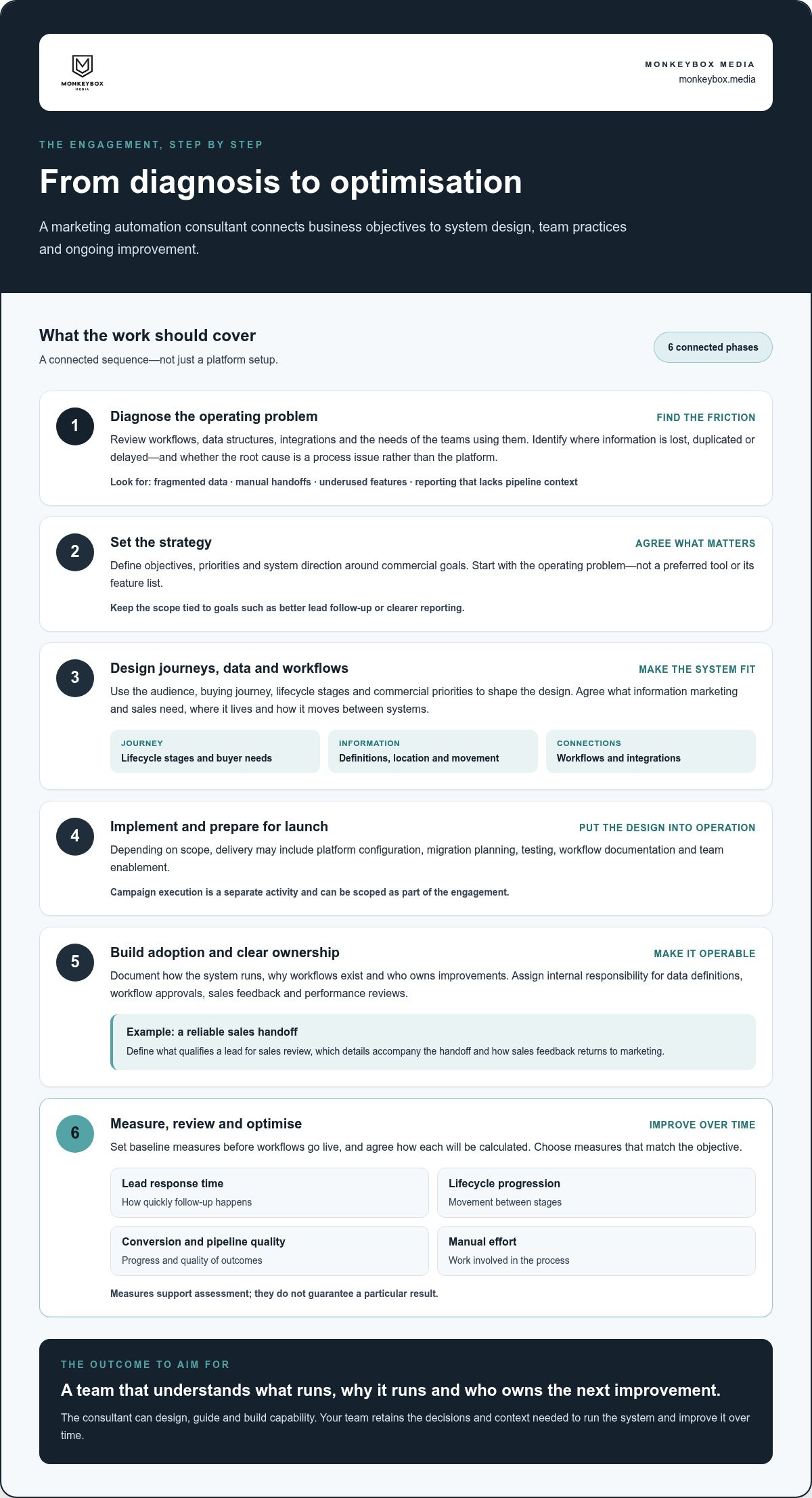
What does a UK marketing automation engagement look like from audit to optimisation?
A well-run engagement moves through clear stages, with decisions and ownership set before implementation begins. A marketing automation consultant UK businesses work with should connect each stage to a business goal, establish how progress will be assessed and make dependencies visible. That keeps delivery focused on improving the marketing operating system, not simply launching more workflows.
How should the engagement begin and progress?
Start by reviewing commercial goals, current workflows, technology, data quality and team capability. Then prioritise a manageable set of high-value processes rather than automating everything at once. For each phase, agree a decision owner, dependencies, milestone, acceptance criteria and the person responsible for measurement.
- Diagnose: Map the current journey, systems, handoffs and friction points.
- Prioritise: Select processes that support a defined business objective.
- Design: Document the workflow, required data, ownership and success measures.
- Implement and validate: Configure the agreed changes, then test integrations, permissions, data flows and marketing-to-sales handoffs before wider use.
- Enable and optimise: Train users, capture feedback and review performance against the baseline to guide improvements.
For example, don’t accept a lead-routing change simply because a test record reached the right queue. Define what successful routing means, which fields sales needs and how exceptions will be handled. Those criteria make sign-off meaningful and expose gaps before the process scales.
How do UK data governance and team adoption fit?
Build governance into workflow design. Document who owns consent records, data accuracy, access permissions and retention decisions, and make clear how staff should handle data within the process. These are operational controls, not boxes to tick after launch. For current information on applicable UK data protection expectations, consult the ICO’s UK GDPR guidance and resources; confirm relevant requirements against up-to-date guidance before implementation.
Adoption needs the same discipline as configuration. Give users practical training, concise process documentation and a route to report problems or suggest improvements. Their feedback can reveal where a workflow creates extra steps, produces unclear tasks or fails to reflect how sales works in practice.
With ownership, testing and review built into the engagement, optimisation becomes a controlled cycle rather than a one-off launch. Plan a B2B marketing automation engagement with Monkeybox Media to connect implementation decisions with operational priorities and measurable progress.
How Monkeybox Media connects marketing automation to B2B growth
Automation works harder when it sits inside a clear growth strategy. Monkeybox Media connects fractional CMO leadership, B2B go-to-market planning and marketing operations, linking strategic priorities to the systems and workflows that support execution. The result is a joined-up approach: decide where the business is going, then build the marketing operating system to support that direction.
Why connect automation with fractional marketing leadership?
Executive oversight helps prioritise automation against wider go-to-market objectives, rather than treating each workflow as a standalone technical task. Positioning and target audiences inform the customer journey; the journey shapes lifecycle stages and sales handoffs; those decisions then guide system design, responsibilities and reporting.
For example, if a B2B company wants to improve how it engages different stakeholders in a buying journey, its automation priorities could include clearer audience data, relevant nurture paths and agreed sales follow-up. That’s an illustrative planning example, not a promised result. The point is to make each workflow serve a defined objective and fit the way marketing and sales operate.
Fractional CMO leadership sets direction and aligns priorities, while marketing operations translates that direction into process, data and platform requirements. This combination keeps implementation connected to the commercial plan. For more on strategic marketing leadership, read the Fractional CMO agency guide.
What should the next step look like?
Begin with three points: the growth objective you’re pursuing, the bottleneck slowing progress and the systems challenge behind it. For instance, you might need stronger visibility across the customer journey, clearer marketing-to-sales processes or more effective use of your existing technology. These specifics create a productive starting point for a strategic conversation about priorities, operating context and implementation needs.
As a marketing automation consultant UK partner, Monkeybox Media connects marketing strategy and operational execution, including marketing automation implementation and marketing technology optimisation. AI agents can support selected workflows where they fit the strategy and governance model. They’re an additional capability, not a replacement for clear objectives, sound processes or human accountability.
Define the business outcome first. Then align the technology and team around it. Build a stronger B2B marketing operating system with Monkeybox Media.
Turn your automation investment into a growth system
The right marketing automation consultant UK businesses choose should connect strategy, systems and accountability, not just configure workflows. Define the commercial objective first, then scope the work around the data, processes and team responsibilities needed to support it. Compare engagement models by the strategic ownership, implementation capability and knowledge transfer your business needs.
Monkeybox Media brings fractional CMO leadership together with go-to-market strategy and marketing operations, connecting automation priorities to wider B2B growth objectives. Marketing automation implementation and AI agent integration can support relevant workflows as part of that operating system, with strategy and governance setting the direction.
Start by identifying the growth goal you’re working towards, the bottleneck holding progress back and the systems challenge behind it. Then turn those priorities into a focused plan your team can measure and improve. Build a stronger B2B marketing operating system with Monkeybox Media, and move forward with a clearer path from automation decisions to commercial priorities.
Frequently Asked Questions
What does a marketing automation consultant do?
A marketing automation consultant helps align marketing systems, data and workflows with business objectives. They may assess existing processes, recommend a system design, guide implementation and support team adoption and optimisation. For example, they can help define how a qualified lead moves from marketing to sales, what information travels with it and how the handoff is measured. The scope should reflect the organisation’s goals, not just the platform’s available features.
How do I choose a marketing automation consultant in the UK?
Choose a marketing automation consultant UK businesses can rely on by assessing relevant B2B experience, strategic thinking and technical capability together. Ask how they would connect proposed workflows to your customer journey, sales process and commercial objectives. Look for clear plans for data quality, integration testing, documentation, team enablement and performance measurement. A strong partner makes responsibilities explicit and explains how knowledge will transfer to your team, rather than leaving you dependent on outside support.
When should a business hire a marketing automation consultant?
Consider bringing in a consultant when recurring manual tasks, disconnected data, inconsistent lead qualification or unclear reporting are limiting your marketing operation. Another signal is a platform with useful capabilities that the team hasn’t put into practice. First identify whether the need is a focused optimisation, such as improving lead routing, or broader strategic direction. If positioning, priorities and sales alignment are also unclear, address those foundations alongside the technology.
Should I hire a marketing automation consultant or an agency?
Choose based on the capabilities and capacity your business needs. A consultant can provide focused expertise or strategic leadership for a defined challenge, while an agency may suit work requiring a broader delivery team across multiple activities. An in-house specialist can build sustained internal ownership. These models can complement each other: fractional marketing leadership can set priorities, while consultants, agencies or internal teams support implementation and ongoing operations.
Can a marketing automation consultant improve lead quality?
A consultant can help improve the processes that determine how leads are qualified, nurtured and passed to sales, but should not promise a specific outcome. Start by agreeing what makes a lead appropriate for sales, which data points support that decision and how sales feedback will inform marketing. Then review qualification consistency, follow-up and progression through lifecycle stages. Better definitions and handoffs give the team a clearer basis for assessing lead quality.
How long does marketing automation implementation take?
Implementation time depends on the scope, existing systems, data condition, integration requirements and the availability of people needed to make decisions and test changes. A focused workflow improvement involves different work from a broader platform implementation or migration. Set milestones for diagnosis, design, configuration, testing and team enablement, with acceptance criteria for each. This creates a realistic delivery plan without committing to a timeline before the dependencies are understood.
What should a marketing automation consultant measure?
Measure performance against the business objective, using agreed definitions and a baseline established before changes go live. Useful measures may include lead response time, conversion between lifecycle stages, lead-to-opportunity progression, pipeline quality and manual effort in a workflow. Pair activity measures with sales feedback and data-quality checks so reports show more than email opens or campaign volume. Assign an owner to review results and use them to prioritise improvements.