
Unaddressed marketing automation technical debt silently cuts B2B go-to-market execution speed in half. When your architecture buckles under hundreds of zombie workflows, duplicate fields, and fragile sync scripts, routine campaign execution turns into a high-stakes liability. Momentum stalls. Strategic agility disappears behind endless operational fire drills.
You already know the frustration of running revenue campaigns on a brittle foundation. Marketing operations teams spend critical hours untangling system breakages manually, terrified to modify legacy trigger routines because a single change might poison downstream CRM data or misattribute qualified pipeline. Piling tactical workarounds on top of undocumented legacy builds won't scale your enterprise.
Dismantling this operational drag doesn't require freezing live revenue generation. By systematically isolating structural friction points, you can purge platform bloat, secure bidirectional sync integrity, and build the clean architectural runway required for autonomous AI agent integration.
Here is your ruthless, step-by-step checklist to audit, score, and eliminate technical debt across your entire marketing operations ecosystem.
Key Takeaways
- Expose the compounding operational drag of marketing automation technical debt, identifying the hidden failure points that silently throttle pipeline velocity.
- Map your full architectural data topology across MAP, CRM, and custom APIs to isolate sync bottlenecks before they corrupt reporting.
- Execute a ruthless purge of zombie workflows, orphaned triggers, and redundant fields while re-sequencing logic to eliminate race conditions.
- Modernise lead scoring frameworks away from vanity engagement points toward verified intent signals, creating the clean runway needed for autonomous AI agents.
- Establish rigorous change-management governance and asset naming standards to permanently lock in system gains and prevent future architectural decay.
The Anatomy of Marketing Automation Technical Debt
Left unmanaged, marketing automation technical debt is far more destructive than an unkempt contact database. It represents compounding systemic friction resulting from expedient, short-term architectural shortcuts. Every undocumented webhook, hastily mapped custom field, and ad-hoc trigger creates systemic drag on future campaign execution. Borrowing from traditional software engineering, technical debt in automated revenue systems exacts a punishing interest rate, transforming routine campaign launches into fragile, high-stakes engineering diagnostics.
Defining Operational Drag Across the Modern B2B Stack
In revenue operations, technical debt stems from rapid, low-code fixes built without documentation or lifecycle governance. Because modern marketing platforms allow operators to deploy visual logic trees instantly, teams routinely bypass peer review to hit tight campaign deadlines. When teams prioritize short-term speed over architectural discipline, they deploy point-to-point webhooks and brittle custom field syncs. These quick patches quickly metastasize. An intentional trade-off can accelerate a single launch, but undocumented workarounds leave behind ghost workflows that silently consume API bandwidth, throttle sync engines, and degrade downstream data integrity.
The Four Symptoms of Critical Automation System Failure
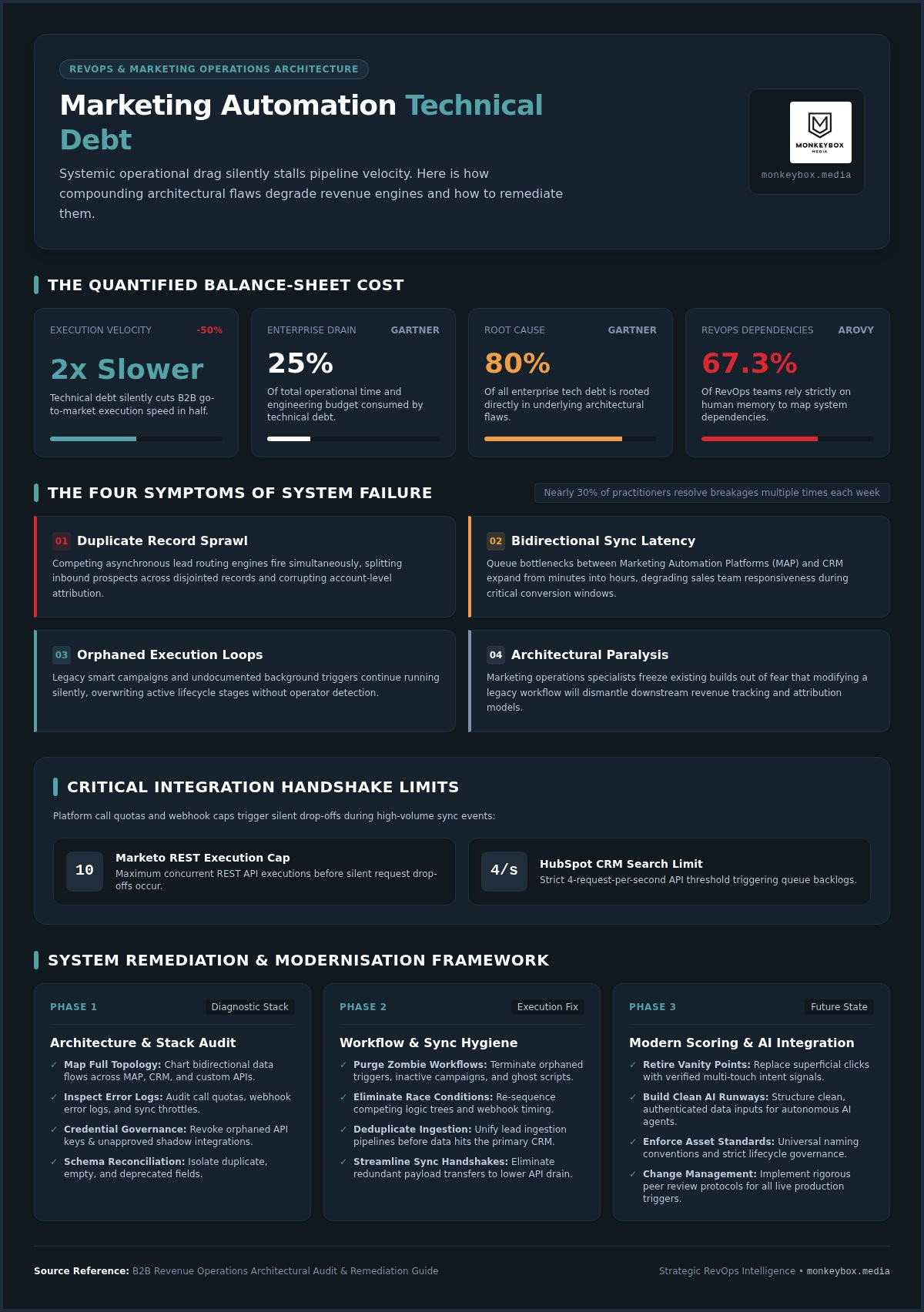
Systemic decay within your marketing automation technical debt footprint reliably manifests across four operational flashpoints:
- Duplicate Record Sprawl: Competing asynchronous lead routing engines fire simultaneously, splitting inbound prospects across disjointed records and corrupting account attribution.
- Bidirectional Sync Latency: Queue bottlenecks between MAP and CRM platforms expand from minutes into hours, degrading sales responsiveness during critical conversion windows.
- Orphaned Execution Loops: Legacy smart campaigns continue modifying production records in the background, quietly overriding active lifecycle stages without detection.
- Architectural Paralysis: Marketing operations specialists freeze existing builds, terrified that altering a legacy workflow will dismantle downstream revenue tracking.
Quantifying the Cost: Lost Speed, Bad Data, and Burnout
This friction carries an undeniable balance-sheet cost. Gartner reports that technical debt consumes roughly 25% of enterprise operational time and engineering budget, with 80% of all debt rooted in architectural flaws. In RevOps environments, research from Arovy revealed that 67.3% of revenue operations teams identify system dependencies manually from memory, with nearly 30% of practitioners resolving breakages multiple times each week. This constant firefighting destroys pipeline attribution, degrades inbound conversion velocity, and burns out high-performing talent forced to untangle broken plumbing instead of scaling revenue.
Phase 1: The Diagnostic Stack and Architecture Audit Checklist
You cannot dismantle what you cannot see. Auditing marketing automation technical debt requires an unsparing inventory of every platform, integration pipe, and background sync handshake powering your revenue engine. Modern revenue stacks don't fail because of isolated software glitches. They collapse under the weight of unmapped dependencies. Map the architecture first, then surgically cut the bloat.
Full-Stack Inventory and Integration Mapping
Begin by cataloging every connected endpoint across your MAP, CRM, enrichment providers, and intent engines. Document every data highway:
- API Limits and Error Logs: Inspect platform call quotas and webhook error logs. Flag bottlenecks like Marketo's 10 concurrent REST execution cap or HubSpot's strict 4-request-per-second CRM search limit before they trigger silent drop-offs.
- Topology Diagrams: Chart bidirectional data flows between systems. Pinpoint every latency point and untracked middleware script.
- Credential Governance: Audit administrative permissions. Revoke orphaned API keys and dismantle shadow martech integrations deployed without operational oversight.
Schema and Data Dictionary Reconciliation
Database bloat silently pollutes reporting and stalls campaign execution. Reconciling your schema restores cross-platform data reliability:
- Field Deprecation: Isolate duplicate, empty, and deprecated custom properties across your MAP and CRM. Archive unused attributes to reduce sync payloads.
- Picklist Alignment: Standardize property values across systems. Incompatible dropdown options trigger validation crashes and strand leads in queue purgatory.
- Lifecycle Single Source: Lock in an ironclad definition for core lifecycle stages. Designate a single system of record for each status to eliminate circular overwrites.
Categorizing Technical Liabilities by Risk and Effort
Not all technical debt carries equal weight. Group every identified liability into three distinct tiers: Critical (sync failures, API threshold breaches, circular sync loops), Moderate (unsequenced lead routing, unpruned scoring programs), and Cosmetic (inconsistent naming conventions, obsolete email templates). Prioritize fixes using a high-impact, low-effort matrix to unlock operational velocity quickly.
As research from MIT Sloan on managing technical debt in the AI era demonstrates, eliminating core architectural liabilities before layering advanced automated tooling is the only way to avoid compounding failure. If your internal team lacks bandwidth to diagnose these points of friction, engaging seasoned marketing ops support can accelerate this diagnostic phase and establish an unshakeable operational baseline.
Phase 2: Workflow, Sync, and Data Hygiene Remediation Checklist
Dismantling accrued marketing automation technical debt requires tactical execution, not passive observation. According to McKinsey's research on technical debt, legacy liabilities consume between 20% to 40% of an enterprise tech estate's total value while siphoning up to 20% of new project resources. In revenue marketing, this drag appears as compounding execution friction. Remediating it demands systematic pruning of zombie logic, restructuring unstable triggers, and purging toxic database records.
Decommissioning Zombie Campaigns and Deprecated Rules
Deactivate legacy bloat systematically. Dormant automation assets silently consume execution queues and skew reporting accuracy:
- Archive Inactive Workflows: Identify and deactivate all trigger programs and smart campaigns that have seen zero activity over the past 12 months.
- Protect Live Conversion Points: Before turning off legacy programs, verify that form endpoints, tracking parameters, and inbound webhook listeners are safely mapped to active operational workflows.
- Preserve Change History: Log every deactivated asset within a central registry. Include the deprecation date, previous owner, and functional dependencies to maintain clear compliance records.
Eliminating Trigger Loops and Race Conditions
Asynchronous executions operating without rigid sequencing cause race conditions. When three independent programs attempt to evaluate a new lead at the exact same second, assignment failures follow:
- Centralize Master Routing: Consolidate fragmented, single-action workflows into a single master orchestration flow per lifecycle stage. Replace competing triggers with clean sequential steps.
- Implement Enrichment Delay Buffers: Insert deliberate 60-to-120-second wait steps after initial form fills. Allow third-party enrichment tools to write data fully before routing rules execute.
- Batch Non-Critical Operations: Offload routine processes like historical lead scoring or non-urgent status updates to scheduled off-peak batches. This preserves API bandwidth for real-time sales actions.
Deep Database Hygiene and Standardization Protocols
A corrupted database directly erodes sender reputation and pipeline velocity. Strict mailbox provider enforcement from Google, Yahoo, and Microsoft penalizes dirty databases. Keep spam complaints under the mandatory 0.3% threshold by aggressively cleaning dirty records. Purge hard bounces, chronic unopens, and unauthenticated addresses immediately. Standardize core firmographic fields using deterministic picklists to ensure routing engines fire accurately every time.
Phase 3: Modernising Scoring, Routing, and AI Integration
Deploying advanced intelligence on top of unpruned architectural clutter is a recipe for expensive failure. While roughly 45% of marketing organizations now use agentic systems to run operational routing and workflow hygiene, layering artificial intelligence over unresolved marketing automation technical debt simply automates bad decisions faster. Upgrading your execution engine requires dismantling legacy heuristic models, refining data pipelines, and establishing deterministic frameworks before introducing autonomous logic.
Refactoring Fit vs. Behavioral Lead Scoring Models
Scrap point-accumulation models that award arbitrary scores for superficial engagements like downloading a top-of-funnel whitepaper. Transition toward a dual-axis framework:
- Fit Qualification: Isolate explicit firmographic and demographic data. Score accounts strictly against ideal customer profile (ICP) parameters like company revenue, tech stack compatibility, and verified job titles.
- Intent-Driven Behavior: Track high-conviction actions such as pricing page views, review site visits, and interactive demo engagements. Implement aggressive 30-day behavioral decay rules to prevent stale activity from triggering false sales alerts.
- Negative Attributes: Deduct significant points for personal email domains, student titles, career page visitors, and active competitors to keep your pipeline clean.
Optimizing Lead-to-Account Matching and Routing Precision
Lead-to-account matching logic must eliminate manual sorting entirely. Implement deterministic domain matching paired with fuzzy logic algorithms to bind inbound leads instantly to their parent CRM account records. Map routing rules directly to dynamic territory tables rather than hardcoding representative names into individual campaign steps. Connect these routing engines to real-time notification endpoints to shrink outbound follow-up latency from hours down to minutes.
Preparing Clean Data Architecture for Autonomous AI Agents
Autonomous agents require immaculate, structured data environments to function effectively. Under modern regulatory requirements, including algorithmic transparency rules under the EU AI Act, automated lead profiling systems must operate with structured inputs and auditable decision trails. Feed algorithms standardized picklists and clean lifecycle stages, not fragmented text fields. Establish strict boundary controls so autonomous agents operate within verified operational guardrails with human oversight for high-value sales handoffs.
If your stack is weighed down by legacy heuristics and disjointed triggers, you must architect the foundation correctly. Partner with Monkeybox Media to deploy production-ready AI agents that accelerate revenue execution without adding operational complexity.
The Governance Playbook: Preventing Technical Debt Recurrence
Remediating system decay is pointless if poor operational habits rebuild it within two quarters. Sustainable pipeline velocity demands structural governance. Without strict protocols, unchecked marketing automation technical debt inevitably creeps back into your platform. Revenue leaders must treat marketing automation platforms with the same architectural discipline, change control, and peer review required by core software engineering.
Standard Operating Procedures and Naming Architecture
Enforce standardized operational hygiene across your entire organization. Structural chaos begins with casual asset creation:
- Predictable Taxonomy: Mandate an ironclad naming format:
[Type]_[Region]_[Audience]_[YYYYMM]_[ProgramName]. Standardized labels keep assets instantly searchable and auditable. - Architecture Decision Records (ADRs): Require concise design documentation before deploying complex, multi-stage workflows or custom webhook listeners. Define the business rationale, expected inputs, downstream dependencies, and planned review dates.
- Centralized Changelog: Maintain an active log of every production logic modification, property update, and system deprecation. Eliminate dangerous reliance on tribal knowledge.
Change Management and Sandbox Testing Discipline
Production instances are not development testing environments. Pushing unverified logic directly into live prospect journeys invites catastrophic pipeline breaks:
- Sandbox Validation: Run end-to-end tests inside dedicated sandbox environments. Validate edge cases, API call efficiency, and field sync mappings before executing production rollouts.
- Role-Based Access Governance: Lock down global administrative credentials. Restrict custom field creation, webhook generation, and integration access to verified platform architects.
- Mandatory Peer Reviews: Institute a strict four-eyes principle. Require a second revenue operations specialist to inspect payload configurations and branch dependencies before activating any major workflow.
Quarterly Audit Cadence and Executive Leadership Alignment
Establish recurring 90-day technical audits to benchmark platform throughput, sync queue latency, and database health. Present these operational findings directly to executive leadership alongside pipeline velocity and revenue attribution. When leadership treats architectural integrity as a strategic revenue driver, execution friction evaporates.
Sustaining this discipline requires specialized expertise. Partnering with seasoned marketing operations consulting ensures your architecture stays clean, resilient, and continuously aligned with aggressive go-to-market scale.
Dismantle the Drag to Accelerate Your Revenue Engine
Eliminating marketing automation technical debt is not merely a database cleanup exercise. It is a strategic growth mandate. Purging zombie workflows, reconciling fragmented sync schemas, and enforcing strict change governance transforms your platform from a fragile bottleneck into an agile revenue driver. Clean systems don't just protect pipeline integrity; they create the essential operational runway required to deploy high-impact AI agents.
Do not let legacy shortcuts compromise your market expansion. Sustainable scale demands senior-level operational architecture, rigorous data discipline, and an unyielding commitment to system integrity. Eliminate your technical debt with Monkeybox Media's strategic marketing operations and turn your automated stack into an unstoppable, high-velocity growth engine.
Frequently Asked Questions
What is marketing automation technical debt?
Marketing automation technical debt is the compounding operational friction created by temporary, undocumented software patches, orphaned triggers, and unmapped database properties. When teams build rapid workarounds to launch short-term campaigns without architectural oversight, they accumulate hidden drag. Over time, these expedient fixes trigger circular sync errors, slow down execution speed, and turn standard updates into high-risk troubleshooting exercises across your CRM and automation platforms.
How do I know if my marketing automation stack has critical technical debt?
You have critical debt if your team fears modifying legacy workflows, bidirectional sync delays exceed acceptable windows, or lead attribution frequently breaks. Tangible red flags include hundreds of dormant smart campaigns, duplicate field mappings between your MAP and CRM, and recurring API rate-limit errors during peak inbound hours. If operations teams must constantly resolve data conflicts manually from memory rather than clear documentation, your architecture is compromised.
Can technical debt in marketing automation impact email deliverability?
Yes, technical debt directly degrades domain reputation by triggering mailbox provider spam filters and deliverability blocks. Forgotten autoresponders, outdated subscription centers, and unpruned contact lists cause spam complaint rates to climb above the mandatory 0.3% threshold enforced by Google and Yahoo. When legacy systems send unauthenticated traffic lacking proper DKIM, SPF, or DMARC alignment, mailbox providers reject or quarantine your primary domain's outbound messages.
How often should a B2B enterprise audit its marketing automation architecture?
B2B enterprises should conduct a comprehensive architectural audit every 90 days, supplemented by continuous sprint-level hygiene reviews. A quarterly cadence prevents minor marketing automation technical debt from solidifying into systemic failure points. During these structured reviews, revenue operations teams must evaluate API utilization quotas, deprecate unused assets older than 12 months, verify webhook health, and align lifecycle stage tracking directly with executive revenue reporting requirements.
Why does marketing technical debt derail AI agent implementation?
Marketing technical debt derails AI agents because autonomous systems require deterministic, highly structured data to execute reliable decisions. Feeding an autonomous agent fragmented customer records, duplicate fields, and unpruned scoring logic causes hallucinated routing and erroneous prospect communications. Autonomous models can't discern unwritten operational context. Without a clean, governed marketing operations infrastructure, deploying AI simply accelerates execution errors across your entire customer lifecycle.
Is it better to refactor an existing marketing automation setup or migrate entirely?
Refactoring is usually faster and more cost-effective unless the underlying data model is completely corrupted beyond repair. Migrating to a new platform without addressing your team's operational habits simply moves your existing organizational dysfunction into fresh software. A disciplined remediation sprint clears away obsolete workflows, fixes synchronization latency, and establishes strict governance. Reserve full migrations for scenarios where your existing platform can't satisfy modern API concurrency or architectural compliance demands.