
While 91% of B2B marketers report active AI usage in 2026, fewer than 33% have actually deployed autonomous agentic capabilities. Most are still trapped in the coordination tax of linear macros. You know the frustration of managing a bloated HubSpot or Marketo instance where automation is just a series of fragile "if-then" statements. Technical debt is mounting. Headcount costs for manual data reconciliation are cannibalizing your margins. Fragmented data silos continue to turn your sophisticated tools into expensive filing cabinets. It's time to stop managing software and start orchestrating intelligence.
This guide provides the blueprint to break that cycle. You'll master the transition from static marketing process automation AI to autonomous agentic workflows that plan, execute, and self-correct with surgical precision. We're moving beyond simple triggers into a world of closed-loop execution. This is about building a GTM engine that scales aggressively without a linear increase in headcount. We'll audit your infrastructure for agent-readiness, deploy cross-platform frameworks, and establish a clear roadmap for full-scale implementation. The era of the human-in-the-loop bottleneck is ending. Let's build the replacement.
Key Takeaways
- Shift from deterministic macros to probabilistic marketing process automation AI to eliminate the coordination tax and drive autonomous GTM execution.
- Execute a rigorous infrastructure audit to purge technical debt and unify fragmented data, preventing AI hallucinations and operational friction.
- Navigate the "Black Box" dilemma by strategically balancing platform-native tools with custom agentic architectures for maximum scalability and control.
- Follow a surgical implementation blueprint to engineer specific agent personas and inject high-level GTM context into your autonomous workflows.
- Anchor your AI engine with Fractional CMO oversight to maintain brand integrity and align every automated action with aggressive growth targets.
Beyond Macros: The Evolution of Marketing Process Automation AI in 2026
The era of linear macros has ended. In its place, marketing process automation AI has evolved into a workforce of autonomous agents capable of reasoning, planning, and execution. If your GTM strategy still relies on rigid "If-This-Then-That" logic, you aren't just behind; you're bleeding revenue. Traditional systems were built for a slower world. The coordination tax of human-managed workflows is now too high for high-growth B2B engines to bear. You need a system that thinks, not just one that triggers.
Deterministic vs. Agentic Automation
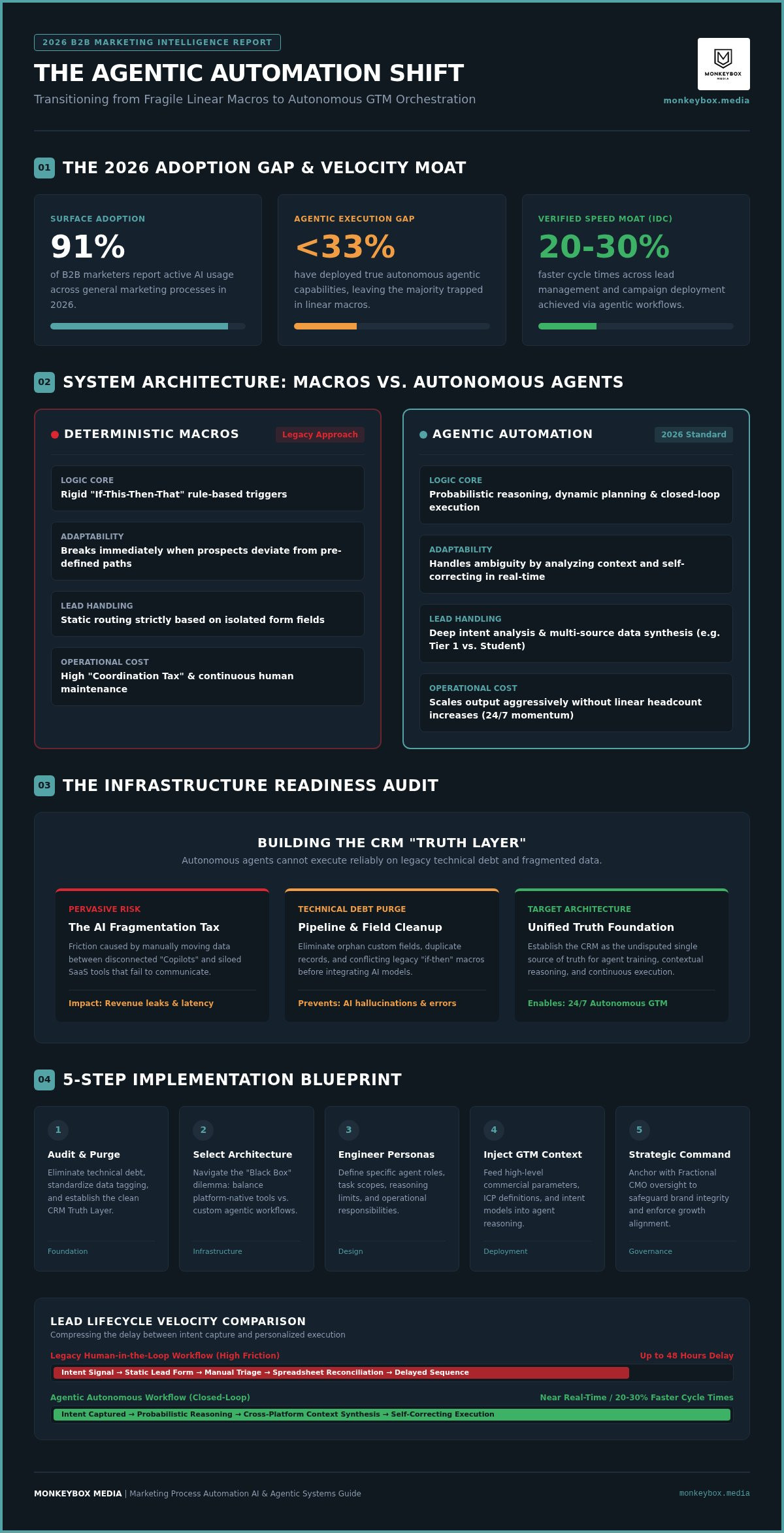
Deterministic automation is rule-based and fragile. It breaks the moment a prospect deviates from a pre-defined path. These systems are rigid architectures that require constant human maintenance to remain functional. Agentic AI, by contrast, is probabilistic. These systems handle ambiguity by analyzing context and self-correcting in real-time. While traditional marketing automation simply routes a lead based on a form field, an agentic system qualifies that lead through deep intent analysis and cross-platform data synthesis. It doesn't just follow a map. It navigates the terrain. It understands that a "request a demo" click from a Tier 1 account requires a different sequence than the same click from a student. It adapts the workflow autonomously.
The 2026 B2B Landscape: Why Speed is the Only Moat
Speed is the only sustainable moat in 2026. The customer journey has compressed significantly as buyers use their own AI agents to vet vendors and filter out noise. Organizations deploying agentic workflows report 20% to 30% faster cycle times across lead management and campaign deployment. Traditional teams are bogged down by the "AI fragmentation tax," which is the friction of moving data between disconnected "Copilots" that can't communicate. Autonomous agents eliminate this friction. They maintain 24/7 GTM momentum, ensuring that no signal is missed and no opportunity is delayed. This isn't just about efficiency. It's about structural competitive advantage. Waiting to automate process-heavy tasks isn't a minor oversight; it's a massive revenue leak that compounds daily. The Agentic Marketing Stack allows you to scale output without a linear increase in headcount, turning your operations into a high-velocity growth engine.
The Infrastructure Audit: Preparing Your Marketing Ops for AI Integration
Scaling marketing process automation AI requires more than just an API key. It demands a structural reset of your entire operations layer. You cannot build autonomous workflows on a foundation of fragmented data and legacy technical debt. If your CRM is currently a graveyard of orphan custom fields, conflicting duplicate records, and inconsistent tagging, your agents will fail. They will hallucinate. They will trigger erroneous outreach that damages your brand. They will burn through expensive usage credits on dead-end leads. Before deploying your first agent, you must establish a "Truth Layer" where your CRM serves as the undisputed, clean source for AI training and execution.
Identifying High-Impact Workflows for Automation
Don't fall into the trap of automating for the sake of novelty. Start by mapping your entire GTM journey to identify high-friction, high-volume tasks. Audit your lead research, content distribution, and monthly reporting cycles. You need to rank these workflows by their automation potential versus their strategic value. Focus on the bottleneck processes where human intervention currently delays revenue generation. If it takes 48 hours for a lead to move from a high-intent signal to a personalized outreach sequence, you have a structural leak. Organizations that fix these gaps and deploy agentic workflows report 20% to 30% faster cycle times according to 2026 IDC data. These are the high-impact areas where marketing process automation AI delivers the fastest ROI by compressing the sales cycle and maintaining 24/7 momentum.
Cleaning the Pipeline: The Technical Debt Audit
Technical debt is the silent killer of agentic efficiency. You must standardize naming conventions and data tagging to ensure your AI can actually "read" the environment it's operating in. Legacy automations, those rigid "if-then" macros that served you in previous years, often conflict with the probabilistic reasoning of modern AI agents. Purge the redundant systems that no longer serve your strategy. Robust API connectivity across your entire marketing technology stack is non-negotiable to avoid the AI fragmentation tax that slows down traditional teams. This isn't just a technical requirement; it's a governance necessity. Aligning your operations with the NIST AI Risk Management Framework ensures you have the guardrails in place to monitor and audit autonomous systems effectively. A fragmented stack is an expensive liability that prevents AI from being effective. If your current infrastructure feels like a collection of disconnected tools, a strategic marketing ops audit can identify the exact levers needed to prepare your engine for autonomous scale.
Architecture Selection: Platform-Native AI vs. Custom Agentic Workflows
Choosing your architecture is a strategic fork in the road. You can't afford to get this wrong. Most B2B firms default to platform-native tools because they're already embedded in the existing stack. HubSpot Breeze and Salesforce Agentforce offer turnkey solutions that integrate directly with your CRM context. These are excellent for top-of-funnel tasks like lead enrichment or basic prospecting. However, they present a "Black Box" problem. You lose granular control over the reasoning logic. You're restricted by the vendor's guardrails. For a high-velocity marketing process automation AI strategy, relying solely on native features often leads to strategic stagnation. You're playing by someone else's rules. Execution becomes generic.
Evaluating Native AI Features in Your CRM
Native "Copilots" are designed for the average user. They prioritize ease of use over surgical precision. While they excel at drafting emails or summarizing deals, they often struggle with complex, multi-step GTM strategies that require cross-platform orchestration. Salesforce's Agentforce, for instance, uses a consumption-based model with Flex Credits priced at $500 per 100,000 units. This simplifies billing but can become an operational bottleneck if your workflows are inefficient. Native tools are "good enough" for standard TOFU tasks. They aren't enough for a dominant market position. You need more than a generic assistant to win in 2026.
The Case for Custom AI Agents
Bespoke agents are the answer for proprietary outbound and deep research tasks. By building custom frameworks using LangGraph or CrewAI, you maintain absolute control over the model routing. You can choose Claude 3.5 Sonnet for reasoning or GPT-4o for speed. This isn't just about performance; it's about security. Custom architectures orchestrated via the Model Context Protocol (MCP) keep your proprietary GTM data out of public training sets. You own the "brain" of your operation. This is your IP.
Agent orchestration is the next frontier. Making different AI tools talk to each other creates a seamless execution layer that native platforms can't match. You can fine-tune model parameters to mirror your specific brand voice with a level of nuance that "out-of-the-box" tools lack. The cost-benefit analysis is clear. While custom builds require higher upfront investment, the long-term headcount savings and increased output quality outweigh the initial friction. You aren't just buying a tool. You're building a proprietary asset. Dominance requires a stack that you control, not one you rent. Build the machine that builds the business.
The Implementation Blueprint: A 5-Step How-To for AI Process Automation
Execution is where strategy lives or dies. To transition from static workflows to a high-velocity engine, you need a rigorous deployment framework. This isn't about toggling a setting in your CRM. It's about engineering a digital workforce. Follow this five-step blueprint to implement marketing process automation AI with surgical precision.
First, define the Agent Persona. You must establish specific operational boundaries. An agent without a scope is a liability. Second, engineer the Context Injection. This ensures the AI understands your unique GTM strategy. Third, build Human-in-the-loop (HITL) safety valves. Brand protection is non-negotiable. Fourth, pilot the agent in a controlled, low-risk environment. Internal reporting or data enrichment are ideal testing grounds. Finally, move to full-scale deployment. Use iterative performance tuning to sharpen the engine as it gathers real-world data. This methodical approach eliminates the "AI fragmentation tax" and ensures every autonomous action contributes to your ARR targets.
Prompt Engineering for Marketing Operations
Effective orchestration requires moving beyond simple, one-off prompts. You must implement complex Chain of Thought instructions that force the AI to reason through its execution path. Standardizing prompt libraries across the marketing department ensures consistency and prevents "shadow AI" from corrupting your data. Context Injection is the process of feeding specific B2B personas and GTM goals into an LLM. By grounding the model in your specific market reality, you reduce hallucinations and increase the relevance of every output. Precision in your instructions dictates the quality of your results. Don't settle for generic responses when you can engineer expert-level execution.
Establishing Human-in-the-Loop (HITL) Protocols
Autonomy does not mean abdication. You must set Confidence Thresholds for every autonomous action. If an agent's reasoning falls below a 95% confidence score, it must trigger a manual review. Designing a streamlined approval interface for AI-generated outbound and content prevents bottlenecks while maintaining quality control. Your team's role will shift. They are no longer "doers" of repetitive tasks. They are now AI editors and orchestrators. This transition reduces operational friction and allows your talent to focus on high-level strategy. If you're ready to stop managing manual tasks and start leading an autonomous engine, our team specializes in building custom AI agents that integrate directly into your GTM stack.
Strategic Command: Governing Your AI-Driven Marketing Engine
Governance is the difference between a high-performance engine and a structural liability. Most firms treat AI as a series of disconnected experiments. This is a strategic failure. To master marketing process automation AI, you need absolute strategic command. This involves aligning every autonomous action with your high-level GTM strategy and brand positioning. You aren't just automating tasks; you're automating your market reputation. Without executive-level oversight, autonomous agents can quickly drift from your core messaging, creating a chaotic brand experience that confuses prospects and erodes trust.
Measuring success in 2026 requires a fundamental shift in perspective. Traditional metrics like "time saved" are insufficient for high-stakes decision-makers. You must focus on the "New ROI": velocity, volume, and conversion accuracy. How fast can your agents move a lead through the funnel without human intervention? Is the output consistently accurate across every touchpoint? High-velocity engines thrive on precision, not just speed. You need a dashboard that tracks the reasoning quality of your agents alongside your standard revenue targets.
Future-proofing your engine means building for inevitable change. Your stack must be modular. The AI model that leads the market today, whether it's GPT-4o or Claude 3.5 Sonnet, may be obsolete in six months. A robust architecture allows you to swap models or update your "brain" layer without rebuilding the entire system. This flexibility is your ultimate defense against technical obsolescence. It ensures your marketing process automation AI remains at the cutting edge of performance without requiring a total infrastructure overhaul every time a new LLM drops.
The Fractional CMO’s Role in AI Orchestration
Strategic leadership is the bridge between technical execution and revenue goals. A Fractional CMO provides this oversight, ensuring that AI initiatives don't drift into technical vanity projects. They manage the cultural shift, moving the team from manual execution to AI-first operations. This isn't just about software; it's about people and processes. For a deeper dive into this strategic layer, see The Fractional CMO Agency Guide 2026: Scaling B2B Revenue with Strategic Authority. They ensure every agentic workflow serves the broader GTM mission and maintains brand integrity at scale.
Scaling the Engine: From Pilot to $10M+ ARR
Scaling from $1M to $10M+ ARR requires a system that grows without a linear increase in headcount. AI agents are the key to this expansion. They allow you to enter new markets and execute complex outbound strategies with minimal human overhead. This creates a continuous optimization loop. Real-world performance data feeds back into the strategy, sharpening the engine with every interaction. It's a self-improving machine that compounds your competitive advantage over time.
The transition to an autonomous marketing engine is complex. It requires a vision that balances technical mechanics with strategic oversight. Monkeybox Media acts as the architect of this high-octane transition. We don't just implement tools; we build the infrastructure for your next phase of growth. We align your marketing ops with your broader GTM strategy to ensure every credit spent is an investment in ARR. Let's engineer your dominance.
Dominate the Agentic Frontier
The transition from deterministic macros to autonomous reasoning is the most significant structural shift in B2B history. You've seen the roadmap. You understand that a clean "Truth Layer" and custom agent orchestration are the pillars of a high-velocity engine. Mastery of marketing process automation AI is no longer a luxury reserved for early adopters. It's the baseline for any firm serious about scaling from $1M to $10M+ ARR without drowning in headcount costs. The coordination tax is a relic; the future is autonomous.
To execute this transition with surgical precision, you need an architect who understands both the code and the commerce. Monkeybox Media provides the Fractional CMO leadership and sophisticated GTM strategy frameworks required to build a robust B2B marketing infrastructure. We don't just implement tools; we engineer growth engines designed for dominance. Scale your B2B engine with Monkeybox Media's AI Agent Implementation and secure your market position. The future belongs to the automated. Let's build it.
Frequently Asked Questions
What is the difference between marketing automation and AI process automation?
Marketing automation relies on rigid, rule-based logic to execute repetitive tasks. It follows a map. Marketing process automation AI uses autonomous agents to reason through ambiguity and self-correct based on real-time data. It navigates the terrain. While traditional systems wait for a specific trigger, agentic workflows identify objectives and plan multi-step execution paths independently. This shift eliminates the coordination tax that slows down traditional marketing operations.
How much can AI agents actually reduce marketing headcount costs in 2026?
Organizations deploying agentic workflows report 20% to 30% faster cycle times across lead management and campaign deployment. This efficiency allows B2B firms to scale from $1M to $10M+ ARR without a linear increase in headcount. AI agents don't just replace roles; they augment your capacity to enter new markets and manage complex GTM strategies. You reduce operational friction while significantly increasing the volume and quality of your output.
Is it better to use HubSpot's native AI or build custom agents via API?
HubSpot Breeze and similar native tools offer turnkey integration for top-of-funnel tasks like lead enrichment. They're perfect for teams needing immediate, low-complexity results. However, custom agents built via API provide the strategic control needed for proprietary outbound or deep research. Custom architectures keep your GTM data out of public LLM training sets and allow you to swap models as technology evolves. Dominance requires a stack you control.
How do I ensure AI-generated marketing content maintains our B2B brand voice?
Maintaining brand voice requires sophisticated context injection and standardized prompt libraries. You must feed specific B2B personas, GTM goals, and past successful content into the LLM as a reference layer. By using few-shot prompting and custom-tuned model parameters, you ensure the AI mirrors your brand's nuance. Human-in-the-loop protocols act as the final safety valve, allowing your team to move from doers to high-level orchestrators and editors.
What are the biggest risks when automating complex marketing processes with AI?
The primary risks include "garbage in, hallucination out" scenarios caused by uncleaned CRM data and technical debt. Redundant legacy automations often conflict with new agentic reasoning, leading to erroneous outreach. Regulatory compliance is also critical. Under the EU AI Act of August 2026, any automated bot communicating with leads must explicitly disclose its artificial nature. Failing to implement robust governance leads to brand damage and significant financial penalties.
How do I measure the ROI of AI agent implementation in my marketing ops?
ROI is measured through velocity, volume, and conversion accuracy rather than just time saved. Track how quickly a lead moves through your funnel and the precision of the agent's reasoning at each touchpoint. Look for a reduction in the coordination tax, the human effort previously required to reconcile data between tools. A successful implementation results in a scalable outbound engine that drives ARR growth without the bloat of traditional operations.
What is a 'Human-in-the-Loop' system in the context of AI marketing?
A Human-in-the-Loop (HITL) system establishes mandatory approval gates for high-risk autonomous actions. While the AI plans and drafts execution, a human operator must authorize budget allocations, public content publication, or legal disclosures. You set confidence thresholds; if an agent's reasoning score falls below your benchmark, it triggers a manual review. This protocol protects your brand while allowing the marketing process automation AI to handle the heavy lifting.
Can AI agents handle multi-channel GTM strategies autonomously?
Yes, AI agents use the Model Context Protocol (MCP) to connect disparate databases and marketing APIs into a unified execution layer. They can autonomously plan and deploy multi-channel GTM strategies by coordinating between your CRM, email platforms, and social channels. This orchestration ensures a cohesive brand message across all touchpoints. It allows your engine to maintain 24/7 momentum, identifying intent signals and responding instantly across the entire digital landscape.