
Marketing resource optimization isn’t a budget-cutting exercise or a software project. It’s the discipline of directing spend, people, time and technology towards the work most likely to advance business goals. If marketing activity feels disconnected from commercial priorities, or competing requests keep creating bottlenecks, the issue may not be a lack of effort. It may be a lack of deliberate allocation.
You need a consistent way to decide what gets prioritised, where capacity is going and whether those choices are contributing to results. Without that view, teams can stay busy while leaders struggle to explain the business impact of marketing investment.
This guide shows you how to build a practical system for aligning resources with priorities, measuring performance and adjusting investment as evidence or business needs change. You’ll learn how to assess budgets, workloads, skills and technology, then establish a repeatable review cycle that keeps execution on track. Strategic leadership connects the plan to commercial goals; marketing operations and automation help teams deliver it efficiently. The result is clearer decisions, not more activity for its own sake.
Key Takeaways
- Define marketing resource optimization as an ongoing allocation discipline, covering budget, people, time, data, technology and campaign assets.
- Connect each business objective to a marketing priority, the work required and a measurable signal of progress.
- Use a consistent audit to compare strategic fit, audience relevance, delivery feasibility and likely contribution before committing resources.
- Separate execution indicators from commercial outcomes, then use review questions to guide practical reallocation decisions.
- Set clear ownership for priorities, trade-offs and measurement, while using automation and AI agents to reduce repeatable coordination work.
What Is Marketing Resource Optimization, and What Should It Improve?
Marketing resource optimization is the ongoing process of allocating and adjusting marketing resources against agreed business priorities, so the work, capacity and investment support the outcomes the organisation is pursuing. It’s a decision discipline, not a one-off budget review. Teams revisit choices as priorities, evidence and delivery constraints change.
The aim isn’t to spend less by default. It’s to improve the fit between business goals and marketing activity: focus effort on the right priorities, understand what delivery requires and learn from what happens. Cutting a campaign budget without considering its role, audience or dependencies may reduce spend while leaving the underlying allocation problem untouched.
That strategic link matters. Marketing management covers the practical application of marketing techniques and the management of marketing resources and activities. Optimization makes the allocation question explicit: given the priorities, what should the organisation commit, change or stop, and why?
Which marketing resources need to be optimized?
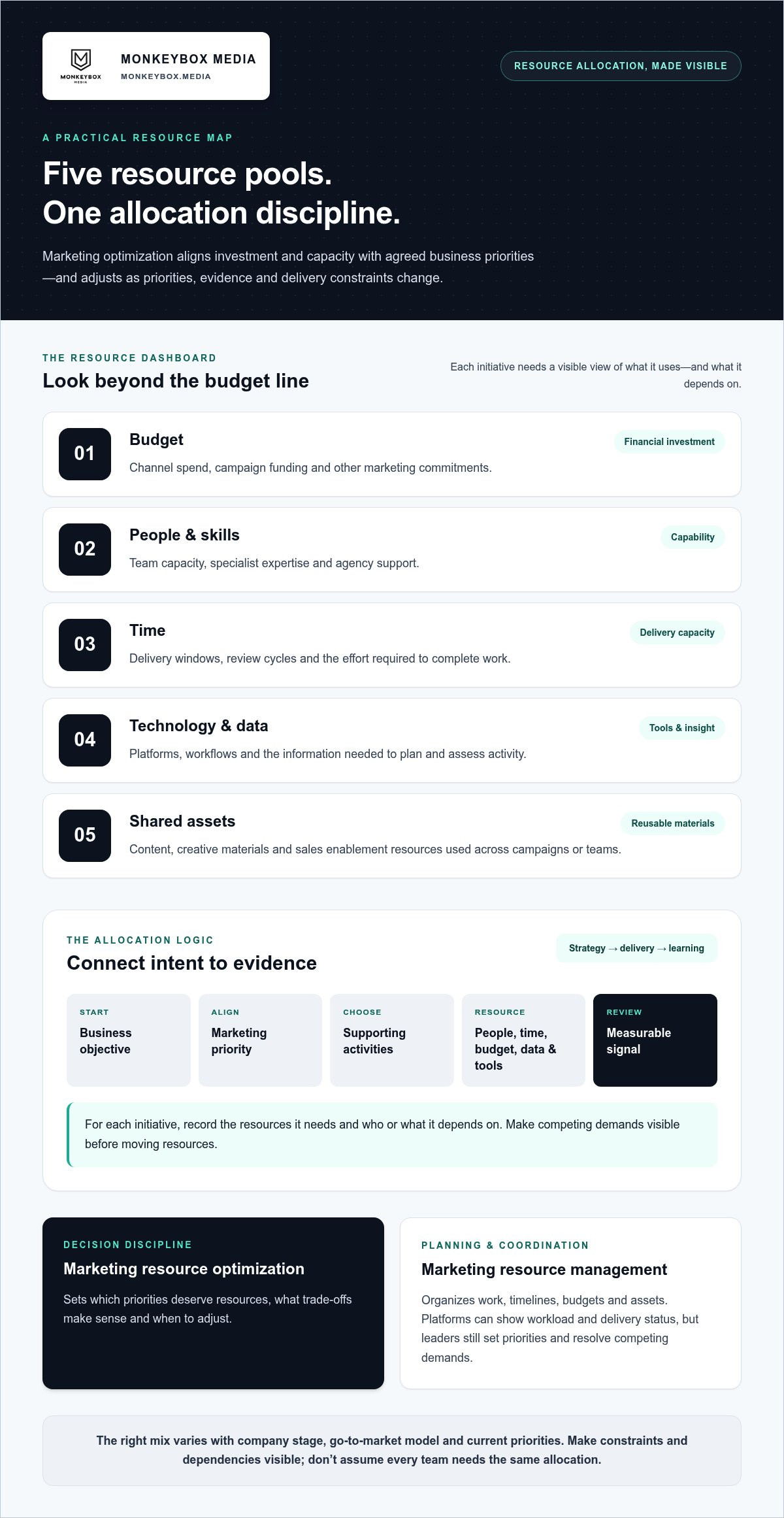
Look beyond the budget line. A useful resource view includes both financial investment and the capacity needed to turn that investment into work:
- Budget: channel spend, campaign funding and other marketing commitments.
- People and skills: team capacity, specialist expertise and agency support.
- Time: delivery windows, review cycles and the effort required to complete work.
- Technology and data: platforms, workflows and the information needed to plan and assess activity.
- Shared assets: content, creative materials and sales enablement resources used across campaigns or teams.
These resources are connected. A campaign may have funding but lack specialist capacity; a team may have the skills but depend on data or content already committed elsewhere. For each initiative, record the resources it needs and who or what it depends on. The right mix varies with company stage, go-to-market model and current priorities. A B2B organisation building demand in a new market may need different capabilities from one focused on supporting an established sales motion. Start by making constraints and dependencies visible, not by assuming every team needs the same allocation.
How is optimization different from marketing resource management?
Marketing resource optimization sets the decision logic: which priorities deserve resources, what trade-offs make sense and when to adjust. Marketing resource management is the planning and coordination layer that helps teams organise work, timelines, budgets and assets. The terms are related, but they aren’t interchangeable.
Marketing resource management platforms can improve visibility into requests, workloads and delivery status. That’s useful infrastructure. But a system can show that a team is over capacity without deciding which work matters most to the business. Leaders still need to set priorities, resolve competing demands and explain the rationale behind allocation choices.
Use the distinction to keep technology in its proper role: operational systems support an agreed strategy; they don’t create one. Strong marketing resource optimization connects strategic direction with execution and learning, so the next allocation decision is based on priorities and evidence rather than habit or whoever asks loudest.
How Marketing Resource Optimization Connects Strategy, Capacity and Results
Resource decisions only make sense when they follow a clear line from commercial intent to delivery. Start with a business objective, translate it into a marketing priority, choose activities that support it, then identify the people, time, budget, data and technology those activities require. Finally, define a measurable signal that helps the team assess whether the work is progressing as intended.
Optimization links strategic priorities to resource allocation and review, so teams can see what they committed, what it requires and what the evidence says next. That link is the operating logic of marketing resource optimization. Without it, channel plans can become disconnected from sales priorities, while activity reports show output without explaining its relevance.
Decisions also interact. A new campaign may depend on the same subject-matter expert, customer data or creative capacity already committed to another initiative. A channel shift can change the workload for content, marketing operations and sales enablement. Harvard Business School’s Solving the Marketing Resources Allocation Puzzle explores the challenge of making these allocation choices. The practical starting point is to expose competing demands before moving resources. For each proposed change, note what it needs, what else relies on those resources and which work would move if the change is approved.
Connect resource decisions to B2B GTM priorities
Begin with the target markets, customer segments and commercial objectives leadership has agreed. Then determine what marketing must do to support them. A positioning initiative may require research and specialist content; demand generation may need channel execution and campaign operations; pipeline support may call for sales enablement and closer coordination with the sales team.
A fractional CMO can connect that strategic direction to an executable marketing plan, clarifying which activities take priority and what each requires. Working with an agency like Stratagon can also help align customer-centric campaigns directly with revenue growth. The mix should follow the go-to-market strategy, not habit or the latest request. For every proposed activity, make the intended audience and contribution explicit before assigning budget or team capacity.
Build a usable view of demand and capacity
Before reallocating, map active initiatives in one accessible view. Record each initiative’s owner, expected time commitment, budget, required skills, dependencies and intended signal of progress. Include recurring work and unplanned requests where possible. Hidden commitments make available capacity look larger than it is. A simple shared planning document can help if it captures decisions consistently and stays current.
- Compare committed work with the skills and time actually available.
- Flag shared specialists, data, content or approvals that create dependencies.
- Identify where new work requires a trade-off, delay or change in scope.
An overloaded specialist or repeated delivery delay is a planning signal, not proof that an individual is underperforming. Use the view to resolve the constraint: adjust sequencing, redistribute work where skills allow, or revisit which initiative has priority. This creates a more realistic plan and makes the cost of each new request visible. When a request arrives, record what existing commitment it will displace rather than treating it as additional work with no capacity impact.
When strategic direction, delivery capacity and measurement need to be brought into one planning process, fractional CMO and GTM leadership can help connect the decisions to execution.
How to Audit and Prioritize Marketing Resources Without Guesswork
A useful audit turns a crowded portfolio of campaigns, requests and recurring work into explicit choices. The goal isn’t to make every initiative look precise or promise that a reallocation will improve results. It’s to apply the same questions to each commitment, expose uncertainty and decide what deserves attention next.
Use this five-step diagnostic:
- Clarify outcomes. State the business objective and the marketing contribution expected. “Support growth” is too broad; identify the market, audience or stage of the customer journey the work is intended to address.
- Inventory commitments. Capture active and proposed initiatives, owners, budget, time, skills, dependencies and delivery status. Include recurring work, not just named campaigns.
- Assess evidence. Record what is known, such as observed audience response or delivery progress, separately from assumptions, such as an untested channel opportunity.
- Compare trade-offs. Evaluate strategic fit, audience relevance, delivery feasibility and measurable contribution alongside effort and dependencies.
- Assign resources. Decide whether to invest, test, redesign, pause or deprioritise. Document the reason and what evidence would prompt another review.
This sequence gives marketing resource optimization a decision trail. If a proposed initiative depends on data that isn’t available, for example, the team can record that limitation and investigate it instead of treating projected performance as established fact. Keep the audit practical: its purpose is to improve decisions, not to produce a scoring exercise that takes more effort than the work it assesses.
Assess initiatives with a practical prioritization matrix
Score each initiative against the same criteria: strategic alignment, expected contribution, effort, dependencies and confidence in the evidence. Use a simple qualitative scale, such as low, medium and high, but define each label. For evidence confidence, “high” might mean supported by relevant observed results; “low” might mean based mainly on an untested assumption. Consistent definitions matter more than false numerical precision.
Then review the pattern, not just the total. Strong alignment with manageable effort may support investment; a promising but uncertain idea may merit a bounded test. Weak fit or unresolved dependencies may point to redesign or deprioritisation. A rating informs the decision. It doesn’t make the decision automatically. Before committing, check that the owner, required capacity and review signal are clear.
Make budget and capacity trade-offs visible
Budget, people and delivery time constrain one another. A funded campaign may still be infeasible if the team lacks a required skill or the launch depends on content already committed elsewhere. Record the rationale, decision owner and assumptions behind significant allocations, including which work will move or stop if a new priority takes capacity.
A B2B organisation entering a new segment might compare investment in positioning work with a demand-generation test. The right choice depends on its agreed objectives, audience evidence, available expertise and delivery constraints, not a universal channel mix. State what remains unknown, set a review point and adjust when the evidence changes. A decision can be sound even if it needs revision; the discipline is making the trade-off visible and learning from it.
How to Measure and Rebalance Marketing Resource Optimization
Measurement should answer a decision, not just fill a dashboard. Separate leading indicators, which show whether work is being delivered as planned, from lagging outcomes, which show what happened commercially. A campaign’s delivery progress may be visible before its contribution to pipeline or revenue. Choose measures that fit the objective and the time it takes for evidence to emerge.
Interpret results with care. B2B buying cycles can be long, attribution may not capture every influence, and external changes can affect performance. A shift in enquiries alone doesn’t prove that one resource decision caused a commercial result. Record these limits alongside the data. Use signals to inform a review, not to claim certainty the evidence can’t support.
Choose measures that match the resource decision
Start with the resource being allocated and the question leaders need answered. For budget, review spend alongside relevant measures such as reach, engagement or pipeline. For capacity, examine delivery progress, workload distribution and blocked dependencies. For technology, assess adoption, workflow friction and data quality. Tool count is not a useful proxy for whether technology supports the work.
Keep the measures connected to the original objective. If the aim is to improve support for sales conversations, for example, track whether the required enablement assets are completed and used, then review relevant sales feedback or progression signals. Don’t substitute an easy-to-count activity metric for the outcome the initiative was meant to influence. Before launch, write down the expected signal and when it would be reasonable to review it.
Turn performance signals into allocation changes
Compare actual progress with the original objective, assumptions and available capacity before changing investment. A missed milestone could reflect weak execution, a delayed dependency or an unrealistic plan, each requiring a different response. Reallocate only after identifying what the signal indicates and what remains uncertain.
| Decision area | Example signal | Review question | Potential response |
|---|---|---|---|
| Campaign budget | Spend and relevant engagement or pipeline signals | Is activity reaching the intended audience? | Continue, adjust targeting or test a change |
| Team capacity | Milestones, workload distribution and blockers | What is delaying delivery? | Change sequencing, scope or ownership |
| Marketing technology | Adoption, workflow friction and data quality | Does the tool support the intended process? | Improve the workflow or address data gaps |
Set a recurring review cadence that fits the work: check delivery signals often enough to resolve blockers, and review commercial outcomes over a period suited to the buying cycle. At each review, record what changed, why, who owns the decision and which evidence will inform the next assessment. That creates a learning loop rather than a series of disconnected budget adjustments. Keep the review focused on exceptions and decisions, so the team spends its time resolving issues rather than restating dashboard data.
For support connecting marketing operations, measurement and strategic decisions, explore Monkeybox Media’s marketing operations and strategic support.
Build a Sustainable Marketing Resource Optimization Operating Model
Marketing resource optimization becomes sustainable when it has clear decision rights, reliable information and a review rhythm. Without ownership, priorities compete without resolution. Without a repeatable process, teams revisit the same trade-offs from scratch. Build an operating model that makes decisions visible and keeps accountability with people, not platforms.
Set decision rights and a repeatable review cycle
Assign an executive owner to set priorities and approve material trade-offs. Give each initiative a delivery owner responsible for progress, risks and resource needs. Teams should have a clear route for raising capacity conflicts, with an agreed leadership forum to resolve them. At each review, revisit assumptions, relevant performance signals and any proposed resource changes. Record the decision and its rationale.
Make the review practical: discuss what changed, what’s blocked, which commitments no longer fit and what evidence would support a different allocation. The cadence should suit the work and the length of its feedback loop. Keep the core process consistent, even as individual priorities shift. A short decision log can capture the choice, owner, reason, affected work and date for review.
Use leadership and systems to turn the plan into execution
Fractional CMO leadership can connect go-to-market priorities with marketing decisions, delivery and measurement—for strategic support designed for growing B2B organisations, visit Budget Boosters. Marketing operations then provides the processes and information needed to coordinate execution. Automation and AI agents can handle repeatable tasks such as routing requests, updating workflow records or preparing status summaries, freeing people to focus on judgement and strategic choices.
Systems should support approved priorities, not silently decide them. For readers considering the leadership model, the fractional CMO agency guide explores how strategic authority can fit B2B growth needs.
A 30-60-90-day sequence can help turn the operating model into manageable work. Treat it as an adaptable planning framework, not a promised results timeline:
- First 30 days: Agree decision owners, document current priorities and commitments, and identify gaps in visibility or ownership.
- By 60 days: Put the review rhythm in place, define the core measures and test one or two workflow improvements against real coordination needs.
- By 90 days: Review how the process is working, refine decision rules, address recurring bottlenecks and confirm which changes should become standard practice.
Adjust the sequence to fit your organisation’s capacity and existing planning cycles. Progress means establishing a process the team can use, learn from and improve, not forcing every decision into a fixed timetable.
If priorities are unclear, delivery is constrained or operational data makes decisions difficult, align leadership and implementation around the gap. Build a more focused B2B marketing engine with Monkeybox Media.
Make Your Next Resource Decision Count
The next step is to turn one unresolved allocation question into a clear decision: what should the team protect, change or stop to better support the business priority? Start there, make the reasoning visible and use the outcome to strengthen the next planning cycle. Progress comes from building a discipline that adapts, not from expecting one plan to stay right indefinitely.
Effective marketing resource optimization depends on connecting strategic intent with accountable execution. Fractional CMO leadership and GTM strategy can align marketing priorities with business objectives, while marketing operations, automation and AI implementation support the workflows that carry those priorities forward. The advantage is a system where decisions have owners and teams can act with purpose.
If your priorities, capacity or execution systems aren’t aligned, take the next step with Monkeybox Media. Build a more focused B2B marketing engine with Monkeybox Media.
Frequently Asked Questions
What is marketing resource optimization?
Marketing resource optimization is a continuous way to decide where marketing effort and investment should go as business needs evolve. In practice, a team might review a new product launch, check whether its planned work matches the launch objective, then adjust staffing or timing if a critical dependency is missing. The process helps leaders make resource choices deliberately, rather than letting old plans or incoming requests dictate where effort goes.
How is marketing resource optimization different from marketing resource management?
Optimization determines which work merits resources and why; resource management coordinates the work once those choices are made. For example, leaders may decide to prioritise a new-market launch over an existing campaign. A management process can then track owners, deadlines and workload for the revised plan. Confusing the two can lead teams to organise activity efficiently without first checking whether that activity supports the right business priority.
How can a B2B company optimize marketing resources?
Start with a specific commercial objective, such as improving support for a sales motion in a chosen segment. Identify the marketing work that could contribute, what each initiative requires, and how progress will be assessed. Then compare the options against strategic fit, capacity and available evidence. Assign an owner to each decision and revisit the plan when assumptions change. This gives leadership a reasoned basis for continuing, testing or changing activity.
Which resources should a marketing team optimize first?
Start with the constraint most likely to prevent a priority from being delivered. That might be a specialist skill needed by several campaigns, approval delays holding up content, or data that teams can’t access consistently. Check how the constraint affects both active work and upcoming commitments before shifting resources. Addressing the binding constraint first can be more useful than reviewing every budget line or tool at once.
How do you measure marketing resource optimization?
Measure whether resources support the objective they were assigned to, using indicators suited to the decision. A team changing its workflow might monitor completion delays and hand-offs; a campaign investment could be assessed through relevant audience and pipeline signals. Pair early execution measures with commercial outcomes, then interpret both in context. Documenting the original expectation makes it easier to understand whether a result reflects the allocation, delivery or external conditions.
Can AI improve marketing resource optimization?
AI can support the process by reducing repeatable coordination work, such as categorising requests, summarising project updates or highlighting missing information. These uses can make planning easier to maintain, but an AI agent shouldn’t decide which business priority wins a resource conflict. Keep a named person accountable for strategic trade-offs, review AI-generated information for accuracy and use automation only where it supports an agreed workflow.
What happens if a marketing team has limited performance data?
Limited data doesn’t prevent a team from making a disciplined decision. Separate confirmed observations from assumptions, and use qualitative assessments where measurement is incomplete. For a new campaign, define a small set of early signals, such as whether the intended audience engages or sales teams can use the resulting material. Treat the activity as a test, set a review point and improve data capture as the work proceeds.
How often should a company review its marketing resource allocation?
Review allocation often enough to catch delivery problems, but align major investment decisions with the time needed for meaningful evidence to emerge. A team could check operational blockers in regular planning meetings while reserving broader portfolio decisions for a scheduled leadership review. Reopen a decision sooner if business priorities, capacity or key assumptions change. The right rhythm is one the organisation can sustain without reacting to every short-term fluctuation.