
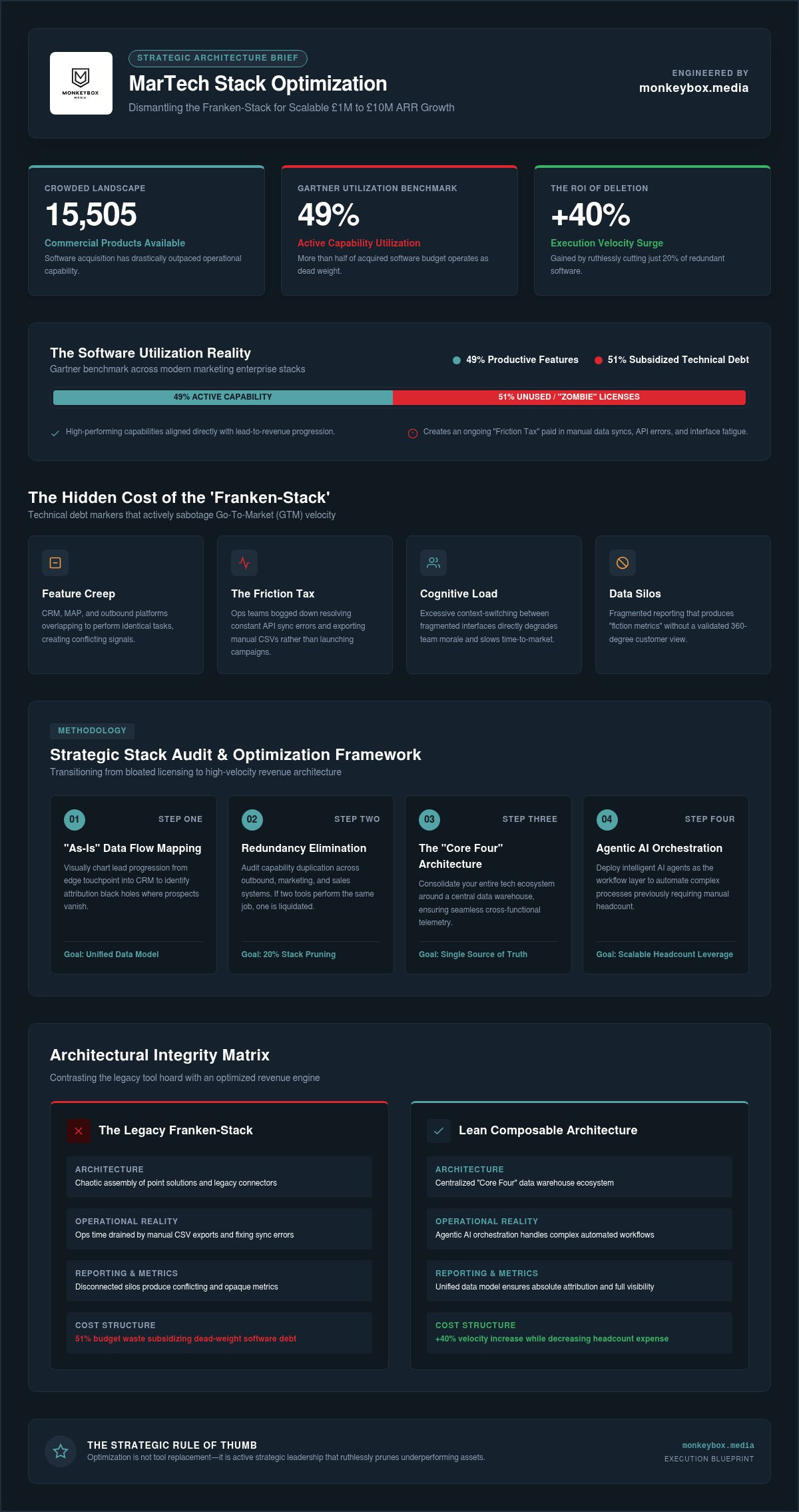
The average marketing organization utilizes only 49% of its purchased software capabilities. In a landscape now crowded with 15,505 products, more than half of your budget is effectively dead weight, subsidizing technical debt instead of driving ARR. Achieving marketing technology stack optimization is no longer about adding more tools; it's about architectural integrity. You've likely felt the friction of a "Franken-stack" where dozens of disconnected tools create data silos rather than a 360-degree customer view. Software acquisition has outpaced operational capability, leaving your team buried under manual workflows and opaque performance metrics.
We're here to fix that. This guide provides the 2026 execution blueprint for high-velocity growth. You'll learn how to engineer a powerful revenue engine by ruthlessly eliminating technical debt and deploying strategic AI agents across your infrastructure. We're moving beyond simple tool replacement. We'll show you how to transition to a lean, composable architecture that reduces headcount costs while delivering absolute attribution and strategic urgency.
Key Takeaways
- Identify the specific technical debt markers that sabotage GTM velocity and drain budgets through redundant tool subscriptions and fragmented integrations.
- Execute a comprehensive marketing technology stack optimization by mapping your "As-Is" data flow to ensure architectural integrity from first touch to final revenue.
- Deploy the "Core Four" framework to consolidate your ecosystem around a central data warehouse, eliminating the friction of disconnected silos.
- Integrate agentic AI workflows to serve as the intelligent orchestration layer, automating complex tasks that previously required manual headcount.
- Transition from passive software licensing to active strategic leadership, ruthlessly pruning underperforming assets to prioritize scalability and ROI.
The Hidden Cost of the 'Franken-stack': Identifying MarTech Technical Debt
The modern B2B growth engine often stalls under its own weight. We call this a "Franken-stack." It is a chaotic assembly of point solutions, legacy integrations, and redundant subscriptions that creates accumulated technical debt. This debt isn't just a financial line item. It's a drag coefficient on your entire Go-To-Market (GTM) strategy. When your team spends more time managing API errors and manual CSV exports than executing campaigns, your architecture has failed. Rigorous marketing technology stack optimization is the only way to reclaim that lost velocity and clear the path for expansion.
A bloated stack actively sabotages team morale. High-performing marketers want to build revenue, not fight data silos. When software utilization sits at a mere 49%, as reported by Gartner, you aren't just wasting budget. You're institutionalizing inefficiency. Strategic Commanders view this clutter as a threat to structural integrity. Optimization isn't a "nice-to-have" project for a slow quarter. It is the foundational prerequisite for any firm aiming to scale ARR from £1M to £10M. You must identify the symptoms of decay: "zombie" software subscriptions that no one uses and data that remains trapped in disconnected silos.
The Redundancy Audit: Spotting Overlapping Features
Every tool in your ecosystem must justify its existence. Most organizations suffer from "feature creep" where the CRM, the Marketing Automation Platform (MAP), and niche outbound tools all attempt to perform the same task. This overlap creates a "Friction Tax" paid daily by your operations team. Mapping your stack against core functional requirements reveals these redundancies. If two platforms can send the same email, one is a liability. You need a single source of truth, not a chorus of conflicting data points. A successful marketing technology stack optimization requires you to map every tool against your core GTM requirements to find where the bloat lives.
Quantifying the ROI of Deletion
The true cost of a tool extends far beyond the monthly license fee. You must account for training, ongoing maintenance, and the cognitive load of switching between interfaces. Technical debt is the interest paid on poor architectural decisions. Ruthlessly pruning your stack delivers immediate results. Cutting 20% of redundant software often leads to a 40% increase in execution speed. You aren't losing capabilities; you're gaining the clarity needed to deploy AI agents and automated workflows at scale. Stop paying for dormant licenses that provide zero leverage. Move fast. Delete the fluff. Build for power.
Mapping the Architecture: A Strategic Framework for Stack Audit
Strategic Commanders don't guess; they map. Before you can execute a meaningful marketing technology stack optimization, you must possess a high-fidelity blueprint of your current infrastructure. This "As-Is" documentation is your battlefield intelligence. It reveals the structural weaknesses and redundant loops that drain your GTM velocity. You need to move beyond a simple list of software licenses. You must define a unified data model that spans the entire revenue lifecycle, ensuring Sales and Marketing speak the same technical language. Without this architectural clarity, your stack is just a collection of expensive, disconnected parts.
A fragmented architecture leads to fragmented results. If your data doesn't flow seamlessly from the top of the funnel to the bottom line, your reporting is fiction. High-stakes decision-makers require absolute visibility into performance. This starts with a clinical audit of every system currently drawing from your budget. We're looking for movement, structural integrity, and measurable progress. If a tool isn't actively accelerating a deal toward a close, it's a liability that needs to be liquidated.
Step 1: Lead-to-Revenue Data Flow Mapping
Start at the edge. Trace every digital signal from the first anonymous touchpoint through the CRM and into the final closed-won deal. You must visually chart this progression to identify "black holes" where lead data vanishes or attribution breaks. Every tool in your arsenal must have a non-negotiable purpose. If a platform doesn't contribute to the movement of a prospect down the funnel, it's a candidate for decommissioning. Aligning your systems with Gartner's marketing technology research suggests that capability-focused audits are the only way to curb license bloat. If you need an expert eye to spot these gaps, a fractional CMO can provide the strategic oversight required to rebuild your data foundations.
Step 2: The Integration Integrity Check
A map is only as good as the connections between its points. You must evaluate the health of your APIs and native connectors with clinical precision. Distinguish between "deep" integrations that allow for real-time bi-directional syncing and "surface-level" patches that merely push flat data. High-velocity engines require structural integrity. You should prioritize native integrations for core systems like your CRM and Marketing Automation. Use middleware only for edge-case automation or as a temporary bridge. If your integration layer is held together by fragile, manual patches, your data will eventually leak. Fix the pipes before you turn on the water. Build a robust, modular architecture that supports autonomous AI agents and scales without breaking.
Consolidation Strategy: Selecting the Core for Scalable Growth
In the 2026 landscape, the "Franken-stack" is a terminal condition. You must consolidate your architecture around a high-performance core to sustain B2B SaaS ARR growth. We utilize the "Core Four" framework to anchor your infrastructure: a robust CRM, a high-velocity Marketing Automation platform, a centralized Data Warehouse, and a sophisticated AI Orchestration layer. This isn't just a list of tools. It's a strategic alignment of systems that ensures every byte of data serves the revenue engine. Marketing technology stack optimization requires you to prioritize this core before adding niche capabilities.
Choosing your "System of Record" is the most critical decision a Strategic Architect makes. This platform acts as your single source of truth, dictating lead status, attribution, and customer health across the entire lifecycle. According to this McKinsey analysis on rewiring martech, moving from a fragmented cost center to a growth engine requires this precise level of cross-functional leadership. Optimization fails when you have multiple systems competing for authority. Pick one core, then build outward with intent.
Platform vs. Point Solutions: The 2026 Verdict
The debate between "Best-of-Breed" and "All-in-One" has shifted toward composability. In 2026, we prioritize specialized point solutions only when they offer a definitive competitive advantage, such as advanced ABM platforms with proprietary intent data. You must avoid "platform lock-in" by ensuring every tool has a mature API and high AI-readiness. We evaluate every potential addition using a 2x2 matrix: Strategic Value vs. Operational Complexity. If a tool offers low strategic value but high complexity, you liquidate it immediately. Maintain architectural flexibility to swap components without collapsing the entire engine.
Total Cost of Ownership (TCO) Calculation
Your CFO doesn't care about feature lists; they care about the bottom line. You must calculate the Total Cost of Ownership beyond the initial SaaS quote. This includes implementation timelines, API call overhead, and the "headcount drag" required to maintain the system. The cheapest tool often has the highest integration cost. Build a business case for consolidation by showing how a leaner stack reduces manual labor and improves performance visibility. Marketing technology stack optimization is a financial strategy as much as a technical one. When you reduce the number of vendors, you increase your leverage and your execution speed. This focus on performance is why many firms look to The Palm Group to architect digital communication systems that are specifically optimized for business revenue.
Static automation is dead. If your team still relies on rigid "if-this-then-that" triggers, you're operating with a legacy mindset. True marketing technology stack optimization in 2026 requires a pivot to agentic workflows. These are autonomous systems capable of reasoning, prioritizing, and executing multi-step sequences without constant human intervention. AI agents act as the intelligent glue between your legacy CRM and modern automation tools. They solve the "disconnected silo" problem by translating and syncing data in real-time across your entire infrastructure. Position AI as your execution engine. It's the force multiplier for your GTM strategy.
High-velocity growth requires more than just faster software. It demands smarter orchestration. AI-driven data cleansing and lead enrichment are now foundational to any serious GTM strategy. Instead of relying on manual updates, intelligent agents continuously scrub your data warehouse, ensuring your outbound infrastructure is powered by pristine records. This isn't about replacing your strategic vision. It's about building an engine that can execute that vision at a scale and speed that was previously impossible. Build for power. Execute with precision.
Deploying AI Agents for Operational Efficiency
Stop wasting human talent on manual lead routing and territory management. Sophisticated AI agents now handle these complex, multi-step workflows with surgical accuracy. By deploying agents into your outbound email infrastructure, you can perform real-time sentiment analysis on every prospect interaction. This allows your sales team to ignore the noise and focus exclusively on high-intent signals. Strategic agent implementation can reduce manual data entry by 80%. It's about reclaiming your team's cognitive bandwidth for high-value closing activities. Efficiency is your new baseline.
Future-Proofing Your Stack for Agentic Commerce
The next frontier is agentic commerce. In this environment, your AI agents will communicate directly with your prospects' AI agents to negotiate meeting times and exchange technical documentation. This future requires a foundation of structured, clean data. If your data architecture is a swamp, your agents will fail. Clean data is the fuel for this autonomous engine. For leaders ready to command this transition, The Fractional CMO Agency Guide 2026 provides the strategic authority required to oversee such a complex architectural overhaul. You must build the infrastructure today to survive the autonomous economy of tomorrow. Integrate sophisticated AI agents into your GTM workflow today.
Execution at Speed: Why Strategic Leadership Trumps Software Licences
Strategic Commanders understand that marketing technology stack optimization is a leadership challenge, not a technical one. You don't need more code; you need better governance. Internal teams often struggle with stack audits because they are paralyzed by sunk cost bias. They cling to expensive, underperforming platforms simply because they've spent years on configuration. This emotional attachment is a liability. It kills momentum and drains resources. You must foster a strategy-first culture that views software as a disposable means to a revenue end. If a tool doesn't serve the current GTM strategy, you liquidate it.
Transitioning from a tool-first mindset to a strategic framework requires objective oversight. You need a leader who isn't afraid to dismantle inefficient systems to clear the path for growth. This is where the Bold Architect takes control, ensuring the infrastructure supports the mission without becoming the mission itself. Decision-makers who value efficiency over fluff recognize that high-velocity execution is impossible when the leadership is buried under license management.
The Fractional CMO Advantage in MarTech Ops
A Fractional CMO brings the objective, high-level perspective required to solve common B2B infrastructure bottlenecks. They leverage cross-industry experience to identify redundancies that internal teams, who are too close to the tools, often miss. This role bridges the gap between executive GTM goals and technical implementation. You get the strategic authority of an elite partner who drives accountability and rapid execution. This approach provides the structural integrity needed to scale without the overhead of a full-time executive hire. It's about having the right person pull the right levers at the right time.
Building Your 12-Month Optimization Roadmap
Speed requires a clinical plan. Your roadmap must prioritize "Quick Wins" like tool consolidation and license liquidation before you attempt "Big Moves" like deploying sophisticated AI agents. Start by pruning the 51% of unused features that Gartner identifies as standard industry waste. Set aggressive KPIs for stack health: implementation speed, data accuracy, and tool utilization. If your utilization remains at the industry average of 49%, your leadership has failed. Aim for 80% or higher to ensure your engine is lean and powerful. True marketing technology stack optimization is the foundational move for scaling ARR from £1M to £10M. Stop collecting software and start building a revenue machine. Book a strategic audit to begin your architectural overhaul.
Command Your Revenue Engine: The Path to B2B Scale
Success in 2026 requires more than a collection of software licenses. It demands architectural integrity. You've learned that marketing technology stack optimization is a foundational GTM move, not a technical afterthought. By ruthlessly eliminating technical debt and consolidating around a "Core Four" infrastructure, you clear the path for sophisticated AI agents to drive your execution. Stop letting disconnected data silos and "zombie" subscriptions sabotage your ARR growth.
The transition from a bloated "Franken-stack" to a high-velocity revenue engine requires objective, strategic leadership. Internal teams often struggle with the sunk cost bias of legacy systems. You need a Strategic Commander who can design a complex roadmap and oversee its construction. As specialists in B2B SaaS ARR scaling and AI-agent implementation, we provide the authority needed to rewire your MarTech for elite performance. Scale your B2B revenue infrastructure with Monkeybox Media's Fractional CMO leadership. It's time to build a leaner, more powerful machine that delivers absolute performance visibility. Your next level of professional maturity starts now.
Frequently Asked Questions
What is marketing technology stack optimization?
It is the strategic process of auditing, pruning, and re-architecting your software ecosystem to eliminate technical debt and maximize revenue velocity. This isn't just about deleting tools. It's about ensuring every piece of your infrastructure supports a unified data model and high-velocity GTM execution. You move from a fragmented "Franken-stack" to a lean, composable architecture where every tool has a non-negotiable purpose in your revenue funnel.
How often should a B2B company audit its MarTech stack?
You should perform a deep-dive structural audit at least annually, with quarterly health checks on tool utilization. In a market where over 1,300 tools were decommissioned in a single year, your architecture can become obsolete quickly. High-growth B2B firms scaling toward £10M ARR need constant vigilance to ensure software acquisition doesn't outpace operational capability. Regular audits prevent the accumulation of expensive, redundant software licenses.
What are the first signs that my marketing stack has too much technical debt?
The most glaring signs are low feature adoption and a reliance on manual CSV exports to move data between systems. If your marketing ops team spends more time fighting API errors than building campaigns, your debt is critical. Other symptoms include disconnected data silos that prevent a 360-degree customer view and "zombie" subscriptions that continue to draw budget despite zero active user engagement from your team.
Can a Fractional CMO help with technical tool implementation?
A Fractional CMO acts as the Strategic Commander who oversees the architecture and ensures tool implementation aligns with high-level GTM goals. While they provide the vision and roadmap, they also manage the specialized resources needed for the operational plumbing. They bridge the gap between executive revenue targets and the granular mechanics of marketing technology stack optimization, driving accountability without the overhead of a full-time hire.
How do AI agents differ from traditional marketing automation?
Traditional automation follows rigid "if-this-then-that" rules, while AI agents possess reasoning capabilities to handle multi-step, autonomous workflows. Agents act as the intelligent glue between systems, performing real-time sentiment analysis or lead enrichment without human intervention. They move your engine from static triggers to agentic commerce, where the system actively learns and adapts to prospect signals to accelerate the sales cycle and reduce manual headcount costs.
What is the typical ROI of consolidating a marketing technology stack?
Consolidation typically yields a 40% increase in execution speed and significant reductions in headcount drag. By eliminating redundant tools, you stop paying the "Friction Tax" associated with fragmented data and overlapping features. Organizations that prioritize marketing technology stack optimization often see improved performance visibility and clearer attribution. This allows for more aggressive and accurate budget allocation toward high-performing channels that drive measurable ARR growth.
How do I manage a MarTech migration without losing lead data?
You must establish a clinical data migration plan that prioritizes a unified data model before moving a single record. This involves mapping every digital signal from your legacy systems to your new core architecture to prevent "black holes" in your reporting. Use a staged approach with rigorous validation checks at each phase. Ensuring structural integrity during the transition is a prerequisite for maintaining lead flow and historical attribution accuracy.
Should I prioritize a CRM-first or a MAP-first architecture?
You should always prioritize a CRM-first architecture to ensure your sales team has a single source of truth for every revenue-generating interaction. The CRM serves as the foundation of your data warehouse, while the Marketing Automation Platform acts as the execution layer. A CRM-centric approach provides the necessary structural integrity for scaling ARR and ensures that your AI agents have a clean, centralized database to pull from for orchestration.