
The platform with the longest feature list won’t necessarily build the stronger B2B revenue engine. In the Marketo vs HubSpot for B2B decision, the real risk is choosing a system your team can’t operate effectively, leaving sales and marketing data fragmented, technical debt intact, and ROI difficult to defend.
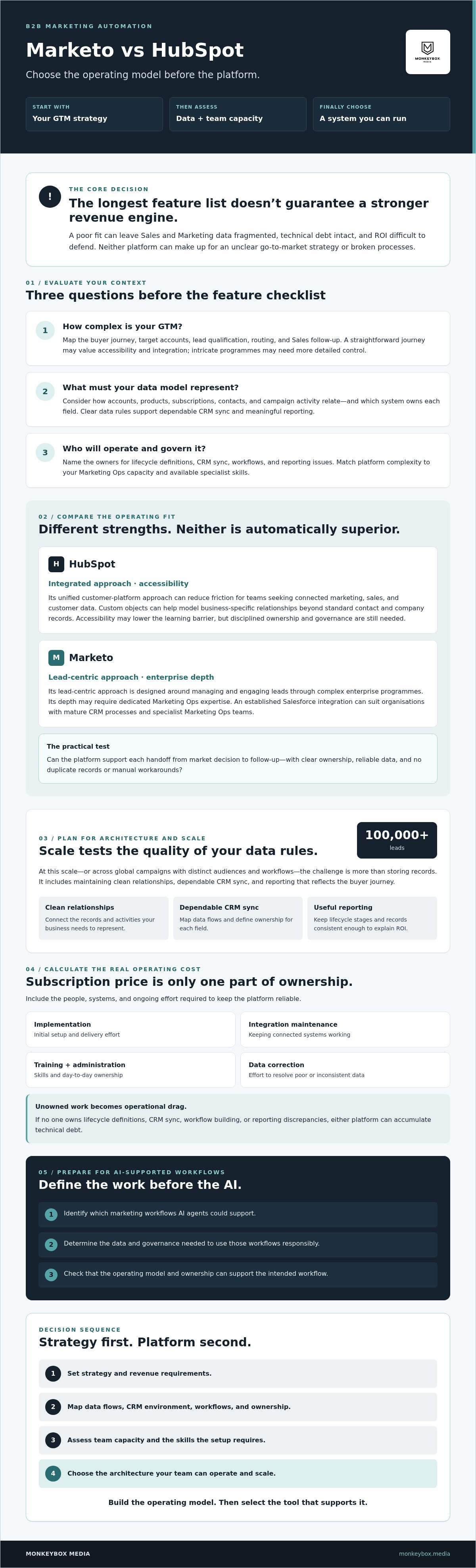
HubSpot is often valued for ease of use and an integrated approach, while Marketo offers depth for complex enterprise operations. Neither platform can compensate for an unclear go-to-market (GTM) strategy or broken processes. The right choice depends on your operational maturity, team capacity, data architecture, and plans for AI-driven workflows.
This comparison gives you a framework for evaluating both platforms beyond feature checklists. You’ll see how their strengths, ownership requirements, automation capabilities, and AI direction may fit different B2B needs, and what to assess before committing. The goal is a scalable marketing infrastructure, connected revenue data, and a more dependable lead-to-revenue process. Start with the operating model, then choose the platform that can support it.
Key Takeaways
- Assess your GTM complexity, CRM environment, and team capacity before comparing platform features.
- In the Marketo vs HubSpot for B2B decision, weigh data structure and integration requirements against usability and operational overhead.
- Identify which marketing workflows AI agents could support, and define the data and governance needed to use them responsibly.
- Use your Marketing Ops capacity to determine whether your team can sustain a more complex automation environment.
- Set strategy and revenue requirements first, then choose the platform that can support them as your operation scales.
Beyond the Interface: The Strategic Stakes of Choosing Your B2B Engine
Choosing marketing automation is an architectural decision, not just a software preference. The platform shapes how customer data moves, how Sales and Marketing coordinate, and how quickly your team can turn a GTM decision into a campaign. Replacing it later can involve data mapping, workflow reconstruction, retraining, and temporary disruption. A poor fit creates drag well before a migration begins.
From a Fractional CMO perspective, the test is straightforward: does the system help your team execute GTM plans, or does it make every change depend on scarce technical capacity? Marketing automation platforms support capabilities such as lead nurturing, scoring, and CRM integration. Those features create value only when they serve a defined commercial process. Your B2B go to market framework should define that process before you select the platform.
The Integrated Ecosystem vs. Specialist Precision
HubSpot’s unified customer-platform approach can reduce friction for teams that want marketing, sales, and customer data in a connected environment. Marketo’s lead-centric approach can suit complex nurturing and enterprise workflows. Neither approach is automatically superior. A team with a straightforward buyer journey may value integration and accessibility, while a team coordinating intricate programmes may need more detailed control.
Consider a company entering a new segment. It needs to define target accounts, qualify engagement, route leads, and give Sales useful context. The platform should support those handoffs without creating duplicate records or manual workarounds. To compare the options, map each step from market decision to follow-up, then check which platform can support it with clear ownership and reliable data.
Calculating the Strategic ROI of Your Martech Stack
Subscription cost is only one part of total cost of ownership. Include implementation, integration maintenance, training, administration, specialist skills, and the effort required to correct poor data. Marketo’s depth may require dedicated Marketing Ops expertise. HubSpot’s accessibility may lower the learning barrier, but it still needs disciplined ownership and governance.
Model the actual operating requirements. Who maintains lifecycle definitions, manages CRM sync, builds workflows, and investigates reporting discrepancies? If those responsibilities have no clear owner, either platform can accumulate technical debt. Assess whether you can recruit or retain the skills your chosen setup requires rather than assuming the existing team will absorb the work.
Data integrity is the foundation of a credible B2B revenue growth strategy. Inconsistent lifecycle stages or duplicate records weaken attribution and make ROI harder to explain. Before committing to Marketo or HubSpot, map your data flows, operating capacity, and desired revenue outcomes. Monkeybox Media brings Fractional CMO leadership, GTM strategy, and Marketing Ops expertise to roadmap-first assessments. Choose an architecture your team can run and scale, then choose the platform.
Marketo vs HubSpot for B2B: Architecture and Extensibility
Architecture determines whether your marketing system can support the way your revenue engine works. At 100,000 or more leads, or across global campaigns with distinct audiences and workflows, the challenge isn’t just storing records. It’s maintaining clean relationships, dependable CRM sync, and reporting that reflects the buyer journey. Scale can expose weak data rules and unclear ownership quickly.
HubSpot supports custom objects, which can help model business-specific relationships beyond standard contact and company records. Marketo’s lead-centric approach is designed around managing and engaging leads through complex enterprise programmes. The right structure depends on what your business needs to represent. For example, consider whether account, product, or subscription relationships need to connect to individual contacts and campaign activity.
Integration depth matters too. Marketo’s established Salesforce integration can suit organisations with mature CRM processes and specialist Marketing Ops teams. HubSpot’s integrated platform can simplify connected workflows for teams seeking a more unified environment. In either case, map which system owns each field, how updates flow, and how sales activity feeds back into marketing. The in-depth comparison from Zapier can help frame the differences, but your CRM architecture and operating requirements should determine the decision.
Lead Management and Scoring Frameworks
Marketo offers granular scoring and a Revenue Cycle Modeler for teams that need to define detailed stages and handoffs across a long buying process. HubSpot provides lead scoring and lifecycle stages in a more accessible environment. For a multi-touch journey involving several stakeholders, compare how each platform captures engagement, applies qualification rules, and passes useful context to Sales. Complexity alone doesn’t justify a more complex tool.
To make the comparison practical, write down the signals that influence qualification, the conditions that trigger a sales handoff, and what information Sales needs to act. Test how each platform handles exceptions, such as an existing customer showing interest in another product or a contact engaging with several campaigns. This helps reveal whether the process can be maintained without unnecessary manual steps.
Reporting and Attribution: Proving Value to the Board
HubSpot includes multi-touch attribution reporting. Marketo Performance Insights (MPI) supports performance analysis, while some organisations may need external BI tools to combine marketing, CRM, and revenue data for their specific questions. Before choosing, define what leaders need to see: campaign contribution, pipeline movement, or revenue outcomes. Then check whether the required data can be captured, reconciled, and reported consistently.
A structured Marketing Ops and infrastructure audit can expose gaps in field definitions, CRM sync, lifecycle stages, and attribution before they become reporting disputes. That’s where the Marketo vs HubSpot for B2B decision becomes operational, not theoretical. If your architecture needs a roadmap before a platform choice, explore Monkeybox Media’s Marketing Ops and GTM strategy support.
The AI Frontier: Agentic Workflows and Marketing Automation in 2026
Traditional automation follows a script: if a contact takes an action, send a message or change a status. AI agents can add a decision layer by interpreting signals, generating a response, or recommending a next step within defined boundaries. That changes the design challenge. The question is not only which workflow to automate, but also what decisions the system may make and where a person must remain in control.
HubSpot is embedding AI across its platform, including Breeze tools and agents for work such as content creation, prospecting, and data analysis. Marketo is developing Marketo AI, which entered open beta in May 2026. Its APIs and webhook-based integrations can also support custom workflows that connect marketing activity with external AI services. A structured framework on modern automation architecture can help frame the broader shift, but platform choice still depends on your operating model and controls.
For the Marketo vs HubSpot for B2B decision, native AI may reduce integration friction and help teams adopt capabilities within familiar workflows. Custom AI can offer more flexibility, but it adds design, integration, monitoring, and governance demands. Neither approach wins by default. Choose the one your team can manage reliably.
Automating Lead Nurturing with AI
AI can help tailor email drafts to a contact’s role, account context, or recent engagement, rather than relying on one template for every segment. It can also help teams review buying signals and recommend workflow changes. Keep approval steps for claims, sensitive messages, and high-impact actions. Treat marketing automation technical debt as a constraint to resolve, not a reason to automate a broken process. Well-designed automation can free capacity for higher-value work, but it shouldn’t be assumed to reduce headcount.
Data Hygiene and AI: The Foundation of Scale
Predictive scoring is only as useful as its inputs. HubSpot introduced AI-powered lead scoring rule discovery in July 2026, while Marketo’s AI capabilities are developing through its own product releases. Before activating either, check record quality, lifecycle definitions, consent and access controls, and CRM sync. Poor data can make automated decisions confidently wrong.
A Fractional CMO assessment can set the use case, data rules, and human checkpoints before the team builds. That roadmap helps prepare your systems for AI agents for marketing without adding another layer of technical debt. For support with B2B automation and AI agent integration, explore Monkeybox Media’s Marketing Ops expertise.
Operational Maturity: Assessing Your Team’s Readiness for Enterprise Power
A platform’s ceiling matters only if your team can reach it. Marketo offers depth for complex programmes, but its learning curve and specialist requirements can slow execution when Marketing Ops capacity is limited. HubSpot is generally more accessible, which can help teams launch and adjust campaigns with less platform-specific expertise. The practical question isn’t which system is “simpler.” It’s which one your organisation can operate consistently without creating technical debt.
Before choosing, map ownership across the revenue team. Name the person accountable for platform architecture, lifecycle definitions, data quality, and governance. Then identify who builds campaigns, approves content, manages CRM handoffs, and uses performance reporting. One person may cover several roles in a lean team, but each responsibility still needs a clear owner. If core workflows rely on undocumented knowledge held by one administrator, you have an operational risk, not just a staffing gap.
The Learning Curve vs. The Execution Ceiling
HubSpot’s accessibility can support faster GTM experimentation. Teams may be able to test a message or adjust a workflow without routing every change through a small group of specialists. Marketo’s advanced capabilities may better serve organisations that need detailed control across complex campaigns and enterprise processes. Balance speed to market with structural integrity. A fast launch that creates inconsistent data or fragile workflows isn’t real velocity.
Use a readiness check: can your team document its lead lifecycle, maintain CRM sync rules, review workflow changes, and troubleshoot campaign issues? If not, resolve ownership and process gaps before taking on additional platform complexity.
Governance and Multi-Team Collaboration
For global organisations, Marketo Workspaces and Partitions can help organise assets, audiences, and access across teams or divisions. HubSpot Business Units offer a more straightforward approach to managing multiple brands. The right setup depends on how much separation teams need, which data must remain shared, and how central governance should work. Confirm that the platform configuration supports those requirements before building a multi-team operating model around it.
Operational maturity also means planning for change. Establish naming conventions, permission rules, campaign standards, and a review process before teams build independently. This limits duplicated assets and inconsistent reporting as programmes expand. A strong enterprise marketing automation strategy makes collaboration repeatable without forcing every team into the same campaign workflow.
If your team lacks a dedicated platform owner or needs help assessing operational readiness, a B2B marketing operations specialist can help define the capability gap and governance model. That’s central to the Marketo vs HubSpot for B2B decision: match the platform to the team you have and the operating model you can sustain. Explore Monkeybox Media’s Fractional CMO and Marketing Ops support to map your readiness before committing to a tool.
Implementing for Scale: Why the Strategy Matters More Than the Tool
Platform selection is not a growth strategy. Start with your revenue model, buyer journey, sales handoffs, and reporting requirements, then select the system that can support them. Otherwise, an implementation can simply automate unclear processes and carry technical debt into the next phase of growth.
A practical 90-day roadmap can create discipline without promising instant results. Use the first phase to audit the current stack, data quality, workflows, and team ownership. Next, define requirements and assess the platforms against them. Then prioritise configuration, integration, team adoption, and measurement. Set a small number of launch outcomes, such as reliable lead routing or clearer pipeline reporting, and review progress against them.
Monkeybox Media connects GTM strategy with marketing automation and Marketing Ops, helping B2B teams design the roadmap before choosing a tool. This treats implementation as a commercial change, not just a technical project.
The Role of the Fractional CMO in Platform Selection
A Fractional CMO can bring a neutral, revenue-focused perspective to a decision often shaped by existing preferences or vendor demonstrations. The role is to align Sales, Marketing, and Finance around shared requirements: how leads qualify, which handoffs matter, what leaders need to see, and what resources the organisation can sustain. Clear criteria make executive buy-in more achievable. They also help leaders assess strategic marketing leadership hires against actual capability gaps rather than platform hype.
Future-Proofing Your Marketing Infrastructure
As a B2B company grows, its infrastructure must support more segments, teams, data, and coordinated campaigns without making every change slower. Whether you’re planning for a move from $10M to $100M ARR or another stage of expansion, build around adaptable data definitions, clear system ownership, and workflows the team can maintain. AI readiness starts with trustworthy data, documented processes, and clear boundaries for automated decisions. It doesn’t depend on choosing one particular platform.
Before making the leap, audit what you already have: map integrations, identify duplicate or unused workflows, document data ownership, and confirm how marketing activity connects to pipeline and revenue. Then compare Marketo and HubSpot against that evidence, your operating capacity, and the outcomes you need. Strategy first, platform second.
Scale your B2B growth with a Fractional CMO and expert Marketing Ops.
Build the Revenue Engine Your Next Stage Demands
The right platform is the one your team can operate, govern, and connect to revenue goals. Marketo vs HubSpot for B2B isn’t a contest with one universal winner. It’s a strategic choice shaped by your GTM model, operational capacity, data foundations, and appetite for complexity.
Keep the sequence clear: define the revenue outcomes first, assess capability and data gaps next, then select the platform that fits. AI can extend that engine, but only when workflows have sound ownership and reliable inputs. Strong architecture creates room to scale without letting technical debt slow execution.
Monkeybox Media brings Fractional CMO leadership, B2B Marketing Ops expertise, and AI-driven growth frameworks to help connect GTM vision with operational execution. If your platform decision needs a roadmap grounded in revenue priorities, take the next step: Optimize your B2B revenue engine with Monkeybox Media.
Choose with clarity, build with intent, and give your team a system ready for what comes next.
Frequently Asked Questions
Is Marketo still the gold standard for B2B enterprise marketing in 2026?
No single platform is the gold standard for every enterprise. Marketo remains a strong fit for organisations with complex lead-nurturing requirements, established Marketing Ops capability, and a need for detailed control. HubSpot may fit better where teams prioritise an integrated environment and accessibility. Judge the platforms against your GTM model, CRM architecture, governance needs, and ability to operate the system, not a blanket ranking.
Can HubSpot handle the complex lead scoring and routing required by large B2B organizations?
HubSpot can support lead scoring and routing, but validate your specific rules before committing. Map how scores combine demographic fit and engagement, what triggers a sales handoff, and how records should be assigned across teams or product lines. Test edge cases with real examples, such as an existing customer showing buying intent. The right fit depends on whether HubSpot’s capabilities and configuration support your process without workarounds.
What are the hidden costs of migrating from Marketo to HubSpot?
Migration costs extend beyond platform subscriptions. Plan for data mapping and cleanup, rebuilding forms and workflows, recreating integrations, validating lifecycle stages, and maintaining reporting continuity. Teams may also need training, testing, and a period of parallel operation to reduce disruption. Before estimating effort, inventory assets and dependencies, identify what can be retired, and document which historical data and processes must remain usable after cutover.
How do AI agents integrate differently with Marketo vs HubSpot?
HubSpot is embedding AI capabilities and agents within its platform, which can make some workflows more accessible in the existing environment. Marketo’s APIs and webhooks can support custom connections to external AI tools, offering flexibility alongside added integration and governance work. In the Marketo vs HubSpot for B2B decision, compare use cases, data access, approval controls, and monitoring requirements. Choose native or custom AI based on fit, not novelty.
Is a Fractional CMO necessary for a marketing automation implementation?
No. A Fractional CMO isn’t a prerequisite for implementation. The value is executive-level direction when goals, ownership, or alignment across Sales, Marketing, and Finance need definition. That leader can clarify GTM requirements, establish success measures, and guide platform selection before configuration begins. Organisations with established leadership and clear operating processes may already have this capability internally. The essential requirement is accountable strategic ownership, whether internal or external.
Which platform is better for aligning sales and marketing teams in a high-growth SaaS?
Neither platform creates alignment by itself. HubSpot’s integrated environment may help teams share customer and pipeline context, while Marketo can fit organisations with mature Salesforce processes and specialist operations. Define shared lifecycle stages, lead handoff criteria, data ownership, and follow-up expectations first. Then test how each platform supports those agreements in daily use. Alignment comes from consistent process and accountability, reinforced by the system you select.
What is the typical ROI timeline for a new marketing automation deployment?
There’s no dependable universal timeline for ROI. Results depend on implementation scope, data quality, adoption, sales follow-up, and the outcome being measured. Set a baseline before launch, then track operational milestones such as accurate routing and workflow reliability alongside commercial measures such as qualified pipeline contribution. Agree on review points with Finance and Sales. This gives leaders a defensible way to assess progress without treating early activity metrics as proven revenue impact.
How do I know if my team is mature enough for Marketo?
Your team is better prepared for Marketo when it can clearly define lifecycle stages, maintain CRM data and integrations, document workflows, and assign ownership for platform governance. Check whether Marketing Ops has the capacity and specialist skills to build, troubleshoot, and improve campaigns without relying on one person’s undocumented knowledge. If these foundations are missing, address the gaps or assess a more accessible setup before adding enterprise-level complexity.