
A packed marketing calendar can hide a leadership gap. If campaigns, systems and sales priorities pull in different directions, more activity won’t create commercial momentum. On-demand CMO services put senior ownership around the marketing function, connecting strategy to the decisions and execution that support growth.
That doesn’t mean every business needs a full-time CMO. The right model depends on what’s missing: strategic direction, clear go-to-market priorities, stronger marketing operations, or leadership to align the team and its work. Scope the role around the business’s actual priorities, not a generic job description.
This guide explains what an on-demand CMO can lead, how the model compares with hiring a full-time leader or relying on an agency, and what to define before an engagement begins. It also shows how strategy, marketing operations, automation and AI agents can work as one system, so priorities don’t stall between planning and execution. The aim is a leadership model that fits your growth stage and commercial priorities.
Key Takeaways
- Spot the signs that marketing leadership, coordination or operational capacity has fallen behind your B2B growth ambitions.
- Assess whether on-demand CMO services can provide the strategic ownership and decision-making cadence your team needs.
- Compare fractional leadership, a full-time CMO, project-based consulting and agency execution against your priorities and internal capabilities.
- Set clear outcomes, stakeholder roles and decision rights before an engagement begins, so accountability is built in from the start.
- See how fractional CMO and GTM strategy can connect executive direction with marketing operations, automation and AI workflows.
When do on-demand CMO services solve a real B2B leadership gap?
Growth expectations often move faster than the marketing structure built to support them. A B2B organisation may add campaigns, channels or team members, yet still lack a clear owner for priorities, budget decisions and the link between marketing activity and commercial goals. The issue isn’t always a shortage of output. It may be a shortage of senior direction.
On-demand CMO services provide flexible access to senior marketing leadership, with responsibilities and involvement shaped around the organisation’s priorities and internal capability. The role is to set direction, make decisions and align people and resources. That differs from hiring a specialist to deliver one campaign, bringing in an agency to execute channels, or receiving advice without ongoing ownership. The value lies in connecting decisions across the marketing function, not simply adding another supplier.
What does on-demand CMO leadership mean?
A Chief Marketing Officer leads the marketing function and connects its work to wider business objectives. The Chief Marketing Officer (CMO) role provides a useful baseline: senior leadership involves more than promoting products or overseeing campaigns. In an on-demand arrangement, the business accesses that direction flexibly rather than assuming it needs a full-time position.
In practice, a CMO can set priorities, align teams and establish how decisions are made. The agreed scope might focus on positioning and go-to-market planning, or include regular oversight of marketing operations and execution. Define what the leader owns, what the internal team delivers and where specialist support fits.
Which signals suggest the business needs senior marketing direction?
Look for recurring patterns, not one frustrating week. Priorities change without a clear rationale, teams can’t agree who owns outcomes, or marketing reports activity without showing how it supports pipeline and revenue goals. A growing team may also need consistent planning and decision-making systems before it adds more campaign output.
- Priorities keep shifting: new requests displace planned work, with no shared method for deciding what matters most.
- Accountability is blurred: several people contribute, but no one has authority to resolve trade-offs or own the result.
- Activity and commercial goals are disconnected: campaigns run, but the team can’t explain how they support business objectives.
Separate a temporary execution bottleneck from a persistent leadership gap. If a defined project is delayed because the team lacks capacity or a particular skill, targeted execution support may address it. If coordination and prioritisation problems recur across projects, the business likely needs clearer senior ownership. On-demand CMO services can provide that leadership while keeping the scope proportionate to current needs.
What should on-demand CMO services include beyond advice?
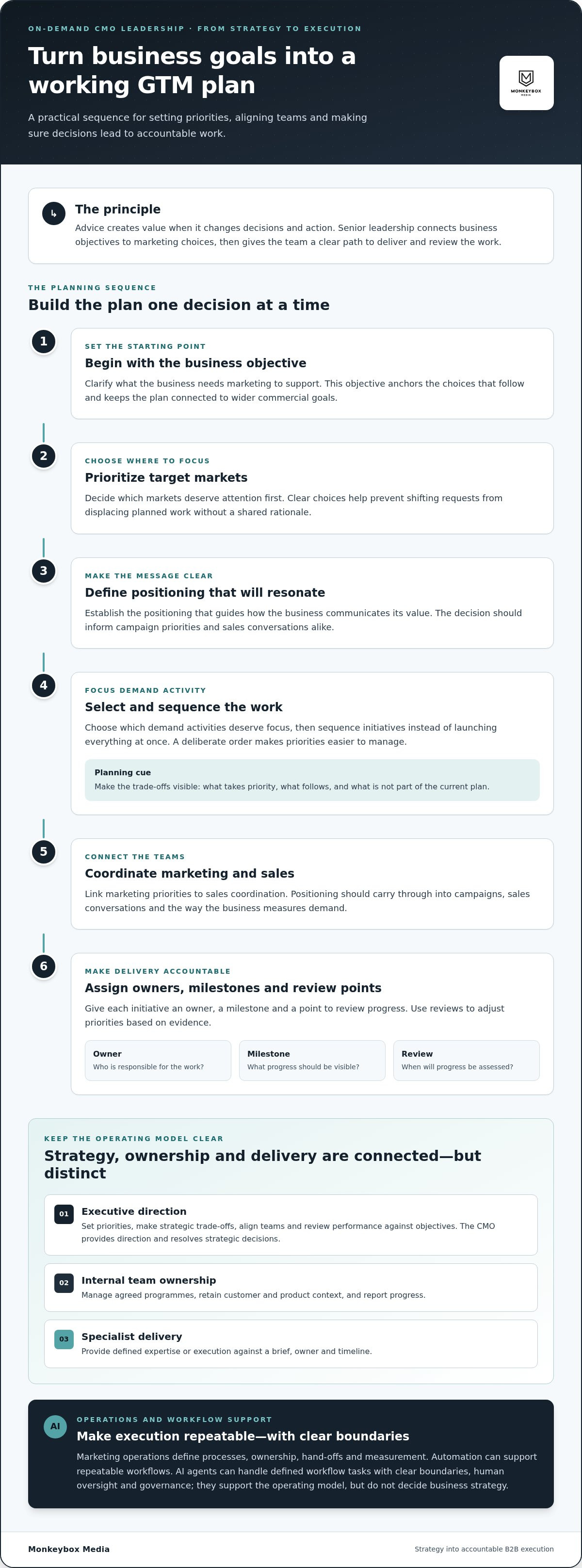
Advice only creates value when it changes decisions and action. A strong leadership engagement connects business objectives to marketing priorities, positioning, go-to-market planning and a clear decision-making cadence. It then translates those choices into a roadmap with accountable owners, milestones and measures. The team knows what happens next, who is responsible and when progress will be reviewed.
That roadmap should connect marketing with sales and other relevant teams. For example, a positioning decision should inform campaign priorities, sales conversations and how the business measures demand. The CMO provides direction and resolves strategic trade-offs; internal and specialist teams carry out the work they own.
How does a CMO turn strategy into a working GTM plan?
Start with the business objective, then make the choices that shape how marketing supports it: which target markets to prioritise, what positioning will resonate, which demand activities deserve focus, and how sales and marketing will coordinate. Sequence the work instead of launching every initiative at once. Give each initiative an owner, a milestone and a review point. Use those reviews to adjust priorities based on evidence.
For a broader look at how strategic authority fits within an agency model, read this fractional CMO agency guide.
Where do marketing operations and AI fit?
Marketing operations make the plan workable by defining processes, ownership, hand-offs and measurement. Automation can support repeatable workflows, helping teams manage routine steps consistently. AI agents can also be integrated into workflows for defined tasks, with clear boundaries, human oversight and governance. They support the operating model; they don’t decide business strategy.
Make responsibilities visible. A simple map can prevent strategy, execution and accountability from collapsing into one vague remit:
- Executive direction: set priorities, make strategic trade-offs, align teams and review performance against objectives.
- Internal team ownership: manage agreed programmes, maintain customer and product context, and report progress.
- Specialist delivery: contribute defined expertise or execution against a brief, owner and timeline.
The exact division depends on the organisation’s priorities, internal capability and agreed responsibilities. Monkeybox Media connects fractional CMO leadership and B2B GTM strategy with marketing operations, automation and AI workflow implementation. Explore B2B marketing leadership to see how strategy connects to practical execution.
How do on-demand CMO services compare with other leadership options?
The right model depends on the gap you need to close. Compare options by continuity, strategic authority, internal capability, execution ownership and how much the workload is likely to change. A business with a capable team that needs clear priorities has a different requirement from one that needs daily executive leadership or specialist delivery for a defined project.
On-demand CMO versus full-time CMO
A full-time CMO can provide sustained daily leadership, deep organisational integration and capacity for broader executive responsibilities. That may suit a business needing continuous leadership across functions. On-demand CMO services can fit when the organisation needs senior marketing direction and a defined strategic remit, but flexible involvement better matches its priorities or internal structure. Neither model is automatically superior; the difference is the leadership capacity and continuity the business needs.
On-demand CMO versus consultant or marketing agency
Project-based consultants typically focus on a defined question or recommendation, while agencies concentrate on delivering agreed marketing work. A CMO takes broader responsibility for priorities and alignment, helping ensure specialist activity supports business objectives. These models can work together: a CMO can guide internal teams and agency partners, setting direction while specialists deliver their areas of work.
- On-demand or fractional CMO: Provides ongoing senior direction, prioritisation and alignment, with involvement shaped around the agreed remit.
- Full-time CMO: Offers sustained daily leadership and deeper integration, which may be important when the business needs a constant executive presence.
- Project-based consultant: Addresses a specific strategic question or project, but may not own continuing decisions or implementation.
- Marketing agency: Delivers specialist or channel-focused execution; internal leaders still need to set business-wide priorities unless leadership is explicitly part of the arrangement.
Use the comparison to locate the real constraint. If the strategy is clear but a particular capability or delivery resource is missing, specialist execution may be the priority. If the team needs a focused answer to a bounded challenge, project consulting may be appropriate. If priorities, ownership and cross-functional coordination repeatedly stall, senior leadership may be the gap. Workload matters too: flexible involvement can suit changing leadership needs, while a persistent requirement for daily executive decisions may point towards a full-time role.
The strongest choice gives the business the right level of continuity and authority without leaving execution ownership unclear. Define what leadership must decide, what the internal team can own, and what specialist partners will deliver. Then match the engagement model to that operating reality.
How can you assess fit, scope, and accountability before engaging?
Before choosing on-demand CMO services, turn the leadership need into a clear brief. Define what marketing must advance, who needs to be involved, and which decisions the CMO can make. A focused scope gives the engagement a practical starting point and makes accountability visible.
Use this assessment to establish fit:
- Identify the gap. Is the primary need strategic prioritisation, go-to-market direction, team alignment, marketing operations, or oversight of execution? Separate leadership needs from a temporary shortage of delivery capacity.
- Define the outcomes. Name the business objectives marketing leadership must support, such as improving demand generation or strengthening alignment with sales. Agree what evidence would show progress, based on the data the organisation can access.
- Map stakeholders. Identify who will contribute context, own internal work and make decisions across marketing, sales and leadership. Clarify how the CMO will access those people and information.
- Set decision rights. Specify which priorities, recommendations and trade-offs the CMO can decide, which require leadership approval, and where implementation sits with internal teams or specialist partners.
What should the engagement scope make explicit?
Document the strategic remit, near-term priorities, key stakeholders and expected leadership involvement. Set a meeting cadence that supports decisions, not just status updates, and define how the CMO works with internal teams and external specialists. Separate direction and oversight from hands-on implementation so every critical task has an owner. Reporting should connect agreed objectives to available data and the decisions leaders need to make.
How can a business judge progress without overpromising?
Establish a baseline before changing the plan. Depending on the objective and data available, this could include pipeline, demand, conversion or operational measures. Agree which early indicators can show whether planned work is moving, and distinguish them from commercial outcomes shaped by sales activity, market conditions and other factors. Early signals are useful, but they are not guarantees.
Build regular reviews into the engagement. Use them to assess evidence, surface blockers, test assumptions and adjust priorities transparently. If a campaign is generating activity but not progressing towards the agreed objective, the review should clarify whether to change the approach, resolve a hand-off issue or revisit the underlying assumption. Record decisions, owners and next steps to create accountability without pretending every result is controlled by one person.
Monkeybox Media scopes fractional CMO and B2B GTM strategy around organisational priorities, connecting leadership with practical marketing operations and execution. Discuss your B2B marketing leadership needs.
How can Monkeybox Media connect CMO leadership to B2B execution?
Senior marketing direction matters when it shapes how the business goes to market. Monkeybox Media provides fractional CMO leadership and B2B GTM strategy, connecting growth objectives to the priorities, processes and systems that support execution. Engagement scope is shaped around the organisation’s needs and growth objectives, keeping strategic leadership tied to practical action.
How does strategic leadership connect to marketing systems?
GTM priorities should guide operational choices. If a business is focusing on a particular market or audience, that direction can inform campaign workflows, how marketing and sales coordinate, and which measures the team reviews. Marketing operations and automation structure repeatable work around those decisions. They support the strategy; they don’t determine it.
AI agents can support defined marketing workflows when the task, oversight and governance are clear. For example, an agent might contribute to a bounded workflow step, while people remain accountable for decisions and review. The right application depends on the organisation’s processes and priorities. Technology should serve the operating model, not create activity without strategic purpose.
What is a practical first step?
Bring three points into the initial strategic conversation: the growth objective the business is pursuing, the current constraint holding marketing back, and the decision that needs senior ownership. This gives the discussion a firm starting point. From there, align priorities and a practical engagement direction with the organisation’s needs.
For some B2B organisations, the constraint may be go-to-market focus; for others, it may be the operational systems needed to carry priorities through consistently. Distinguishing between them helps define where leadership should begin and what the next step needs to address.
Monkeybox Media connects fractional CMO leadership with GTM strategy, marketing operations, automation and AI workflow implementation. The aim is a coherent path from business objective to marketing direction to practical execution. If your team needs clearer senior ownership, start by outlining the growth goal and the decision that’s currently stuck. Discuss your B2B marketing leadership needs.
Turn your marketing leadership gap into a clear next step
The right marketing leadership model starts with the gap, not the job title. On-demand CMO services can provide flexible senior direction when the business needs clearer priorities, stronger go-to-market alignment or someone to connect strategy with execution. Define responsibilities, decision rights and progress measures from the outset.
That structure matters. A CMO’s direction can align internal teams and specialist delivery, while marketing operations, automation and AI workflows support how work gets done. These systems strengthen execution; they don’t replace strategic ownership.
Monkeybox Media brings fractional CMO leadership and strategic GTM planning to B2B organisations, alongside marketing operations, automation and AI workflow implementation. Start by identifying the growth objective, the current constraint and the decision that needs senior direction. Then shape an engagement around the organisation’s priorities.
Discuss your B2B marketing leadership needs and take the next step towards a more connected, accountable marketing function.
Frequently Asked Questions
What are on-demand CMO services?
On-demand CMO services give a business flexible access to senior marketing leadership without assuming a full-time role. The CMO can set priorities, guide go-to-market strategy, align marketing with commercial objectives and establish how decisions and progress are reviewed. The agreed scope may also include team coordination and oversight of execution. Define responsibilities around the organisation’s needs, internal capability and growth objectives.
Are on-demand CMO services the same as fractional CMO services?
Often, the terms describe a similar model: access to experienced marketing leadership on a flexible or part-time basis. Their precise meaning can vary between providers, so focus on the engagement rather than the label. Clarify the CMO’s authority, expected involvement, strategic remit and responsibility for execution. A useful agreement makes clear which decisions the leader owns and how they work with internal teams and specialists.
When should a B2B company use an on-demand CMO?
A B2B company should consider an on-demand CMO when marketing priorities lack senior ownership, activity isn’t clearly tied to commercial objectives, or a growing team needs stronger direction and coordination. It can also suit an organisation that needs strategic leadership but isn’t seeking a full-time CMO role. First distinguish a persistent leadership gap from a temporary delivery bottleneck that may need specialist execution instead.
Can an on-demand CMO help with marketing execution?
Yes, an on-demand CMO can connect strategy to execution by setting priorities, assigning ownership, aligning teams and reviewing progress. The specific hands-on work depends on the agreed scope and the organisation’s internal capability. The CMO may oversee internal teams and specialist partners, while marketing operations, automation and AI workflow implementation can support delivery. Define who is responsible for each task to prevent gaps or duplicated effort.
How much do on-demand CMO services cost?
There isn’t one standard price for on-demand CMO services. Fees depend on the engagement’s scope, expected involvement, business priorities and responsibilities, so a limited advisory remit differs from broader strategic leadership and execution oversight. For a useful proposal, first define the outcomes required, the decisions the CMO will own and the support expected from internal teams. Agree how the work and responsibilities will be structured before the engagement begins.
What happens if our business already has a marketing team?
An existing marketing team can benefit from senior leadership without replacing its members. The CMO can help set direction, prioritise work, clarify ownership and connect marketing plans to business objectives. Team members retain responsibility for their agreed areas, while the CMO provides executive guidance and helps resolve strategic trade-offs. Map roles and decision rights at the outset so the arrangement strengthens the team rather than adding another layer of confusion.
How do you measure whether an on-demand CMO is working?
Measure progress against agreed business objectives and a relevant baseline, using evidence the organisation can access. Depending on the priorities, measures could include pipeline, demand, conversion or marketing operations. Review early indicators alongside commercial outcomes, which can also be affected by sales activity and market conditions. Regular reviews should surface blockers, test assumptions and prompt transparent adjustments to priorities, without treating early signals as guaranteed results.