
What if your marketing problem isn’t a lack of activity, but a lack of direction connecting it to pipeline and revenue? For B2B businesses that need senior marketing leadership without committing to a full-time hire, outsourced CMO services UK can provide a way to align strategy, teams and execution. The value comes from more than a strong plan. It comes from making that plan work across your go-to-market priorities, marketing operations and measurement.
Marketing needs to deliver more than activity and attention. It should support commercial priorities, give teams clear direction and show how execution contributes to growth. The challenge is finding a working model that provides strategic leadership while bringing fragmented teams, technology and suppliers into a more connected system.
This guide explains how outsourced CMO services work and what to assess before choosing an engagement model. You’ll learn how to evaluate scope and accountability, connect positioning and go-to-market decisions to measurable execution, and understand how marketing operations, automation and AI agents can support a purposeful operating system for B2B growth.
Key Takeaways
- Understand how outsourced CMO services UK can provide strategic marketing ownership, not just campaign delivery or one-off recommendations.
- See how business objectives can shape positioning and go-to-market priorities, with marketing operations, automation and reporting supporting execution.
- Compare an outsourced CMO with an agency, consultant or full-time CMO by looking at leadership ownership, scope, continuity and team coordination.
- Use a practical evaluation sequence to define the business problem, agree scope, establish governance and measure progress.
- Explore how fractional CMO leadership can connect GTM strategy with marketing operations and purposeful workflows.
What outsourced CMO services mean for UK B2B businesses
For a B2B business, outsourced CMO services UK means bringing in external senior marketing leadership, with the scope shaped around the organisation’s priorities and existing capabilities. The aim isn’t simply to add another supplier. It’s to establish clear ownership of marketing direction, connect decisions to business objectives and coordinate the people and work needed to deliver them.
An outsourced CMO owns marketing leadership without becoming a full-time employee. Unlike task-based support, which delivers defined activities, this role helps decide which activities matter, why they matter and how progress will be assessed. A one-off consultant may recommend a direction; an outsourced CMO can help guide its ongoing application. Fractional leaders such as Sean Brightman provide the strategic roadmapping and senior marketing guidance needed to bridge that gap.
What does an outsourced CMO actually do?
A CMO sets marketing direction across positioning, priorities and alignment with commercial objectives. The Chief Marketing Officer role provides a useful baseline: outsourced leadership adapts that senior remit to an external working model. Depending on the agreed scope, the CMO may coordinate internal marketers, specialist partners and execution, keeping activity anchored to the chosen strategy.
That means making trade-offs, not just producing plans. If the business is refining its ideal customer profile or entering a new market, leadership can connect those choices to messaging, channel priorities, marketing operations and reporting. The balance of direction and oversight should reflect what the organisation already has in place.
When might a UK B2B business need external marketing leadership?
Look for structural signals: campaigns run without shared priorities, teams use different definitions of success, or marketing activity has no clear link to go-to-market choices. The business may have capable specialists and suppliers, yet lack a senior owner to align their work. The founder or sales leader may also be making marketing decisions without enough dedicated capacity to steer them consistently.
- Activity is happening, but teams can’t explain how it supports current commercial priorities.
- Positioning, sales priorities and marketing execution have drifted apart.
- Marketing technology and workflows exist, but aren’t organised around a clear operating plan.
The right scope depends on business stage, internal capability and growth priorities, not a fixed revenue figure or company size. Some organisations need strategic direction and team coordination; others need leadership that also addresses gaps in marketing operations. For a broader look at the agency model, read this fractional CMO agency guide. The key is matching leadership ownership to the work the business needs to move forward.
How outsourced CMO leadership connects GTM strategy to execution
Strategy creates value when it changes what the business does next. An outsourced CMO connects commercial objectives and market choices to positioning, go-to-market priorities and the operating work required to carry them through. The leadership team sets business goals and makes key commercial decisions; the CMO translates those decisions into marketing direction, aligns internal marketers and specialist partners, and keeps execution tied to agreed priorities.
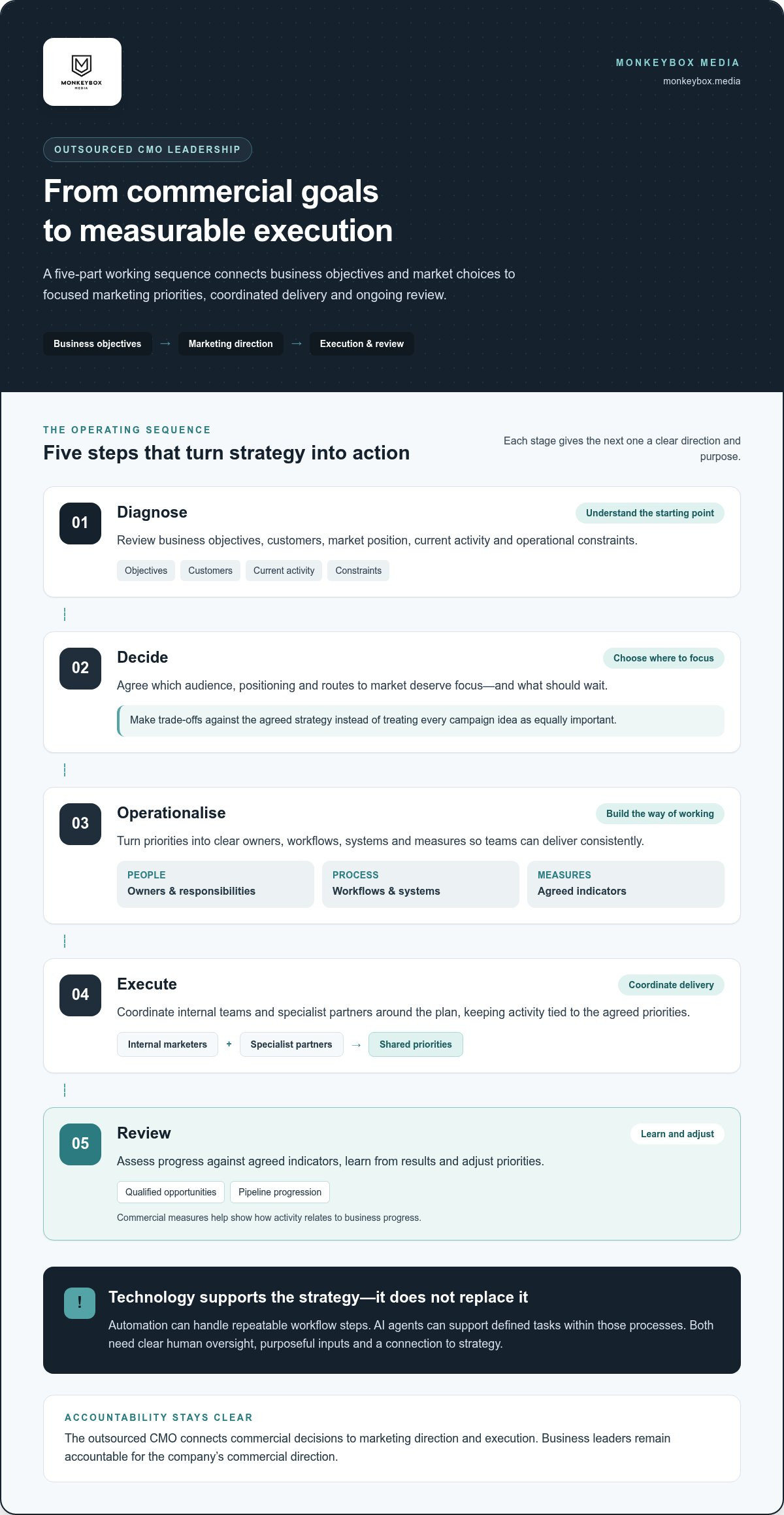
A useful working sequence is:
- Diagnose: Review business objectives, customers, market position, current activity and operational constraints.
- Decide: Agree which audience, positioning and routes to market deserve focus, and what should wait.
- Operationalise: Turn priorities into owners, workflows, systems and measures.
- Execute: Coordinate internal teams and partners around the plan.
- Review: Assess progress against agreed indicators, learn from results and adjust priorities.
This sequence makes outsourced CMO services UK more than strategy advice. It connects decisions to a repeatable way of working, while leaving business leaders accountable for the company’s commercial direction.
From market position to a focused go-to-market plan
Start by clarifying who the business is best positioned to serve and why those buyers should choose it. That informs positioning and messaging, then guides the routes to market that fit the objectives and available resources. When requests compete for attention, the CMO helps sequence them against the agreed strategy instead of treating every campaign idea as equally important. This is a focused overview, not a substitute for detailed GTM planning.
From marketing operations to measurable execution
Once priorities are clear, marketing operations provide the structure to deliver them consistently. Defined workflows, responsibilities and reporting help teams see what is planned, what is progressing and how activity relates to commercial measures such as qualified opportunities and pipeline progression. Reporting should help teams make decisions, not simply produce dashboards.
Automation can handle repeatable workflow steps, while AI agents can support defined tasks within those processes. Both need clear human oversight, purposeful inputs and a connection to strategy. Technology should enable a strategy, not replace one. Without agreed priorities, more automation can simply accelerate disconnected activity.
For B2B organisations connecting GTM planning with marketing operations, Monkeybox Media’s fractional CMO and GTM strategy work brings leadership and practical execution into the same operating conversation.
Outsourced CMO vs agency, consultant or full-time CMO
These models solve different problems. The useful comparison isn’t simply who can produce marketing work, but who owns priorities, coordinates delivery and stays accountable for progress. Scope varies, and some providers combine strategic leadership with implementation. Assess the responsibilities and decision rights in the engagement rather than relying on the label.
| Model | Leadership ownership | Execution scope | Continuity and coordination |
|---|---|---|---|
| Outsourced CMO | Guides marketing direction and priorities within an agreed remit. | May oversee delivery, teams and specialist partners; hands-on execution depends on scope. | Provides ongoing leadership and alignment with business stakeholders. |
| Marketing agency | Usually delivers against a defined brief; strategic ownership varies by engagement. | Focuses on contracted services, channels or campaigns. | Coordinates delivery within its remit, while the client may retain overall marketing ownership. |
| Project consultant | Advises on a specific challenge or decision. | Typically centres on analysis, recommendations or a defined project. | Continuity beyond the project depends on the arrangement; implementation ownership may sit with the client. |
| Full-time CMO | Holds an internal executive remit, shaped by the organisation. | Can lead the ongoing marketing function and its delivery capacity. | Embedded in the business, with regular access to leadership and teams. |
How does an outsourced CMO differ from a marketing agency?
An agency may execute a campaign or specialist service against agreed objectives; an outsourced CMO helps decide which objectives and activities should take priority across marketing. For example, the CMO and leadership team might prioritise a market segment and define the message, while an agency develops and runs a campaign to reach it. The CMO then aligns that delivery with the wider plan. Some providers combine both roles, so clarify who sets direction, who executes and who evaluates results.
When is external leadership a better fit than a full-time hire?
External leadership may suit a business that needs senior marketing ownership but has a defined remit, capable internal contributors or a workload that doesn’t require a full-time executive. It can also offer flexibility in how leadership capacity is structured. A full-time CMO may be a better fit when the organisation needs continuous executive presence, broad internal authority and day-to-day leadership of a substantial marketing function. A specialist agency may be the sharper choice when the requirement is a discrete delivery capability, not organisation-wide ownership.
For outsourced CMO services UK, make the operating agreement explicit: define decision rights, who approves priorities and spend, how often leaders review progress, and which measures indicate success. An external CMO can lead strategy while specialist partners deliver specific work. That combination works when accountability is clear and delivery remains connected to business priorities.
How to evaluate outsourced CMO services in the UK
Choose an engagement by testing how it will turn business priorities into clear ownership, decisions and measurable work. A confident strategy presentation is only a starting point. For outsourced CMO services UK, assess whether the working model connects B2B market understanding with operational depth, and whether the leadership style will work with your team.
Use this sequence to shape the evaluation:
- Define the business problem: Identify the gap the engagement must address, such as unclear positioning, competing priorities or weak alignment between marketing and sales.
- Agree the scope: Set priorities, responsibilities, execution boundaries and the internal stakeholders involved.
- Set governance: Establish decision rights, access to relevant information and a regular meeting cadence.
- Establish measures: Connect reporting to business objectives, pipeline stages and agreed marketing activity.
- Review progress: Assess milestones, risks and results, then adjust the plan when priorities or evidence change.
During discussions, look for strategic thinking that goes beyond channel recommendations, relevant experience with B2B buying and go-to-market decisions, and the ability to connect direction to marketing operations. Collaboration matters too. The CMO needs a clear working relationship with company leadership, sales and internal marketers, not a parallel process that leaves teams guessing.
What should the engagement scope and governance cover?
Document what the CMO owns, what the leadership team approves and what internal marketers or specialist partners deliver. Agree how marketing leadership will work with sales on shared priorities, customer insight and pipeline reporting. Set a regular review cadence to make decisions, surface risks, track progress and reset priorities. Clear boundaries prevent duplicated effort and keep accountability visible.
Which measures show whether the work is progressing?
Use both operational milestones and performance indicators. Milestones might track completion of agreed positioning work, a GTM plan or a reporting workflow. Indicators can follow relevant funnel stages, such as marketing-qualified activity, sales-qualified opportunities or pipeline progression, where these align with the business model and available data.
Separate leading indicators, which show whether the plan is being put into operation, from revenue outcomes. Revenue and growth are influenced by factors beyond marketing, including sales execution and market conditions, so don’t treat any single result as guaranteed. Agree how measures will be interpreted and reviewed before work begins.
For a leadership model that connects CMO direction with go-to-market priorities, see Monkeybox Media’s CMO and GTM support.
Why Monkeybox Media combines outsourced CMO leadership with marketing operations
Strategic direction can lose momentum when it stops at a plan. For B2B organisations, the challenge is connecting market choices and growth priorities to the workflows, responsibilities and systems that make marketing happen consistently. Monkeybox Media brings fractional CMO leadership and GTM strategy together with marketing operations, automation and AI-agent implementation, connecting executive direction to practical infrastructure.
Strategic leadership that connects priorities to systems
Fractional CMO leadership sets the direction: clarify positioning, shape go-to-market priorities and focus marketing effort on the business’s objectives. Marketing operations then help translate those choices into repeatable processes, clear ownership and useful reporting. Together, they create a connected way to plan and deliver work instead of separating strategy from systems.
Automation and AI agents can support defined steps within these workflows, helping teams handle operational tasks more efficiently. They don’t set market position or decide which opportunity matters most. Those decisions need human leadership informed by business context and aligned with the team. Technology supports the operating model; it doesn’t replace strategic judgement.
This integrated approach is relevant when an organisation needs more than recommendations but doesn’t want strategy and implementation oversight split across disconnected workstreams. The engagement can connect leadership priorities with the marketing infrastructure required to put them into practice, with scope shaped around the company’s needs and internal capabilities.
A practical next step for your leadership team
Start by naming the constraint you need to solve. Is marketing direction unclear? Are teams struggling to turn GTM decisions into coordinated work? Do systems and reporting make execution difficult to manage? Identify which decisions need senior marketing ownership and where your existing team can lead delivery.
Bring a clear view of:
- Your current business and marketing priorities.
- Your team structure and the responsibilities already in place.
- The systems and workflows that support marketing execution.
- Measurement gaps or challenges connecting activity to commercial priorities.
This gives the conversation a practical starting point: the leadership gap, the operating requirements and the work that needs to move forward. Learn how Monkeybox Media can help build a stronger B2B marketing operating system.
Turn marketing leadership into sustained B2B progress
The right marketing leadership model is the one that fits your priorities, team and need for ownership. As you assess outsourced CMO services UK, look beyond the title: define who sets direction, how strategy connects to execution, and what measures will show whether the work is progressing.
A strong operating model links positioning and GTM choices to clear responsibilities, coordinated delivery and useful reporting. It also makes room to improve marketing operations and use automation or AI agents purposefully, without mistaking technology for strategic leadership.
Monkeybox Media brings fractional CMO leadership and GTM strategy together with marketing operations, automation and AI-agent implementation for B2B organisations. If you’re ready to connect senior direction with practical execution, build a more accountable B2B marketing engine with Monkeybox Media.
Set the direction. Align the work. Keep progress visible. With a clear operating model, your team can move forward with greater focus and confidence.
Frequently Asked Questions
What are outsourced CMO services?
Outsourced CMO services provide external senior marketing leadership to guide a company’s strategy and execution. The scope can include positioning, go-to-market priorities, team alignment, marketing operations and performance reviews. Unlike a one-off consultant, an outsourced CMO can work with leadership over time, helping turn recommendations into coordinated action. Agree responsibilities and decision rights around your business objectives and internal capabilities so everyone understands who sets direction, who delivers work and how progress is reviewed.
How much do outsourced CMO services cost in the UK?
Fees vary with the scope, seniority required, engagement cadence and implementation responsibilities. There isn’t one UK-wide rate that applies to every business, so compare what each engagement covers rather than headline fees alone. Assess responsibilities, working rhythm, deliverables and measures together. The right arrangement should reflect the leadership capacity and priorities your business needs, whether that means strategic guidance, ongoing coordination or support connecting plans to marketing operations.
Is an outsourced CMO the same as a fractional CMO?
The terms often overlap: both can describe an external marketing leader working with a business for part of their time or on an agreed basis. Usage varies between providers, so the label alone won’t tell you what the role includes. Compare the actual scope, authority, continuity and execution responsibilities. Agree who sets priorities, how the leader works with your team and how progress is reviewed. Clear expectations matter more than the terminology.
When should a B2B company hire an outsourced CMO?
Consider outsourced CMO support when your business needs senior marketing direction but its current structure can’t provide the leadership required. Possible signs include unclear positioning, disconnected campaigns, weak alignment between sales and marketing, or systems that hinder execution. These are prompts for diagnosis, not proof that every business needs the same model. Define the underlying problem first, then decide what leadership, scope and working arrangement would address it.
Can an outsourced CMO work with an existing marketing team?
Yes. An outsourced CMO can provide direction and coordination while working with internal marketers and delivery partners. Success depends on clear responsibilities, access to relevant information and agreed decision-making. Define who owns strategy, execution, approvals and reporting at the outset. For example, the CMO might set priorities with leadership while internal marketers manage delivery. This clarity helps strengthen the existing team without creating overlapping responsibilities or competing priorities.
How do you measure the success of outsourced CMO services?
Start with business objectives and agree suitable measures before work begins. Depending on the scope, reporting may cover strategic milestones, marketing operations, sales and marketing alignment, pipeline indicators and campaign performance. Separate leading indicators and completed work from revenue outcomes, which can depend on factors beyond marketing. Review progress regularly, interpret measures in context and adjust priorities when evidence or business conditions change. This keeps outsourced CMO services UK accountable without promising a particular commercial result.