
Could outsourced marketing operations add another layer of work instead of removing friction? It can happen when strategy, systems and execution sit with different owners. Teams then spend time chasing handovers, reconciling disconnected data and explaining activity that does not connect to commercial progress.
You should expect more than extra capacity. The right outsourced marketing operations model strengthens how your B2B team plans, executes and measures growth, while giving internal leaders clear visibility and control.
This guide explains how to assess outsourced marketing operations, compare fully outsourced, specialist and hybrid delivery models, and define ownership, workflows and performance measures before work begins. It also covers how marketing automation and AI can support a purposeful operating system rather than add complexity for its own sake.
Start by connecting operational priorities to your go-to-market objectives. Then define who owns each step, how progress will be reviewed and what needs to change. A clear foundation makes it easier to scale execution without losing accountability.
Key Takeaways
- Identify whether bottlenecks stem from limited capacity, missing expertise or disconnected processes before choosing a delivery model.
- Assess outsourced marketing operations by how well it connects commercial priorities, systems and execution, not by task coverage alone.
- Compare in-house, outsourced and hybrid models against your needs for expertise, control, continuity and internal coordination.
- Define outcomes, scope, ownership, systems and review processes to make accountability part of the engagement from the start.
- Align marketing operations, automation and AI workflows with B2B growth priorities so the operating system can scale with the business.
What outsourced marketing operations covers, and when B2B teams need it
Marketing operations is the design and management of the processes, systems and data that help marketing work run reliably and support commercial priorities.
Outsourced marketing operations gives an external specialist ownership of, or support for, part of that operating function. The scope might include improving how leads move between marketing and sales, maintaining automation workflows or making reporting more consistent. It is not simply campaign production. While direct mail specialists like We Mail America produce and distribute physical collateral, marketing operations makes sure the processes, tracking and systems behind the campaign work as intended.
Nor is it a software purchase or a strategy presentation. Tools provide capabilities, and strategic advice sets direction. Operations connects decisions to repeatable execution. Marketing management principles include coordinating processes and resources, which helps explain why operational ownership matters alongside campaign activity.
Which marketing operations responsibilities can be outsourced?
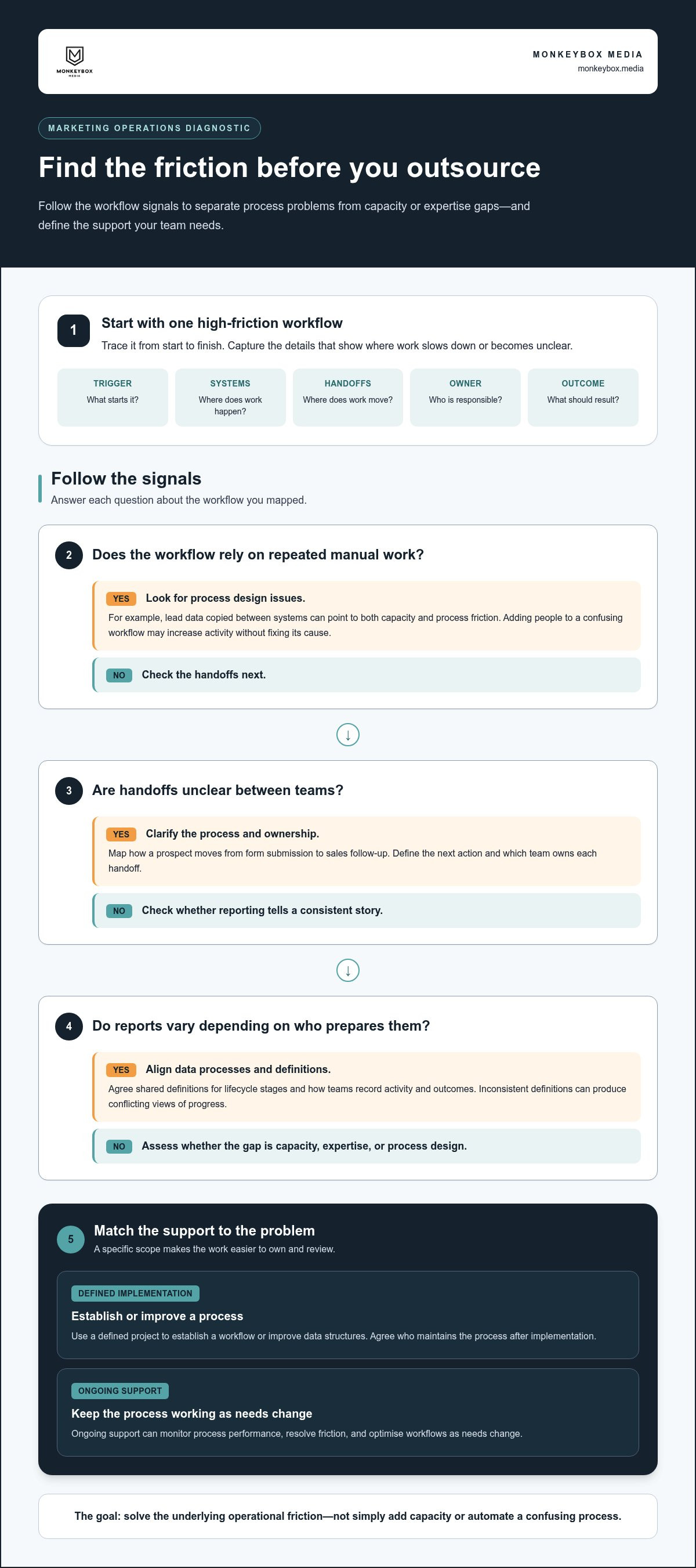
Responsibilities can span workflow design, marketing automation, data processes and coordination across teams. For example, an external specialist might map how a prospect moves from form submission to sales follow-up, configure the related automation and clarify which team owns each handoff. The goal is a functioning process, not automation for its own sake.
Set the scope around business priorities, existing systems and internal ownership. A defined implementation project might establish a workflow or improve data structures. Ongoing support might monitor process performance, resolve friction and optimise workflows as needs change. These are different responsibilities. Agree who maintains a process after implementation so that a well-designed workflow does not become an abandoned one.
What signals that an internal model is under strain?
Look for repeated manual work, unclear handoffs and reports that vary depending on who prepares them. If campaign lead data has to be copied between systems, or sales cannot see the context behind an enquiry, the issue may involve both capacity and process design. Adding people to a confusing workflow can increase activity without fixing the underlying friction.
Disconnected systems become harder to manage as channels, campaigns and team responsibilities expand. A missing data field or unclear status definition can disrupt reporting and follow-up. Meanwhile, staff spend time reconciling information instead of improving execution. Ask not only, “Who has time to do this?” but also, “Why does this task require repeated manual effort?”
Before deciding what to outsource, map one high-friction workflow from start to finish. Record its trigger, systems, handoffs, owner and intended outcome. This makes it easier to distinguish a skills or capacity gap from a process that needs redesign, and gives external support a specific problem to solve.
How an outsourced marketing operations model connects strategy, systems, and execution
Commercial priorities set the direction. If the business needs to build demand in a particular market, marketing must turn that objective into an operating plan: which audiences to engage, what activity supports the goal, what information teams need and how progress will be assessed. Systems carry the agreed process, while people make decisions and deliver the work.
Aligned processes turn marketing strategy into repeatable execution.
In outsourced marketing operations, the external team should work from the organisation’s go-to-market priorities, not manage tools or tasks in isolation. Connect campaign and lifecycle workflows to shared definitions. For example, agree what counts as a qualified enquiry, when a lead is ready for sales and which team owns the next action. Clear definitions give teams a common operating language.
How workflows and marketing automation support repeatable execution
Map the process before automating it. Document what starts the workflow, what information is required, who acts at each stage and what happens when a condition is not met. Automation can then handle consistent steps, while people remain responsible for the rules and exceptions.
For example, a B2B enquiry workflow might capture a prospect’s details, apply agreed data fields, route the enquiry to an appropriate owner and record follow-up status. Clear triggers and handoffs reduce ambiguity. They do not remove the need for people to assess context or make decisions.
Where AI agents fit into marketing operations
AI agents can be integrated into marketing workflows to perform defined tasks within an established process. Keep their role specific, bounded and overseen. A team might use an agent to organise incoming information or support a repeatable workflow step, while people retain decisions that require judgement, approval or commercial context.
Define what information the agent can use, what output it should produce, who reviews that output and when the process must stop for human input. Quality checks and named owners keep the workflow accountable. Without them, AI can make an unclear process faster without making it more reliable.
Reporting closes the loop. Agree how teams record activity and outcomes, then review whether the process supports the commercial priority. If marketing and sales use different lifecycle definitions, reports may show conflicting versions of progress. Shared data definitions and consistent handoff records help teams identify where work advances, stalls or needs adjustment.
The operating model should connect strategic direction, process design, system configuration and review. Fractional CMO leadership and GTM planning can anchor operational choices to business priorities, while marketing automation and AI agents support defined workflows. Marketing operations support can help bring strategy and execution into the same operating system.
Outsourced vs in-house vs hybrid marketing operations: how to compare
There is no single best delivery model. Compare the options against the work your business needs done, the expertise available internally and how much coordination your team can sustain. Keep decisions with the people who have the necessary context, and make sure operational work has a clear owner.
- In-house: Provides close day-to-day context and direct control. It supports continuity when the team has the capacity and specialist skills required, but gaps in expertise or competing priorities may constrain delivery.
- Outsourced: Adds external specialist capacity for defined operational needs. It can reduce pressure on internal resources, but requires deliberate onboarding, access arrangements and coordination with internal stakeholders.
- Hybrid: Keeps priorities and key decisions inside the business while external specialists support operational design, systems work or execution. It can balance control and specialist input, but responsibilities must be explicit to avoid duplicated work.
These are typical trade-offs, not guarantees. An internal team may need external support for a complex automation project, while an outsourced arrangement may work closely with internal staff. Assess continuity, required expertise, internal capacity and coordination effort together. Do not make cost or control the only deciding factor.
When does outsourced marketing operations make sense?
Consider outsourcing when a capability gap, workload constraint or systems challenge is slowing an important process. A defined need might be to improve lead routing or establish consistent marketing data practices. “We need more marketing activity” is less actionable. Without a specific outcome, scope and owner, an external team can add tasks without resolving the operational problem.
Before selecting a model, name the business priority, the process that supports it and the capability needed to improve that process. Unclear goals or ownership can undermine in-house, outsourced and hybrid arrangements alike. Strategic leadership can connect these choices to commercial direction. This fractional CMO agency guide explores how that leadership can sit alongside operational support.
When should a B2B team keep ownership in-house?
Keep decisions internal when they depend on close customer knowledge, sensitive stakeholder dynamics or executive authority. Internal leaders should set priorities, approve strategic changes and resolve conflicts between teams. External specialists can still strengthen execution, document processes or bring focused operational expertise. Outsourcing should extend the team’s capability, not remove internal accountability.
Address control concerns through operating rules. Define the system access the external team needs, which decisions it can make, what requires approval and where process documentation lives. Set approval boundaries for changes to data definitions, workflows and reporting. Named internal owners retain visibility and decision rights, while documented responsibilities let specialists move work forward without creating uncertainty.
How to evaluate an outsourced marketing operations partner
Evaluate the operating approach, not just a list of capabilities. Before shaping an outsourced marketing operations engagement, map a current workflow from trigger to outcome. Note where work waits, information is re-entered, ownership changes or reporting breaks down. This gives both sides a concrete problem to solve and a baseline for assessing whether the proposed scope fits.
Operational success depends on agreed ownership and measurable outcomes. Use this sequence to test whether the model is accountable:
- Outcomes: Define the business priority and the operational change needed to support it. Be specific about what should work better.
- Scope: List included processes, deliverables and boundaries, alongside work that remains with your team.
- Ownership: Name the internal sponsor, day-to-day contacts and decision-makers. Make handoffs and approval rights explicit.
- Systems: Identify the platforms, data and access needed, plus dependencies such as internal technical support or sales input.
- Governance: Agree documentation standards, change control, escalation routes and how risks or blockers will be raised.
- Review: Set a review rhythm, baseline measures and a process for turning findings into decisions and adjustments.
Keep the proposed engagement tied to the workflow map. If the bottleneck is unclear lead definitions, for instance, adding campaign execution may not address it. A well-framed scope targets the cause, identifies dependencies and explains how the work connects to strategic priorities.
What should the scope and ownership model make explicit?
Document who performs each task, who approves changes and which decisions stay with internal leaders. Include points of contact, system access responsibilities, where process documentation will live and how issues are escalated. Clarify dependencies too. An external specialist cannot complete a handoff redesign without timely input from the teams involved. Link operational tasks to strategic priorities and scheduled reviews so the scope remains relevant as plans evolve.
How should teams measure operational performance?
Choose indicators that reflect process reliability and data quality. These might include whether required fields are completed, handoffs are recorded consistently or agreed workflow steps are followed. Pair them with business measures selected for the objective, such as marketing-qualified leads or marketing-influenced pipeline. Establish current baselines first, then compare like with like. Revenue outcomes have several influences, so assess them alongside operational indicators rather than treating them as proof of one partner’s impact in isolation.
Use each review to examine the evidence, decide what needs attention and assign an owner to the next action. To shape an accountable operating model around your B2B priorities, discuss your marketing operations needs with Monkeybox Media.
How Monkeybox Media aligns outsourced marketing operations with B2B growth
Outsourced marketing operations should reinforce the direction of the business, not run as a separate layer of activity. Monkeybox Media provides fractional CMO leadership and go-to-market (GTM) strategy alongside marketing operations, automation and AI agent implementation. The work starts with your growth priorities, existing systems and workflows, then identifies the operational changes that can support those priorities.
This connection keeps implementation grounded. If the GTM plan calls for a stronger focus on a particular market or buyer group, operational choices should follow: which processes support that focus, what data teams need and how responsibilities move across marketing and sales. Automation and AI agents belong where they support a defined workflow. The operating model should fit the business, not force it into a generic template.
How strategic leadership strengthens operational work
Fractional CMO leadership and GTM planning provide context for operational sequencing. A strategic priority informs which process needs attention first, while operational insight can surface constraints that affect execution. Connecting executive direction with implementation decisions helps teams understand why work is prioritised and how it supports the wider plan. Strategy sets the course; operations structures the route.
That alignment also clarifies what to improve and how to assess progress. Each operational change should relate to a business objective, with relevant owners and review points. This creates a practical link between strategic intent and day-to-day execution without assuming technology alone will resolve a process issue.
What to prepare before an initial conversation
A focused discussion starts with useful context, not a polished transformation plan. Bring the information that explains where execution is getting stuck and what the business needs its marketing operation to support. A simple workflow sketch or example can make the current state easier to assess.
- Objectives: Current marketing and GTM priorities, plus the operational outcome you want to improve.
- Systems: The platforms in use and how teams rely on them.
- Workflows: A process example, its handoffs and known bottlenecks.
- People and decisions: Internal stakeholders, process owners and who approves changes.
These details help distinguish a specific operational need from a general request for more activity. They also give the discussion a clear foundation for considering marketing operations, automation or AI agent implementation in the context of your organisation’s priorities.
Bring the strategic question and operational friction into the same conversation. Discuss your B2B marketing operations needs with Monkeybox Media and explore how leadership, systems and execution can align around your growth objectives.
Make your next operational move count
The next step is not to overhaul every marketing process at once. Choose one operational constraint that is limiting progress, define what better should look like and decide who owns the change. A focused starting point gives your team a practical way to build momentum while keeping the wider growth plan in view.
Outsourced marketing operations can provide a stronger growth foundation when strategic direction and implementation decisions stay connected. Monkeybox Media brings fractional CMO leadership and GTM strategy together with marketing operations, automation and AI agent implementation, aligning operational choices with your B2B priorities. The aim is not more activity for its own sake, but an operating approach your organisation can develop as its needs evolve.
Bring your current objectives and the friction you want to remove into the next conversation. Explore a strategic operations partnership with Monkeybox Media and take the first step towards a more focused, scalable marketing system.
Frequently Asked Questions
What does outsourced marketing operations include?
It can include ownership or support for the infrastructure that keeps marketing processes working, such as lifecycle rules, campaign tracking conventions, CRM data flows and workflow maintenance. For example, outsourced marketing operations might ensure a webinar registration is recorded consistently and its follow-up activity is visible to the relevant team. The scope should reflect the operational need, the systems involved and the responsibilities your team retains.
Is outsourced marketing operations right for a small B2B team?
It can suit a small B2B team when a specific operations need is blocking execution and the business can name an internal owner for priorities and decisions. A team without a dedicated automation specialist, for instance, may need focused help improving a particular workflow rather than a broad increase in marketing activity. Start with a bounded need and clear responsibilities, then review whether the arrangement still fits as the team grows.
How do outsourced marketing operations differ from a marketing agency?
Marketing operations focuses on the processes, data and systems that enable marketing work. An agency may focus on producing and delivering campaigns or other marketing activities. The distinction is not absolute, because an agency’s scope can include operational work too. Look at the agreed responsibilities: who maintains workflows, resolves process issues and keeps data practices consistent? The answer shows whether the engagement covers operational ownership or mainly campaign delivery.
Can outsourced marketing operations work alongside an in-house team?
Yes. An internal team can retain customer insight, positioning, priorities and approvals while external specialists support defined operational work. For example, marketing leaders might decide the qualification criteria, while a specialist helps implement those criteria across workflows and reporting. A shared plan should identify the internal owner, how decisions are recorded and how external support fits existing team routines. That keeps expertise in the business while adding capacity where it is needed.
How should a business measure outsourced marketing operations?
Measure operational health as well as progress towards the business objective. Depending on the work, useful indicators might include workflow completion, missing or inconsistent data, lead-routing exceptions and whether teams use agreed lifecycle stages. Compare performance with a recorded starting point, using the same definitions each time. Pipeline or revenue measures can add commercial context, but other factors affect them, so interpret those outcomes alongside process indicators rather than in isolation.
What should be agreed before outsourcing marketing operations?
Agree the intended outcome, scope, owners, decision rights, dependencies and review approach before work begins. Also document which systems the external team will use, how access is managed, where process notes are stored and who approves changes. For a workflow project, specify what counts as complete, such as agreed routing rules being documented and tested by the responsible teams. Clear boundaries reduce ambiguity and make handover easier if responsibilities later change.