
The best part time marketing director services aren’t necessarily the ones offering the most hours. They’re the ones that take clear ownership of B2B growth. More time won’t fix disconnected campaigns, unclear priorities or marketing that can’t show its contribution to pipeline. Strategic direction and accountability matter more.
It’s reasonable to ask where leadership ends and task delivery begins, whether a part-time partner can maintain momentum, and how their work will connect to revenue. The right partner should set direction, align marketing with business goals and establish a practical route from strategy to execution. They shouldn’t leave your team with a plan but no operating structure.
This guide will help you assess the scope, working model and strategic fit of part-time marketing director services before speaking with providers. You’ll learn what to clarify about leadership, execution, team collaboration and performance measures, then compare providers against criteria that support measurable B2B growth. The aim is to choose a partner for strategic ownership and operating accountability, not just hours on a timesheet.
Key Takeaways
- Clarify whether you need a senior marketing service or a part-time role, then define what leadership should own.
- Organise the engagement around business decisions and operating needs, with clear boundaries between GTM strategy and specialist execution.
- Compare part time marketing director services using evidence of B2B experience, scope, access, decision-making authority and measurement.
- Set priorities, decision rights and a working cadence together. The right level of involvement depends on your company’s needs.
- Shortlist providers by the gap you need to close, whether that’s marketing direction, GTM strategy, marketing operations or automation.
What Do Part Time Marketing Director Services Include?
A company searching for marketing leadership has a different need from a candidate searching for a part-time job. Job listings describe employment responsibilities. A service engagement defines what an external senior leader will own, how they’ll work with your team and what falls outside the agreed scope.
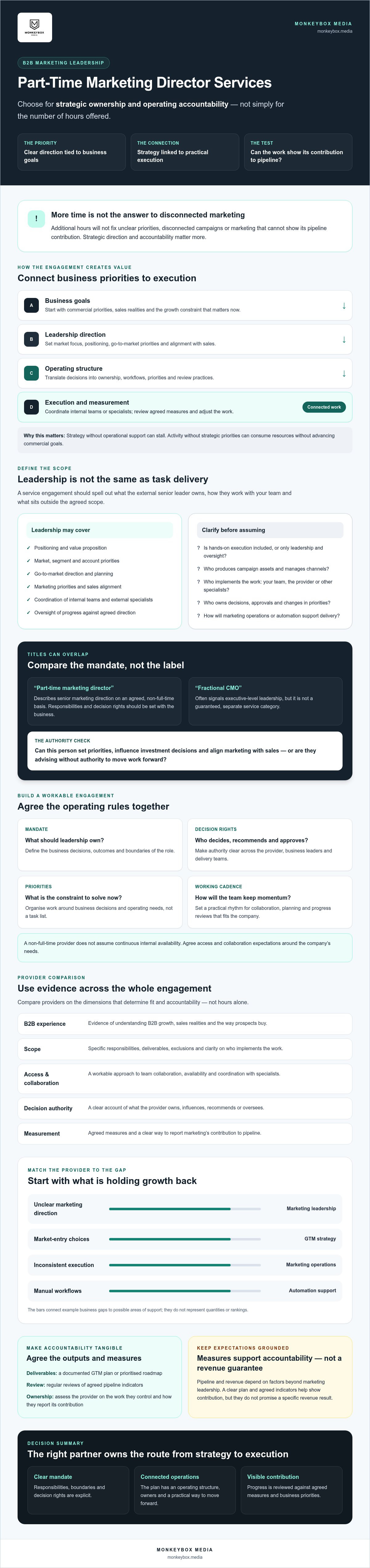
Part time marketing director services provide senior marketing direction on an agreed, non-full-time basis, with responsibilities and decision rights set between the business and provider. Unlike a full-time appointment, the role doesn’t assume continuous internal availability. The provider may lead planning and oversight, while your team or external specialists handle delivery. Hands-on execution isn’t automatic. Clarify whether it’s included, who provides it and how work will be prioritised.
The fractional executive model offers useful context: an experienced leader contributes to an organisation without taking a conventional full-time executive position. The value depends on the mandate, not the label. A practical scope links leadership to the systems and workflows needed to put decisions into action.
How is a part-time marketing director different from a fractional CMO?
The titles can overlap. “Fractional CMO” often signals executive-level marketing leadership, but it isn’t a guaranteed, separate service category. Compare the actual remit: can the person set priorities, influence investment decisions and align marketing with sales, or are they advising without authority to move work forward? Confirm who owns decisions, which teams or specialists they oversee and how progress is reviewed. For broader role context, read the fractional CMO agency guide.
What outcomes and responsibilities can the service cover?
For a B2B organisation, the remit may include sharpening positioning, shaping go-to-market plans, setting marketing priorities and improving alignment with sales. The director may also coordinate internal teams and external specialists, helping keep activity connected to the agreed direction rather than turning into a disconnected task list. Depending on the engagement, marketing operations or automation may support execution. Clarify what the provider leads, implements or oversees.
Agree tangible deliverables, decision rights and measures before work begins. These might include a documented GTM plan, a prioritised roadmap or regular reviews of agreed pipeline indicators. Such outputs support accountability, but they don’t promise a specific revenue result. Pipeline and revenue depend on factors beyond marketing leadership, so assess the provider on the work they control and how they report its contribution.
Which Services Should a B2B Marketing Director Engagement Cover?
Build the scope around the decisions and operating gaps holding back growth, not a long list of disconnected marketing tasks. A B2B business entering a new market may need clearer positioning and go-to-market direction. Another may already know its priorities but lack the processes, measurement or automation to execute consistently. Start by identifying the constraint that matters most now.
Strategic marketing leadership turns business priorities into a focused direction, while marketing operations and workflows make that direction executable and measurable. This connection is central to effective part time marketing director services. A strategy without operational support can stall, while activity without strategic priorities can consume resources without advancing commercial goals.
Strategic leadership, positioning and go-to-market direction
At the strategic level, the director can help determine which markets or customer segments to prioritise, how the company should position its offer, which accounts to target and how to express its value proposition. These choices should connect to commercial goals and sales realities, including how prospects buy and where sales conversations reveal friction.
The remit may also include turning those decisions into a GTM plan, setting priorities and reviewing progress with relevant stakeholders. Agree the planning and review rhythm with the provider, because no single cadence suits every organisation. Be clear about what the director decides, what they recommend and who approves changes.
GTM strategy defines the market focus, audience, positioning, route to market and priorities. It doesn’t automatically include producing every campaign asset, managing each channel or carrying out specialist execution. Agree whether the director will oversee internal staff or external specialists, and who is responsible for campaign production and delivery.
Marketing operations, automation and AI workflows
Marketing operations connect the plan to the day-to-day system of work. Depending on the agreed scope, this can include clarifying hand-offs between marketing and sales, improving process consistency, defining useful performance measures and checking whether existing marketing technology supports the workflow. The practical aim is to make activity easier to track and understand.
Automation or AI agents may support specific agreed workflows, such as reducing repetitive steps or helping teams manage information more consistently. Their use should follow a defined business need, process and measurement plan, rather than becoming a technology project for its own sake. The services described here cover marketing strategy, operations, automation and AI agent implementation, not software development or standalone software products.
Before agreeing to an engagement, map each priority to an owner, an output and a review point. If your B2B team needs connected strategic direction and operational support, you can explore fractional CMO and GTM strategy support.
How to Compare Part Time Marketing Director Services
Compare a provider’s ability to own strategic decisions and create accountability, not just the confidence of their pitch or the seniority of their title. Ask for evidence of how they diagnose a B2B business, set priorities and connect marketing work to commercial objectives. Then check whether their working practices fit your team.
| Criterion | What to assess |
|---|---|
| Strategic fit | Can they link marketing priorities to your growth goals, market position and current constraints? |
| B2B experience | Can they explain relevant work with comparable sales cycles, buyers or go-to-market challenges? |
| Scope | Are responsibilities, deliverables and boundaries between leadership and hands-on execution explicit? |
| Access | Is there a clear plan for communicating with leadership, sales and marketing contributors? |
| Authority | Can they make or influence the decisions needed to move agreed priorities forward? |
| Measurement | Will they agree meaningful baseline measures, reporting ownership and review points? |
These criteria help distinguish strategic ownership from task-only consultancy. A consultant may provide recommendations or complete a defined piece of work, while a part-time director may take an ongoing role in setting priorities and coordinating execution. A full-time hire may suit a business with a stable strategy and a consistent volume of leadership and delivery work. There’s no universal winner. Compare the capability you need, the continuity required and the commitment each model involves. Cost, time allocation and engagement length depend on the agreed scope, so assess proposals on their terms rather than assuming a standard arrangement.
What should you ask a prospective marketing director?
Ask how they investigate business priorities before recommending activity. How will they work with sales, leadership and existing marketing contributors? Request examples of relevant work, then clarify what the provider personally led and what outcomes can be evidenced. Strong answers connect diagnosis, decisions and follow-through rather than relying on broad claims or impressive titles.
How will you know whether the engagement is working?
Agree baseline measures tied to business objectives before activity begins. Separate leading indicators, such as qualified pipeline, from lagging outcomes such as revenue, and define how each will be interpreted. Set the review frequency, reporting owner and decision-making responsibilities in advance. This creates a shared way to assess progress without treating any single metric as proof that the provider alone caused a result.
Will a Part-Time Marketing Director Have Enough Time and Authority?
Yes, if the engagement is designed around decisions and priorities rather than assumed availability. Fewer scheduled hours can work when the director knows what they own, which choices need approval and who carries agreed work forward between sessions. Without that structure, even a senior appointment can become a bottleneck.
There’s no single time allocation that fits every B2B company. The right scope and working cadence depend on business goals, team capacity, the complexity of the marketing operation and the level of support required. Agree these together. Documenting decisions, owners and next steps also reduces reliance on constant access, so people can keep moving without waiting for the next meeting to clarify responsibilities.
How to structure the first stages of an engagement
Set up the work in a clear sequence. Keep the initial focus narrow enough to act on, then adjust the plan as the director learns more about the business.
- Establish the starting point. Review business goals, current marketing activity, available team capacity and any process or system constraints.
- Choose priorities. Agree a focused set of strategic decisions and operational improvements, and identify what can wait.
- Set the working rules. Confirm stakeholders, approval routes, required access and communication cadence so work doesn’t stall between sessions.
This creates a shared operating plan, not a promise of a specific impact timeline. The pace depends on the scope, available resources and decisions the business needs to make.
How to establish authority, continuity and accountability
Make decision rights explicit. Record which decisions the director owns, which they recommend and which they escalate for approval. Then name an internal or external owner for each delivery responsibility. If the director sets a priority but no one is accountable for carrying it out, the plan stops at the meeting.
A recurring review keeps the engagement connected to changing business conditions. Use it to check progress against agreed priorities, surface risks, resolve blockers and decide whether anything should change. Keep a written record of decisions, owners and actions so the team has a reliable reference between reviews.
Strong part time marketing director services combine senior direction with a workable rhythm for decisions and follow-through. If you’re defining that model for your B2B team, discuss fractional CMO leadership and marketing operations support.
How to Choose a Part Time Marketing Director Service for Your Business
Start with the gap you need to close, not the provider’s preferred package. If your team lacks clear direction, prioritise senior marketing leadership. If you’re preparing to enter a market or sharpen your route to buyers, assess go-to-market planning. If priorities are set but processes and technology are getting in the way, look for marketing operations or automation capability.
Use that need to build a shortlist, then ask each provider the same questions. How will they understand your business before proposing activity? Who will lead the work? How will they coordinate with sales, leadership and existing marketing contributors? Compare the evidence and proposed working practices, not just a confident pitch.
What should a strong proposal make clear?
A useful proposal makes the engagement operationally clear. Check that it reflects your business context, identifies the priorities to address and defines responsibilities and a proposed working rhythm. Measurement should link to agreed objectives, not simply count outputs such as meetings held or campaigns launched.
Before agreeing to proceed, make sure the proposal also states:
- Scope and deliverables: what the provider will lead, implement or oversee, and what remains with your team or other specialists.
- Access and governance: which stakeholders need to participate, who approves decisions and how issues are escalated.
- Measurement and reviews: which indicators will be tracked, who reports on them and when progress will be assessed.
- Exclusions and dependencies: what’s outside the engagement and what access, information or internal capacity the work depends on.
These details reduce the risk of mismatched expectations. They also give you a practical basis for comparing proposals, even when providers describe their services differently.
When is Monkeybox Media a potential fit?
Monkeybox Media may be relevant to B2B organisations seeking senior marketing and go-to-market leadership alongside stronger execution systems. Its capabilities include fractional CMO leadership, GTM strategy, marketing operations, marketing automation and AI agents integrated into marketing workflows. That combination may suit a business where strategic direction and the processes supporting delivery both need attention.
Fit still depends on your priorities, required scope and working expectations. Before starting a conversation, identify the main gap, the decisions the provider would need to influence and how you’ll assess progress. Then discuss fractional CMO and marketing operations support if those needs align with Monkeybox Media’s capabilities.
Choose a Partner Who Can Turn Strategy into Progress
The right part time marketing director services should match the gap your B2B business needs to close, whether that’s strategic direction, go-to-market planning or stronger marketing operations. Look beyond the title and time allocation. Confirm what the provider will own, how they’ll work with your team and how you’ll review progress against agreed objectives.
Strong partnerships connect decisions to execution. Clear priorities, decision rights and ownership keep work moving between leadership sessions, while relevant measures help you assess whether marketing activity supports business goals. Make the scope explicit, including what the provider will lead and what remains with your team or other specialists.
Monkeybox Media brings together fractional CMO leadership and go-to-market strategy with marketing operations, automation and AI agent implementation. If your B2B organisation needs strategic leadership connected to the systems that support execution, discuss your B2B marketing leadership and operations needs.
Choose the partner whose strengths fit your priorities, and give the engagement a clear foundation for focused, accountable progress.
Frequently Asked Questions
Is a part-time marketing director the same as a fractional CMO?
Not always, although the titles can overlap. “Fractional CMO” usually describes executive-level marketing leadership, while “part-time marketing director” may describe a similar remit under a different title. The label alone doesn’t establish authority or accountability. Check whether the provider can set priorities, influence decisions, align marketing with commercial goals and oversee execution, or whether their role is limited to advice or a defined project.
How much time does a part-time marketing director work?
There’s no standard number of hours that suits every business. The time commitment should reflect the agreed scope, complexity of your marketing needs, team capacity and level of access required. A focused strategic remit may call for a different cadence from an engagement involving operational change and regular team coordination. Agree scheduled sessions, communication expectations, decision routes and responsibilities between meetings before work starts.
Can a part-time marketing director lead a B2B go-to-market strategy?
Yes, if GTM planning is within the agreed remit and the director has the authority and access to lead it. They can help clarify market focus, positioning, target accounts, value proposition and how marketing priorities align with sales. Confirm whether the work includes strategic planning only or also oversight of implementation. Campaign production and specialist channel execution may need separate owners, such as your internal team or external specialists.
What happens if my company already has a marketing team?
An existing team can make the engagement more effective, not redundant. A part-time director can provide senior direction, establish priorities, align marketing activity with sales and help the team coordinate around business goals. Define how responsibilities divide between the director and team members, who approves decisions and who owns delivery. This prevents duplicate work and gives contributors clear priorities rather than adding another layer of unclear oversight.
How do I measure whether part-time marketing director services are working?
Agree measures before activity begins, using business objectives and an honest baseline. Part time marketing director services should be assessed through both leading indicators, such as qualified pipeline, and lagging outcomes, such as revenue. Also track agreed deliverables and operational improvements where relevant. Set the reporting owner and review cadence, and interpret results in context: marketing leadership can influence outcomes, but it can’t control every factor affecting revenue.
Should I hire a part-time marketing director or a full-time CMO?
Choose based on the leadership capacity your business needs. A part-time director may suit a company that needs senior strategic direction but doesn’t require a full-time executive presence. A full-time CMO may be a better fit when leadership demand and team oversight are continuous and the volume of work requires sustained daily involvement. Compare the required authority, availability, scope and commitment, then select the model that fits your operating reality.