
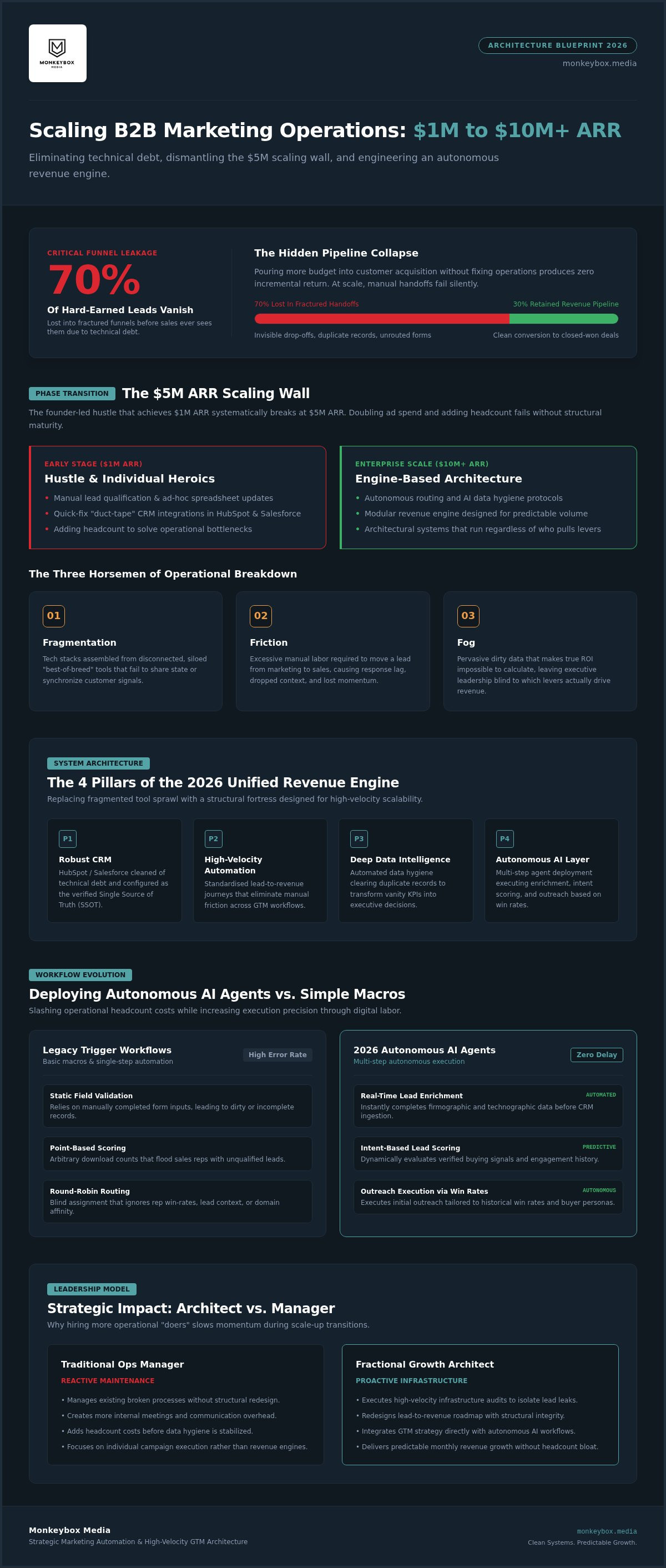
Your current marketing stack is a ticking time bomb of technical debt. While you're chasing aggressive expansion, 70% of your hard-earned leads are likely vanishing into a fractured funnel that your team can't even see. Scaling marketing ops B2B isn't a matter of hiring more managers or buying another SaaS subscription. It's about structural integrity. You've likely felt the friction of inconsistent data making ROI impossible to track. It's a common ceiling. It kills momentum.
We agree that throwing more bodies at a broken process is a recipe for wasted capital. You need a predictable revenue engine that runs on precision, not guesswork. This article provides the master blueprint for the structural architecture and AI-powered workflows necessary to scale your operations from $1M to $10M+ ARR. We'll explore how to eliminate technical debt in HubSpot and Salesforce, automate workflows to slash headcount costs, and finally gain clear visibility into every pound spent. Prepare to build a system designed for high-velocity growth.
Key Takeaways
- Identify the specific structural failure points where manual processes collapse and learn how to dismantle the fragmentation, friction, and fog holding your growth hostage.
- Discover why the "best of breed" software approach is obsolete and how to architect a unified revenue engine for scaling marketing ops B2B in 2026.
- Compare the strategic impact of fractional leadership against traditional full-time hires to ensure you have an architect, not just a manager, at the helm during expansion.
- Execute a high-velocity infrastructure audit to identify lead leaks and standardise your lead-to-revenue journey through precise, automated workflow mapping.
- Master the integration of high-level GTM strategy with AI agent automation to reduce headcount costs while maintaining a relentless, predictable expansion pace.
The Scaling Wall: Why B2B Marketing Operations Stalls at $5M ARR
Hit the $5M ARR mark and the wheels start to wobble. This is the Scaling Wall. It is the exact point where manual, "hustle-based" processes collapse under the weight of increased volume. In the Business-to-business (B2B) sector, this wall is often invisible until you try to accelerate. You double the ad spend, but the revenue doesn't move. You hire more sales reps, but the pipeline remains stagnant. The systems that supported your early growth are now the very things holding you back.
Operational failure at this stage is driven by three horsemen: fragmentation, friction, and fog. Fragmentation occurs when your tech stack is a collection of siloed tools that don't talk to each other. Friction is the manual labor required to move a lead from marketing to sales. Fog is the lack of clean data, making it impossible to see which levers actually drive growth. Scaling marketing ops B2B requires a hard truth: hiring more "doers" often slows you down. Adding headcount to a broken system just creates more meetings and more confusion. By 2026, the market demands operational maturity before you touch the accelerator. Systems must be built to scale before the capital is deployed.
The Hidden Cost of Marketing Technical Debt
Technical debt is the accumulation of "quick fixes" and duct-tape integrations in your CRM and automation platforms. In early growth, these shortcuts seem efficient. At $5M ARR, they become expensive bottlenecks. Dirty data is the ultimate momentum killer. If your database is cluttered with duplicates and incomplete records, your AI-driven marketing efforts will fail. AI agents require high-fidelity data to function; without it, you're just automating chaos. You can't build a skyscraper on a swamp. You must clear the debt before you build the engine.
From Hustle to Systems: The Mindset Shift
The founder-led marketing approach that got you to $1M will fail you at $10M. It relies on individual heroics rather than repeatable systems. Transitioning to $10M+ ARR requires engine-based thinking. You aren't just running campaigns; you're building a machine. This shift requires a "Bold Architect" who can redesign the growth roadmap with structural integrity. It is about moving from a reactive "hustle" culture to a proactive, systematic execution engine. You need a structure that produces predictable results every single month, regardless of who is pulling the levers. Scaling marketing ops B2B is about building for the next level of professional maturity.
Architecting the 2026 B2B Marketing Ops Stack
The "best of breed" era is over. It left B2B leaders with a graveyard of disconnected tools and fragmented data. Scaling marketing ops B2B in 2026 requires an integrated Revenue Engine, not a loose software collection. This architecture rests on four critical pillars: a robust CRM, high-velocity automation, deep data intelligence, and a sophisticated AI layer. You aren't just buying software. You're building a fortress. Modularity is your insurance policy. When scaling marketing ops B2B, the focus shifts from individual campaign performance to the structural integrity of the entire machine. Your stack must be agile enough to pivot when the market shifts, ensuring your infrastructure remains an asset rather than a liability.
Deploying AI Agents in Marketing Workflows
Stop settling for simple macros and basic triggers. The 2026 State of Marketing Report highlights that leading firms have moved toward autonomous AI agents. These agents handle complex, multi-step tasks like real-time lead enrichment, intent-based lead scoring, and predictive routing. They don't just flag a lead; they execute the initial outreach strategy based on historical win rates and buyer personas. This level of sophistication allows you to slash operational headcount costs while significantly increasing output. It’s about replacing manual, error-prone labor with high-precision digital labor that never sleeps.
The Data Foundation: Cleanliness as a Competitive Advantage
AI is only as good as the data it consumes. A Single Source of Truth (SSOT) across your GTM team is no longer optional. It is the baseline for survival. You must automate your data hygiene to fuel high-accuracy predictions and prevent the "fog" mentioned earlier. When your data is clean, your KPIs actually mean something. They transition from vanity metrics to drivers of executive decision-making. If you're ready to stop firefighting and start building, exploring strategic marketing automation is the next logical step. Robust systems produce robust results. Every time.
Fractional CMO vs. Full-Time Ops: Choosing Your Leadership Model
Hiring a full-time CMO with a £150,000+ base salary is a high-risk gamble during aggressive growth phases. You're paying for a captain before you've even finished building the ship. Most B2B organizations at this stage don't need a career manager to oversee a legacy team; they need an architect to build one. This is where the cost-to-impact ratio of fractional leadership becomes undeniable. According to McKinsey’s analysis of the new B2B growth equation, speed and agility are now the primary drivers of market share. Fractionals bypass the six-month onboarding period and internal office politics. They arrive with a proven playbook, ready to execute.
The primary difference between these models is the objective. A full-time hire often focuses on job security and incremental improvements. A fractional leader is focused on the exit: building a system so robust they are no longer required. Effectively scaling marketing ops B2B requires this "architect" mindset. You need someone who can dismantle technical debt and install AI-driven workflows without being bogged down by "the way we've always done it." They provide the strategic urgency required to move from $1M to $10M ARR without the long-term liability of a permanent executive contract.
The ROI of Flexible Strategic Leadership
High burn rates kill B2B SaaS companies. A misaligned executive hire can set your roadmap back by a year or more. Fractional CMOs mitigate this risk by providing cross-industry insights that internal teams often lack. They've seen the same bottlenecks across multiple sectors and know exactly which levers to pull. For a deeper dive into this model, see The Fractional CMO Agency Guide 2026: Scaling B2B Revenue with Strategic Authority. Strategic leadership should be an investment in momentum, not a fixed overhead that drains your cash reserves during critical scaling phases.
When to Hire In-House Operations Specialists
There is a tipping point where in-house management makes sense. This usually occurs once the core infrastructure is stable and the primary challenge shifts from "building" to "optimizing." Scaling marketing ops B2B often thrives under a hybrid model. Use fractional leadership to design the high-level GTM strategy and oversee the initial build. Then, hire junior-to-mid-level specialists to handle daily execution. This approach builds a culture of operational excellence from the top down without the heavy executive price tag. It ensures your engine keeps running at peak performance long after the initial blueprints are drawn.
The 5-Step Roadmap to Scaling Marketing Ops
Execution is the only differentiator. Successfully scaling marketing ops B2B requires a clinical, sequence-driven approach to your existing infrastructure. You cannot automate a mess; you must first dismantle it. This roadmap is designed to transition your organization from a collection of reactive tactics to a proactive revenue engine. It follows a logical progression: identify the rot, map the flow, inject intelligence, trim the fat, and engineer for performance. Each step is a building block. Skip one, and the entire structure remains fragile. We move from the foundational audit to real-time performance engineering, ensuring every pound of spend is accounted for and every lead is captured.
- Step 1: The Infrastructure Audit. Locate every leak and quantify your technical debt.
- Step 2: Workflow Mapping. Standardise the lead-to-revenue journey to eliminate ambiguity.
- Step 3: AI Agent Integration. Automate the high-friction manual tasks that drain your team's time.
- Step 4: Stack Consolidation. Kill redundant tools to reduce costs and increase system speed.
- Step 5: Performance Engineering. Deploy a real-time revenue dashboard for total visibility.
Phase 1: Eliminating the Friction
Complexity is the enemy of velocity. A comprehensive B2B marketing infrastructure audit reveals where your capital is being set on fire. You're looking for "phantom processes"—legacy workflows that your team follows out of habit but no longer serve the GTM strategy. These are the silent killers of productivity. We simplify the tech stack to increase team adoption and operational speed. When the system is intuitive, the team moves faster. When the friction is gone, the data flows. This isn't just about saving money on software; it's about reclaiming the mental bandwidth of your best people. If you're ready to stop the leaks, book an infrastructure audit today.
Phase 2: Automating for Velocity
Once the friction is removed, we inject speed. Scaling marketing ops B2B in 2026 relies on marketing process automation AI to handle routine lead management. This goes beyond simple email triggers. We're talking about automated "hand-offs" between marketing and sales that occur in seconds, not hours. AI agents now handle real-time market sentiment analysis and competitor tracking, providing your team with actionable intelligence without the manual research grind. This creates a high-velocity environment where your sales reps only talk to qualified, high-intent prospects. The machine handles the noise. Your people handle the revenue.
Commanding the Market: The Monkeybox Execution Engine
Scaling marketing ops B2B is a high-stakes engineering project. You can't leave your growth to generalists or agencies that prioritize creative awards over commercial outcomes. Monkeybox Media builds the robust infrastructure required for market dominance. We don't just advise; we architect and execute. Our methodology integrates high-level GTM strategy with granular AI automation to ensure your expansion isn't just fast, it's sustainable. We eliminate the unpredictability of early-stage "hustle" and replace it with a clinical, data-driven machine designed for firms ready to smash through the $10M ARR wall. Execution is our only metric. Momentum is our only mode.
Strategic GTM Planning for Dominance
Dominance begins with positioning. We help B2B leaders define their category with such precision that competition becomes irrelevant. This isn't about vague brand statements or aesthetic fluff. It's about aligning every operational lever to your core revenue goals. From lead enrichment to sales hand-offs, every process is engineered for high-velocity and precision. We move with a sense of strategic urgency because, in 2026, the slow are eaten by the fast. Effectively scaling marketing ops B2B requires an operational reality that can actually deliver on your market promise. We ensure your infrastructure is ready to support your ambition.
Building Your Scalable Growth Infrastructure
We specialize in custom AI agent implementation tailored to your specific B2B sales cycle. These aren't generic chatbots. They are sophisticated digital workers that handle lead scoring, market sentiment analysis, and competitor tracking with inhuman precision. This technology allows your human team to focus on high-value strategy while the machine handles the volume. Our ongoing fractional CMO support provides the executive-level oversight necessary to ensure your strategy evolves alongside the market. We stay grounded in the mechanics of execution while keeping our eyes on the big picture. It's time to move from unpredictable leads to a predictable growth machine. The next step is a decision for those serious about professional maturity. Book a Strategic Growth Audit with Monkeybox Media to begin the transition.
Command the Machine: Your Blueprint for $10M+ ARR
The transition from $1M to $10M ARR is a structural challenge that exposes every crack in your operational foundation. You've seen why manual processes fail at the scaling wall and how technical debt acts as a silent tax on your growth. Successfully scaling marketing ops B2B requires moving beyond fragmented tools and into a unified, AI-powered revenue engine. It demands a shift from hiring administrative managers to partnering with strategic architects who build for velocity.
Monkeybox Media delivers this through expert RevOps consulting for B2B SaaS and specialized AI agent implementation. We provide the fractional CMO leadership necessary to navigate high-stakes expansion without the bloat of a permanent executive hire. Your growth machine should be predictable, automated, and relentless. It's time to stop fighting your systems and start leveraging them. The architecture for your next phase of growth is ready for deployment.
Secure your Fractional CMO leadership and scale your GTM engine today
Frequently Asked Questions
What is the first sign that my marketing operations need scaling?
The primary indicator is the "Scaling Wall" where increased ad spend fails to produce a proportional rise in revenue. If your sales team complains about lead quality while marketing reports high volume, your systems are likely fractured. Inconsistent data across your CRM makes it impossible to track ROI with any precision. Scaling marketing ops B2B becomes mandatory when manual processes break under the weight of your growth ambitions. You can't out-hustle a broken engine.
How much does it cost to implement AI agents in a B2B marketing workflow?
Implementation costs for AI agents depend on the complexity of the workflows being automated and the depth of integration required. While initial project fees apply, the focus should remain on the reduction of long-term headcount costs and the elimination of manual errors. These agents act as digital labor that scales without increasing your burn rate. It's an investment in structural integrity that pays dividends by allowing your human team to focus on high-value strategy.
Can a fractional CMO really replace a full-time marketing leader?
A fractional CMO is often more effective than a full-time hire during high-growth phases. They act as the "Bold Architect" who designs and builds the engine rather than a career manager who maintains the status quo. Monkeybox Media provides this elite strategic leadership to help firms bypass internal politics and focus entirely on aggressive market expansion. This model offers the executive-level GTM strategy required for $10M+ growth without the long-term liability of a permanent contract.
How do I identify technical debt in my current HubSpot or Salesforce setup?
Technical debt manifests as manual workarounds, redundant fields, and "phantom processes" that your team follows out of habit. If your HubSpot or Salesforce setup requires spreadsheet exports to generate a single report, you have a structural debt problem. A comprehensive infrastructure audit is the only way to quantify these bottlenecks. Identifying these leaks early prevents your CRM from becoming a graveyard of dirty data that eventually kills your AI automation efforts and stalls expansion.
What is the typical ROI for scaling marketing operations in B2B SaaS?
The ROI of scaling marketing ops B2B is measured in predictability and reduced Customer Acquisition Cost (CAC). By automating the lead-to-revenue journey, you create a system that produces consistent results regardless of individual performance. Most organizations see a significant increase in lead follow-up rates and pipeline velocity. Clear visibility into every pound spent allows for aggressive, data-backed scaling decisions that would be impossible in a fragmented, manual environment where leads simply vanish.
How long does it take to see results from a marketing ops re-architecture?
Efficiency gains are often immediate, but full revenue impact typically takes three to six months. The first phase focuses on eliminating friction and cleaning the data foundation. Once the AI-driven workflows are live, you'll see a measurable reduction in manual labor within the first ninety days. The long-term goal is a self-sustaining revenue engine that compounds in value as your data matures and your AI agents become more precise in their execution.
Should I focus on demand generation or marketing operations first?
You must focus on marketing operations first. Pouring money into demand generation before your infrastructure is ready is like pouring water into a leaky bucket. You'll waste capital on leads that your team can't track or follow up with effectively. Building a robust operational foundation ensures that every lead generated by your demand programs is captured, enriched, and routed with clinical precision. Operational maturity must always precede aggressive market spending.