
What if the problem isn’t a lack of marketing activity, but the decisions that activity is meant to support? If campaigns aren’t tied to commercial priorities and Sales and Marketing are working from different assumptions, adding more tactics won’t fix the gap. Choosing a strategic marketing consultant for B2B means finding someone who can connect market choices to execution and business outcomes, not just deliver a list of recommendations.
You need senior direction that moves the work forward, with clear ownership, practical systems and measures that show progress. That’s why the right partner’s remit matters as much as their strategy. A fractional CMO or GTM strategy partner should help establish what the business needs to solve, then connect those priorities to the way marketing operates day to day.
This guide gives you a practical framework for comparing consultants by the decisions they own, the systems they build and the outcomes they measure. You’ll learn how to assess strategic fit, clarify scope and accountability, and set working rhythms that keep Sales and Marketing aligned. The result: a partner whose direction translates into focused, measurable execution.
Key Takeaways
- Choose a strategic marketing consultant for B2B based on the decisions they’ll own, how they’ll work with your team, and the outcomes they’ll track.
- Start with the commercial constraint, then assess whether the proposed priorities address it before tactics or channels enter the plan.
- Match the engagement model to the need: a defined strategy project, fractional leadership, or focused implementation.
- Review proposals for clear scope, responsibilities, working rhythms, and measures linked to business objectives, not guaranteed results.
- Prepare a brief covering your growth objective, current constraints, team structure, and the decisions you need to make.
What a strategic marketing consultant for B2B should actually solve
A strategic marketing consultant for B2B helps leadership make and act on the marketing decisions that shape growth: which markets and audiences to prioritise, how to position the business, where to focus go-to-market (GTM) effort, and how to measure progress. The work starts with the business challenge, not a channel recommendation.
Business-to-business (B2B) marketing serves organisational buyers, so strategy needs to account for how a company creates value for other businesses and supports their purchasing decisions. That’s different from simply increasing campaign output. Strategy sets direction and priorities; campaign delivery and specialist execution put defined activities into market. Fractional leadership is different again: it provides ongoing senior ownership, often coordinating strategy and execution over time.
The right remit depends on the growth constraint, available team capacity and decisions leaders need to make. If the market choice is unclear, another campaign may only amplify the uncertainty. If direction is settled but a channel is under-resourced, focused execution may be the more relevant need. Strategic B2B marketing consulting is senior guidance that turns commercial priorities into clear market, positioning, GTM and measurement choices, rather than general marketing support without a defined decision to resolve.
When does a B2B company need strategic marketing support?
Look for patterns: prospects struggle to understand why the business is different, marketing priorities keep changing, or demand generation is difficult to plan consistently. These can signal a strategic issue, especially when Sales and Marketing describe the target buyer or value proposition differently. By contrast, a temporary capacity gap or one underperforming channel may call for an execution fix, not a full strategy reset.
Start with the leadership decision: what must the business decide about its market, audience, offer or growth priorities? If the team can’t answer clearly, strategic support may help establish direction before more activity is commissioned.
What should a strategic consultant own?
Agree ownership in practical terms. A consultant may lead analysis and recommendations on priority markets and audiences, positioning, GTM choices and measurement direction, then translate decisions into an actionable plan. They should work with leadership, Sales and Marketing to test assumptions and align the plan with how the business sells and delivers.
Ownership doesn’t mean taking over internal decision rights. Define who recommends, who approves, who executes and who tracks progress. A fractional CMO can provide continuing leadership; GTM strategy can focus on market-to-execution alignment; marketing operations and automation can support the workflows that carry the plan forward. Clear boundaries prevent strategy from ending as a presentation.
How to evaluate a strategic marketing consultant for B2B
A strong proposal starts with diagnosis. Before recommending channels or campaigns, the consultant should investigate the commercial constraint: for example, whether the business is targeting the wrong accounts, struggling to communicate its value, or losing momentum between marketing and Sales. If the recommendation arrives before the problem is clear, the plan may simply add activity without addressing what’s holding growth back.
Assess the thinking behind the proposal, not just the list of services. The role of a consultant is to bring expertise to a defined challenge. For B2B, that expertise should connect market understanding and positioning with GTM planning, implementation realities, and measurement. A strategic marketing consultant for B2B should show how their recommendations fit your team, systems, and commercial objectives.
Which capabilities matter beyond marketing experience?
Look for joined-up reasoning across positioning, go-to-market priorities, marketing operations, and cross-functional alignment. A sound plan accounts for who will execute it, how Sales will contribute, and whether existing systems can support the work. Relevant experience matters, but a long service list is no substitute for explaining why a specific approach fits your business.
How can you assess strategic thinking before engagement?
Read how the consultant frames the challenge. Do they separate known evidence from assumptions, identify trade-offs, and explain what the business must prioritise? Strong recommendations name the people responsible, the intended measures, and the points where progress will be reviewed. A polished presentation or an isolated success story can be useful context, but neither proves the approach fits your situation.
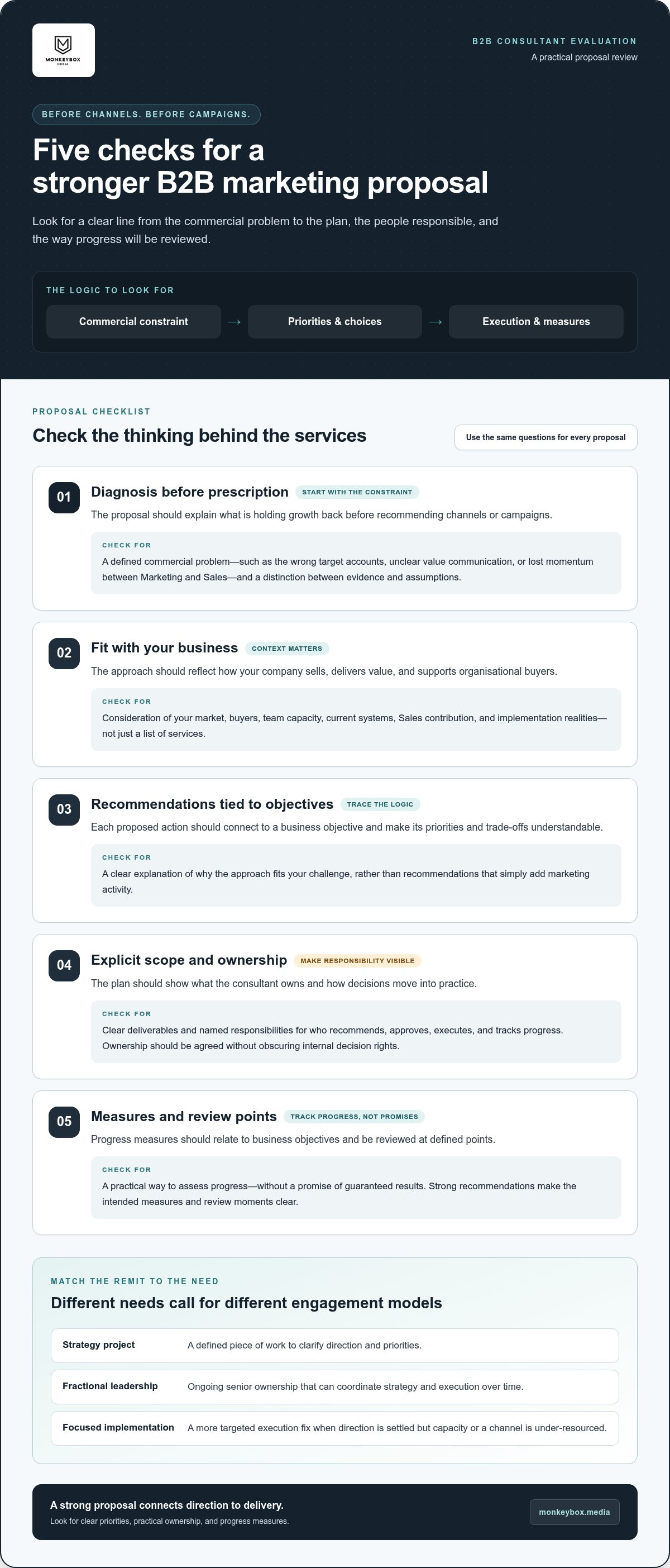
Compare proposals using the same questions. A concise checklist makes gaps visible:
- Diagnosis: Does the proposal explain the commercial problem before prescribing activity?
- Fit: Does it reflect your market, buyers, team capacity, and current systems?
- Logic: Can you trace each recommendation back to a business objective?
- Ownership: Are deliverables, decision-makers, and execution responsibilities explicit?
- Measurement: Are progress measures and review points defined without promising guaranteed results?
Then check whether the proposed work can move from direction into practice. If the plan depends on automation, for instance, it should account for the workflows and operational ownership needed to make that automation useful. If your team needs senior oversight as well as a strategic plan, clarify how ongoing leadership differs from a time-bound engagement. The best fit is the one whose scope matches the decision and delivery capacity you actually have.
Use this checklist to compare partners consistently, then identify where your team needs stronger strategic direction. Explore B2B marketing strategy and leadership as a practical next step.
Compare B2B consultant engagement models, scope, and accountability
The engagement should fit the growth problem, not a preferred service label. A defined market question may need a focused strategy project; a team facing continuing prioritisation and coordination challenges may need fractional leadership; a clear plan with a delivery gap may call for specialist implementation. Strong B2B marketing strategies connect direction to action, but the engagement model determines who keeps that work moving.
| Engagement model | Remit and typical outputs | Internal ownership | Suitable situation |
|---|---|---|---|
| Project-based strategy | Investigates a defined question and delivers findings, recommendations, and a prioritised plan. | Leaders make decisions; an internal owner takes forward agreed actions after handover. | The business needs to resolve a specific market, positioning, or GTM question. |
| Fractional CMO leadership | Provides continuing senior direction, aligns priorities, and guides the marketing function over time. | The fractional leader coordinates with executives and the team; decision rights are agreed internally. | The business needs sustained leadership but not a full-time CMO role. |
| Specialist implementation | Delivers a defined operational or technical workstream, such as marketing operations or automation implementation. | An internal lead sets priorities and provides access, approvals, and workflow context. | The strategy is clear, but a specific capability or delivery resource is needed. |
These models can connect, but they aren’t interchangeable. A project can establish priorities, while fractional leadership guides decisions as the plan evolves. Specialist implementation turns a defined workstream into operational practice. In every case, specify the handover, internal owner, review rhythm, and measures used to assess progress. Strategy shouldn’t stop at recommendations: name who turns each decision into owned work.
When is project-based consulting the right fit?
Choose a bounded project when leadership has a focused question, such as which market to prioritise or how to sharpen a value proposition. Agree the scope, evidence to review, decision outputs, and handover at the outset. If the recommendations require ongoing coordination or substantial delivery, establish who will lead that next phase before the project closes.
When does fractional CMO leadership make more sense?
Fractional leadership fits when priorities need regular senior oversight, teams need alignment, and decisions continue as the business learns. It differs from a discrete assessment by staying involved beyond the initial recommendations, and from specialist delivery by guiding the wider marketing function rather than owning only one workstream. For a deeper look at this model, read the fractional CMO agency guide.
For a strategic marketing consultant for B2B, the key test is whether the proposed structure makes accountability visible: clear remit, named owners, agreed reviews, and a route from strategic choices to execution.
How to assess a B2B marketing proposal before you commit
A proposal should make the path from business objective to accountable work easy to follow. Use this review process to compare scope and working expectations, not just the recommendations or presentation quality. A strategic marketing consultant for B2B should make clear what the engagement is designed to address, what it will produce, and how the team will assess progress.
- Check the brief. Does it capture your growth objective, current constraints, team capacity, and the decision you need to make? If the brief describes activities but not the business question, ask whether the underlying challenge has been understood.
- Review the diagnosis. Look for a clear distinction between evidence, assumptions, and open questions. Recommendations should follow from this diagnosis, rather than defaulting to familiar channels or campaign tactics.
- Trace the scope. Check that the proposal sets out objectives, work phases, deliverables, decision points, and exclusions. For example, a positioning recommendation is a strategic output; updating campaign assets or operating them continuously may be separate implementation work.
- Confirm ownership and access. Identify who leads each task across the consultant, leadership, Sales, and Marketing. Establish who approves decisions, which people need to contribute, how often you’ll meet, and how the consultant will share updates between reviews.
- Test the measures and handover. Agree how progress will be assessed against the commercial objective and available baseline data. The proposal should set review points and define what happens to recommendations, workflows, and outstanding tasks at handover.
What should a clear consulting scope include?
A useful scope connects the business question to the work: objectives, phases, deliverables, decision owners, and handover expectations. It should distinguish strategy from execution and continuing operational responsibilities. If implementation is included, specify which tasks the consultant owns and which depend on your team. Clear boundaries reduce ambiguity once work starts.
Which measures show whether the engagement is progressing?
Choose measures that match the goal and the data you can reliably access. A project to improve GTM focus might track whether priority decisions are made, translated into plans, and adopted by the responsible teams. Review execution evidence alongside commercial indicators as they become available. Activity volume, such as emails sent or content produced, can show work completed, but it doesn’t prove business impact on its own. No proposal should guarantee an outcome the consultant can’t control.
Before you agree, make sure the working rhythm gives your leaders and teams enough access to resolve decisions and keep delivery moving. For a strategic conversation about connecting B2B marketing direction with execution, discuss your marketing priorities.
Build a practical next step with a strategic B2B marketing partner
A productive first conversation starts with a clear picture of the growth challenge, not a polished presentation. A concise readiness brief helps a strategic marketing consultant for B2B focus on the decisions that matter, identify what’s blocking progress, and shape a scope that fits your team’s capacity. You don’t need every answer. Bring the context that makes the right questions possible.
What should you prepare before an initial strategy conversation?
Summarise your growth objective, target markets, positioning concerns, and relevant performance context. Note which leadership decisions are stalled and what’s getting in the way. Add a practical view of the team: who owns marketing and Sales priorities, what capacity is available, which systems support current work, and who would own execution. This gives the conversation a useful starting point.
- Objective: What growth priority should marketing support?
- Constraints: Where do positioning, demand, resources, or decision-making create friction?
- Team and systems: Who contributes, and what tools and workflows are already in place?
- Decisions: What must leadership agree before execution can move forward?
How can strategy connect to scalable marketing operations?
Clear priorities should shape how work gets done. GTM planning can define the audiences, messages, and activities to focus on; marketing operations can establish ownership, workflows, and measurement; automation can support repeatable processes. AI agents may also be integrated into suitable marketing workflows, with human teams retaining strategic judgement and oversight. The aim is alignment between choices and operating practice, not technology added for its own sake.
Monkeybox Media connects fractional CMO leadership and B2B GTM strategy with marketing operations, automation, and AI agent implementation. That combination links senior direction to the infrastructure required to put decisions into practice, while keeping priorities, responsibilities, and workflows connected.
Bring your brief, constraints, and key decisions to a focused discussion. Discuss your B2B marketing challenge and explore a practical next step.
Turn strategic direction into accountable growth
The right strategic marketing consultant for B2B doesn’t just recommend activity. They connect commercial priorities to market choices, clear ownership, practical execution, and measures that help your team assess progress. Choose an engagement model that fits the challenge, then make the scope, decision rights, working rhythm, and handover explicit.
That alignment is what turns a strategy into an operating system. Monkeybox Media brings fractional CMO leadership and GTM strategy together with marketing operations, automation implementation, and AI agents integrated into marketing workflows. Each element can support the next, from setting direction to building the processes that put it into practice.
Ready to clarify your priorities and identify a practical next step? Discuss your B2B marketing strategy with Monkeybox Media. A focused conversation can help you move from scattered activity to a more deliberate path forward.
Frequently Asked Questions
What does a strategic marketing consultant for B2B do?
A strategic marketing consultant for B2B helps a business make focused decisions about its market, positioning, go-to-market priorities, and measurement. Depending on the engagement, they may diagnose commercial challenges, shape a plan, advise leaders, or design implementation. The value lies in connecting the business challenge to recommended actions, accountable owners, and ways to assess progress. A list of tactics without that connection is not a complete strategy.
How do I choose a strategic marketing consultant for a B2B company?
Start by defining the growth constraint or decision you need help resolving. Then compare relevant B2B experience, quality of diagnosis, strategic reasoning, scope clarity, collaboration, and measurement. Look for a clear explanation of how recommendations become owned work, who needs to contribute, and how progress will be reviewed. Choose the approach that fits your challenge and team capacity, rather than relying on credentials or a polished presentation alone.
Is a strategic marketing consultant the same as a fractional CMO?
No, the roles can differ in scope and duration. A strategic marketing consultant may assess a defined challenge and deliver recommendations or a plan. A fractional CMO provides ongoing senior marketing leadership, helping set priorities, align the team, and guide execution over time. Some businesses need a focused strategy project; others need continuing leadership. Compare the decisions the role owns, how long support is needed, and what internal capacity is available.
When should a B2B company hire a strategic marketing consultant?
Consider strategic support when growth priorities are unclear, positioning needs work, or marketing activity isn’t connected to commercial goals. It can also help when leadership needs an objective view of its go-to-market approach before committing to more activity. Define the decision the engagement should inform, such as which market to prioritise or how to align Sales and Marketing. A clear question helps set scope and involve the right stakeholders.
What should a B2B marketing consultant proposal include?
A clear proposal should define the business question, objectives, scope, work phases, deliverables, decision points, responsibilities, and review cadence. It should explain how strategic recommendations connect to execution and how progress will be assessed against agreed measures. Check that it distinguishes the consultant’s responsibilities from internal ownership, including who approves decisions and carries out actions. Treat guaranteed outcomes with caution: a proposal can commit to work, not promise results outside the consultant’s control.
How can a strategic marketing consultant measure success?
Measurement should reflect the agreed business objective and use an appropriate baseline. Depending on the engagement, progress could include clearer market choices, aligned go-to-market priorities, completed implementation milestones, or relevant pipeline and revenue indicators. Agree measures and review points before work begins, then interpret results in context. Activity totals, such as campaigns launched or content produced, can show delivery, but they don’t demonstrate business impact on their own.