
Disconnected marketing infrastructure is rarely fixed by adding another platform. When campaign workflows, CRM data and reporting don’t connect, the problem is often unclear ownership or a gap between growth strategy and technical execution. A technical marketing operations consultant helps close that gap by translating go-to-market priorities into connected systems, dependable processes and measurable outcomes.
If your team is struggling to scale automation or trust its marketing data, working faster is unlikely to solve the issue. The remit matters: strategy, platform configuration, data governance and campaign delivery each need clear ownership. Without it, the operating model can become as fragmented as the tools.
This guide explains what a technical marketing operations consultant can own, how to assess their fit and which operational issues to tackle first. It also shows how to link improvements in marketing operations and automation to B2B growth goals. When strategic direction and hands-on systems execution work together, your infrastructure can support growth rather than add complexity.
Key Takeaways
- A technical marketing operations consultant should connect business priorities with the systems, processes and data that make B2B execution reliable, not just administer tools.
- Assess how CRM, marketing automation, campaign workflows and reporting rely on shared definitions, integrations and clear data governance.
- Match support to the work required: diagnosing problems, designing system architecture, implementing changes, strengthening governance or enabling your internal team.
- Prioritise operational issues by business impact, risk, dependencies and implementation effort before building a roadmap.
- Fractional CMO leadership, GTM strategy, marketing operations, automation and AI agents can align technical improvements with growth priorities.
What a technical marketing operations consultant does for B2B teams
A technical marketing operations consultant connects marketing systems, processes and data so B2B teams can execute go-to-market plans consistently. The work starts with how the organisation needs to operate, then checks whether its CRM, automation, workflows and reporting support that reality. It may include diagnosing gaps, designing a more coherent system, prioritising changes and coordinating implementation with the people responsible for each platform.
A technical marketing operations consultant turns business requirements into a practical design for how marketing technology, data and workflows should work together. That remit goes beyond administering tools. If sales needs timely, useful lead context, for example, the consultant may review how lead stages are defined, what information passes between platforms and where the hand-off breaks down. Marketing automation can make execution repeatable, but it depends on sound processes and data foundations. Marketing Automation provides an overview of how automated marketing tasks and CRM integration fit into that picture.
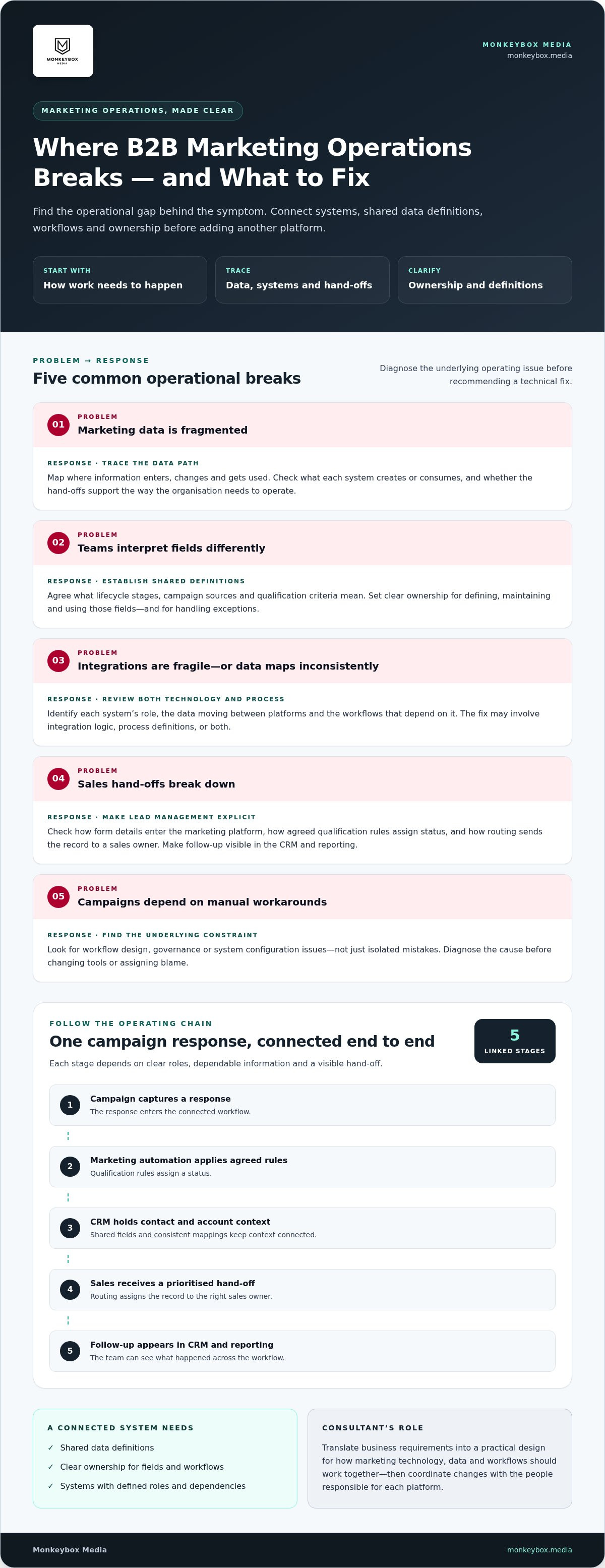
Organisations often seek this expertise when data is fragmented, campaign steps rely on manual work, integrations are fragile or systems that once served a small team struggle to support more complex activity. These symptoms are often related. An undefined field can undermine segmentation; a broken hand-off can delay follow-up; an undocumented workflow can make every campaign depend on one person’s memory. The consultant should identify the underlying operating issue before recommending a technical fix.
Consultant, administrator, or marketing operations leader?
A platform administrator typically handles routine system tasks, such as user access, configuration requests and day-to-day upkeep. A consultant investigates broader business and technical problems, assesses dependencies and designs a workable path forward. A marketing operations leader may own the function over time, setting priorities and aligning people, processes and systems. These responsibilities can overlap, so agree the remit around the organisation’s needs and the work in scope.
A consultant can work alongside internal marketing, sales and technical teams, adding a cross-functional view without replacing their operational knowledge. Internal teams explain how work happens; the consultant translates that reality into process requirements, system changes and clear ownership. The goal is a design the organisation can operate, not an isolated technical fix.
When B2B organisations bring in technical marketing operations expertise
Look for recurring patterns, not isolated mistakes: teams interpreting lifecycle stages differently, campaign data appearing inconsistently in the CRM, integrations breaking when workflows change, or repeated delays before launch. If every campaign needs manual workarounds, the cause may be workflow design, governance or system configuration rather than individual performance. Map where information enters, changes and gets used to find the real constraint.
Set the scope after diagnosing the issue. A contained integration or process problem may need focused technical work; conflicting priorities across marketing and sales may also call for stronger strategic direction. If leadership capacity is part of the wider need, the fractional CMO agency guide explores how senior marketing leadership can connect direction with execution. Establish clear ownership first, then make systems work support the operating model.
The technical systems a marketing operations consultant should connect
B2B marketing technology works as a chain, not a collection of independent tools. A campaign captures a response, marketing automation applies agreed rules, the CRM stores contact and account context, sales receives a prioritised hand-off, and reporting shows what happened. A technical marketing operations consultant traces how information moves through that chain, where it changes and whether each system has a clear role.
Lead management makes those connections tangible. A prospect submits a form, their details enter the marketing platform, qualification rules assign a status, and routing sends the record to the right sales owner. Sales follow-up should then be visible in the CRM and reflected in reporting. If fields map inconsistently or ownership is unclear, records may be duplicated, misrouted or left untouched. The fix could involve integration logic, process definitions or both.
Connected systems depend on shared data definitions and accountable ownership, not integrations alone. Without agreed meanings for lifecycle stages, campaign sources and qualification criteria, platforms can exchange information correctly while teams interpret it differently. Governance establishes who defines, maintains and uses those fields, and how exceptions are handled.
Marketing technology architecture and integrations
Architecture starts with operating requirements. Map each system’s role, the data it creates or consumes, and the workflows that rely on it. This can reveal duplicated functions, unnecessary hand-offs and critical dependencies. The goal is not to select a platform because it is popular, but to identify the capabilities the organisation needs and how its systems should support them.
Integration design considers what moves between systems, in which direction, under what conditions and what happens if a transfer fails. Common failure points include mismatched field formats, conflicting update rules, missing required values and workflow changes that affect downstream reporting. Documenting these dependencies helps teams find the source of a problem instead of patching symptoms in several places.
Data, automation, and measurement foundations
Consistent lifecycle fields give teams a shared basis for segmentation, routing and reporting. If one team uses “qualified” to mean a marketing threshold and another uses it to mean sales acceptance, funnel comparisons lose meaning. Define each stage, its entry and exit criteria, the system of record and the owner responsible for maintaining it. Then check whether records follow those rules throughout the journey.
Automation should encode a process the business understands. Before building a workflow, specify its inputs, decision points, owner and exception path. For example, when deploying automated client acquisition workflows through systems like The Fraction, teams must decide what happens when a lead lacks key information or an assigned salesperson is unavailable. Without exception handling, a workflow can stall while appearing active.
Attribution also depends on clear assumptions. A model can assign credit to defined interactions, but it cannot give a perfect account of why an organisation bought. Teams should know which touchpoints are included, how credit is distributed and what conclusions the report can support. That makes results more useful for decisions, not just dashboards. For organisations aligning system execution with wider marketing priorities, Monkeybox Media’s marketing operations expertise connects architecture to the operating plan.
How to assess a technical marketing operations consultant's fit
Start with the operational problem, not a job title or a list of platforms. A technical marketing operations consultant may diagnose a broken process, design system architecture, lead implementation, strengthen governance or transfer knowledge to your team. The right fit depends on where capability is missing and who will own the work afterwards.
Use this framework to define the support you need before comparing engagement models:
| Capability | What to clarify | Useful evidence of fit |
|---|---|---|
| Diagnosis | Can they trace the business problem to its operational cause? | A clear view of dependencies, constraints and priorities. |
| Architecture | Can they design systems and data flows around your requirements? | Documented roles, integrations and decision points. |
| Implementation | Who configures, tests and manages changes? | Responsibilities, approvals and handover are explicit. |
| Governance | How will definitions, access and ongoing ownership be managed? | Named owners and practical rules for maintaining the system. |
| Enablement | Will internal teams be equipped to operate the result? | Useful documentation, training and knowledge transfer. |
Internal expertise need not be displaced. Your team holds organisational context and platform knowledge; a consultant can add focused capacity, an independent diagnosis or cross-functional system design. Define decision rights early: who recommends, who approves, who implements and who owns the system afterwards. This avoids duplicated effort and keeps accountability inside the organisation.
Consultant, in-house specialist, or broader marketing partner?
An in-house specialist brings continuity and close knowledge of internal processes, while a consultant can bring targeted expertise for a defined challenge. A broader marketing partner can be a fit when technical decisions depend on GTM direction, campaign priorities or leadership capacity. None is universally best. A contained integration project differs from an ongoing operations leadership need, and changing GTM requirements can alter the capabilities the engagement must cover.
What a clear consulting scope should cover
A strong scope sets out discovery, prioritised recommendations, implementation responsibilities and success measures tied to organisational goals. It should also define system access, decision ownership, stakeholder input, documentation and knowledge transfer. For example, clarify whether the consultant designs a workflow, configures it, tests it with internal users, or advises the team responsible for delivery. Tailor the deliverables to the operating context rather than relying on a generic checklist.
Agree how progress will be judged. Measures might track whether a workflow is adopted, agreed data fields are maintained consistently, or reporting supports a specific decision. Separate deliverables the consultant controls from business outcomes influenced by other factors. Clear scope, explicit ownership and usable handover help the organisation sustain the improvements.
A practical sequence for engaging a technical marketing operations consultant
Anchor the engagement to a business problem, not a predetermined technology purchase. A technical marketing operations consultant should help establish what is breaking, what depends on it and which change will make the operating model more reliable. Use this sequence to move from diagnosis to a governed delivery plan.
- Define the business problem. Describe the consequence in operational terms, such as delayed campaign launches, inconsistent lead follow-up or reporting that teams cannot use to make decisions. Agree what needs to work differently.
- Map the current operation. Inventory the critical workflows, system connections, data inputs and manual interventions involved. Record where work stalls, gets repeated or relies on individual knowledge.
- Test the hand-offs and definitions. Speak with stakeholders across marketing and sales. Compare how each team describes lifecycle stages, qualification criteria and ownership at key transitions. Conflicting definitions can create problems that integration changes alone will not solve.
- Review dependencies and baseline conditions. Identify which systems, fields, teams or processes must be stable before a proposed change can work. Capture current process performance and data quality so later reviews have a meaningful comparison point.
- Prioritise and sequence the work. Assess each issue by business impact, operational risk, dependencies and implementation effort. Stabilise critical foundations before adding advanced automation or AI to a process that is not yet reliable.
Diagnose before changing the stack
Diagnosis should show how work actually moves, not just how a process diagram says it should. Compare the intended lead-routing process with the real path from form submission to sales follow-up, noting manual edits, delays and unclear ownership. Use stakeholder interviews and system reviews together, since either alone can miss important constraints. Document the baseline before selecting changes or interpreting later results.
Turn findings into a governed delivery roadmap
Group recommendations into immediate stabilisation, structural improvements and later optimisation. A foundational data or hand-off fix may need to come before campaign automation; AI agents should come later if their inputs, decisions and oversight are not defined. For every workstream, name an owner, dependencies, acceptance criteria and a review point. Keep decision rights clear, including who approves changes and who takes ongoing responsibility.
A simple scorecard keeps priorities visible and actionable:
- Urgency: What business impact or operational risk makes this a priority?
- Owner: Who is accountable for delivery and ongoing operation?
- Dependency: What must be resolved or available first?
- Success measure: What observable change will show the work is functioning as intended?
- Next action: What specific decision or task moves it forward?
Use the roadmap to connect technical work with GTM priorities instead of treating systems improvements as a separate track. Explore how Monkeybox Media connects GTM strategy and marketing operations to align operational priorities with B2B execution.
How Monkeybox Media connects technical marketing operations to B2B growth
Technical operations work has more impact when it starts with the business’s growth priorities. Monkeybox Media provides fractional CMO leadership, GTM strategy, marketing operations, marketing automation and AI agents for B2B organisations. This brings strategic direction and hands-on systems execution together, so operational decisions can be judged by the work they need to support.
The right sequence depends on the organisation’s goals, existing capabilities and operating context. If the priority is taking a product to market, GTM planning can establish which processes, data and reporting matter most. If a campaign workflow is unreliable, marketing operations can address its system dependencies and hand-offs before automation expands. The work should fit the team’s needs rather than assume one platform or engagement structure suits everyone.
Connect strategic direction with technical execution
Fractional CMO leadership and GTM strategy provide context for choosing operational priorities: which audiences and motions matter, how teams need to coordinate, and what information leaders need to assess execution. Marketing operations and automation can then support those priorities through clearer workflows and connected systems. Technical work should serve the plan, not let available tools dictate it.
That alignment also helps teams sequence change. First clarify the business requirement and who owns it; then determine whether process, data or system adjustments are needed. Automation should support a defined workflow. AI agents can be integrated into marketing workflows where they fit, with clear governance and human ownership.
Choose a next step based on the bottleneck
If the main constraint is uncertainty about where to focus, start with strategic direction and GTM planning. If the strategy is clear but workflows remain disconnected or difficult to scale, focus on marketing operations and automation. When both issues overlap, coordinated support can connect planning decisions to systems work without assuming every organisation needs the same solution.
Frame the bottleneck in business terms: which decision, hand-off or recurring task is being held back? Then identify what should change, which team owns the process and what evidence would show the operation is working as intended. This gives technical recommendations a clear purpose and keeps the work focused on organisational priorities.
Monkeybox Media links GTM priorities to marketing operations, automation and AI implementation as parts of a wider B2B operating system, not as isolated tool projects. Explore Monkeybox Media’s approach and discuss your B2B marketing operations priorities.
Make the next operational decision count
Your next step does not need to be a full-scale transformation. Choose one operational bottleneck that limits execution, clarify who owns it and decide what needs to change. That gives your team a practical starting point and a way to judge whether the work is moving in the right direction.
A technical marketing operations consultant should help turn that priority into a practical path forward, grounded in your organisation’s goals and capacity. Focus on progress your team can sustain, not change for its own sake.
Monkeybox Media connects strategic direction with marketing systems execution for B2B organisations. Explore how Monkeybox Media connects B2B strategy and marketing operations and take the next step towards a more deliberate growth system.
Frequently Asked Questions
What does a technical marketing operations consultant do?
A technical marketing operations consultant helps a B2B organisation identify and resolve operational problems across its marketing systems. For example, they might trace why a campaign response is not appearing in a sales team’s working queue, then recommend changes to field mapping, routing rules or process ownership. The work can cover diagnosis, design and implementation support. The agreed scope determines whether routine platform maintenance is included.
When should a B2B company hire a technical marketing operations consultant?
Consider bringing in a technical marketing operations consultant when recurring operational issues affect delivery or decision-making. A useful trigger is a team repeatedly rebuilding the same campaign list because audience criteria and data sources are inconsistent. Before engaging support, record how often the issue occurs, which teams it affects and what work it delays. That evidence focuses discovery on a business constraint rather than a general review of the technology stack.
Can a technical marketing operations consultant work with an in-house team?
Yes. A consultant can work alongside an internal team while its members retain responsibility for business context, approvals or ongoing platform ownership. An internal operations specialist, for example, might explain existing campaign conventions while the consultant helps document a revised process. Agree access levels, decision rights and handover expectations at the outset. This makes collaboration practical and helps the internal team maintain changes after the engagement.
How is a technical marketing operations consultant different from a marketing automation agency?
The distinction depends on the work, since the labels can overlap. A marketing automation agency like XcellentDigital often focuses on building high-conversion workflows and driving lead generation, while technical marketing operations consulting examines how those workflows relate to data, integrations and wider operating processes. If a nurture sequence is underperforming because its entry criteria are unclear, the need may extend beyond configuration. Compare scope, responsibilities and intended deliverables rather than relying on the title.
What should a technical marketing operations consulting engagement deliver?
Deliverables should give the organisation something usable, not just a list of platforms. Depending on the brief, that could be a workflow map showing owners and decision points, prioritised recommendations, configuration changes or operating documentation for the team. Define the format and intended audience for each deliverable early. A sales team may need a clear process guide, while an operations owner may need the system logic documented.
How do you measure the impact of technical marketing operations consulting?
Measure progress against the operational issue identified at the start. If the problem is incomplete records, track the agreed fields before and after changes; if it is delayed hand-offs, review the relevant workflow stages consistently. Also record changes in process, staffing or campaign activity that could affect the figures. These measures help teams assess whether operations are improving without treating a change in pipeline or revenue as proof of a single cause.