
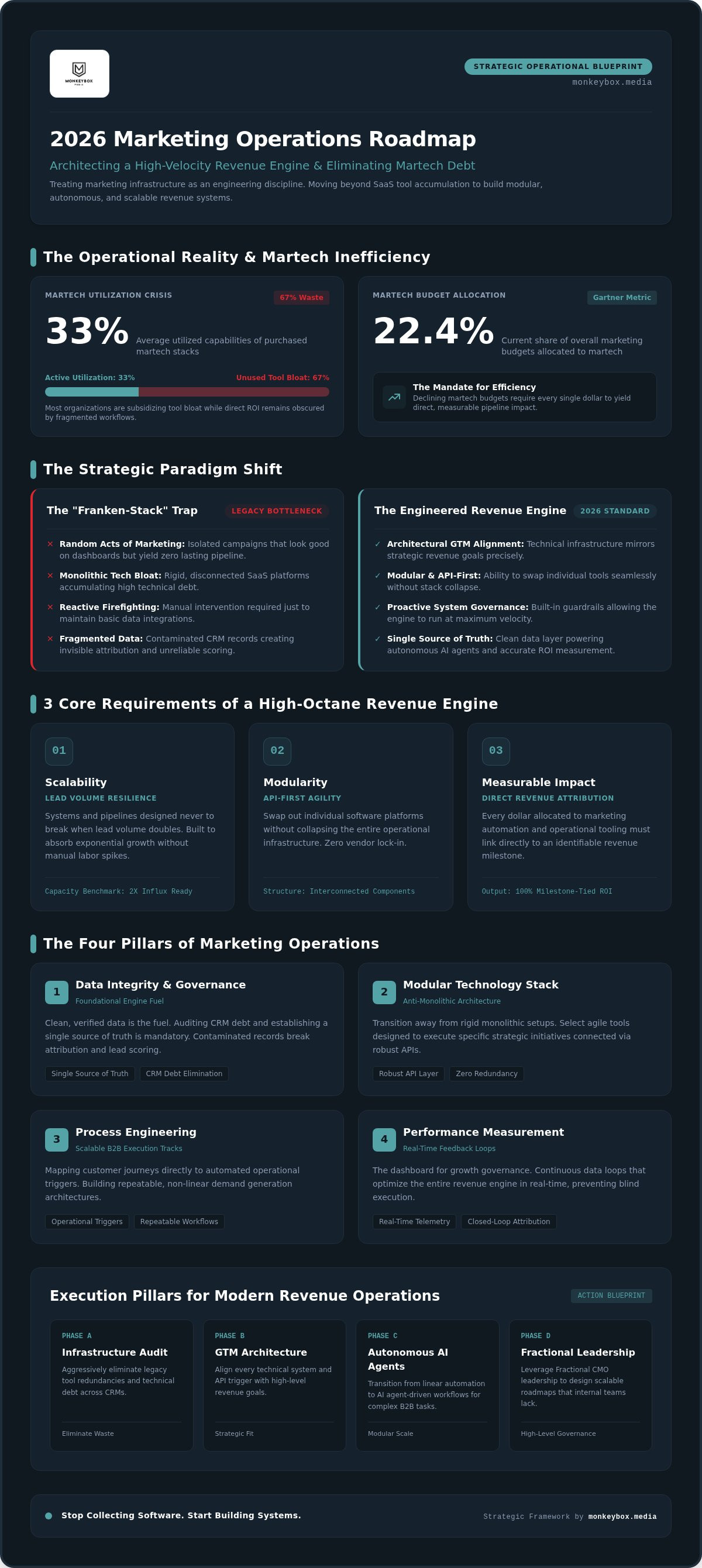
Your current martech stack isn't a competitive advantage; it's a high-interest loan on your future growth. With recent research showing that marketing teams utilize a mere 33% of their purchased capabilities, most leaders are effectively subsidizing tool bloat while their ROI remains invisible. You need a 2026 marketing operations roadmap that treats infrastructure as an engineering discipline rather than a creative afterthought. It's time to stop collecting software and start building a system.
You already know that technical debt in your automation systems is the silent killer of scale. You're likely exhausted by fragmented data and "franken-stacks" that require constant manual intervention just to maintain basic functionality. This guide provides the strategic blueprint to architect a high-velocity marketing infrastructure that eliminates operational waste. We'll explore how to integrate autonomous AI agents for modular B2B growth and establish a phased execution plan that transforms your stack into a future-proofed revenue engine. It's time to move from tactical firefighting to elite operational performance.
Key Takeaways
- Align technical infrastructure with high-level GTM goals to transform your existing stack into a high-velocity revenue engine.
- Execute a phased infrastructure audit to build a marketing operations roadmap that aggressively eliminates technical debt and operational waste.
- Transition from traditional linear automation to autonomous AI agent-driven workflows to scale complex, non-linear B2B marketing tasks.
- Secure data integrity as the foundational fuel for your marketing automation engine to ensure every campaign delivers measurable ROI.
- Leverage Fractional CMO leadership to architect a scalable operational blueprint that internal teams often lack the strategic perspective to build.
Defining the 2026 Marketing Operations Roadmap: Beyond the Tech Stack
A marketing operations roadmap is not a glorified shopping list of SaaS subscriptions. It's a high-level engineering blueprint. In 2026, the distinction between your technical infrastructure and your marketing strategy has vanished. If your systems don't mirror your GTM goals, you aren't scaling; you're just accelerating toward a bottleneck. True operational excellence requires a shift from manual, linear workflows to AI-orchestrated systems that prioritize modularity over sheer tool volume.
Most B2B organizations fail because they layer new technology on top of broken processes. This creates a mountain of technical debt that slows down execution and obscures ROI. Your roadmap must act as a filter. It should ruthlessly eliminate redundant platforms and legacy workflows before you even consider adding AI agents to the mix. Build for the engine you want, not the mess you currently have.
The Architecture of a High-Octane Revenue Engine
Operations is the most critical lever in B2B growth. Without a structured roadmap, teams fall into the trap of "random acts of marketing." These are isolated campaigns that look good on a dashboard but fail to contribute to long term revenue. A high-octane engine requires three things: scalability, modularity, and measurable impact. Scalability ensures your systems don't break when lead volume doubles. Modularity allows you to swap out individual tools without collapsing the entire stack. Measurable impact means every dollar spent on automation is tied directly to a revenue milestone. Stop collecting tools. Start building systems.
The Strategic Urgency of Operational Governance
Effective governance moves your team from reactive firefighting to proactive system design. It's the difference between fixing a broken integration and designing an API-first ecosystem that prevents the break in the first place. A comprehensive marketing operations roadmap prevents the "Franken-stack" phenomenon, where disconnected tools create data silos and manual workarounds. High-level leadership, such as a Fractional CMO, is essential here to define the operational pillars. They provide the outside perspective needed to see where the friction lies. Governance isn't about restriction; it's about creating the guardrails that allow your revenue engine to run at maximum velocity without veering off course.
The Four Pillars of the Marketing Operations Framework
A high-performance revenue engine requires more than just high-octane fuel. It demands structural integrity across four specific pillars. A marketing operations roadmap that ignores any of these will eventually stall. We build on Data Integrity, Technology Stack, Process Optimization, and Performance Measurement. These aren't independent silos. They are interconnected systems that transform raw activity into predictable revenue growth. If one pillar crumbles, the entire infrastructure loses its ability to scale.
Your technology stack must be modular. In 2026, the goal is to move away from the monolithic approach that locks you into rigid, outdated systems. Instead, select tools that execute specific strategic initiatives and integrate seamlessly through robust APIs. This modularity is essential as martech spending has decreased to 22.4% of marketing budgets, according to Gartner. Every dollar must work harder. Performance measurement provides the dashboard for your growth governance. It creates the data-driven feedback loops necessary to optimize your engine in real-time. Without it, you're flying blind.
Data Integrity and Growth Governance
Data is the fuel. Dirty data is a contaminant that destroys your automation engine from the inside out. Establishing a single source of truth for revenue data is non-negotiable for any serious B2B organization. Most companies suffer from fragmented records across disconnected sales and marketing infrastructure. This creates friction. Auditing for data waste and technical debt in CRM systems is the first step toward recovery. You can't scale what you can't trust. Accurate attribution and lead scoring depend entirely on the cleanliness of your underlying data layer. Clean data allows for the marketing automation precision required to win in competitive markets.
Process Engineering for Scalable B2B Growth
Workflows are the tracks your engine runs on. Process engineering is about mapping the customer journey to specific operational triggers. We don't build linear paths; we build repeatable, modular processes for demand generation. This is the "Bold Architect" approach to marketing operations roadmap design. It focuses on engineering workflows for maximum velocity. By standardizing how leads move through the funnel, you eliminate manual intervention. This allows your team to focus on high-level strategy while the machine handles the execution. If your processes aren't documented and automated, they don't exist. You aren't just managing tasks; you are engineering a system for expansion.
Integrating AI Agents: The 2026 Operational Advantage
The evolution of the marketing operations roadmap has reached a critical inflection point. We are moving past the era of rigid, linear automation. Traditional "if-then" triggers are no longer sufficient to manage the complexity of modern B2B buyer journeys. In 2026, 91% of marketers are actively using AI, with 76.3% having fully integrated it into their operational workflows according to Jasper's State of AI in Marketing report. The competitive advantage belongs to those who deploy AI agents to handle non-linear, high-complexity tasks that previously required massive human bandwidth.
These agents don't just follow rules; they solve problems. They reduce headcount costs by assuming the burden of routine maintenance while simultaneously increasing operational output. This isn't about replacing your strategy. It's about engineering a system where AI assumes the tactical load, allowing your leadership to focus on high-level expansion. By integrating these autonomous systems, you eliminate the friction that typically slows down B2B growth. You move faster. You produce more. You scale without adding bloat.
From Macros to AI-Driven Marketing Workflows
Linear macros are fragile. They break when data is imperfect or when a prospect deviates from a predicted path. AI-driven workflows are resilient. They handle research, content creation, and database maintenance autonomously. For example, in outbound lead generation, an AI agent can research a prospect's recent funding round, cross-reference it with their current tech stack, and craft a hyper-personalized outreach sequence without human intervention. This is the shift from setting rigid rules to directing intelligent systems. You are no longer building a sequence; you are managing a workforce of digital specialists. It's high-velocity execution at a fraction of the traditional cost.
Human-in-the-Loop: Managing AI Performance
Automation without oversight is a liability. Strategic authority must remain with the human architect. You must train your AI agents on your specific GTM framework to ensure every output aligns with your brand's unique voice and positioning. Partnering with a specialist like PurpleCow Digital ensures that your brand identity is clearly defined before being scaled through automation. This is especially critical for B2B SaaS companies scaling from $1M to $10M ARR. The stakes are too high for generic AI hallucinations. Auditing these systems for strategic alignment and precision is a core function of modern marketing ops. You aren't just looking for typos; you are ensuring the machine understands the nuances of your market. The goal is a seamless integration where the AI executes with the same tactical precision as your best human strategist.
Strategy without execution is just a hallucination. To build a system that scales, you must follow a disciplined, phased approach. A marketing operations roadmap isn't a one-time event; it's a sequence of strategic maneuvers designed to harden your infrastructure. We start by stripping away the waste and end with a high-velocity engine capable of $10M+ ARR dominance. Each phase builds on the structural integrity of the last. Success here isn't about speed; it's about the sequence.
Phase 1 & 2: Auditing and Consolidating the Engine
We begin with the infrastructure audit. You can't optimize what you don't understand. We identify leaky funnels and redundant software costs that drain your budget. Considering that the total cost of ownership for marketing technology is often 2-3 times the license fees when implementation and headcount are factored in, consolidation is your fastest path to ROI. We look for tools that overlap or sit idle. Most teams are paying for features they'll never use. This is where we eliminate the bloat that slows down your response time.
The Fractional CMO verdict on stack consolidation is clear: prioritize modularity over complexity. While Salesforce Marketing Cloud Advanced starts at $3,250 per month, HubSpot Marketing Hub Professional offers a lower barrier to entry at $890 per month. The choice depends on your specific growth stage and technical requirements. Regardless of the platform, you must clean your outbound infrastructure. This ensures high deliverability and prevents your domain from being blacklisted. A clean stack is a fast stack.
Phase 3 & 4: Automation and High-Velocity Scaling
Once the foundation is stable, we deploy AI agents. These systems assume the tactical burden of non-linear workflows. We integrate them into your newly optimized stack to drive maximum output with minimal human friction. This isn't just about automation; it's about orchestration. We establish performance measurement systems that provide real-time visibility into your ROI. You need to know exactly which levers are driving growth at any given moment. Data-driven decisions are the only way to maintain momentum.
The final phase is about $10M+ ARR dominance. We use the marketing operations roadmap to pivot and scale based on hard data. Iterative growth requires a system that can adapt without breaking. As your lead volume increases, your infrastructure must remain robust and modular. If you're ready to stop firefighting and start engineering your expansion, it's time to build a professional GTM Strategy. Your roadmap is the difference between a stagnant stack and a scalable revenue engine. Build it with precision.
The Fractional CMO: The Architect of Your Marketing Roadmap
Internal marketing teams often fail to build a robust marketing operations roadmap because they are too close to the machine. They treat symptoms rather than designing systems. When your team is consumed by tactical firefighting and manual data entry, they lose the ability to see the structural flaws in your GTM strategy. A Fractional CMO enters the organization as a strategic partner, not a subordinate. They bridge the gap between high-level revenue goals and the granular technical execution required to achieve them. It is the difference between a mechanic and an aerospace engineer.
Monkeybox Media drives scalable growth by assuming this architectural role. We don't just suggest tools; we engineer the entire revenue engine. This requires a "take-charge" energy that traditional consulting lacks. By establishing clear operational pillars, we ensure that every automation sequence and AI agent deployment serves a specific, measurable business outcome. Your roadmap shouldn't just exist on a slide deck. It should be the living blueprint for your expansion.
Strategic Leadership Without Full-Time Friction
The ROI of flexible, executive-level leadership is undeniable for growth-stage B2B SaaS companies. Navigating the "Fractional CMO vs Full Time" debate comes down to efficiency. Research shows that monthly retainers for fractional leadership typically range from $8,000 to $12,000, providing elite strategy without the heavy overhead and long-term commitment of a full-time C-suite hire. This allows you to allocate more capital toward the actual technology and Marketing Ops infrastructure. An outside perspective is the only way to identify the operational blind spots that internal teams have grown accustomed to ignoring. You need someone who has seen the $1M to $10M ARR transition multiple times and knows exactly where the infrastructure will break.
Executing the Roadmap with Monkeybox Media
Our approach at Monkeybox Media is built on high-velocity execution. We build high-octane B2B revenue engines that prioritize structural integrity over fluff. This involves integrating autonomous Ai agents into your stack to handle the complex, non-linear tasks that slow down your human talent. We eliminate technical debt in your outbound infrastructure and ensure your data remains a clean, actionable asset. If you are serious about scaling with strategic authority, you need to understand the mechanics of elite leadership. Take the next step by reading The Fractional CMO Agency Guide 2026: Scaling B2B Revenue with Strategic Authority. Stop building campaigns and start engineering a system that wins.
Architect Your Path to $10M ARR
Building a high-velocity revenue engine isn't a matter of chance; it's a matter of engineering. You've seen how a structured marketing operations roadmap eliminates technical debt and replaces manual friction with autonomous AI agents. By prioritizing data integrity and modularity, you transform your stack from a cost center into a scalable asset. The transition from $1M to $10M ARR requires more than just better tools. It requires the strategic authority of a Fractional CMO to oversee the construction of every operational mile. Stop reacting to market shifts and start directing them through a system built for strategic dominance.
Monkeybox Media specializes in this exact transformation. As pioneers in AI agent marketing integration and specialists in B2B SaaS scaling, we provide the leadership your infrastructure demands. Don't let legacy systems anchor your growth. It's time to scale your B2B revenue with Monkeybox Media and secure your position as a market leader. The future of marketing operations is here. Build it with precision and lead with confidence.
Frequently Asked Questions
What is a marketing operations roadmap?
A marketing operations roadmap is a strategic engineering blueprint that aligns your technical infrastructure with high-level GTM goals. It moves beyond a simple list of software tools to define the phased execution of data integrity, process optimization, and system integration. This roadmap ensures that your revenue engine is modular and scalable; preventing the technical debt that typically stalls B2B growth. It is the foundational architectural plan for your entire marketing ecosystem.
How long does it take to implement a marketing operations roadmap?
Implementation typically follows a phased approach over three to twelve months; depending on the complexity of your existing stack. The initial infrastructure audit and "leaky funnel" identification often occur in the first thirty days. Subsequent phases, such as tech stack consolidation and the deployment of AI agents, require iterative testing to ensure maximum velocity. While some efficiency gains are immediate, building a future-proofed revenue engine is a continuous strategic evolution.
Why is technical debt a problem for B2B marketing operations?
Technical debt acts as a high-interest tax on your growth; slowing down execution and obscuring real ROI. In B2B environments, this debt often manifests as fragmented data silos, redundant software costs, and "Franken-stacks" that require constant manual intervention. Gartner reports that marketing teams use only 33% of their purchased capabilities on average. This inefficiency creates friction that prevents scaling and makes it impossible to achieve true AI-driven maturity in a competitive market.
What is the difference between marketing automation and AI agents?
Traditional marketing automation follows rigid, linear "if-then" macros that break when a prospect deviates from a predicted path. Conversely, AI agents are autonomous systems capable of handling non-linear, high-complexity tasks such as deep prospect research and hyper-personalized content creation. While automation executes static rules, AI agents solve problems and adapt to real-time data. This shift from setting rules to directing intelligent systems is the key to achieving elite operational efficiency.
How does a Fractional CMO help with marketing operations?
A Fractional CMO acts as the "Bold Architect" who bridges the gap between high-level GTM strategy and technical execution. They provide the executive-level leadership necessary to design a marketing operations roadmap without the overhead of a full-time hire. By offering an outside perspective, they identify operational blind spots and ensure that your technology stack serves your revenue goals. They move your team from reactive firefighting to proactive, system-driven expansion and measurable performance.
Can AI agents really replace marketing headcount?
AI agents don't just replace headcount; they assume the burden of routine, tactical maintenance that slows down human talent. By automating complex workflows like outbound lead generation and database cleaning, these systems allow you to increase operational output while reducing the need for administrative roles. This doesn't eliminate the need for strategy. Instead, it shifts the human focus toward high-level leadership and creative direction while the machine handles the high-volume, repetitive execution.
What are the core pillars of a 2026 marketing operations strategy?
A 2026 strategy relies on structural integrity across five critical pillars:
- Data Integrity: Establishing a single source of truth for all revenue data.
- Technology Stack: Building a modular, API-first ecosystem.
- Process Optimization: Engineering workflows for maximum velocity and scalability.
- Performance Measurement: Creating data-driven feedback loops for growth governance.
- AI Integration: Deploying autonomous agents to manage non-linear marketing tasks.
These pillars transform your marketing from a series of disconnected campaigns into a high-performance revenue engine.