
What if your marketing doesn’t need more activity, but someone senior enough to make it work as a system? If campaigns, content and tools keep moving without a clear link to pipeline or commercial priorities, the question isn’t simply how to do more. It’s when to hire a fractional CMO to set direction and take ownership before a permanent executive hire makes sense.
That gap is familiar to B2B leadership teams: capable people are delivering work, but no one has the capacity or authority to connect strategy, sales priorities and execution. A fractional CMO can bring executive-level marketing leadership without assuming every business needs a full-time CMO. The right choice depends on what’s missing: senior direction, specialist expertise or delivery capacity.
This guide will help you recognise the growth, leadership and execution signals that point to fractional support, compare it with a full-time hire, consultant or specialist, and assess whether your business is ready. You’ll also find practical questions for evaluating a potential partner, from strategic thinking and accountability to fit with your team. The goal is a clear decision, not another layer of marketing activity.
Key Takeaways
- Recurring gaps in marketing direction and accountability can signal a need for senior ownership, not simply another campaign or specialist.
- Clarify what a fractional CMO should lead and which people or partners will deliver the work before defining the role.
- Compare fractional, full-time and specialist support against the leadership capacity, continuity and execution your business actually needs.
- Use a readiness check to confirm your business objective, desired outcomes, decision owner and ability to act on the strategy.
- When deciding when to hire a fractional CMO, assess how a potential partner diagnoses a real B2B challenge and connects strategy to execution.
When to Hire a Fractional CMO: B2B Growth Signals to Watch
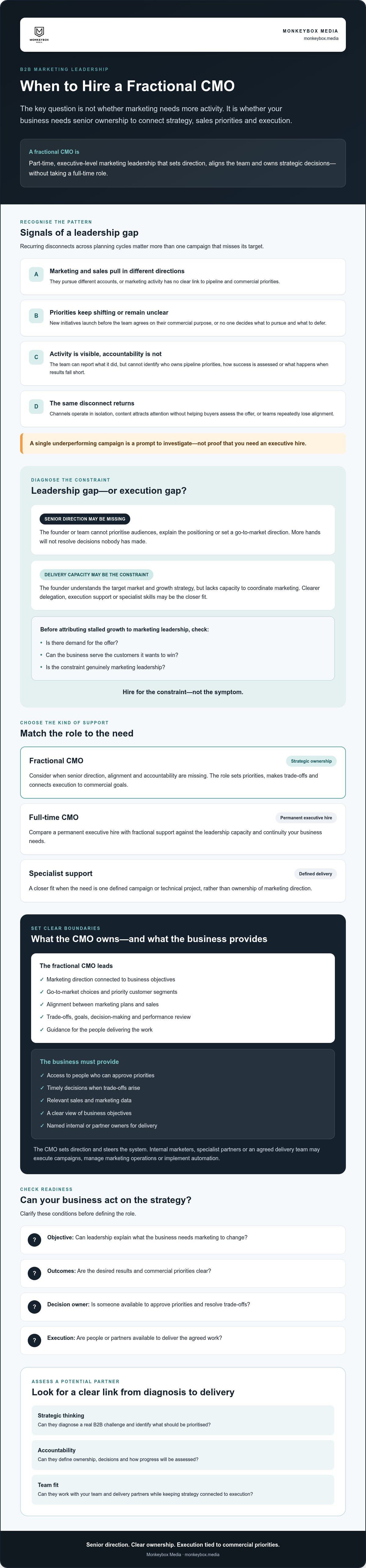
Recurring leadership gaps matter more than one underperforming campaign. A launch can miss its target for reasons that don’t call for an executive hire. But when priorities remain unclear, channels work in isolation and nobody owns the link between marketing activity and pipeline, the problem may be structural. That’s a stronger signal to consider when to hire a fractional CMO.
A fractional CMO is part-time, executive-level marketing leadership that sets direction, aligns the team and owns strategic decisions without taking a full-time role. The distinction is ownership, not simply hours worked.
Which recurring B2B marketing problems signal a leadership gap?
Look for patterns that persist across planning cycles. Sales and marketing may pursue different accounts, content may attract attention without helping buyers assess the offer, or new initiatives may launch before anyone agrees on their commercial purpose. A short-term dip in campaign performance is a prompt to investigate. The same disconnect returning quarter after quarter suggests there’s no shared system for setting priorities and correcting course.
Weak accountability is another signal. If the team can report activity but can’t identify who owns pipeline priorities, how success is measured or what happens when results fall short, senior direction may be missing. A fractional CMO can connect those decisions to the wider business plan. The role draws on the responsibilities associated with a Chief Marketing Officer (CMO), including leading marketing direction and aligning it with organisational objectives.
When is a fractional CMO more than an extra pair of hands?
Start by diagnosing the constraint. A founder who knows the target market and growth strategy but has no capacity to coordinate marketing may need execution support, clearer delegation or specialist skills. A founder who can’t prioritise audiences, explain the positioning or set a go-to-market direction faces a leadership gap. More hands won’t resolve decisions nobody has made.
A fractional CMO should shape priorities, make trade-offs, establish accountability and guide the people delivering the work. That delivery might sit with internal staff or specialist partners. The CMO’s value is setting direction and connecting execution to commercial goals. If you need one defined campaign or technical project, targeted specialist support may be a closer fit.
Stalled growth alone doesn’t prove you need a CMO. Check the fundamentals first: is there demand for the offer, can the business serve the customers it wants to win, and is the issue genuinely marketing leadership? Hire for the constraint, not the symptom.
What a fractional CMO should own, and what your team must provide
A fractional CMO creates value by taking responsibility for marketing direction, not by becoming an extra pair of hands for every task. The remit should connect business objectives to go-to-market (GTM) choices, team priorities and the decisions needed to move work forward. Without clear boundaries, strategic ownership can blur into an open-ended list of requests.
What responsibilities belong in the remit?
The scope should reflect the business challenge. It may include sharpening positioning for a new market, deciding which customer segments to prioritise, aligning marketing plans with sales, or coordinating a launch around the company’s commercial objectives. The CMO should help leadership choose what to pursue, what to defer and how to assess progress.
Executive marketing ownership sets priorities and steers the system; specialist delivery completes defined tasks within it. A fractional CMO can establish goals, decision-making processes and a regular performance review. Internal marketers, specialist partners or an agreed delivery team may then carry out campaign work, manage marketing operations or implement automation. Confirm who is responsible for each activity rather than assuming the CMO will personally execute every item.
What does the business need to contribute?
Leadership must provide the conditions for sound decisions: access to the people who can approve priorities, timely answers when trade-offs arise, relevant sales and marketing data, and a clear view of the business objectives. If the company can’t explain which market it wants to win or what it needs marketing to change, the first task is to resolve that ambiguity together.
Execution also needs named owners. Agree which internal people or partners will deliver the work, what authority the CMO has to guide them, and where the CMO reports. Set the working cadence upfront, including how decisions are made, what information is reviewed and how often leadership checks progress. The rhythm should suit the scope, not be left to assumption.
Before work begins, define how success will be reviewed. Choose measures linked to the agreed business objective, such as whether priority segments are being reached or whether sales and marketing are acting on the same pipeline focus. These indicators support informed decisions; they aren’t a promise of a particular commercial result.
That shared operating model is central to deciding when to hire a fractional CMO: the leader can own strategy and accountability, but your business must supply access, decisions and delivery capacity. B2B organisations considering fractional CMO and GTM strategy can use these boundaries to clarify what leadership support should cover and what the team must retain.
Fractional CMO vs full-time CMO, consultant or marketing agency
The right model depends on the constraint. Does the business lack senior marketing ownership, need a decision on a defined problem, or have a clear plan but not enough delivery capacity? These options solve different problems. Fractional leadership can bridge strategy and execution, but it isn’t a universal replacement for a permanent executive, consultant or specialist team.
| Option | Leadership ownership | Capacity and continuity | Internal execution needs |
|---|---|---|---|
| Fractional CMO | Ongoing strategic direction and marketing leadership, within an agreed remit. | Part-time capacity with an ongoing relationship. | Internal staff or delivery partners are usually needed to carry out the work. |
| Full-time CMO | Permanent executive ownership of marketing direction and leadership. | Full-time capacity and continuity within the organisation. | Still relies on an internal team and, where needed, specialist support. |
| Consultant | Advice and recommendations on a defined issue, rather than ongoing ownership. | Typically focused on a bounded piece of work or question. | The business takes responsibility for decisions and implementation. |
| Agency or specialist | Usually responsible for agreed delivery, not overall executive marketing direction. | Capacity is focused on specified campaigns, channels or specialist work. | The business needs a clear strategy and someone to coordinate the work. |
When should a company choose fractional rather than full-time leadership?
Choose fractional leadership when the business needs an experienced decision-maker to set direction, align marketing with sales and guide execution, but doesn’t need a permanent executive working full time. This can suit a team facing a strategic shift, such as entering a new market, while it builds the internal structure to support that move.
A full-time CMO may be the stronger fit when marketing leadership requires sustained daily involvement, the organisation’s complexity demands frequent executive decisions, or the role needs to be continuously available to lead a large function. Assess the actual workload, decision flow and continuity requirements. Don’t rely on a generic revenue or headcount threshold.
When is a consultant, specialist or agency the better fit?
Engage a consultant for a contained question, such as reviewing a positioning decision, when leadership needs expert advice but can own the follow-through. Choose a specialist or agency when the strategy is already clear and the gap is delivery, such as executing a defined campaign or supporting a particular channel.
If the business needs both direction and delivery, a fractional CMO may coordinate internal staff and external partners without replacing every specialist. The key decision in when to hire a fractional CMO is whether someone must own the marketing system, or whether the team simply needs advice or additional execution capacity.
How to assess readiness before hiring a fractional CMO
Before you start the search, check that the business can give a senior marketing leader a clear mandate, access to useful information and the authority to act. This readiness check helps separate a genuine leadership need from a vague desire to “do more marketing”.
Define the mandate before you search
Write down the business constraint and why current leadership can’t resolve it. For example, the issue might be competing market priorities, unclear positioning or a gap between marketing plans and sales activity. Then identify the decisions the fractional leader should own, the stakeholders they need to align and the outcomes leadership will review. Keep objectives tied to business priorities, without treating a particular performance result as guaranteed.
- 1. Name the business objective. What needs to change, and why does it matter to the organisation now?
- 2. Identify the leadership gap. Why can’t the current team set direction, make trade-offs or coordinate the work?
- 3. Confirm the decision owner. Who in the leadership team can approve priorities, resolve conflicts and act on recommendations?
- 4. Check access to evidence. Can the leader review relevant marketing, sales and customer data, such as campaign activity, sales feedback and information about existing customers? Without access, diagnosis risks relying on assumptions.
- 5. Map execution capacity. Which internal owners or delivery partners can carry out agreed work? If nobody has capacity, decide whether separate operational support is needed.
- 6. Set a review process. Agree how progress against the business objective will be assessed and who will take part.
Test the scope during selection
Ask each candidate what they would decide, advise on, coordinate and personally deliver. Ask how they would work with your leadership team, what access they’d need, and what availability and reporting cadence they propose. Agree these details for the specific engagement rather than assuming them from the fractional title.
Listen for a clear line between leadership and delivery. If the candidate expects to own campaign execution, clarify whether that is part of the proposed remit and who will handle other work. If the strategy is clear but implementation is under-resourced, explore operational support separately rather than expecting executive oversight to fill every gap.
If you’re comparing providers, use this fractional CMO agency guide as an additional reference. The question of when to hire a fractional CMO becomes easier to answer when the objective, authority and delivery model are explicit. To understand how fractional leadership could fit your B2B priorities, review the available fractional CMO support.
How to hire the right fractional CMO and turn the decision into action
Select for judgement and leadership fit, not just a polished strategy deck. A candidate should be able to understand your B2B context, identify the constraint behind the brief and connect recommendations to the people and systems needed to act on them.
How can you evaluate a fractional CMO during selection?
Bring a real business challenge, such as inconsistent lead handover or uncertainty about which market segment to prioritise. Ask the candidate how they’d diagnose it before recommending tactics. Listen for the questions they ask, the evidence they’d seek and how they separate root causes from symptoms. Strong strategic judgement starts with diagnosis.
- Check B2B relevance: Can they explain how they’d account for your buying process, sales cycle and stakeholder needs?
- Test prioritisation: Can they turn the challenge into clear decisions, owners and next steps, including what they’d deprioritise?
- Assess execution alignment: Do they identify who needs to deliver the work and how marketing should coordinate with sales and leadership?
- Verify evidence: Ask for relevant examples, then clarify the business context, the candidate’s specific contribution and how outcomes were assessed.
- Evaluate communication: Can they explain trade-offs plainly and challenge assumptions constructively?
Don’t expect a complete strategy from a selection conversation. You’re testing how the person thinks, communicates and approaches uncertainty, not asking for unpaid consulting.
What should the first phase of an engagement establish?
Agree how the work will move from discovery to action. The initial phase should build a shared view of the business objective, review relevant marketing and sales information, align key stakeholders and set priorities. Define how progress will be measured against the agreed objectives, without treating any commercial outcome as guaranteed.
Put the operating rules in writing: scope, decision rights, access to leadership and data, communication rhythm, reporting expectations and how priorities can change. Confirm what the fractional CMO will decide, advise on or coordinate, and who will own delivery. If strategy points to gaps in marketing operations or automation, clarify whether that work is included or requires separate support.
Monkeybox Media works across fractional CMO leadership, B2B go-to-market strategy, marketing operations and automation. The right combination depends on your needs, so confirm the proposed scope and working arrangements before proceeding. If you’re weighing up when to hire a fractional CMO, a conversation about your current challenge can help clarify whether leadership, GTM direction or operational support is the gap. Explore fractional CMO support as one option.
Turn your marketing leadership gap into a clear next step
The decision isn’t about adding seniority for its own sake. It’s about matching support to the constraint: a fractional CMO when you need executive direction and accountability, a full-time leader when the role requires sustained internal capacity, or specialist support when the strategy is already clear. Knowing when to hire a fractional CMO starts with defining the business objective, decision authority and delivery capacity you can provide.
For B2B teams, leadership creates more value when it connects go-to-market priorities to practical systems. Monkeybox Media provides fractional CMO and GTM strategy, alongside marketing operations, automation and AI workflow implementation. The right scope depends on your needs, so clarify the engagement fit before moving forward.
Explore how Monkeybox Media can connect B2B marketing leadership with scalable execution. With a clear mandate and the right support in place, your team can move from disconnected activity to focused action.
Frequently Asked Questions
When should a company hire a fractional CMO?
Hire a fractional CMO when the business needs senior marketing direction and accountability, but a permanent executive role isn’t yet justified. Recurring issues such as unclear priorities, disconnected marketing and sales activity, or no owner for go-to-market decisions may indicate a leadership gap. Before hiring, confirm the business objective, the decisions the CMO should own, and who will deliver the agreed work.
What stage of business needs a fractional CMO?
There isn’t one required stage. A business may be ready when it has evidence of demand and marketing activity, but lacks the senior capacity to set priorities, coordinate execution or align marketing with commercial goals. A company with no clear offer, limited leadership buy-in or no ability to act on recommendations may need to address those fundamentals first. Readiness depends more on the gap than on company age.
Is a fractional CMO worth it for a B2B startup?
A fractional CMO may suit a B2B startup if it has a viable offer and needs experienced leadership to clarify positioning, shape its go-to-market approach or coordinate an existing team. It may be a poor fit if the startup needs one specialist task completed or hasn’t established who it serves. Weigh the need for strategic ownership against the capacity to implement recommendations, and agree how progress will be reviewed.
How is a fractional CMO different from a marketing consultant?
A marketing consultant typically advises on a defined problem and provides recommendations for the business to implement. A fractional CMO takes an ongoing leadership role within an agreed scope, helping set priorities, align stakeholders and guide marketing decisions. The distinction is ownership, not simply the type of advice. If you need a focused assessment, a consultant may fit; if you need continuing direction and accountability, consider fractional leadership.
Should I hire a fractional CMO or a full-time CMO?
Choose a fractional CMO if you need senior marketing leadership but not a permanent, full-time executive presence. Consider a full-time CMO when the workload, organisational complexity and need for continuous leadership require sustained involvement inside the business. Compare the decision-making load, continuity required and team structure rather than relying on a universal revenue or headcount threshold. Either model still needs clear authority, objectives and execution support.
Can a fractional CMO execute marketing campaigns?
They may contribute to campaign planning or execution if that work is explicitly included in the agreed scope, but the core role is usually strategic leadership and coordination. Campaign delivery may sit with internal marketers, specialist partners or an agency. Before starting, clarify who develops, approves and delivers each activity. If strategy is already set and you only lack campaign capacity, a specialist or agency may be the more direct fit.
What should I ask before hiring a fractional CMO?
Ask how they would diagnose your business constraint before proposing tactics, what decisions they would own, and how they would align marketing with sales and leadership. Request relevant B2B examples and clarify the candidate’s contribution and the context behind reported outcomes. Also agree scope, decision rights, access to data, availability, reporting cadence and who handles delivery. A real business challenge can reveal how clearly they think and communicate.