
98% of senior leaders say their go-to-market strategy is in motion, but only 10% say it’s delivering the results they need, according to Highspot’s June 2026 research. That gap points to a hard truth: why GTM strategies fail is often less about effort than about disconnected market assumptions, execution and measurement.
If your teams are busy but progress is unclear, you’re not alone. Sales and marketing may be targeting different accounts, using different messages or disputing lead quality. Meanwhile, leadership may struggle to tell whether the strategy itself is flawed or the execution is falling short.
This article will help you identify the failure point, distinguish visible symptoms from root causes and prioritise corrective action using evidence. We’ll examine five common breakdowns, from an inaccurate ideal customer profile to fragmented data and misaligned teams. Then we’ll outline a practical recovery plan to reconnect strategy, execution and measurable outcomes.
Key Takeaways
- Distinguish a persistent commercial performance gap from a temporary setback or noisy data.
- Trace why GTM strategies fail by testing market assumptions, ICP choices and positioning against evidence from real sales conversations.
- Separate strategy, execution, measurement and infrastructure problems by matching visible symptoms to evidence leaders can inspect.
- Use a sequenced recovery process: define the gap, establish a baseline, locate the break, test a correction and review the results.
- Build an operating rhythm that connects market choices, pipeline evidence and team decisions, with marketing operations and CRM processes supporting consistent execution.
Why GTM Strategies Fail: The Signals Leaders Should Not Ignore
A GTM strategy is failing when the commercial outcomes it was designed to produce remain persistently out of reach, despite enough time and reliable evidence to assess progress. That’s different from missing a quarterly target once. A delayed deal, seasonal demand shift or small sample of opportunities can distort the picture. None proves the strategy is broken. The stronger signal is a recurring gap between the plan and what buyers and commercial results show.
A go-to-market strategy connects the customers a business targets with its offer, route to market and competitive position. The Go-to-market strategy Wikipedia overview provides useful context on these components and how GTM differs from marketing alone. A campaign can generate attention while the broader strategy still fails to turn that interest into sustainable sales.
What does a failing GTM strategy look like?
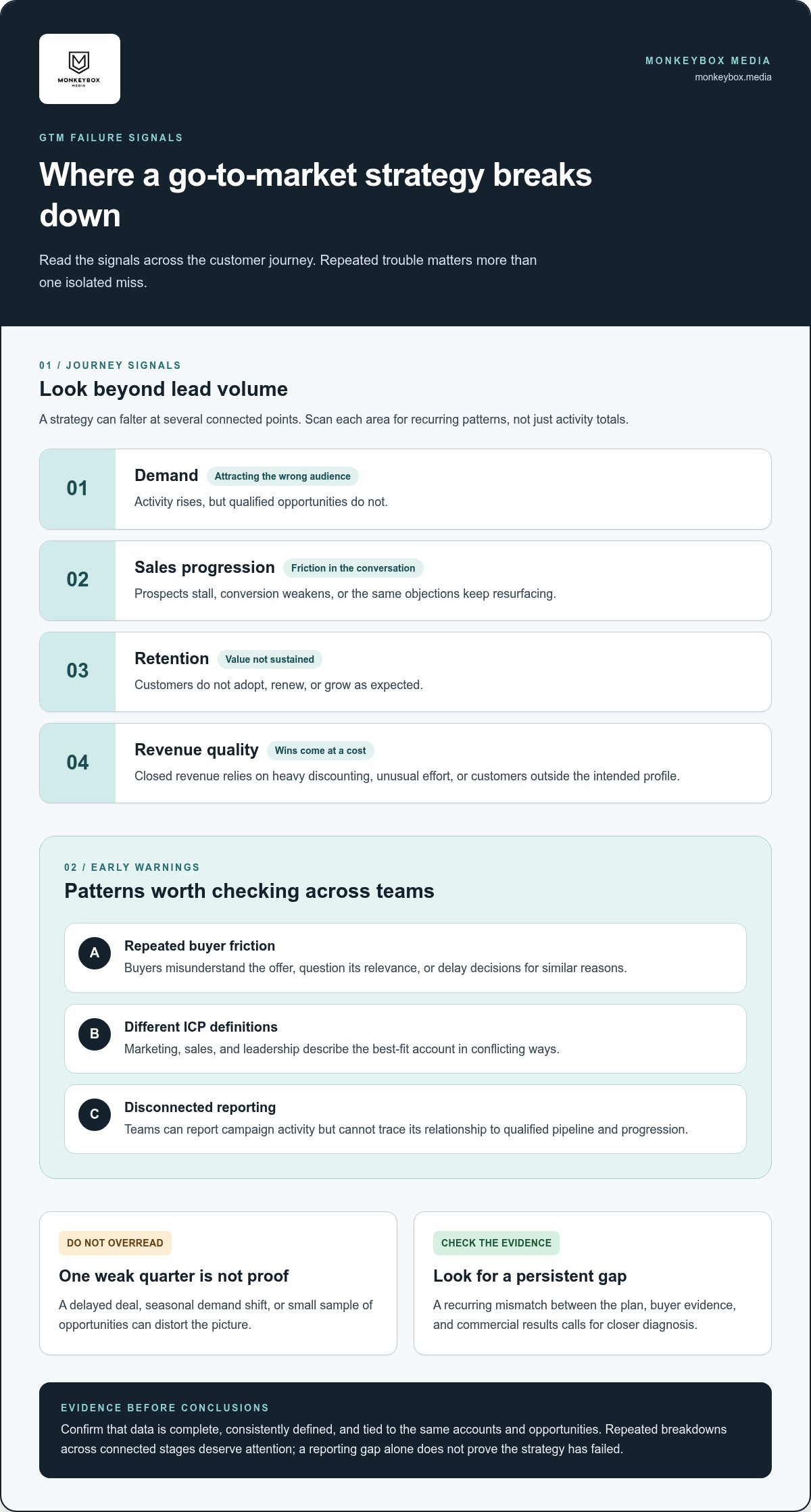
The pattern can surface at several points in the customer journey. Demand creation may attract the wrong audience. Sales conversations may stall or end without a clear decision. Customers may fail to renew or expand, and closed revenue may come from deals that are poorly matched to the intended market. Look across the whole system, not just at lead volume.
- Demand: Activity rises, but qualified opportunities do not.
- Sales progression: Prospects stall, conversion weakens or the same objections keep resurfacing.
- Retention: Customers don’t adopt, renew or grow as expected.
- Revenue quality: Wins depend on heavy discounting, unusual effort or customers outside the intended profile.
These symptoms matter most when they persist across a meaningful review period and affect connected stages. One weak quarter may reflect timing or incomplete data. Repeated underperformance, especially when activity metrics climb but pipeline movement and revenue quality stay flat, calls for a closer diagnosis.
Which early warning signals deserve attention?
Look for evidence that repeats across relevant buyer conversations and teams. Capture why deals stall or are lost, then compare those reasons with the assumptions behind your positioning and target market. A single objection may be incidental. The same concern appearing across suitable prospects can point to a mismatch between what buyers value and what your GTM motion communicates.
- Repeated buyer friction: Buyers misunderstand the offer, question its relevance or delay decisions for similar reasons.
- Different ICP definitions: Marketing, sales and leadership describe the best-fit account in conflicting ways.
- Disconnected reporting: Teams can report campaign activity but can’t trace its relationship to qualified pipeline and progression.
Don’t mistake a reporting gap for proof that a strategy has failed. First establish whether the data is complete, consistently defined and tied to the same accounts and opportunities. If the evidence is sound and the same breakdown keeps appearing, act on it. The next step is to locate whether the failure sits in market choices, execution, measurement or infrastructure.
The Root Causes Behind GTM Strategy Failure
Visible symptoms point to trouble, but they don’t explain its source. The reasons why GTM strategies fail differ by business, market and growth stage. A team can execute consistently and still miss because its assumptions about buyers are wrong. Equally, a sound market opportunity can be undermined by unclear positioning, conflicting team priorities or ownership gaps. Diagnose the mechanism before prescribing a fix.
When market assumptions do not match buyer reality
Every GTM plan contains hypotheses: buyers feel enough urgency to act, will change from their current approach, and judge options using criteria your offer can satisfy. If those beliefs haven’t been tested, disciplined campaigns and sales activity can simply scale the wrong message to the wrong audience.
Challenge those hypotheses with customer interviews, lost-deal notes and patterns in successful wins. Ask what triggered the search, what alternatives buyers considered, what delayed a decision and which capabilities mattered most. Look for evidence across several relevant conversations, not one unusually vocal prospect. If buyers consistently see the problem as low priority or don’t value the proposed solution, a copy refresh won’t resolve a product-market fit concern. Fix the underlying offer or target-market assumption first—an area where evidence-led teams such as freshfacedmarketing.co.uk help businesses align their messaging and outreach with verified buyer demand.
When positioning and teams pull in different directions
Even a real buyer need can be missed if the value proposition sounds interchangeable with competitors. Vague claims leave marketing without a sharp campaign angle and sales without a compelling reason for buyers to choose or act. The result is often more explanation, weaker qualification and conversations that drift towards price rather than distinctive value.
Internal misalignment compounds the problem. Compare how marketing, sales and leadership describe the ideal customer profile (ICP), buying triggers and account priorities. Then inspect whether qualification rules and handoffs reinforce the same choices. Watch for:
- Conflicting ICP definitions: Teams pursue different sectors, company characteristics or buyer roles.
- Misaligned incentives: One team is rewarded for activity or lead volume while another is accountable for qualified pipeline or revenue.
- Unclear ownership: No one owns the transition from marketing engagement to timely sales follow-up, leaving interested accounts in limbo.
These are root causes, not simply communication problems. For example, a lead may appear to be “poor quality” because marketing and sales use different qualification criteria, or because sales follow-up happens after the buyer’s urgency has passed. Define shared terms, decision rights and handoff expectations so teams can trace where the journey breaks.
Don’t force every underperforming GTM motion into one diagnosis. Use buyer evidence to test market assumptions, then map positioning, incentives and ownership against the breakdown you observe. Fractional CMO and GTM strategy leadership can help connect those decisions to coordinated execution, but the correction should follow the evidence.
GTM Strategy Problems vs Execution Problems: Diagnose the Difference
Strategy sets choices; execution turns those choices into coordinated action. If the choices are wrong, better execution can make the wrong approach more efficient. If the choices are sound but teams apply them inconsistently, changing the strategy may create more disruption than progress. The reasons why GTM strategies fail can sit in either layer, or in the systems that connect and measure them.
Start with evidence, not a preferred explanation. Before adding headcount, increasing campaign volume or replacing a channel, inspect whether the offer resonates with the intended segment and whether teams consistently carry out the plan. Use this comparison to locate the likely break:
| Failure pattern | Visible symptom | Evidence to inspect |
|---|---|---|
| Strategy | Target buyers show weak urgency, struggle to see distinctive value, or don’t respond to the assumed channel. | Segment-level conversion, buyer interviews, win and loss reasons, and whether actual decisions match the plan’s assumptions. |
| Execution | Follow-up varies by representative, sales adoption is uneven, or agreed plays are applied inconsistently. | Response and follow-up records, playbook use, handoff completion, and differences in progression across teams or accounts. |
| Measurement | Teams report different pipeline figures or can’t explain which activities influenced opportunity movement. | Shared metric definitions, attribution logic, stage-entry criteria, and whether campaign records connect to the right accounts and opportunities. |
| Infrastructure | Important account or activity data is missing, duplicated or trapped across disconnected tools. | CRM field completeness, system syncs, duplicate records, and whether teams can follow an account’s journey from engagement to outcome. |
How to tell a strategy problem from an execution gap
Strategy trouble shows up in weak segment fit, unclear value or channel assumptions buyers don’t support. Execution trouble appears when the intended audience and message are credible, but follow-up, ownership or sales adoption varies. Check buyer evidence alongside workflow evidence. If suitable prospects understand the offer and still don’t see enough value to act, more activity won’t solve the underlying choice.
Patterns can also narrow the diagnosis. If one team or channel progresses similar accounts while another does not, examine execution before rewriting the whole strategy. If the same objection or lack of urgency appears across teams and channels, revisit the market choices and value proposition. Treat these as clues, not proof. Validate them against consistent records and direct buyer feedback.
How measurement and systems can obscure the real cause
Disconnected CRM definitions, inconsistent stage criteria and attribution gaps can make a strategy look weaker or stronger than it is. Leaders then debate anecdotes because they can’t agree on what counts as a qualified opportunity or where movement stopped. Fix the measurement foundation before drawing conclusions. Automation can reinforce reliable handoffs and reporting, but it can’t replace sound decisions. It amplifies the process already in place.
Don’t force a single diagnosis. A weak market assumption can coexist with poor follow-up, while unreliable data hides both. Identify each break, then prioritise the one that most directly blocks buyer progression. That gives the repair process a precise starting point.
How to Diagnose and Repair a GTM Strategy That Is Underperforming
Resist the urge to change several things at once. A new message, channel and qualification rule launched together might improve results, but you won’t know which change mattered. A disciplined recovery process turns the question of why GTM strategies fail into a testable sequence: define the gap, inspect evidence, locate the constraint, make one focused change and review what happened.
A five-step diagnostic for GTM underperformance
Work through these steps with marketing, sales and the people accountable for commercial results. Agree on definitions before reviewing the numbers. Otherwise, teams may draw different conclusions from the same pipeline.
- Specify the outcome and gap. State the intended result, the observed result and the point of divergence. For example, if the goal is to progress qualified opportunities but deals repeatedly stall after discovery, name that stage rather than labelling the entire GTM motion a failure.
- Compare evidence with assumptions. Review buyer feedback, pipeline progression, sales activity and retention. Check whether the evidence supports assumptions about the target segment, buying urgency, decision criteria and value proposition.
- Locate the constraint. Map the journey from first engagement to closed business or renewal. Identify where movement breaks down and whether the cause appears strategic, operational, measurement-related or tied to infrastructure.
- Test one correction. Choose a change linked to the suspected cause, such as refining qualification criteria or changing how a key benefit is explained. Keep other variables stable where possible so the team can interpret the result.
- Review and record learning. Compare results with the baseline after a period suited to your sales cycle and the volume of relevant opportunities. Record what changed, what the evidence shows and whether to adopt, adjust or stop the test.
A short review window can produce noise; an open-ended one delays decisions. Set the review point in advance, and don’t call a test conclusive if there isn’t enough comparable buyer or pipeline evidence.
Turn diagnosis into coordinated corrective action
A diagnosis only matters if it changes decisions. Give the corrective action a named owner, define who can approve changes, select leading indicators that show whether the fix is being applied, and schedule a review cadence. A broader B2B go-to-market strategy framework can help put those decisions in strategic context.
- Are the outcome, baseline and review period clearly defined?
- Does the evidence support the hypothesis about the constraint?
- Is one owner accountable, with decision rights agreed?
- Can teams track whether the correction is being adopted and whether buyer progression changes?
If the review reveals a leadership or coordination gap, fractional CMO support can help connect your GTM recovery plan to execution. Keep the test focused. Learn, decide, then scale what the evidence supports.
Build a GTM Operating System That Keeps Strategy and Execution Connected
A recovery plan only holds if the business keeps connecting market assumptions to buyer evidence and day-to-day decisions. That connection is the job of a GTM operating system: a repeatable rhythm for reviewing what the business believes, what buyers do, how pipeline moves and what teams should change next. It helps prevent the same reasons why GTM strategies fail from returning under a new campaign or quarterly plan.
What a connected GTM operating system needs
Start with shared definitions. Marketing, sales and leadership need the same understanding of target accounts, qualified opportunities and commercial progress. If teams define qualification differently, pipeline reports won’t support clear decisions. A fit-for-purpose CRM should make those definitions usable in everyday workflows, capturing the account, buyer activity, opportunity stage and outcome without asking teams to maintain disconnected versions of the truth.
Then connect the feedback loop. Customer insight should inform positioning; positioning should shape campaigns and sales conversations; sales feedback and pipeline evidence should reveal where buyers respond or hesitate. Retention and expansion signals add another check: are the customers who buy also finding continuing value? Marketing operations can support this flow with clear processes, dependable reporting and handoffs that show who acts next.
Set a review cadence that fits the business and its sales cycle, rather than copying a generic template. A team with long, complex buying journeys may need to assess pipeline movement over a different window than a team with shorter cycles. Each review should answer three practical questions:
- What changed? Review buyer feedback, pipeline evidence and commercial outcomes against the assumptions currently guiding the GTM motion.
- What needs a decision? Identify whether to maintain, adjust or test a market choice, message, workflow or measure.
- Who owns the next action? Record the decision, accountable owner and point when the team will review its effect.
Automation and AI agents can help carry out repeatable workflow steps, surface information and support consistent execution. But they need clear ownership, reliable data and a sound process to work from. Automating an unclear handoff or inconsistent qualification rule makes the inconsistency faster. Build the operating discipline first, then use technology to support it.
Where fractional leadership and operations support fit
Fractional CMO leadership can connect strategic choices to accountable execution, align priorities across teams and keep decisions tied to evidence. Marketing operations strengthens the workflow and reporting foundations that make those choices practical, while marketing automation and AI agents can support defined processes. The components work together. Tools alone don’t set direction.
For B2B leaders ready to connect GTM decisions with the systems that carry them into execution, explore Monkeybox Media’s GTM and marketing operations support. Start with the evidence you already have, agree on one shared definition or handoff to improve, and build the next operating rhythm from there.
Make Your Next GTM Decision Count
The next step isn’t to rebuild everything. Choose one decision that will make your go-to-market motion more coherent, then give it an owner, evidence to track and a clear point for review. That discipline turns uncertainty about why GTM strategies fail into a better way to decide what your business should do next.
For organisations that need strategic direction connected to day-to-day delivery, fractional CMO leadership can align GTM choices with accountable execution. Marketing operations and automation can strengthen the workflows that carry those choices forward, while AI agents can support defined tasks within marketing workflows. The value comes from making these elements work as one system, not adding more activity for its own sake.
Build a GTM strategy that connects leadership, operations and execution. Explore how Monkeybox Media can help shape your next step, and move forward with a clearer path from market insight to action.
Frequently Asked Questions
Why do GTM strategies fail even when the product is good?
A strong product can still miss the mark if buyers don’t recognise an urgent problem it solves or can’t adopt it within their existing processes. For example, users may value a feature while the budget holder prioritises a different business outcome. Check who uses the product, who approves it, what alternatives they compare it with and what makes them act. Product quality matters, but it doesn’t guarantee market relevance or a workable route to purchase.
Can a GTM strategy fail because of poor execution rather than bad strategy?
Yes. A viable strategy can underperform if teams don’t consistently apply it. Imagine sales representatives using different qualification questions: one advances unsuitable prospects, while another rejects good-fit buyers. Compare how the same play is carried out across people and channels, then review call notes, follow-up records and opportunity outcomes. If results vary with execution, improve training, ownership or workflow before changing the market or positioning choices.
How do you know when to change a GTM strategy?
Change direction when reliable evidence repeatedly contradicts a core assumption, not simply because a campaign missed a target. For instance, if intended buyers understand the offer but consistently prioritise another problem, revisit the segment or value proposition. First check whether the evidence represents enough relevant conversations and whether the team followed the agreed approach. If both hold and buyer behaviour still conflicts with the plan, adjust the assumption and test the new choice.
What is the most common reason a B2B go-to-market strategy underperforms?
There isn’t one cause that explains every business, but a frequent underlying issue is a mismatch between what the company assumes buyers value and what buyers actually prioritise. That can affect targeting, positioning and sales conversations at once. To investigate why GTM strategies fail in your organisation, compare successful and unsuccessful opportunities. Note the buyer’s trigger, decision criteria, objections and reason for choosing or rejecting your offer. Look for a repeated pattern before settling on a cause.
How long should a business test a GTM strategy before changing direction?
There’s no universal testing period. Set a review point based on your typical sales cycle, the time required for the change to reach buyers and the number of comparable opportunities needed to spot a pattern. Agree this before the test begins. Review early indicators, such as whether target buyers engage with the offer, without treating them as proof of revenue impact. If evidence is too thin at the review, extend the test or narrow its scope.
Can marketing automation fix a failing GTM strategy?
No. Automation can make a defined process more consistent, but it won’t decide whether you’re targeting the right buyers or making a compelling offer. If a nurture sequence sends irrelevant messages, automating it may increase the volume of poor-fit communication. First confirm the audience, trigger, message and desired next action. Then use automation to handle repeatable steps, and monitor whether it supports meaningful engagement rather than simply recording more activity.
Who should be responsible for diagnosing GTM strategy problems?
One senior leader should own the diagnosis, with marketing, sales, finance and customer-facing teams contributing evidence. Shared input prevents a single department from defining the problem around its own targets; clear decision ownership prevents the review from ending in debate. A fractional CMO can provide strategic leadership across GTM choices and execution, while marketing operations supports consistent definitions and reporting. For B2C founders navigating these leadership and operational hurdles, coaching programmes such as founderfreedom.com.au offer executive guidance to help align commercial strategy with execution. The accountable leader should record decisions and ensure teams act on them.