
An account-based marketing GTM strategy brings a specific offering to a defined market by focusing teams on the businesses most likely to create value. It combines account prioritisation, tailored campaigns and coordinated work across marketing, sales and other go-to-market functions.
That focus matters in B2B, where a decision often involves a group of people with different roles, priorities and information needs. Broad marketing can build awareness, but it won’t by itself give teams a shared plan for engaging the right accounts and progressing opportunities.
This guide explains how account-based marketing works as a go-to-market strategy, from identifying priority accounts to aligning teams around shared signals and relevant messages. You’ll see how fit and intent inform account tiers, how campaigns reflect each account’s context, and how to connect activity to business outcomes. The result is a practical framework for deciding where coordinated effort belongs and how it supports growth.
Key Takeaways
- Prioritise target businesses by fit, potential value and buying intent, then adjust focus as signals change.
- Coordinate marketing, sales, customer success and RevOps around shared account context and clear hand-offs.
- Match campaign triggers, content and channels to each account’s stage and level of engagement.
- Build messaging around the needs of the buying group, linking your value proposition to relevant use cases and outcomes.
- Connect account-based activity to a broader go-to-market plan, then assess its contribution to pipeline and revenue.
Cross-functional alignment across marketing, sales, customer success, and RevOps
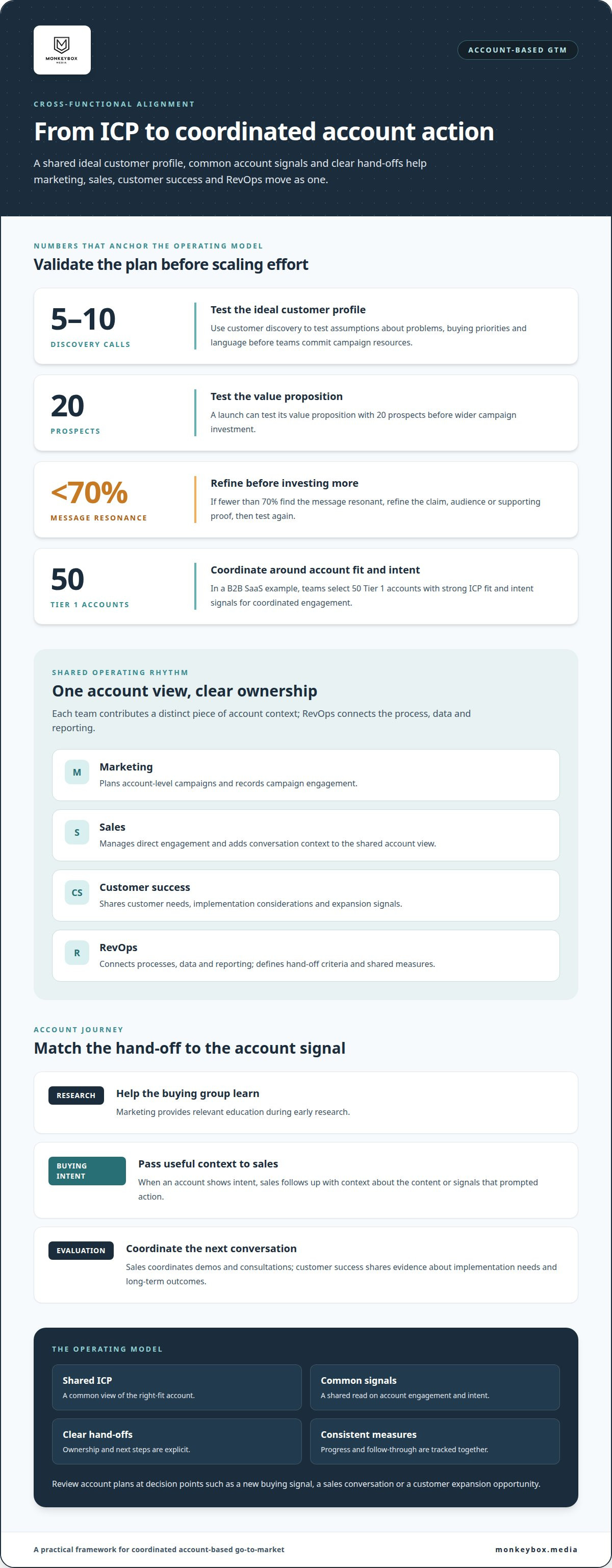
A go-to-market strategy aligns marketing, sales and product around a defined market and offering. An account-based marketing GTM strategy applies that direction to selected companies and their buying groups. Marketing plans account-level campaigns, sales manages direct engagement, and customer success contributes customer needs and expansion signals. RevOps connects processes, data and reporting so teams share a consistent view of each account.
Start with a shared ideal customer profile (ICP), grounded in customer, company and competition analysis. Customer discovery reveals problems, buying priorities and language; company analysis tests sector, scale, technology and potential deal fit. Competitive analysis clarifies alternatives and where the offering can provide distinct value. Use 5-10 customer discovery calls to test assumptions, then update the ICP before teams commit campaign resources.
ABM platforms commonly support account segmentation, workflows and reporting, but they don’t manage the entire B2B customer journey alone. CRM systems can organise account and sales activity, while analytics tools help teams interpret engagement signals. Compare tools by the job they support, their account-level visibility and how well they connect with existing workflows.
Align sales activity with the customer journey, not just the marketing calendar. During early research, marketing can provide relevant education. When an account shows buying intent, sales can follow up with context about the content or signals that prompted action. During evaluation, sales can coordinate demos and consultations, while customer success shares evidence about implementation needs and long-term outcomes. RevOps defines hand-off criteria and tracks progress consistently.
A launch can test the value proposition with 20 prospects before wider campaign investment. If fewer than 70% find the message resonant, refine the claim, audience or supporting proof, then test again. A coordinated B2B SaaS example selects 50 Tier 1 accounts with strong ICP fit and intent signals. Marketing, sales and customer success then coordinate engagement around each account, rather than running disconnected activities.
Make ownership explicit. Marketing records campaign engagement, sales adds conversation context, customer success shares relevant account needs, and RevOps maintains shared definitions and reporting. For example, when several buying-group members engage with evaluation content, marketing can pass that account signal to sales. Sales can then offer a useful next step, while RevOps tracks whether the hand-off happened and what followed.
Review the account plan at agreed decision points, such as a new buying signal, a sales conversation or a customer expansion opportunity. This clarifies each team’s role and makes campaign changes traceable to account needs. The operating model is straightforward: a shared ICP, common signals, clear hand-offs and consistent success measures. This is how cross-functional alignment turns target-account activity into a coherent go-to-market motion.
Campaign triggers, messaging, content and channels
Account signals such as contract renewals, leadership changes and increased research activity can trigger coordinated campaigns.
Messaging and Channel Testing
Messaging and channel testing compares audience responses to different value propositions and distribution routes before broader investment. It helps teams identify which combinations earn attention from target accounts and support revenue outcomes.
Test the core message before committing campaign budget. For example, frame one proposition around a costly operational problem and another around efficiency gains. Track account engagement and sales-team feedback, not clicks alone. A message that attracts attention but fails to prompt relevant conversations may not advance an opportunity.
One-to-one ABM creates a distinct campaign for an individual account. One-to-few groups similar accounts for tailored campaigns, while one-to-many uses broader, scalable messaging across a larger audience. Choose an approach based on account value, fit and available buying signals.
Keep the test focused: vary the message or channel while holding other campaign elements steady. Record which accounts engaged, what content prompted a response and whether sales conversations followed. This gives sales usable evidence for refining outreach, rather than a channel-level result disconnected from account outcomes.
Channel Selection by Account Tier
Selecting channels by account tier matches campaign intensity and personalisation to each account’s fit and intent. This prevents teams from putting equal effort into accounts with different revenue potential.
For high-fit, high-intent Tier 1 accounts, use one-to-one plays that connect relevant content with coordinated sales outreach. A tailored digital experience or direct mail can support a focused conversation when the account warrants that investment. Use account signals to time the approach, rather than sending every asset on a fixed schedule.
For good-fit Tier 2 accounts showing early signals, one-to-few campaigns can group businesses with similar needs. A webinar, targeted advertising and role-specific email can create coordinated exposure while leaving room to adapt examples by account. Sales can follow up when engagement indicates a live topic, carrying the relevant content context into the conversation.
For lower-intent or longer-term-fit Tier 3 and Tier 4 accounts, use scalable nurturing. Segment campaigns by industry or business need, then deliver useful content through suitable digital channels. Review engagement for fresh signals that might justify a more personalised motion.
Set a clear outcome for each tier: start a relevant conversation, deepen buying-group engagement or maintain consideration. Then use structured go-to-market planning to connect campaign choices with account priorities and sales follow-through. Revisit the channel mix when account behaviour changes.
Account prioritisation using ICP fit and buying intent
Prioritisation combines ideal customer profile (ICP) fit with account-level evidence of active buying. Together, these signals help teams focus campaigns on accounts with stronger potential and timely needs.
ICP Fit and Buying Intent
ICP fit measures how closely an account matches the customer profile, while buying intent indicates active interest. Combining the two helps distinguish a strong long-term prospect from an account ready for engagement.
Build an ICP using factors such as sector, business model, operational needs and potential deal fit. Then assess intent through account signals, including website visits, content consumption, email replies and seller feedback. A strong-fit account showing rising research activity merits more attention than a similar company with no current signs of interest.
Divide the total addressable market into 3-4 tiers using fit, potential deal size and intent. Apply personalised 1:1 plays to high-fit, high-intent Tier 1 accounts. This structure makes campaign effort reflect account potential, rather than list size alone.
Market Problems and Buying Triggers
Market problem validation tests whether a target account faces a need your offering can address. Buying triggers indicate why action may matter now. Both help teams ground campaigns in business context.
Look for events that can make a problem urgent, such as a leadership change, technology investment, contract renewal or new regulation. For example, a new operations leader may prompt a review of existing processes. Validate the issue through customer conversations and account research, then connect the trigger to a clear business impact.
Separate an observable event from assumptions about what it means. A contract renewal can create a buying window, but the account’s priorities determine whether a relevant campaign will resonate. This distinction keeps outreach specific and credible.
Signal-Driven GTM Plays
Signal-driven GTM plays use account behaviour and buying triggers to decide when to act, what to say and whom to engage. They help teams respond to changing account context instead of relying only on fixed campaign dates.
Combine signals across the account, not just from individual leads. For example, several contacts viewing related content, alongside a seller’s note about an upcoming review, may warrant a coordinated follow-up. Use the signal to choose a useful next step, such as sharing relevant evidence or arranging a discussion.
Revisit account lists regularly as intent, triggers and market conditions change. If activity falls away, move the account into a nurture motion. If new buying evidence appears, make engagement more relevant and coordinated.
Buyer and Buying-Centre Roles
Buying-centre mapping identifies the people involved, their influence and the information each needs. It matters because B2B decisions involve groups, not isolated leads.
UK B2B buying committees average 13 people. Map roles such as decision-makers, technical evaluators, budget owners and day-to-day users, then connect each role with its likely concerns. A finance lead may focus on value, while an operational user needs to understand workflow impact.
Use account engagement and sales conversations to refine this map across the buying journey. If one contact engages with implementation content, identify other stakeholders who need evidence about adoption or outcomes. This helps campaigns engage the full buying committee and gives sales a clearer view of account momentum.
Personalised messaging for target businesses
Effective account messaging connects a specific business problem to a clear value proposition. It reflects the target account’s context and the buying group’s different information needs.
Buyer Personas and Messaging
Buyer personas describe the roles, priorities and concerns that shape a purchase. They help teams create relevant messages for each audience segment. Build them from customer conversations, account research and sales feedback, not assumptions based on job titles.
For example, an operations leader may need to understand the workflow impact, while a finance stakeholder focuses on return on investment. Give each persona a distinct message, supporting evidence and next step. Keep the central value consistent, but adapt its emphasis to the person’s role.
Measure engagement by role and account, not just total clicks. If technical evaluators respond to implementation details but budget owners don’t engage, add financial evidence to content for that segment. These measures show whether messaging reaches the buying group and supports a focused conversation.
Personalised Account Messaging
Personalised account messaging uses relevant company context to make outreach specific to a target business. This matters because a buying group needs to recognise its priorities in the proposed value and supporting evidence.
Start with a verified account signal, such as a technology investment, leadership change or content interest. Connect that context to a problem your offering addresses, then explain the value, how it is delivered and why it stands apart from alternatives. Avoid superficial personalisation, such as inserting a company name without changing the message.
Tailor examples and content to the account’s sector, operating model and buying stage. A company assessing a new platform may need a clear use case; an account exploring expansion may need evidence about long-term outcomes. Keep messaging consistent across advertising, email and sales follow-up so each interaction advances the same conversation.
Positioning for Target Businesses
Positioning defines the value offered, the audience it serves, how that value is delivered and why it merits consideration. It gives campaigns a coherent foundation while allowing the message to reflect each target business.
Test the value proposition with 20 prospects and refine it if fewer than 70% find it resonant. Use feedback to identify unclear claims, missing proof or a mismatch between the message and the audience’s priorities. Then update the wording before expanding campaign activity.
For UK B2B engagement, make risk and compliance messaging clear, accurate and relevant to the buyer’s decision. Explain how a proposed approach handles data and operational concerns without making unsupported assurances. A procurement stakeholder may need a different explanation from a daily user, so match the detail to each role.
Review account responses, sales conversations and content engagement together. If a claim earns attention but prompts concerns about implementation, strengthen the explanation rather than repeating the headline. This creates a focused message system: a consistent value proposition, relevant account context and role-specific proof.
Account-based marketing as a go-to-market strategy
Account-based marketing focuses coordinated marketing and sales activity on selected businesses, not isolated leads. As part of a go-to-market strategy, it connects a defined audience, offering, value proposition and sales motion.
ABM Costs and Budget Planning
ABM budget planning allocates resources to account selection, campaign execution and measurement. The investment should reflect account value and the depth of engagement required.
ABM costs depend on the scope of the programme. Key factors include the number of accounts, depth of personalisation, channel mix, content production and campaign operations.
Set the budget around the motion, not a generic industry benchmark. A focused programme for high-value accounts may need account research, tailored content and coordinated sales follow-up. A broader audience may rely more on reusable content and scaled digital campaigns. For deals worth £100k or more, consider layering ABM onto the wider GTM plan where account-level coordination can support the opportunity.
Separate campaign costs from the work needed to operate the programme. Teams may need systems for segmentation, workflows and reporting, as well as people who manage account context and seller follow-through. Define success measures before committing budget, such as engaged target accounts, qualified opportunities or closed revenue.
ABM Programme Results Timeline
An ABM results timeline tracks progress from account engagement through to pipeline and revenue outcomes. Each signal appears at a different stage of the buying journey.
Early indicators include relevant contacts engaging with content or responding to outreach. Later evidence includes sales conversations, qualified opportunities and closed or expanded business. Enterprise B2B sales cycles can last 12 months or longer, so judging a programme only by immediate revenue can miss meaningful progress.
Set measures for each stage, then review them against the programme’s defined audience and objectives. For example, a campaign may first increase engagement across an account’s buying group, then support a sales opportunity. Track how the opportunity advances and whether account activity contributes to revenue.
Keep measurement tied to action. If target accounts engage but sales conversations don’t progress, examine the hand-off, message and buying-group coverage. If opportunities move forward, identify which interactions helped and apply those lessons to future campaigns. Build a focused account-based GTM plan around your audience, value proposition and revenue goals.
Monkeybox Media: GTM Strategy
Monkeybox Media helps B2B organisations turn account priorities into a coordinated go-to-market plan. Its GTM Strategy work can bring target-account selection, positioning, campaign activity and sales alignment into one operating direction.
Turn to Monkeybox Media when your teams have account data and campaign activity but lack a clear structure connecting them to commercial priorities. Fractional CMO leadership can guide strategic decisions, while Marketing Ops and Marketing Automation support the workflows and systems behind consistent execution.
The right starting point depends on the gap: strategy, leadership, operations or automation. The focus is on building a practical growth system around your target accounts, not adding disconnected activity.
Contact Monkeybox Media to discuss your GTM strategy.
Turn account focus into your next growth move
Make your account-based marketing GTM strategy a living commercial system, not a campaign document that sits untouched. Give it a clear owner, a regular review rhythm and the authority to shift focus when account behaviour or business priorities change. This keeps strategic choices connected to execution.
Choose the decision that will move your programme forward now. You might clarify which account segment deserves attention, resolve a hand-off gap or connect campaign engagement to sales action. A focused decision creates momentum and gives leadership a practical way to assess whether the plan still supports the organisation’s direction.
If you’re ready to turn that decision into a workable plan, explore a strategic next step with Monkeybox Media. Bring your priorities and growth questions into the conversation, then build from there. Your next move can be clear, deliberate and ready to progress.
Frequently Asked Questions
What is a go-to-market strategy?
A go-to-market strategy is a coordinated plan for bringing an offering to a defined audience and turning its value into commercial action. It connects the market opportunity with positioning, channels, pricing, sales activity and customer support. For example, a business launching a new service might use it to decide which organisations to target, how to reach decision-makers and what sales materials they need.
What is account-based GTM?
Account-based GTM applies go-to-market planning to selected organisations, coordinating marketing and sales around each account’s needs. It’s useful when a purchase involves several stakeholders or requires tailored engagement. For example, a technology supplier could shape separate conversations for an account’s finance, technical and operational teams, while keeping each interaction tied to the same commercial objective.
How long does it take to develop a GTM strategy?
An initial GTM strategy can take 4-8 weeks to develop, depending on the market analysis, customer input and internal decisions required. The work may move faster when teams already understand the audience and offering. Complex launches often need more alignment on positioning, channels, pricing and sales readiness. Treat the strategy as a working plan that can evolve as customer and market feedback arrives.
What does go-to-market mean?
Go-to-market describes how a business brings an offering to customers and supports its journey from awareness to purchase and use. It covers practical choices, such as which audience to serve, how to communicate value and which sales or distribution channels to use. For instance, a business entering a new sector may need a different message and sales process from one serving its established market.
What sections should you include in a GTM strategy?
Include the target audience, market analysis, value proposition, pricing and packaging, sales channels, distribution approach, customer support and launch milestones. Each section should inform the others. For example, if research shows buyers need technical assurance, the message, sales materials and support plan should address that need. Define success measures too, so teams can assess progress and adjust execution.
Why Your GTM Strategy Needs to Shift?
A GTM strategy needs to change when its assumptions no longer match customer behaviour, market conditions or business priorities. A new competitor, changing buyer concerns or repeated sales objections can reveal a mismatch. For example, if prospects understand the problem but don’t see the offering as relevant, revisit positioning and proof points before increasing campaign activity.
How to define and prioritise ideal customer profiles and target accounts for ABM?
Define an ideal customer profile using shared traits among organisations that are a strong commercial and operational fit. Examine existing customer patterns, sector needs, purchase context and the problems your offering solves. Then score target accounts against those criteria and current buying evidence. A company that matches the profile but lacks a relevant need may warrant nurturing, while a stronger fit showing active interest may merit focused engagement.
How to align sales and marketing teams around an account-based GTM strategy?
Align sales and marketing by agreeing on account ownership, shared definitions and what happens after an account engages. Create a common account brief covering the organisation’s priorities, active contacts, campaign interactions and planned next action. Review it together as opportunities develop. For example, marketing can pass relevant engagement context to sales, while sales feedback helps refine future campaigns and account messaging.