
A full pipeline can still hide a broken revenue engine. If lead volume looks healthy but sales questions lead quality, your B2B demand generation strategy may not be connecting buyer interest to commercial outcomes. The problem is rarely a lack of activity. More often, campaigns capture clicks, content builds awareness and teams measure success in different ways.
That frustration is understandable. B2B buyers research independently, buying groups involve multiple stakeholders, and long sales cycles make a single campaign or last-touch report a poor measure of influence. More form fills won’t fix the gap. A demand engine needs to build preference before buyers are ready, capture intent when it emerges and give sales evidence it can act on.
This guide shows how to build a practical strategy around your ideal customer profile, buying groups, priority channels and revenue goals. You’ll learn to distinguish demand creation, demand capture and lead generation, then connect them through an operating and measurement framework that improves with evidence. The result is a coordinated revenue system, not another disconnected campaign.
Key Takeaways
- Build your B2B demand generation strategy around a defined ideal customer profile, priority problems and the needs of the full buying group.
- Give each channel a clear role, then assess it by audience access, attention cost, feedback speed and your team’s capacity.
- Measure progress across leading indicators, buyer engagement, pipeline contribution and revenue, rather than relying on MQL volume alone.
- Launch in a sustainable sequence: diagnose the baseline, focus the audience, design the programme, run a small number of experiments and review the evidence.
- Connect strategy, ownership, data and workflows in a repeatable operating system so each cycle of learning can sharpen execution.
What B2B demand generation means, and why lead volume is not the goal
Marketing teams are expected to show how their work contributes to pipeline. That pressure is real. But reducing marketing to contact capture can make a busy dashboard look productive while leaving sales with names that aren’t ready, relevant or connected to a buying decision. The goal isn’t simply to collect more leads. It’s to build buyer interest, recognise genuine intent and support progress towards revenue.
A B2B demand generation strategy coordinates the work that creates, captures and sustains buyer interest across the buying journey. It connects education and brand visibility with intent signals, sales follow-up and ongoing learning. Demand generation is often used as an umbrella term for these related activities, but separating their roles makes planning and measurement more useful.
Demand generation vs lead generation vs demand capture
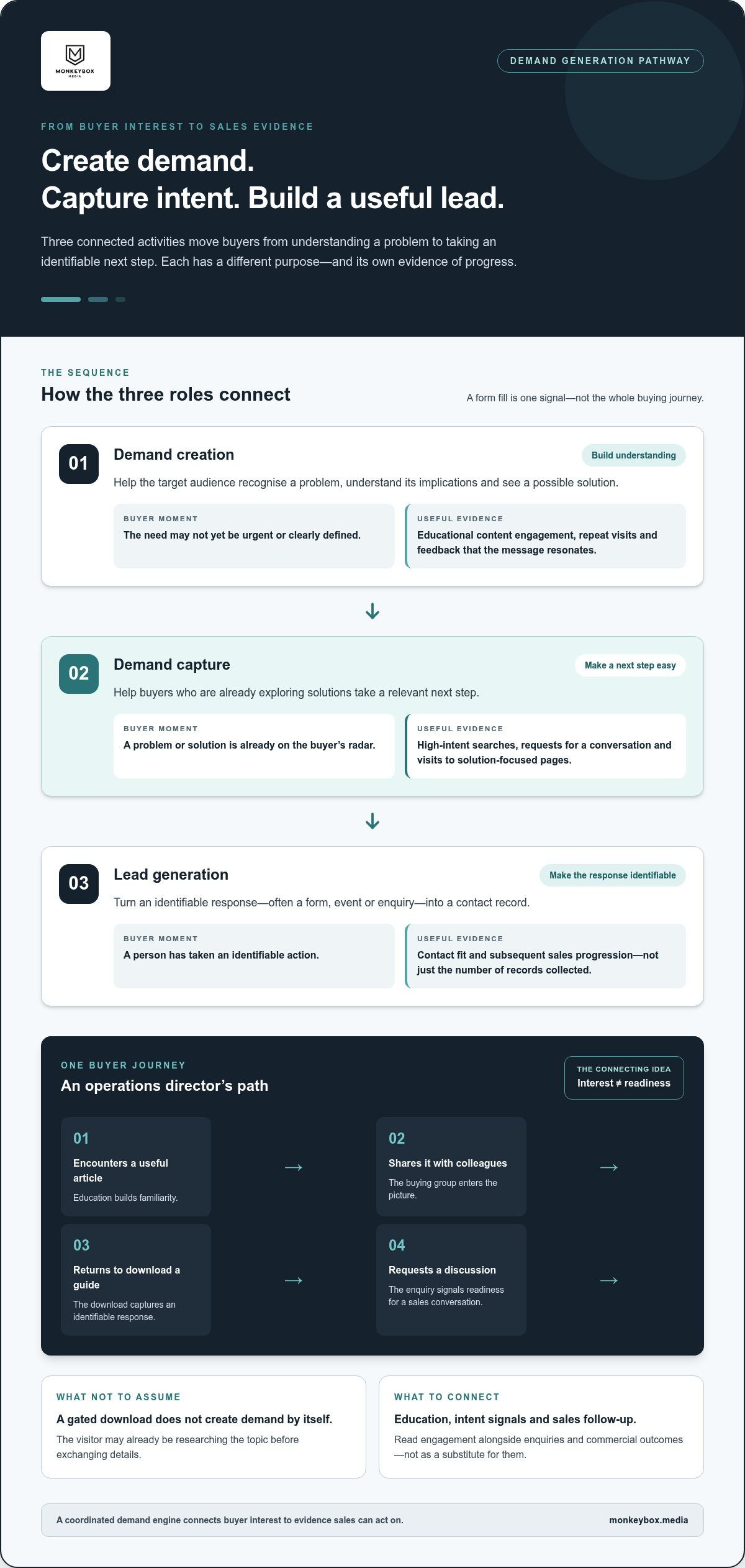
Each activity serves a different purpose, reaches buyers in a different state and needs its own evidence of progress:
- Demand creation helps a target audience recognise a problem, understand its implications and see a possible solution. Useful evidence includes engagement with educational content, repeat visits and feedback that shows the message resonates.
- Demand capture makes it easy for buyers already exploring solutions to take a next step. Relevant evidence includes high-intent searches, requests for a conversation and visits to solution-focused pages.
- Lead generation turns an identifiable response into a contact record, often through a form, event or enquiry. Track the fit and subsequent sales progression of those contacts, not just the number collected.
A gated guide can capture demand by asking a visitor to exchange their details for access. The form doesn’t create demand on its own; the visitor may already be researching the topic. Consider an operations director who first encounters a useful article, shares it with colleagues and later returns to download a guide. After the buying group reviews its options, the director requests a discussion. Education built familiarity, the download captured an identifiable response, and the enquiry signalled readiness for a sales conversation.
Why B2B demand generation spans the whole buying journey
B2B decisions rarely belong to one person. A user may define the need, a technical specialist may assess requirements, and a budget holder may approve the purchase. Each needs different information, and the group may revisit questions as priorities, risks or internal agreement shift. A single campaign or form fill can’t represent that full process.
That’s why a B2B demand generation strategy should make useful education and brand familiarity available before a buyer signals intent. Buyers may encounter your perspective through search, shared content or a colleague, then return when a need becomes urgent. Consistent messages help them understand the problem and recognise your organisation when they begin evaluating options. Measure these signals alongside enquiries, not instead of commercial outcomes.
The same lifecycle view can inform customer communications, including opportunities for retention and expansion. Keep that work connected to the wider journey, but don’t confuse it with the core task: creating demand, capturing intent and enabling a credible path from buyer interest to pipeline.
Build the demand generation strategy around buyers, problems, and buying groups
Before choosing channels or commissioning content, decide whose attention matters and why. A useful strategy starts with a defined ideal customer profile (ICP), the problems your organisation can credibly address, the events that make those problems urgent, and the conditions that make a prospect a poor fit. That focus keeps activity connected to commercial priorities instead of chasing every topic that attracts clicks.
Make the choices explicit. Describe the organisations you want to reach, the roles involved in a purchase and the situations that prompt them to act. Record disqualifiers too, such as a need your solution doesn’t address or a buying context your team can’t support. These boundaries help marketing and sales qualify opportunities consistently and direct effort where there’s a credible route to value.
Turn customer research into a usable demand generation focus
Build the strategy from evidence already available across the business. Interview customers, review sales conversations, examine win-loss insights and look for patterns in existing customer outcomes. Ask what changed before a buyer began searching, what alternatives they considered, which concerns slowed the decision and what ultimately made the solution relevant. Sales conversations can reveal objections; customer evidence can show which promised outcomes matter after purchase.
Then separate urgent problems from interesting subjects. A popular topic may attract attention but have little connection to a buyer’s need, your strengths or a viable commercial opportunity. Prioritise problems where the audience has a reason to act and your organisation can offer a credible perspective. A useful planning record has three parts: assumptions the team is making, evidence supporting them and open questions to test through future activity. This keeps the strategy adaptable without turning every new opinion into a change of direction.
Match messages and content to buying-group needs
Buying-group strategy is more useful than a single-lead strategy because a decision depends on several people building a shared case for change. Map each role’s functional concerns, business case, influence and likely objections. A practitioner may want to understand how a solution fits daily workflows; a finance stakeholder may need a clear rationale for investment; a technical evaluator may focus on implementation demands and risk. The same message won’t answer every question.
Use the map to select a small number of strategic themes, then decide which content and channels can answer those questions well. A practical guide may help a buyer understand a problem; an expert-led briefing may address an objection; a clear comparison may support internal discussion. Don’t start with a format calendar. Start with the decision the audience needs to make and the evidence that will help. monday.com's B2B demand generation strategies also explores ICPs and connected buyer journeys, useful considerations when shaping that plan.
For teams turning customer insight into a focused go-to-market plan, strategic B2B go-to-market planning can align audience priorities, messages and execution.
Choose channels and measure demand generation without relying on MQL volume
A channel is valuable only if it reaches the right people and helps them take a meaningful next step. Compare options by audience access, strategic role, cost of attention, feedback speed and the capacity needed to run them well. This keeps a B2B demand generation strategy focused on learning and commercial progress, not on being present everywhere.
Select a focused channel mix for your B2B audience
Build a measurement model sales and marketing can use
Agree on definitions before reporting. For example, define an engaged account by meaningful actions across relevant people, not by one isolated click. Define a qualified opportunity using shared fit and sales-readiness criteria. Record sourced pipeline when marketing activity initiated the opportunity under your agreed rules, and influenced pipeline when relevant marketing engagement supported an opportunity already in progress.
Use CRM and marketing automation data as operational inputs, not as automatic proof of cause. Attribution models help teams compare patterns and guide decisions, but they can’t fully show which interaction caused a sale. Buyers may share information privately, engage across devices or involve colleagues whose activity isn’t captured. Treat attribution as directional evidence, then combine it with sales feedback, conversion and account progression.
Read the measures together. Reach without engagement may point to a targeting or message issue; engagement without opportunity progression may signal a gap in fit, offer or sales follow-up. Revenue remains the lagging outcome, while earlier indicators show where to investigate and improve. Together, these measures give marketing and sales a shared operating picture without making MQL volume the verdict.
Launch a B2B demand generation strategy in a sequence your team can sustain
A strategy becomes useful when the team can execute it, learn from it and make clear decisions about what happens next. Build the launch sequence around your current data, people and operational capacity. A focused programme with defined ownership will produce more actionable learning than a broad campaign plan the team can’t maintain.
- Diagnose the baseline. Review current marketing activity, sales handoffs, available data and existing pipeline patterns. Note what the team can measure reliably, where records or processes break down, and what sales sees as a quality opportunity. This establishes the constraints and starting evidence for the programme.
- Choose one audience and problem. Focus on a priority segment and a business problem supported by customer or sales evidence. State the hypothesis in practical terms: if the team addresses this problem with a specific message, the intended audience should take a meaningful next step. Keep the scope narrow enough to learn.
- Design the programme and assign ownership. Select the message, channels, content and follow-up that support the hypothesis. Assign a marketing owner for delivery, a sales owner for feedback and follow-up, a leadership sponsor for decisions, and an operations owner for data and workflow readiness. Map dependencies before setting the launch date.
- Launch a coherent test. Coordinate a small number of connected activities rather than launching every channel at once. For example, expert content can introduce an issue, sales can share it with relevant accounts, and a follow-up resource can help interested buyers explore the next question. Keep the audience, message and intended outcome consistent.
- Review evidence and decide. Check delivery, audience response, lead quality, sales feedback and opportunity progression together. Decide whether to continue, adjust the message or audience, fix a handoff, or stop the activity. Record what the team learned so the next test builds on evidence, not assumption.
Set priorities, ownership, and a realistic test plan
Before launch, agree on what evidence would justify continuing, changing or stopping. Set a review point that fits the buying cycle and the speed at which the chosen channel can produce useful feedback. A test plan should name the hypothesis, owner, required inputs, success signals and decision-maker. That structure prevents activity from continuing simply because it has already started.
Use marketing operations and automation to support execution
Map each handoff, data requirement, consent practice and workflow dependency before automating. Marketing automation can make agreed processes more consistent and easier to measure, but it can’t repair unclear strategy or poor-quality inputs. Introduce AI agents only where a defined workflow, human oversight and a clear success measure exist. Start with a controlled task, review its output, then decide whether it should expand.
Failure-prevention check:
- Marketing and sales agree on ownership, handoffs and shared definitions.
- Data and workflow dependencies are ready before campaign activity begins.
- The team tests and reviews before scaling spend, channels or automation.
Monkeybox Media’s B2B go-to-market planning connects strategic priorities to an executable launch plan.
Turn the strategy into a scalable demand generation operating system
A repeatable demand engine needs more than a strong campaign. It needs a connected operating system: strategic priorities that guide decisions, clear team ownership, dependable data, workable processes and regular learning cycles. Each part supports the others. Strategy sets direction; operations make execution consistent; evidence shows where to adapt.
This also addresses a common measurement challenge: buying decisions unfold over time, and not every interaction is visible. The answer isn’t to claim perfect attribution. Build a chain of evidence across stages. Track whether target audiences are reached, whether relevant accounts engage, whether qualified opportunities progress and whether that activity contributes to pipeline and revenue. Each measure answers a different question. Together, they give leaders a more complete view than a single lead count or last-touch report.
When strategic leadership and marketing operations need to work together
A growth plan can set an ambitious direction and still stall if nobody translates it into priorities, responsibilities and day-to-day workflows. Executive leadership aligns marketing and sales on the audiences and outcomes that matter, resolves trade-offs and makes accountability clear. Marketing operations supports that direction with reliable data, defined handoffs, automation and a disciplined review cycle. One provides focus; the other makes the work repeatable.
These capabilities are complementary, not interchangeable. Fractional CMO leadership and go-to-market strategy can establish direction and align decisions. Marketing operations and automation can turn agreed priorities into dependable processes and usable reporting. The operating system improves as teams review results, identify friction and adjust workflows instead of layering more activity onto a broken process.
Create the next step from diagnosis to execution
Before adding another campaign or tool, identify the bottleneck with the greatest impact. Is the audience unclear? Are sales handoffs inconsistent? Can the team not connect activity to opportunity progression? Diagnose first. Then make sure the plan states who it serves, which problem it addresses, what each channel contributes, who owns each step and how the team will judge progress.
Keep the review cycle practical. Compare the intended audience with the people reached, check whether engagement reflects genuine interest, and inspect how qualified opportunities move through the pipeline. If the signal weakens at one stage, investigate that part of the system rather than restarting the whole programme. Document the decision and learning so the next cycle improves on the last.
A scalable B2B demand generation strategy is not a fixed campaign calendar. It’s a coordinated system that connects leadership, execution and evidence, then adapts as the business learns. The right structure depends on the growth stage, team capacity and operational gaps, so start with the constraint that matters most.
Monkeybox Media connects demand generation strategy and execution through an operating system aligned with your growth priorities.
Make your next growth move deliberate
The next step isn’t to add more activity. It’s to identify the constraint holding back progress and decide what the business needs to learn or change. That could mean sharpening strategic direction, improving how teams act on buyer signals or making measurement more dependable. Pick the issue with the greatest commercial consequence, then build from there.
A strong B2B demand generation strategy should evolve with your growth priorities, not sit untouched in a planning document. Fractional CMO leadership, go-to-market planning and marketing operations can connect executive decisions to everyday execution. Automation and AI agents can support that system when they serve a clear workflow and outcome.
Monkeybox Media brings these capabilities together to help organisations connect strategy with the operational work behind demand generation. Explore how Monkeybox Media can help shape your next stage of growth.
Start with the bottleneck. Build with purpose. Keep moving forward.
Frequently Asked Questions
What is a B2B demand generation strategy?
A B2B demand generation strategy is a coordinated plan for building buyer awareness, preference and demand throughout the buying journey. It’s more than a list of campaigns: it connects a defined audience and problem to channel choices, sales alignment, operational workflows and measurement. For example, a team might align educational content and sales follow-up around a newly recognised buyer challenge. The objective is meaningful commercial progress, not simply maximising form fills.
What is the difference between demand generation and lead generation?
Demand generation builds interest and preference; lead generation captures an identifiable response from an interested prospect. Both can support growth, but a form submission alone doesn’t prove that marketing created demand or that the person is ready to buy. For example, a buyer might learn from an ungated guide, then later register for a detailed workshop. The guide helps build understanding; the registration captures a response at a more engaged point.
How do you measure B2B demand generation?
Measure a blend of audience reach, account and buying-group engagement, qualified opportunities, pipeline contribution and revenue outcomes. Choose indicators to match the programme’s purpose and the buyer’s stage: a new educational initiative needs different early evidence from a sales-ready offer. Compare changes over time and examine whether engaged accounts progress. Attribution models can inform those comparisons, but rarely prove that one touchpoint caused a complex B2B purchase.
How long does B2B demand generation take to work?
There’s no universal timeline. Results depend on the sales cycle, audience awareness, market conditions, channel maturity and how consistently the programme runs. Set review points around your organisation’s actual buying process, rather than expecting every activity to produce immediate pipeline. In early reviews, assess whether the intended audience is responding and what the team is learning; evaluate opportunity and revenue outcomes as enough evidence accumulates.
Can B2B demand generation work without gated content?
Yes. Ungated education can help buyers find useful information and form a view of your expertise without giving up contact details. A gated asset can still be appropriate when it offers clear value and the visitor is ready to engage, such as requesting a tailored assessment. Choose access based on the buyer’s needs and the asset’s purpose. Requiring details for every resource can add friction without improving the experience.
What channels should a B2B demand generation strategy include?
There’s no universal channel mix. Expert-led content can explain a complex issue; organic social and paid distribution can help more of the right audience encounter it; email can support relevant follow-up; ABM can focus effort on selected accounts; and sales enablement can equip teams for informed conversations. Prioritise according to audience behaviour, buying-group needs, programme objectives and team capacity. Coordinate channels around a useful experience, not a bigger channel count.
How can marketing and sales align around demand generation?
Marketing and sales can align by agreeing on audience definitions, lifecycle language, handoff expectations, feedback routines and pipeline measures. Make those agreements practical: specify what makes an account worth following up and how sales will share what happened next. Review account and opportunity evidence together, not just a service-level agreement. Sales conversations can surface unanswered buyer questions, while marketing can equip sales with useful content and insight for informed follow-up.