
A market launch should never be a leap of faith. A strong B2B market entry strategy treats expansion as a sequence of evidence-backed commitments, so you can test demand before locking in major investment. Early signals can be hard to read: interest isn’t the same as buying intent, and a promising market doesn’t automatically point to the right route in.
You need more than a market-size estimate. You need clear criteria for comparing opportunities, a realistic view of your capabilities and exposure, and a way to test whether buyers will engage and pay. Direct entry, a local partnership or another operating model each brings different trade-offs. The right choice depends on evidence, not momentum alone.
This practical framework shows how to prioritise a target market, validate demand and select an entry model you can execute. You’ll also see how to set launch measures, align marketing and sales around useful signals, and define review points for adjusting, pausing or scaling. The result is a market-entry plan that connects strategic ambition to accountable action.
Key Takeaways
- Define whether you’re entering a new geography, segment, industry or use case, then identify which assumptions change.
- Build a B2B market entry strategy around buyer evidence and observable commercial behaviour, not desk research alone.
- Compare direct entry, building capability and partnering against control, speed, resource demands, exposure and reversibility.
- Turn validation into a focused launch plan with clear owners, measurable milestones and decision gates.
- Use marketing operations to improve data quality, create repeatable workflows and strengthen sales handoffs as the plan evolves.
What a B2B market entry strategy must prove before expansion
A large market estimate or a handful of enthusiastic conversations does not validate expansion. Before committing meaningful resources, leadership needs to establish that a defined group of buyers has a relevant problem, that the offer can address it, and that the business can reach and serve those buyers on workable terms. A B2B market entry strategy brings those questions into one coordinated decision.
A market entry strategy is a plan to serve a clearly defined new market, grounded in validated demand and a deliberate commitment of resources to an offer and delivery model that can meet it. The principle is straightforward: evidence first, commitment second. For a foundational overview of entry approaches and the factors that shape viability, see Understanding Market Entry Strategies.
What counts as a new B2B market?
A new market can mean a different geography, industry, customer segment or use case. These are distinct moves. Expanding into another country may change access, delivery requirements and the competitive set. Targeting a new industry may keep the geography the same but alter the problem buyers prioritise, the language they use and the evidence they expect. A new use case can shift the decision to a different team or budget.
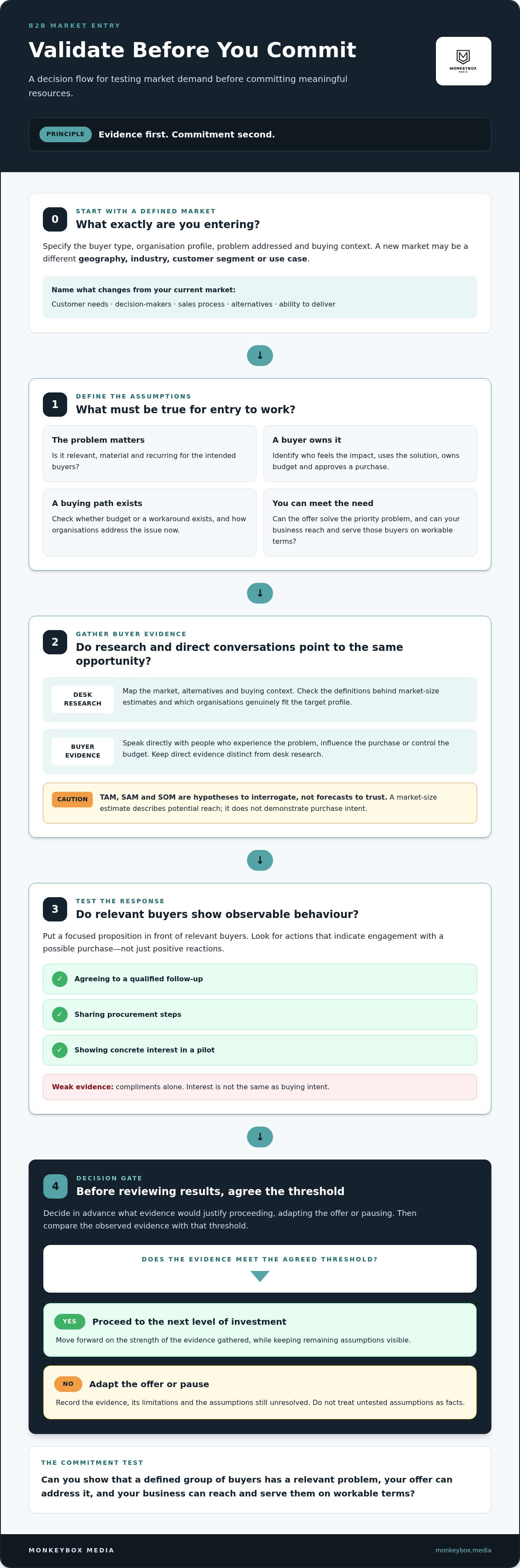
Define the boundary before estimating the opportunity. Specify the buyer type, organisation profile, problem addressed and buying context. Then identify what differs from your current market: customer needs, decision-makers, sales process, alternatives and ability to deliver. A broad label such as “mid-market firms” isn’t enough if it groups organisations with very different needs and buying behaviour.
Why market entry plans fail before launch
Success with current customers is useful evidence about your offer, but it doesn’t prove that a different group will value it. Existing buyers may have found you through a trusted relationship, have a particular internal need or already understand your category. New buyers may compare different options, require different proof or see the problem as a lower priority.
Forecasts create false confidence when teams treat assumptions as facts. An estimated number of target organisations doesn’t establish reachable demand, and positive feedback doesn’t establish willingness to buy. Reusing existing positioning creates another risk: language that resonates with current customers may miss the new market’s priorities. Test the problem and message with intended buyers before using them to justify a major commitment.
Keep the strategic decision distinct from the execution plan. The market-entry decision establishes where to compete, for whom, with what offer and through which delivery model. A go-to-market plan translates that choice into positioning, channels, sales and marketing activity, ownership and measurement. The first sets direction. The second organises execution.
Before moving forward, leadership should be able to state what evidence supports demand, which assumptions remain unproven, what capabilities delivery requires and what level of commitment is justified now. A strong B2B market entry strategy makes those gaps visible rather than hiding them inside an optimistic forecast. That clarity creates a disciplined starting point for validation.
How to validate a B2B market before committing resources
Validation should reduce uncertainty in stages, with each step earning the next level of investment. Desk research helps frame the opportunity, but it can’t prove that buyers will act. As B2B Market Entry Strategies and Research explains, market research needs to account for buyers and competitive dynamics. Connect that research to direct evidence and explicit decision gates.
A market-size estimate describes potential reach; it doesn’t demonstrate purchase intent. Treat TAM, SAM and SOM as hypotheses to interrogate, not forecasts to trust. Check the definitions behind each figure, identify which organisations genuinely fit the target profile, and test whether your team can reach and serve them.
- Define the assumptions. Write down what must be true for entry to work: the problem matters, a buyer owns it, budget or a workaround exists, and your offer can meet the need.
- Gather buyer evidence. Use desk research to map the market, alternatives and buying context. Then speak directly with people who experience the problem, influence the purchase or control the budget. Keep these evidence types distinct.
- Test the response. Put a focused proposition in front of relevant buyers. Look for observable behaviour, such as agreeing to a qualified follow-up, sharing procurement steps or showing concrete interest in a pilot. Compliments alone are weak evidence.
- Decide against a threshold. Before reviewing results, agree what would justify proceeding, adapting the offer or pausing. Record the evidence, its limitations and the assumptions still unresolved.
Which market-entry assumptions should you test first?
Start with the problem and the buying system. Is the issue material and recurring, and how do organisations address it now? Identify who feels the impact, who owns the budget, who uses the solution and who approves a purchase. These roles may belong to different people.
Then test fit. Does the current offer solve the priority buyers describe? Does the positioning make that value clear? Can your delivery model meet their expectations? Market research can sharpen these questions, while buyer conversations and evidence of purchasing behaviour can challenge your initial assumptions.
What evidence is strong enough to justify a next step?
Look for consistency across sources: credible buyer interviews, signs of current spend or an active workaround, and qualified interest in testing a defined offer. A single enthusiastic contact may be an outlier. Note who you spoke with, how they were selected and which buyer roles or organisation types remain unrepresented.
Set a decision rule that matches the commitment at stake. For example, proceed to a limited test only if buyers confirm the problem, identify a plausible route to purchase and engage with a specific next step. Adapt if the need is real but the offer or buyer differs from your assumption. Pause if the evidence is thin or contradictory. A disciplined B2B market entry strategy turns those findings into accountable choices; B2B go-to-market strategy planning can connect the evidence to execution.
Build, buy or partner: compare B2B market entry models
Once the opportunity has passed an initial evidence test, choose how the business will reach customers, deliver the offer and learn from the market. The right model depends on the capabilities you can commit, the control you need and how much exposure you’re prepared to take on. No route is automatically best. Match the operating model to the conditions you’ve validated.
| Entry model | Control | Speed | Capability requirements | Exposure | Ability to reverse |
|---|---|---|---|---|---|
| Build direct | High control of customer relationships, positioning and delivery | Can be slower while the team establishes reach and operations | Requires internal ownership of sales, delivery, support and learning | Direct commitment of people, processes and operating capacity | Can be adjusted, but established operations take effort to unwind |
| Buy through acquisition | Control increases with ownership, subject to integration | May provide quicker access to customers or expertise | Requires integration and the ability to manage an acquired operation | Exposure includes integration demands and business continuity | Harder to reverse once assets and teams are combined |
| Partner | Shared or limited control, depending on responsibilities | Can accelerate access through an established partner | Requires clear governance, coordination and aligned incentives | Depends on partner reliance and the customer-facing arrangement | Potentially more adjustable, depending on commitments and agreements |
When does direct entry make sense?
Direct entry suits a team that can own customer access, delivery and market learning, rather than relying on an intermediary for all three. It offers closer control over positioning and the customer relationship, which can help the business refine its offer through direct feedback. That control requires capacity: plan for the roles, workflows and support needed to serve customers consistently.
Before expanding the operating footprint, map the work from first conversation through delivery and ongoing support. Identify which capabilities already exist, which need to be added and what happens if demand takes longer to develop than planned. Direct entry is strongest when the commitment is proportionate to the evidence and the value of owning the relationship.
When should a company consider acquisition or partnership?
An acquisition may offer access to customers, expertise or distribution that would take time to build. It also brings integration work: aligning teams, processes, positioning and customer experience. Treat the assumed benefits as hypotheses to validate, not automatic gains. A partnership can offer access with a different level of commitment, but only if both sides agree how the arrangement will operate.
Define partner incentives, responsibilities, customer ownership and performance measures before launch. Clarify who generates demand, who manages the relationship, who delivers the offer and how issues are escalated. If these boundaries remain vague, access may not translate into a dependable route to market.
Use a simple fit test for your B2B market entry strategy: choose the model that gives you the capabilities required to serve the validated opportunity, with acceptable exposure and a workable route to change course. Compare the options against your strategic goals, internal capacity and desired level of customer control. Make the commitments explicit before execution begins.
Turn market-entry evidence into a launch plan and decision gates
Validation creates value when it changes what the business does next. Convert findings into a contained launch scope, named owners and milestones that test the remaining commercial and delivery assumptions. A launch plan isn’t a promise to scale. It’s a controlled way to learn while keeping commitments tied to evidence.
What belongs in a market-entry launch plan?
Make the plan specific enough that each team knows what to do and leadership can see whether the test is working. Record:
- Initial target buyers: define the organisation and buyer profile the launch will focus on, including who influences and approves a purchase.
- Tested proposition: state the buyer problem, value offered and positioning that received a credible response. Note what remains an assumption.
- Route and delivery: document the channel, sales approach and delivery model being tested, plus the capacity and dependencies they require.
- Owners and handoffs: assign responsibility for marketing activity, sales follow-up, operational readiness and capturing customer feedback. Make handoffs explicit.
- Milestones and risks: define what evidence is needed at each stage, who reviews it, and which unresolved risks could block progress.
For example, if buyers respond to a particular use case but need a different implementation process, test that delivery requirement rather than simply increasing campaign activity. Keep the test focused. Changing the audience, proposition and channel at once makes it harder to identify what produced the result.
This launch plan is narrower than a complete go-to-market playbook. It sets the initial scope, owners, measures and decision points. The wider GTM framework develops the positioning, channels, sales motion and operating system needed to execute and scale.
Which indicators guide a scale, adapt or pause decision?
Choose leading indicators that show whether the target market is engaging and whether the business can serve it. Track qualified buyer responses and progression through relevant buying stages, not just impressions or unqualified enquiries. Pair commercial signals with delivery readiness: can the team meet the requirements buyers raise, and do the resources and operating assumptions still hold?
Set review points before launch, tied to milestones such as buyer engagement, opportunity progression or readiness to deliver. At each review, assess the quality of the signal as well as its volume. A small or unrepresentative sample may point to a question worth testing, not a reason to expand or abandon the opportunity. Record who responded, which buyer roles were represented and what evidence is still missing.
- Continue or scale when qualified demand progresses and delivery remains viable against the plan.
- Adapt when buyers show interest but expose a mismatch in the offer, message, channel or delivery model.
- Change route or pause when the current approach can’t reach buyers effectively, or evidence fails to support further commitment.
A disciplined B2B market entry strategy links each decision to an owner, evidence and next action. To turn market-entry findings into accountable priorities and launch measures, build a measurable B2B go-to-market plan.
Make B2B market entry an operating system for growth
A market launch shouldn’t sit apart from the business’s commercial priorities. A B2B market entry strategy becomes an operating system when leadership connects the opportunity, execution owners and measurement in one repeatable cycle: set priorities, act on evidence, review progress and adjust. That keeps teams focused on learning and revenue potential, rather than activity for its own sake.
How strategic leadership keeps market entry on course
Use structured reviews to ask whether the evidence still supports the plan. If buyers respond to a different value proposition, or delivery requirements shift, leaders can redirect effort rather than letting teams continue on outdated assumptions. A fractional CMO can provide executive-level marketing leadership across strategy and execution. For more context on the role, explore this fractional CMO agency guide.
Make each review practical. Confirm what has changed, what the data can reliably show, which decision is needed and who owns the next action. This links strategic intent to daily execution without confusing a busy activity report with evidence of commercial progress.
How marketing operations support repeatable expansion
Reliable decisions depend on consistent information. Marketing operations establish the systems and workflows that capture market responses, track opportunities and carry context between marketing, sales and delivery. Define shared stages and data fields, agree who updates them, and make handoffs clear. If sales feedback sits in disconnected notes or teams use different definitions for a qualified opportunity, comparisons become unreliable and useful learning gets lost.
Build a simple operating rhythm around the launch:
- Capture: record buyer role, need, response and next step consistently.
- Connect: pass relevant context from marketing to sales and from sales to delivery.
- Review: bring pipeline signals and customer feedback into regular decision-making.
- Improve: update workflows when repeated friction or gaps appear.
Automation can support repeatable tasks such as routing information or prompting follow-up, while AI agents can assist suitable marketing workflows. Neither replaces strategic judgement: people still need to assess signal quality, interpret buyer context and decide how the business should respond. Strong operations make that judgement better informed, not unnecessary.
Market entry becomes more scalable when strategy, ownership and measurement work as one system. If you’re ready to connect those pieces, build a more disciplined market-entry plan with Monkeybox Media.
Make your next market move a deliberate one
Growth doesn’t come from entering every promising market. It comes from choosing where your organisation can create value, then building the leadership and operating discipline to pursue that opportunity with intent. Turn your B2B market entry strategy into a clear mandate: what the business will commit to, what it needs to learn, and who will act on that learning.
Monkeybox Media brings fractional CMO leadership for B2B organisations together with strategic GTM planning, marketing operations and automation expertise. That combination connects executive priorities to the systems teams need to execute, measure progress and adjust as market understanding develops.
Don’t let an expansion decision remain a slide in a strategy deck. Put it to work as an accountable growth plan, with clear ownership and a practical route from market opportunity to execution.
Build a more disciplined B2B market-entry strategy with Monkeybox Media and move forward with focus.
Frequently Asked Questions
What is a B2B market entry strategy?
A B2B market entry strategy is the set of choices a company makes to start serving a new group of business buyers. It defines the market boundary, the customer problem to address, the commercial route and the resources required. For example, selling an existing service to a new industry may require different proof points and sales expertise, even if the product itself stays unchanged.
How do you create a B2B market entry strategy?
Start by specifying the buyer and use case, then list the assumptions that could invalidate the opportunity. Gather evidence from market sources and conversations with relevant buyers. Test a focused proposition and a realistic route to purchase before setting a launch scope. Document owners, measures and decision thresholds. A useful working document links each assumption to its evidence, confidence level and next validation action.
What are the main B2B market entry strategies?
Common routes include direct sales using internal teams, channel or distribution partnerships, strategic alliances, joint ventures and acquisition. Companies may also adapt an existing offer for a new industry or customer segment without changing the core delivery model. Each option shifts control, capability needs and reliance on other organisations. Compare not only which route looks fastest, but also which one supports the intended customer experience.
How do you know if a B2B market is worth entering?
A market merits further investment when a defined group of buyers has a meaningful problem, a credible way to purchase and a need your organisation can serve. Check whether the addressable buyers are reachable, whether alternatives already meet their needs and whether the sales effort fits the likely commercial value. In a B2B market entry strategy, separate evidence of real buying activity from estimates based mainly on broad market totals.
What is the difference between a market entry strategy and a go-to-market strategy?
A market entry strategy determines whether and how a company should serve a new market. A go-to-market strategy turns that decision into a coordinated plan for reaching and converting customers, including positioning, channels, sales activity and customer experience. For instance, choosing to enter a new industry is an entry decision; defining its messaging, sales process and campaign priorities belongs to GTM execution.
Should a B2B company enter a new market directly or through a partner?
Choose direct entry if you need close control of customer relationships and can support the sales and delivery work internally. A partner may suit a company that needs access to an established customer base, specialised expertise or distribution reach. Compare the trade-offs against the market’s buying behaviour, then make responsibilities explicit, including lead ownership, customer communication and how success will be assessed.
How do you measure the success of a B2B market entry?
Measure success against the purpose of the entry, not activity volume alone. Track whether target buyers progress from initial engagement to qualified opportunities and sales, alongside conversion, revenue contribution and the effort required to deliver. Include customer feedback and repeat business where relevant. Compare results with the assumptions behind the launch, and distinguish a weak market signal from poor targeting, execution or data quality before changing course.