
What if your marketing strategy isn’t the problem, but the system meant to execute it? When your CRM, automation, analytics and AI tools operate in silos, even a clear growth plan can break down between decision and delivery. A B2B marketing systems architect connects those moving parts, turning strategy into workflows, data and measurement your team can use consistently. That’s where scalable execution starts.
More technology doesn’t automatically mean better marketing. Without clear ownership and connected processes, new tools can add complexity instead of momentum. The architect designs the operating system behind the strategy, keeping leadership, implementation and business goals aligned.
This article explains what a B2B marketing systems architect designs, how the role differs from marketing strategy and day-to-day operations, and which system gaps to address first. You’ll also learn when your business may need this expertise and how strategic leadership can work alongside marketing operations, automation and AI implementation to build a coherent growth engine.
Key Takeaways
- A B2B marketing systems architect turns growth priorities into connected, measurable operations, with clear ownership from strategy through execution.
- Assess five connected layers: commercial goals, customer data, workflows, technology and governance. Gaps between them can reveal where execution is breaking down.
- Separate the CMO’s responsibility for marketing direction from the architect’s focus on system design, while clarifying how marketing operations supports delivery.
- Start with a specific business problem, then map workflows, assess existing systems, design changes, assign owners and review progress.
- Fractional CMO leadership and go-to-market strategy can work alongside marketing operations, automation and AI agents in a coherent growth system.
What Does a B2B Marketing Systems Architect Actually Do?
A growth strategy can be clear, ambitious and well supported, yet still stall when systems, workflows and ownership are disconnected. Marketing captures information in one place, sales works from another, and no one can trace what happens between an enquiry and a handoff. The result is friction: duplicated work, inconsistent processes and limited visibility into execution.
A B2B marketing systems architect designs how marketing strategy becomes connected, measurable operations. The work spans people, processes, data, technology and decision rights, not just software configuration. In practice, the architect connects commercial priorities to the workflows and information teams rely on, and considers how each system component affects the others.
Definition: A marketing systems architect designs the operating structure that turns marketing priorities into coordinated, measurable work. A technology implementer configures tools; an architect determines how tools, teams, processes and decisions fit together.
The business problem the role is built to solve
Look for recurring breakdowns rather than a single inconvenient tool. A lead may be entered twice, receive conflicting follow-up, or reach sales without the context needed for a useful conversation. If teams define stages differently or no one owns a handoff, reporting becomes harder to interpret and people spend time patching gaps manually.
- Duplicated work: Teams repeat data entry or rebuild similar campaign processes.
- Inconsistent handoffs: Leads move between marketing and sales without shared criteria or useful context.
- Fragmented data: Activity and outcomes sit across disconnected systems.
- Unclear accountability: Teams can't tell who maintains a workflow, data field or measure.
Adding another platform rarely resolves these structural issues. Without agreed processes, ownership and information flows, a new tool can create another place for work and data to become disconnected. First identify where the process breaks, then decide whether the cause is unclear ownership, inconsistent data, a workflow gap or a genuine technology limitation.
The architect’s remit across strategy and execution
The architect starts with commercial priorities, then translates them into requirements and operating choices. If the goal is to improve how qualified enquiries reach sales, for example, the design should clarify what qualifies, what information is captured, how the handoff works and how the team will measure whether the process is functioning.
- Marketing: Aligns campaign processes and lifecycle definitions with the strategy.
- Sales and operations: Agrees handoffs, responsibilities and shared measures.
- Technology stakeholders: Shapes how existing systems and integrations support the agreed design.
Architecture ownership means setting the blueprint, dependencies and decision rights, then guiding implementation against them. It isn't routine campaign management, which focuses on planning and running campaigns, or software development, which builds software. The architect keeps execution aligned with the intended operating model and makes ownership visible.
The B2B Marketing Systems Architecture: Five Connected Layers
A marketing system works when its parts reinforce one another. Start with the commercial outcome, then define the customer information, workflows, technology and governance needed to support it. A B2B marketing systems architect designs these connections so operational choices follow business requirements, rather than tool preferences.
A marketing system is an operating model for turning commercial priorities into coordinated action, not a stack of software. The five layers are connected, but each has a distinct job:
- Commercial goals: Set the outcomes the system needs to support, such as reaching a defined audience or making a sales handoff more consistent.
- Customer data: Establish what information teams need, where it comes from and how customer and account records are understood across the business.
- Workflows: Specify how work moves, from capturing an enquiry and segmenting an audience to following up and recording outcomes.
- Technology: Assign systems to the tasks they support, including the relationship between CRM, marketing automation and reporting.
- Governance: Set decision rights, ownership and working rules so data definitions and processes remain coherent as teams make changes.
The sequence matters. If the commercial question is how marketing activity supports qualified sales conversations, first clarify what counts as qualified and what information sales needs. Those requirements shape data fields and handoff workflows, which in turn determine the necessary technology configuration and who maintains it. Design around existing capabilities when they meet the need. Add complexity only when a specific requirement justifies it.
Connect customer data, technology and workflows
Consider the path from an enquiry form to a sales conversation. The CRM can hold the customer or account record, while marketing automation supports segmentation and relevant follow-up. The architecture defines how captured information enters the record, what criteria guide segmentation, which workflow activates next and how engagement appears in reporting. Integration choices should support that path, protect data quality and make clear which system owns each piece of information.
Make measurement and ownership part of the design
Measurement should answer leadership’s commercial questions, not simply report activity. Decide which indicators show that a workflow is operating as intended, and connect them to the outcomes leaders need to assess. Then assign owners for definitions, workflow changes and system maintenance. Governance should make changes visible and consistent without adding unnecessary approvals for routine work. The Association of National Advertisers (ANA) is a useful wider resource for marketing leadership perspectives, while the architecture translates priorities into practical operating choices.
When strategy and the operating model need to move together, marketing operations and automation support can help connect system design with implementation.
Marketing Systems Architect vs CMO, Marketing Ops, and Solution Architect
These roles can work on the same growth challenge, but they don’t own the same decisions. Confusion starts when strategic direction, system design and day-to-day operations are treated as one job. A clear remit prevents duplicated effort and makes accountability visible.
A B2B marketing systems architect designs the connections between marketing priorities, processes, data and technology. The CMO sets direction and leads marketing. Marketing operations runs and improves the operating processes. A solution architect typically focuses on the technical design of a particular platform or implementation.
| Role | Primary mandate | Decisions owned | Typical collaboration |
|---|---|---|---|
| CMO or fractional CMO | Set marketing direction and connect it to business priorities. | Market choices, positioning, priorities and leadership focus. | Works with executives and teams responsible for delivering the strategy. |
| Marketing systems architect | Design connected execution across marketing capabilities. | System requirements, process design, data flows, integrations and governance. | Aligns marketing, sales, operations and technology stakeholders around the operating design. |
| Marketing operations | Run and improve marketing processes and systems. | Operational workflows, platform administration and process performance within the agreed design. | Supports campaign teams and works with the architect on system changes. |
| Solution architect | Shape technical solutions for a platform or implementation. | Technical configuration, platform-specific design and implementation choices. | Works with business stakeholders and delivery teams on the technical solution. |
How the architect complements a fractional CMO
A fractional CMO helps determine where marketing should focus: which audiences matter, how the business is positioned and which priorities deserve leadership attention. The architect turns those priorities into the data, processes, technology and governance needed to put them into operation. For example, if the strategy prioritises a specific account segment, architecture helps establish how teams identify, route and measure activity for that segment. One person or team may coordinate both disciplines, but strategic accountability and system-design decisions should remain distinct.
How the role differs from marketing operations and solution architecture
Marketing operations keeps the machinery running: maintaining workflows, supporting campaign execution and improving processes over time. The architect shapes how those processes and systems connect, especially when a change crosses teams or platforms. A solution architect may design a technical implementation for a particular system; the marketing systems architect starts with the wider business requirement and works across interconnected marketing capabilities. The distinction is scope, not status.
Does this add a redundant layer? Not when the remit is explicit. The architect should clarify who owns campaign execution, data definitions, system maintenance and cross-functional design decisions, then help those owners work to a shared blueprint. If a process already has clear ownership and works reliably, preserve it. Involve architecture in decisions that affect connections between teams, workflows or systems, not every routine operational change.
How to Put a B2B Marketing Systems Architect to Work
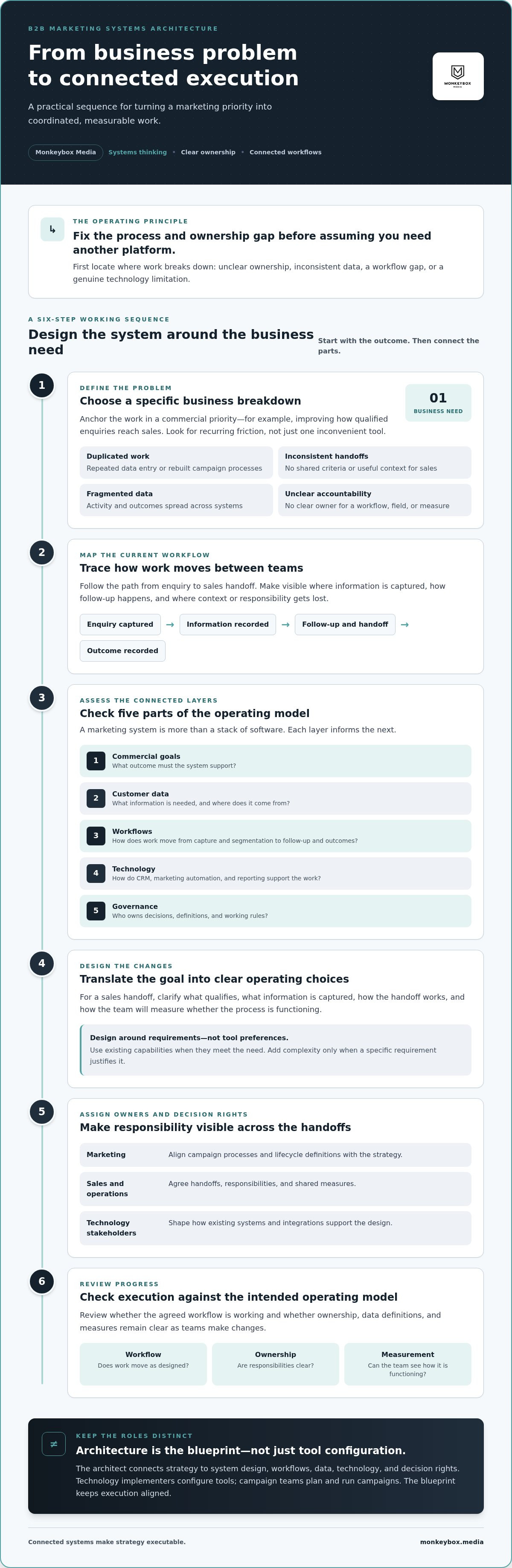
Give the work a defined business problem, a decision-making sponsor and a clear boundary. A B2B marketing systems architect can then trace what needs to change across teams and tools without turning the project into an open-ended technology replacement. For example, if qualified enquiries reach sales without consistent context, focus the work on that handoff and the information it requires.
Start with outcomes and map the current operating model
Start with the question leaders need the system to answer and the behaviour or process they want to change. Map the journey from initial capture through follow-up and reporting, noting who acts, what data they use and where information moves between teams. Document friction, duplication and constraints as they are. Don’t assume every issue calls for new software.
Design the target state and sequence implementation
Turn the findings into a practical design: required workflows, data definitions, system connections, governance and accountable owners. Then sequence the work according to dependencies and team readiness. A workflow that relies on consistent CRM fields, for instance, needs those definitions agreed before automation can use them reliably. Include training and adoption in the plan, not as an afterthought.
- Set the outcome. Define the business question, the process to improve and a measure to review. Keep the scope focused enough to guide decisions.
- Map the workflow. Trace the customer or account journey, handoffs, data inputs and reporting responsibilities. Record where work stalls or gets repeated.
- Assess current systems. Identify which platforms already support the workflow, where information is incomplete and what integration or access constraints affect the design.
- Design changes. Specify the target process, required data, system responsibilities and dependencies. Separate essential changes from optional enhancements.
- Assign owners. Name who decides on process definitions, who implements changes and who maintains them. Make decision rights clear across marketing, sales, operations and technology stakeholders.
- Review and adjust. Check whether the new workflow is being used and whether its chosen operational or commercial measure provides useful visibility. Use the review to refine the design.
This sequence gives teams a shared plan before implementation begins. It also makes trade-offs explicit: which change must happen first, which team needs to adapt, what data must be dependable and how the business will assess progress. The review should test whether the design works, not simply confirm that a platform has been configured.
If your team needs to connect marketing priorities with practical system changes, work with Monkeybox Media on marketing systems and execution.
How Monkeybox Media Connects Marketing Leadership and Systems Execution
Strategy sets direction, but teams still need clear processes, connected systems and accountable execution. Monkeybox Media brings those parts together for B2B organisations, combining fractional CMO leadership and go-to-market planning with marketing operations, automation and AI agent implementation. The aim is to connect a business’s growth priorities with workflows its teams can put into practice.
This joined-up approach matters when strategic choices depend on operational changes. A shift in target market, for example, may affect how teams define an ideal account, capture information, route enquiries and measure activity. Treating leadership and implementation as separate conversations can leave those dependencies unresolved.
Bring strategic direction and operational design together
Fractional CMO leadership helps establish marketing priorities, positioning and go-to-market direction. Those choices form the strategic foundation for system design: they clarify which customer and account processes matter, what information teams need and where marketing and sales must coordinate. The fractional CMO agency guide offers more context for organisations considering senior marketing leadership.
Architecture translates those priorities into connected operating choices. One person or team can coordinate leadership and systems work, but the decisions remain distinct: leadership determines direction, while architecture defines how processes, data and technology support it. That separation keeps implementation focused on the strategy rather than isolated platform requests.
Move from architecture into automation and AI implementation
Once the workflow and ownership are clear, marketing operations and automation can put the design into action. For example, a defined lead handoff may involve agreed qualification information, a consistent process for routing records and reporting that makes the next action visible. Automation should support that agreed process, not create a parallel one teams have to work around.
AI agents can also be integrated into marketing workflows when their role is deliberately designed. The architecture should specify the task, the information the workflow depends on, who oversees it and how teams review its operation. Clear ownership is essential: someone needs to understand the process and decide how it should change as business needs evolve. Technology is the mechanism, not the objective.
For organisations seeking a B2B marketing systems architect, the value lies in connecting strategic priorities, architecture, implementation and operational ownership. Monkeybox Media brings fractional CMO and go-to-market strategy together with marketing operations, automation and AI agent implementation to help shape the system and support its execution.
Discuss your growth system and next steps with Monkeybox Media.
Make Your Next Growth Move a Systematic One
The next step isn’t to redesign everything. Choose one growth priority that’s being slowed by unclear ownership or disconnected execution, then test whether your current operating model can support the direction the business wants to take. That focused starting point gives leadership a practical basis for deciding what to strengthen, what to leave in place and where specialist input can help.
A B2B marketing systems architect can turn that priority into a clear path from decision to delivery. With Monkeybox Media, strategic leadership and go-to-market planning can connect with marketing operations, automation and AI agents integrated into workflows. The aim is a system your people can understand, own and adapt as the organisation evolves.
Build from the business need, not the latest tool. Explore how Monkeybox Media connects marketing strategy with systems execution and take the next step towards a more deliberate growth engine.
Frequently Asked Questions
What is a B2B marketing systems architect?
A B2B marketing systems architect defines how marketing capabilities support commercial work across teams and technical platforms. They clarify requirements, dependencies, data use, decision rights and operational constraints, then shape a design teams can maintain. The distinction from tool buying is purpose: a purchase selects technology; architecture determines whether it fits the business need and how people will use it over time.
Is a B2B marketing systems architect a job title or a consulting role?
Can a B2B marketing systems architect work with an existing technology stack?
Yes. The work can begin by documenting the platforms already in use, what each is responsible for and where information or tasks pass between them. For example, a team might find that its CRM can support a needed handoff once field definitions and permissions are clarified. That assessment helps distinguish a process or configuration change from a genuine capability gap that could justify replacement.
How do you measure the impact of marketing systems architecture?
Choose measures that test the original problem, then establish a baseline before changes begin. If teams struggle to hand over enquiries, review whether records contain the agreed information and whether responsibility is clear. If reporting is unreliable, check whether teams use shared definitions and can reproduce the same view. These indicators show whether the operating design is working; they don't guarantee a particular revenue outcome.
When should a B2B company bring in a marketing systems architect?
Consider the role when teams repeatedly reconcile conflicting records, rely on manual workarounds, or can't explain who owns a system or process. These signs matter most when they obstruct a specific business priority, such as coordinating a new go-to-market motion or making a customer handoff more dependable. Define that priority first so the architect can focus the work and avoid an unfocused audit.
Can AI agents be part of a B2B marketing systems architecture?
Yes, AI agents can support selected marketing workflows when their task is clearly bounded and designed into the operating model. Before introducing one, define the information it may use, where human oversight applies, who handles exceptions and how the team will assess its operation. For example, an agent supporting follow-up needs an assigned owner and a review process, not just access to a workflow.