
A full-time CMO isn’t the only way to get senior marketing leadership. A fractional CMO typically works 5 to 20 hours per week, setting direction and guiding marketing priorities without taking a full-time role. The benefits of a fractional CMO include flexible access to strategic leadership, an external perspective and support that can scale with your business.
It’s sensible to weigh the cost carefully: the right setup should match the work your business needs, rather than simply add another senior salary or provide a short-term fix. One of the key benefits of a fractional CMO is senior leadership to clarify your go-to-market strategy, focus marketing activity and connect plans with execution. A full-time CMO may be a better fit when the business needs dedicated day-to-day leadership.
This article explains what a fractional CMO does, where the role fits and how its flexibility and cost compare with a full-time appointment. You’ll also learn when fractional support is useful and what to consider when choosing the leadership model that can move your marketing forward.
Key Takeaways
- A fractional CMO brings executive marketing direction and helps connect strategy with execution, without taking a full-time role.
- Consider fractional leadership when marketing lacks clear priorities, senior oversight or alignment between strategy and delivery.
- Compare the overall commitment with the work required: a full-time CMO suits businesses that need dedicated leadership day to day.
- Set clear scope, timelines, budgets and responsibilities so flexible support stays focused on business priorities.
- Monkeybox Media connects fractional CMO leadership with GTM strategy, marketing operations and automation to help B2B organisations build a more coordinated growth approach.
Why use a fractional Chief Marketing Officer?
A fractional chief marketing officer brings senior marketing direction to a business without taking a full-time executive role. The value comes from connecting commercial priorities, marketing decisions and delivery.
Experienced Executive Marketing Leadership
A fractional CMO provides executive-level marketing leadership on a part-time basis. Successful fractional marketing leaders typically have 10 to 20 years of senior-role experience. That experience helps a business set priorities, align teams and make decisions at the right level. For example, a leader can connect a product launch plan with sales capacity, rather than treating campaign activity as a standalone function.
Experience across different companies can sharpen that judgement. A leader who has seen varied marketing operations may recognise patterns such as disconnected reporting or a pipeline plan without clear ownership. They can review the existing strategy, identify blind spots and set out practical options. The business still makes the decisions, but gains a more structured view of the trade-offs.
Specialist Talent and Expertise
Fractional leadership can provide access to experienced marketing talent and specialist expertise without requiring every capability to sit in one permanent role. This is useful when the priority is specific, such as improving marketing operations, refining a go-to-market plan or strengthening automation. The executive can identify the skills the work requires and coordinate them around the business’s objectives.
Industry knowledge adds context to that work. A B2B organisation selling a complex product, for instance, may need marketing that supports a longer sales process and gives sales teams useful customer evidence. A fractional leader familiar with that environment can shape the function around the buying journey, rather than applying a generic campaign model. The strongest fit depends on the challenge, not just the job title.
Consultants, Agencies, and Fractional CMOs
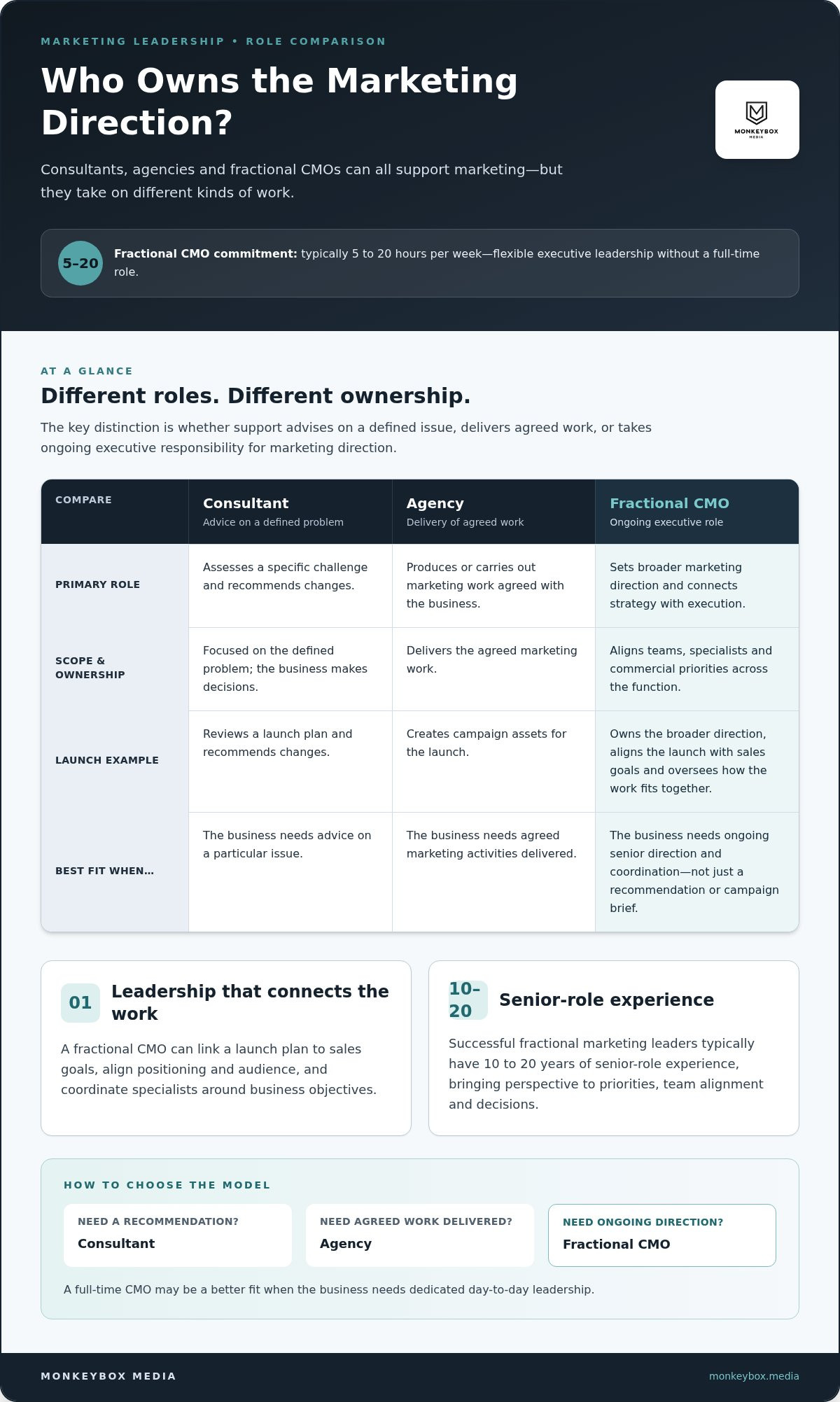
A consultant typically advises on a defined problem, while an agency usually delivers agreed marketing work. A fractional CMO takes an ongoing executive role within the business. That distinction matters when the company needs someone to set direction and connect specialists, teams and commercial priorities. The fractional leader can guide the function beyond a single recommendation or campaign brief.
For example, a consultant might assess a launch plan and recommend changes, while an agency might produce its campaign assets. A fractional CMO can own the broader marketing direction, align the launch with sales goals and oversee how the work fits together. The arrangement can involve 5 to 20 hours per week, making the leadership commitment more flexible than a full-time appointment.
Signs a business may need fractional marketing leadership
A fractional CMO can improve marketing strategy and return on investment by aligning priorities, budgets and measurement with commercial goals. For example, they can spot campaigns that generate enquiries but not qualified sales opportunities, then redirect effort towards stronger pipeline contribution.
A clear warning sign is activity without ownership: campaigns launch, but no one links them to sales priorities or follows results through. If a product team is planning a launch while sales lacks agreed messaging, marketing leadership can align positioning, audience and handover before activity begins. This turns disconnected tasks into a coordinated commercial programme.
Organisational change can create another pressure point. A merger, new leadership team or move into a new market can change the customer proposition and internal responsibilities. If marketing continues to use the old positioning, teams may send conflicting messages. A fractional leader can define decision-making, clarify responsibilities and align the marketing function with the organisation’s new direction.
Strategy problems often surface in demand generation. A business may attract website traffic but struggle to turn interest into sales conversations, or its positioning may describe features without explaining customer value. A focused review can trace the journey from target audience to message, channel and sales follow-up. If a campaign attracts the wrong buyers, for example, refine audience selection before increasing spend.
Go-to-market planning also needs senior ownership when a launch involves product, sales and marketing. A fractional CMO can connect the launch audience, value proposition, channel plan and sales enablement in one operating plan. This is important when each team has its own deadlines but no shared view of launch readiness. The result is clearer sequencing and fewer gaps between promotion and sales follow-through.
Growth can expose weaknesses in measurement and budgets. In 2026, 56% of surveyed CMOs said their marketing budget was insufficient to execute their strategy. For an individual business, the practical signal is a mismatch between available resources and planned activity. A leader can help rank initiatives by strategic contribution, identify overlapping work and connect spending decisions to agreed measures.
- Unclear ownership: Campaign decisions stall because no one sets priorities or resolves conflicts between teams.
- Weak conversion: Enquiries arrive, but the business cannot explain which audience, message or channel drives qualified opportunities.
- Changing direction: A new market or proposition requires updated positioning and a coordinated go-to-market plan.
To assess the fit, map one current growth objective against its audience, owner, budget, activity and success measure. If any link is missing, structured growth planning can help clarify where senior marketing direction is needed.
Cost-effectiveness compared with a full-time CMO
A fractional CMO can be cost-effective when a business needs senior marketing judgement but not a full-time executive commitment. A full-time CMO works 40 or more hours a week for one company, so compare the role’s total commitment with the work your business actually needs. For example, a company preparing a market launch may need executive direction and oversight, rather than a permanent senior post.
Hiring decisions should account for more than salary. Consider the leadership required, the time needed to set direction and the internal capacity to deliver the plan. A full-time appointment may make sense when marketing needs daily executive involvement across teams, channels and commercial decisions. Fractional support can fit when priorities are defined but senior guidance is needed to shape them and coordinate delivery.
Cost savings depend on how the role is structured and what the business can execute. If the company already has capable marketers, a fractional leader can set priorities and help the team focus its effort. If specialist skills are missing, additional delivery support may also be needed. Compare the combined commitment with the cost and value of a full-time CMO, rather than treating the leadership fee as the only cost.
Companies often consider fractional leadership during a transition, such as entering a new market, restructuring marketing or preparing a new offer. It can also suit a business with a stalled pipeline, unclear positioning or competing campaign priorities. Start by defining the business outcome, then identify whether the main need is strategic direction, team leadership, execution capacity or a combination.
The risks include limited availability, less day-to-day presence and slower decisions when responsibilities are unclear. A fractional CMO may also lack the internal context a full-time leader builds over time, so strong communication and access to key decision-makers matter.
Use a practical comparison before hiring. List the decisions that need senior ownership, the work already covered by the team and the gaps blocking progress. If marketers can execute campaigns but lack a prioritised plan, for example, fractional leadership may address the gap. If the business needs a dedicated executive to manage daily coordination, a full-time role may be the stronger fit.
- Choose fractional support when leadership is needed for defined priorities, but not every working day.
- Consider full-time hiring when marketing needs continuous executive involvement and internal coordination.
- Compare total requirements by including internal capacity, specialist delivery and the scope of leadership.
Flexible part-time or contract support
A fractional CMO typically works 5 to 20 hours per week, with the commitment shaped around the business’s priorities. Businesses can engage a fractional chief marketing officer part-time or on a project basis. That flexibility lets leaders match senior input to a defined need, such as preparing a go-to-market plan or improving coordination across marketing and sales.
A project engagement suits a specific piece of work with a clear endpoint. A business launching a new product, for example, might need strategic direction on audience definition, positioning and launch planning. An ongoing arrangement can suit changing priorities, such as reviewing performance, guiding an internal team and adjusting marketing activity as business needs evolve.
The working pattern should reflect the decisions and responsibilities involved, not an arbitrary schedule. If the leadership team needs regular input on priorities, a consistent weekly rhythm may help. If the need centres on a launch milestone, organise the work around planning stages and key decisions. In either case, agree who owns approvals, execution and communication inside the business.
Clear scope is what makes flexibility useful. Establish the objectives, timelines, budget, roles and responsibilities at the outset. For example, define whether the fractional leader will shape acquisition strategy, oversee marketing operations or advise internal staff who execute campaigns. Clear boundaries prevent a strategic role from becoming a catch-all for every marketing task and show the team which decisions require executive input.
Engagements can change as the business moves through different stages. A company may start with a project focused on market positioning, then continue with ongoing leadership as its acquisition programme develops. Another business may need steady strategic oversight while internal specialists deliver campaigns. The right structure reflects workload, decision-making needs and the team’s ability to carry out the plan.
Flexibility still requires a reliable operating rhythm. Schedule regular reviews to assess progress against agreed objectives, surface blockers and reset priorities when conditions change. Reviews might consider whether campaigns support the agreed audience, whether internal owners have what they need and whether timelines remain realistic. These conversations keep a part-time arrangement connected to day-to-day work.
- For a defined project: Tie the engagement to an outcome, such as launch planning or positioning work.
- For ongoing support: Set recurring priorities, decision points and communication responsibilities.
- For changing needs: Review scope and timelines as business objectives or internal capacity shift.
Contract support works best when flexibility has structure: an agreed scope, named owners and a clear route for decisions. This gives the business room to adapt without losing accountability.
Fractional CMO role and business fit
A fractional CMO fits when a business needs executive marketing direction but not a full-time leadership commitment. The role can suit a company with internal marketers who need strategic priorities, clearer accountability or senior oversight for a defined growth challenge.
Business scale is one consideration, not a complete decision rule. The market guidance suggests businesses with turnover over £10 million may not benefit as much from a fractional CMO. The deciding factors are the complexity of marketing decisions, the need for daily executive involvement and whether internal teams can implement the strategy. A smaller organisation with complex sales cycles may need substantial leadership, while a larger one may have established teams and processes.
Choose the arrangement based on the work that needs owning. If a business is entering a new market, for example, it may need a leader to align positioning, customer acquisition and sales priorities. If the main challenge is coordinating a large internal marketing function every day, a dedicated full-time role may fit better. The right arrangement follows the operating need, not the prestige of a title.
What should businesses look for when choosing a fractional CMO? Look for experience relevant to similar business models, sound strategic judgement and the ability to work effectively with internal teams. Before the engagement begins, agree the scope, responsibilities, communication rhythm and measures of progress.
Assess the candidate’s approach through specific examples. Ask how they would diagnose a weak pipeline, prioritise limited resources or bring marketing and sales into alignment. A proven leader should explain the reasoning behind their decisions, not just present a polished playbook. For a B2B company, experience with complex buying groups may matter more than broad consumer campaign expertise.
Fit also depends on authority and access. A fractional leader needs access to decision-makers and performance information to understand constraints and guide choices. If the role can recommend priorities but nobody owns approvals, execution can stall. Name an internal counterpart, establish how decisions are made and define which outcomes the leader is accountable for influencing.
Before committing, compare the business’s needs against these practical criteria:
- Strategic gap: Identify decisions that lack clear senior ownership, such as positioning or market entry.
- Team readiness: Establish whether internal teams can deliver the priorities once direction is set.
- Working fit: Define access, decision rights, responsibilities and measures of progress.
If those criteria point to a need for senior marketing direction, explore fractional CMO leadership as a focused option for aligning strategy and internal execution.
Monkeybox Media: Fractional CMO
Monkeybox Media provides fractional CMO leadership for B2B organisations that need senior marketing direction connected to execution. When growth priorities lack a clear route to market, its GTM Strategy offering can help shape the plan and align marketing activity with business objectives.
For businesses that need better-coordinated systems and processes, marketing operations and marketing automation can create a more structured function. These services connect leadership decisions with the workflows and tools that help teams carry out the strategy. The right starting point depends on the gap: strategic direction, go-to-market planning, operational structure or automation.
If your business is weighing its next marketing leadership move, contact Monkeybox Media or visit monkeybox.media to explore the next step.
Turn marketing priorities into your next move
Start by identifying the marketing decision that would unlock progress now. Is the main gap strategic ownership, a clearer route to market or stronger systems for delivering the plan? Naming that priority gives leadership a practical starting point and keeps the work focused on business outcomes.
The benefits of a fractional CMO are clearest when executive direction connects directly to the work your organisation needs to move forward. Monkeybox Media offers Fractional CMO leadership, GTM Strategy and Marketing Automation to help B2B businesses align direction with execution. The right conversation starts with your growth priorities, current capabilities and the decisions that need senior ownership.
Bring those priorities into focus and decide what needs to change first. Contact Monkeybox Media to discuss a focused next step for your marketing strategy. A clear direction can give your team a stronger platform to act with purpose and build momentum.
Frequently Asked Questions
What does a Fractional CMO do?
A Fractional CMO leads a company’s marketing function at executive level, setting direction and helping teams turn priorities into coordinated work. For example, if a B2B company changes its pricing, the CMO can align customer messaging, sales materials and campaign plans around that decision. The role combines strategic ownership with practical oversight, rather than focusing only on one channel or isolated marketing task.
What type of business benefits the most?
B2B businesses with a capable team but a gap in senior marketing direction can benefit particularly well. For instance, a software company may have people managing content, events and sales support, yet lack a shared view of which customer segment matters most. Executive leadership can connect those activities to buyer needs and sales feedback, helping the team organise its work around a coherent commercial focus.
What are the main benefits of hiring a fractional CMO?
The main benefits of a fractional CMO include executive judgement, more focused priorities and leadership that works alongside existing staff. For example, when a team is weighing several campaign ideas, a CMO can assess which best supports the company’s target customers and sales objectives. This helps decision-makers allocate attention deliberately, clarify ownership and give internal marketers a stronger basis for planning and evaluating their work.
How do fractional CMO fees compare with a full-time CMO salary?
Fractional fees reflect the agreed scope and time commitment, while a full-time salary covers dedicated leadership across the working week. Compare the complete arrangements, including responsibilities, internal capacity and any additional hiring costs. The price depends on the case and is provided after a quote request; scope, time commitment and required expertise shape the cost. A smaller commitment does not automatically mean better value if the business needs daily leadership.
When should a UK business hire a fractional CMO?
A UK business should consider a fractional CMO when a growth priority needs senior marketing ownership but the organisation does not require a full-time CMO. A planned product launch, a new customer segment or a shift in sales direction can all be timely triggers. Bringing in leadership before campaign plans are locked can help connect audience choices, commercial priorities and team activity while changes are still practical to make.
How does a fractional CMO engagement typically work?
An engagement starts by agreeing the business objective, decision-makers, responsibilities and measures of progress. The CMO then reviews the current marketing approach, identifies priorities and works with internal owners to coordinate delivery. For example, a team preparing a launch might agree who owns positioning, approvals and sales materials, then track progress against milestones. Regular communication keeps decisions moving and gives both sides a shared view of the work underway.