
A launch can be polished and still miss its market. A go-to-market strategy connects what a business sells with who needs it, how it will reach those customers, and how sales, marketing and customer teams will deliver the experience. Common go-to-market strategy mistakes happen when decisions rely on assumptions instead of evidence, leaving teams misaligned and activity disconnected from buyer needs.
Teams often prioritise launch plans, campaigns and channel activity because they are visible, tangible moves. But without audience research, those moves can target the wrong buyers or give them little reason to act. A sharper strategy starts with evidence about customer problems, buying priorities and the channels that reach them.
This article explains what a go-to-market strategy covers and how to avoid mistakes in team alignment, customer research, channel choice, messaging and execution. You’ll learn how to connect audience insight to practical decisions, test assumptions before scaling activity and build a more coherent path from market need to customer adoption.
Key Takeaways
- Align sales, marketing, product and customer success around shared priorities, roles and measures of success.
- Use customer conversations and buying behaviour to shape your ideal customer profile and product positioning.
- Choose channels based on where your audience is most likely to engage, rather than spreading effort across every option.
- Tailor messaging to each audience: connect end users’ pain points with decision-makers’ business priorities.
- Match your go-to-market approach to your resources, and validate key assumptions before scaling investment.
1. Sales and marketing alignment
A go-to-market strategy connects market understanding, product positioning, sales execution and customer engagement. Treating sales and marketing as separate functions breaks that chain: marketing may attract prospects whom sales cannot convert because the team lacks training on the product’s distinctive value. Before launch, bring sales, marketing, product and customer success together to agree whom the business serves, what problem it solves and what each function owns.
Make alignment operational, not aspirational. Set shared KPIs that connect marketing activity to pipeline quality, conversion and customer outcomes, then review them regularly. For example, if marketing reports many leads but sales finds that prospects lack the need or authority to buy, refine the audience criteria together. A shared definition of a qualified opportunity gives both teams a practical basis for adjusting targeting and follow-up.
Agree the channel and sales strategy before execution begins. A go-to-market plan should identify how the business will reach customers, which channels will create engagement and how sales will progress interested buyers. For a B2B software launch, that might mean pairing a targeted campaign with a sales-led demonstration and a clear follow-up sequence. The right mix depends on the product and audience, but each channel needs an owner and a defined role in the journey.
Build sales enablement into the plan from the start. Give salespeople product training, a concise playbook, relevant case studies and a way to share customer feedback. Update those materials as objections and buyer needs emerge. If a salesperson cannot explain how a product solves a specific customer problem, more leads won’t fix the gap. Enablement helps the team communicate value consistently while making space for useful, customer-specific conversations.
Choose sales tools and prospecting platforms based on how well they integrate with existing systems and support future growth. A disconnected CRM, marketing platform and prospecting tool can fragment customer records and create manual work. Map the information sales and marketing need to share, then assess tools against those workflows before adopting them. Sales mechanisms or lead aggregators can also prove expensive and difficult to scale, so use them deliberately, not as a substitute for a defined route to market.
Finally, define the sales motion: the repeatable way a business takes a prospect from first contact to purchase. Roger Martin could not find a reference to the term “sales motion” before 2020, but the operating idea is straightforward: specify the sequence, hand-offs and customer interactions that support a sale. Review actual wins and losses, identify where prospects stall, and adjust the process. That feedback loop keeps the value proposition, training and sales execution aligned.
2. Researching product positioning and customer needs
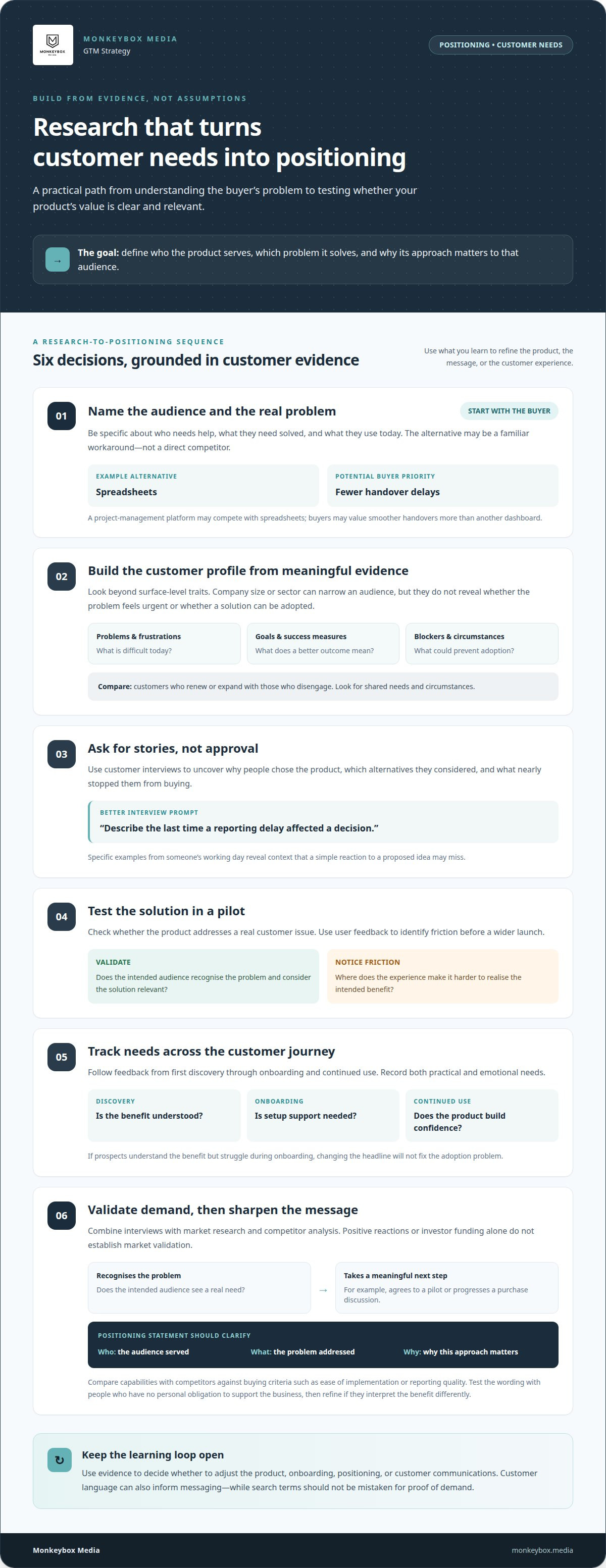
Positioning built on internal assumptions often describes what a product does, not why a customer chooses it. Define the audience, the problem they need solved and the alternative they use today. For example, a project-management platform might compete with spreadsheets, not another platform. That distinction changes the value proposition: buyers may care more about reducing handover delays than gaining another dashboard.
Build an ideal customer profile from evidence about customers’ problems, goals, success measures, blockers and frustrations. Distinguish useful buying criteria from surface-level traits. A business’s size or sector can narrow the audience, but won’t show whether teams feel the problem urgently or can adopt a solution. Compare customers who renew or expand with those who disengage, then identify the needs and circumstances they share.
Use customer interviews to understand why people chose the product, what alternatives they considered and what nearly stopped them from buying. Ask for specific examples from their working day rather than approval of a proposed idea. For instance, ask a finance lead to describe the last time a reporting delay affected a decision. A pilot can then test whether the product solves that real issue, while user feedback reveals friction before a wider launch.
Track feedback across the customer journey, from first discovery through onboarding and continued use. At each stage, record practical needs, such as setup support, and emotional needs, such as confidence in the product. If prospects understand the benefit but struggle during onboarding, changing the headline won’t solve the adoption problem. Use feedback to decide whether to adjust the product, onboarding, positioning or customer communications.
Market validation requires more than positive reactions or investor funding. Test whether the intended audience recognises the problem, considers the solution relevant and takes a meaningful next step, such as agreeing to a pilot or progressing a purchase discussion. Combine interviews with market research and competitor analysis. Compare your capabilities with competitors’ strengths against buying criteria, such as ease of implementation or reporting quality, to find a defensible position rather than claim broad superiority.
Turn those findings into customer-focused positioning and messaging. State who the product serves, which problem it addresses and why its approach matters. Then test that statement with people who have no personal obligation to support the business. If they interpret the benefit differently from what you intended, refine the wording and test again. Keyword research can also show how audiences describe their needs, helping organisations use familiar language without treating search terms as proof of demand.
3. Choosing marketing channels based on the audience
A channel belongs in a go-to-market plan because it reaches the target audience, not because it is familiar. Start by mapping where buyers discover problems, compare solutions and seek approval. For example, a finance leader researching reporting tools may value a detailed webinar, while a technical user may look for product documentation. Match each channel to a buyer need and journey stage, then define the action it should encourage.
Distinguish marketing channels from distribution channels. Marketing channels create awareness and interest; distribution channels determine how customers access or buy the product. A software firm might use industry events to reach buyers, then sell through its own team or a specialist partner. Choose the route that fits customer expectations, product complexity and post-purchase support needs. A mismatch can add friction between interest and adoption.
Prioritise channels using evidence from customer interviews, past campaign performance and sales conversations. Record where prospects first heard about the product, which content helped them assess it and what prompted a conversation. Then compare channels by audience fit, engagement quality and contribution to qualified opportunities. Many clicks mean little if those visitors don’t match the intended customer profile. Optimise for meaningful progress, not activity alone.
Focus creates a stronger test. One recommendation is to select two or three high-leverage channels for a focused go-to-market approach. Another is to concentrate the budget on one or two channels instead of scattering it across disconnected tactics. Apply these choices to the launch objective: a partnership announcement may suit social platforms, while customer reviews and case studies can support a company blog. The best mix depends on the audience and announcement.
Give every selected channel a defined role, owner and measure. For example, a webinar might educate prospects, a follow-up email might encourage attendees to book a demonstration, and a sales conversation might qualify fit. This sequence shows whether channels reinforce one another or operate in isolation. A product or feature launch checklist can also identify relevant channels, owners and timing before execution begins.
Review results against the original audience hypothesis. If an event attracts the right job roles but few qualified conversations, adjust the offer or follow-up before abandoning the channel. If a partner introduces well-matched prospects but delays access to product information, strengthen the enablement materials. Use customer feedback and conversion patterns to refine channel investment. This disciplined loop helps organisations scale what works and stop funding tactics that fail to reach buyers.
4. Tailoring messaging to decision-makers and end users
A single product can solve different problems for the people involved in buying it. End users often focus on daily friction, while decision-makers weigh return on investment and organisational impact. For a workflow platform, users may value fewer manual handovers; an operations director may care about faster delivery and greater visibility. Build messaging for each audience without changing the underlying value proposition.
Start with a clear proposition: specify which customers the product serves, the problem it addresses and the benefit it delivers. Avoid broad claims such as “transform your business”. Replace them with a concrete outcome, such as helping account teams find current customer information without searching separate systems. Explain customer value first, then use features as evidence. A feature list alone leaves buyers to work out why the product matters.
Give each decision-maker and end user a distinct message path. A product page for users might describe how a task becomes easier, while a page for finance leaders explains how the change supports cost control or operational priorities. Keep the core proposition consistent across both. Adapt the proof, examples and call to action to each role, rather than making contradictory promises to different audiences.
Test the wording with people who have no personal obligation to support the business. Ask them to explain, in their own words, who the product helps and what problem it solves. If several readers mistake a reporting tool for a data-storage product, revise the headline and supporting copy. This test exposes gaps between the intended proposition and the message people actually receive.
Use behaviour as a diagnostic. High landing-page bounce rates can point to an unclear value proposition; weak demo or trial conversions can signal that prospects don’t see enough value to continue. If buyers compare the offer only on price, differentiation may not be clear. Treat these metrics as prompts to investigate, not proof of a single cause. Compare page copy, audience fit, sales conversations and follow-up messages before changing the proposition.
Make messaging a measurable part of go-to-market execution. Define the audience, the message being tested and the response that would indicate progress, such as a qualified enquiry or completed product demonstration. Tie the measure to the buying stage: a first-touch advert should create relevant interest, while a later-stage case study should help a prospect assess evidence. Review results by audience and channel, then refine messages that fail to connect. Consistent testing turns customer language into practical improvements, not disconnected slogans.
5. Choosing approaches based on audience and resources
A go-to-market approach must fit the audience, product and team capacity. A specialist service aimed at a narrow business segment may need focused account outreach, while a self-serve product may depend more on clear onboarding and digital acquisition. Choose an approach based on customer buying behaviour and available expertise, not a competitor’s visible tactics. Establish a repeatable foundation before expanding activity.
How can businesses measure go-to-market strategy performance? Track KPIs tied to revenue, adoption, retention and customer satisfaction, alongside pipeline, conversion, acquisition and profitability. Compare results with the strategy’s objectives to identify where customer progress slows or commercial performance weakens.
Use evidence to guide decisions. Review pipeline quality, sales outcomes, onboarding feedback and customer retention together, rather than treating one campaign metric as proof of success. For example, many enquiries with weak conversion may point to poor audience fit or a sales process that doesn’t address buyer concerns. Win/loss analysis can reveal why prospects chose another solution or decided not to buy. Use those findings to adjust targeting, the offer or the customer journey.
Pricing and packaging should meet market needs and reflect the value customers receive. Identify the outcome buyers want, the alternatives they consider and the features they need at each buying stage. A small business seeking a straightforward solution may value a simple package, while a larger organisation may require broader capabilities. Test whether each package communicates its benefits clearly. If prospects focus only on price, clarify differentiated value before changing the price.
Resource decisions should follow validated commercial assumptions. Before expanding investment, establish which audience responds, which sales approach converts and whether the process can be repeated. A business that closes deals inconsistently may need to improve its offer, sales process or customer evidence before adding prospecting capacity. Clear ownership can outperform a large team with unclear responsibilities. Match each initiative to a named owner, defined audience and measurable outcome.
Keep the plan competitive by reviewing customer needs and market responses as conditions change. If a segment values implementation support more than additional features, adjust the offer and supporting resources. If retention weakens after purchase, investigate onboarding and customer outcomes rather than focusing only on acquisition. These decisions protect limited capacity and direct it towards the strongest opportunities.
For a structured approach to these choices, explore GTM strategy support to connect audience priorities, investment decisions and measurable growth objectives.
Monkeybox Media: GTM Strategy
Monkeybox Media helps B2B organisations build a clearer route from audience insight to go-to-market execution. Its GTM Strategy work is relevant when teams need to connect positioning, channel choices and commercial priorities into one plan.
When a strategy needs senior marketing leadership to move forward, Fractional CMO support can help set direction and align priorities. Monkeybox Media’s Marketing Ops and Marketing Automation services support the processes and systems behind that plan, helping teams coordinate marketing activity as the business grows.
If your go-to-market approach needs sharper alignment between research, decisions and execution, contact Monkeybox Media to discuss your priorities.
Turn audience insight into your next move
A go-to-market plan should evolve as customer behaviour and commercial priorities shift. Set a clear review point, identify the evidence that would prompt a change, and assign ownership for acting on it. This turns audience research into an operating discipline, rather than a launch document that loses relevance after publication. Avoiding common go-to-market strategy mistakes depends on keeping decisions connected to what customers actually do.
Monkeybox Media offers GTM Strategy to help B2B organisations shape and execute their market approach. Fractional CMO leadership can provide strategic direction, while Marketing Automation can support the workflows that put marketing activity into action. The right starting point depends on where your strategy needs focus, whether that’s direction, coordination or execution.
Contact Monkeybox Media to discuss your strategy and identify a practical next step. With a clear direction and disciplined learning, your team can move forward with greater confidence.
Frequently Asked Questions
What is a go-to-market strategy?
A go-to-market strategy is a coordinated plan for bringing a product to its intended customers and supporting adoption. It connects the offer, target buyers, route to market, pricing, launch activity and measures of progress. For example, a new business software product needs a defined buyer, a reason to choose it, a way to reach that buyer and a process for turning interest into continued use.
What are the most common go-to-market strategy mistakes?
Common go-to-market strategy mistakes include launching before validating demand, defining the audience too loosely, choosing channels without evidence and using one message for every buyer. Teams can also mistake activity for progress, such as celebrating website traffic without checking whether suitable prospects enquire. Catch these issues early by connecting each major decision to a customer need and commercial outcome, then revisiting assumptions as evidence accumulates.
Why do go-to-market strategies fail?
Go-to-market strategies fail when the offer, audience, sales process and delivery experience don’t work together. A campaign may attract interest, for instance, but adoption can stall if customers struggle to get started or don’t see the promised benefit. Unclear ownership also slows corrective action. Assign a decision-maker to each part of the plan, and use customer and commercial signals to identify where execution breaks down.
What are the risks of targeting too broad or too narrow a market?
A broad target market can dilute positioning and spread limited resources across buyers with different needs. An overly narrow segment can restrict opportunity or leave the product dependent on a small customer group. Define a core audience by shared problems, buying triggers and ability to adopt the offer. Assess adjacent segments separately, expanding only when the product and sales approach remain relevant to their needs.
How do companies avoid mispricing a new product?
Companies can reduce mispricing risk by testing price and packaging against customer value, alternatives and buying behaviour. Ask prospective buyers what outcome matters, which competing solution they use and what would make a purchase worthwhile. Compare responses with actual sales conversations or pilot decisions. Value-based pricing starts with the benefit customers recognise, not simply the cost of delivering features or a competitor’s advertised price.
What are common mistakes in choosing go-to-market channels?
Common channel mistakes include selecting platforms because they’re popular, spreading resources too thinly and judging performance by reach alone. A channel may generate attention without reaching people who influence or make the purchase. Before committing, define the audience, the channel’s role and the next action it should prompt. Review lead quality and progression, then adjust the mix when a channel attracts interest but not relevant opportunities.
How should sales and marketing teams align on a go-to-market strategy?
Sales and marketing teams should agree on the target buyer, qualification criteria, core claims and hand-off process before launch. A practical working session can review sample leads and decide which ones deserve follow-up, what information sales needs and how feedback returns to marketing. Keep a shared view of pipeline quality and conversion. This helps teams resolve mismatched expectations through evidence rather than competing interpretations of success.
What customer research should companies do before a product launch?
Before launch, combine customer interviews, market research, competitor analysis and practical product testing. Ask potential buyers how they currently solve the problem, what prompts them to seek an alternative and what could prevent adoption. A pilot can expose gaps between promised benefits and real-world use. Review feedback from both users and purchase decision-makers, since usability, approval criteria and organisational fit can affect adoption differently.