
A fractional CMO for scale-ups can make sense when growth has outpaced the marketing leadership needed to sustain it. In the UK, businesses often consider the role around £1 million to £2 million in ARR or revenue, bringing in senior strategic direction without committing to a permanent executive hire. The key is finding someone who can set priorities and drive progress, not simply add another layer of advice.
If you’re considering a fractional CMO for scale-ups, the key question is whether their experience, commitment and approach fit the pressures your business faces now. The right match should sharpen decisions and connect marketing activity to commercial goals.
This article explains when it may be time to hire, what a fractional CMO does in practice, and how to assess strategic fit and day-to-day commitment. You’ll also learn what to expect from the working relationship, from early priorities to longer-term marketing systems.
Key Takeaways
- Consider senior marketing leadership when growth is outpacing your team’s ability to set priorities and connect activity to revenue.
- Businesses often explore fractional support around £1 million to £2 million in ARR or revenue, but the deciding factor is the complexity of the growth challenge.
- Expect the role to shape positioning, go-to-market strategy and team priorities, while coordinating execution across the people doing the work.
- Assess commitment by agreeing how the CMO will work with your leadership team, make decisions and stay accountable for progress.
- Look for evidence of solving challenges like yours, then judge progress through clearer priorities, stronger funnel performance and more disciplined marketing investment.
At what revenue stage should a scaleup hire a Fractional CMO?
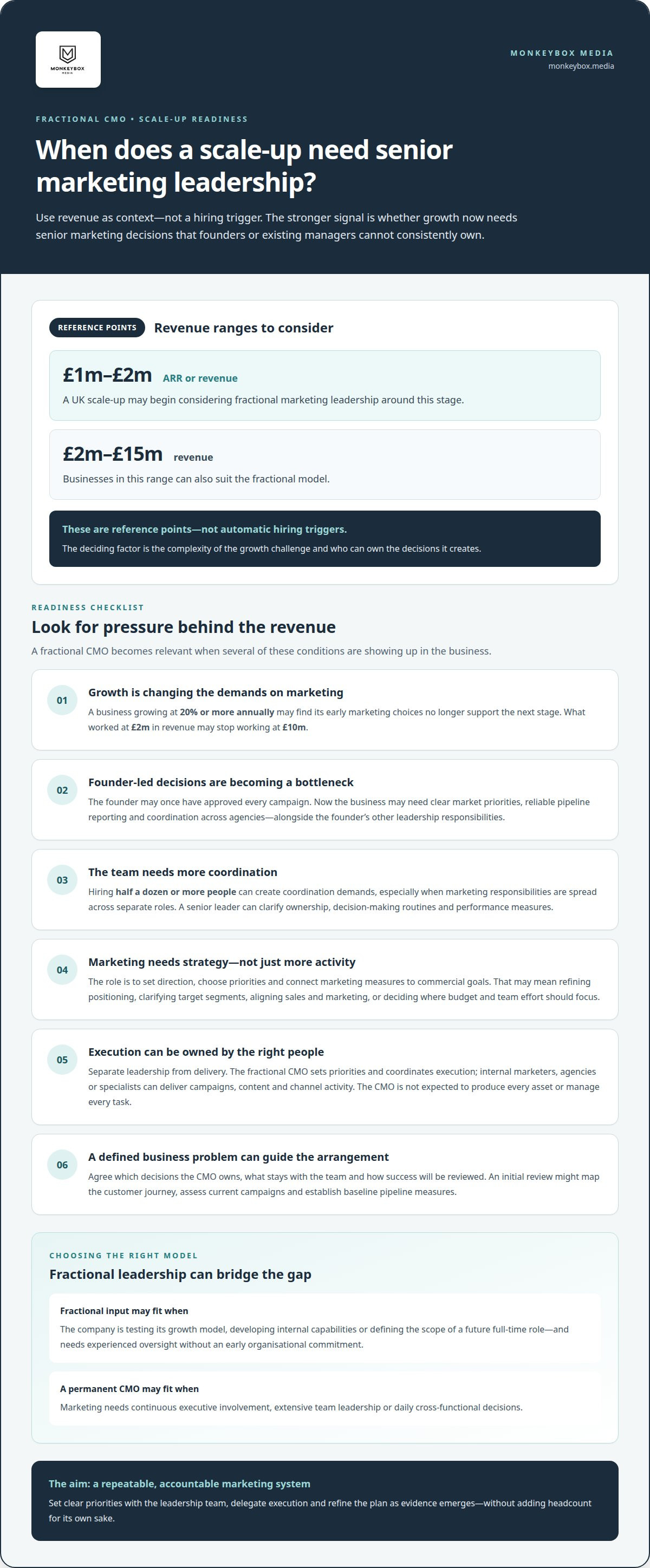
A UK scale-up may consider fractional marketing leadership around £1 million to £2 million in annual recurring revenue or revenue. Businesses with revenue between roughly £2 million and £15 million can also suit this model. These ranges are useful reference points, not automatic hiring triggers. The stronger signal is whether growth now requires senior marketing decisions that founders or existing managers can’t consistently own.
Look at the operating pressure behind the revenue. A business growing at 20% or more annually may find that early marketing choices no longer support its next stage. What worked at £2 million in revenue may stop working at £10 million. For example, a founder who once approved every campaign may now need clear market priorities, reliable pipeline reporting and coordination across agencies. The hire becomes relevant when those decisions compete with other leadership responsibilities.
Separate strategic leadership from day-to-day execution before defining the role. A fractional CMO sets direction, chooses priorities and links marketing measures to commercial goals. They may refine positioning, clarify target segments, align sales and marketing, and decide where the budget and team should focus. Internal marketers, agencies or specialists can then deliver campaigns, content and channel activity. This gives founders an accountable senior leader without expecting that person to produce every asset or manage every task.
That distinction matters as the team grows. Hiring half a dozen or more people creates coordination demands for a small business, especially when marketing responsibilities are spread across separate roles. A fractional leader can establish ownership, decision-making routines and performance measures before gaps become inefficient habits. The aim is not to add headcount for its own sake, but to build a marketing system that supports growth.
Fractional leadership can also bridge the period before a permanent CMO makes sense. It gives the leadership team experienced oversight while the company tests its growth model, develops internal capabilities and defines the scope of a future full-time role. A permanent hire may be appropriate when marketing needs continuous executive involvement, extensive team leadership or daily cross-functional decisions. Until then, flexible senior input can provide structure without an early organisational commitment.
Start the arrangement with a clearly defined business problem. Founders should agree which decisions the CMO owns, what stays with the team, and how success will be reviewed. An initial review, for example, might map the customer journey, assess current campaigns and establish baseline pipeline measures. The CMO can then set priorities with the leadership team, delegate execution and refine the plan as evidence emerges. This creates a clear path from founder-led marketing to repeatable, accountable leadership.
Fractional CMO responsibilities
In a scale-up, a fractional CMO turns commercial goals into marketing priorities and assigns responsibility for delivering them. If the business wants to generate more enterprise demand, the CMO might refine its positioning, identify target accounts and align campaigns with sales conversations. The role connects strategy to execution without requiring the executive to produce every campaign. Founders gain senior marketing oversight while the marketing team, agencies or freelancers handle delivery.
Start with customers and the market. A CMO can review customer segments, sales feedback, competitor positioning and the journey from first contact to revenue. If product enquiries rise but qualified opportunities do not, they can investigate messaging, channel mix and marketing-to-sales handovers. Priorities should follow the evidence rather than treat every channel as equally valuable. A clear strategy gives teams a shared direction.
- Positioning: Assess whether the value proposition speaks to the customers the business wants to win.
- Go-to-market planning: Align target segments, channels, messaging and sales activity around a defined commercial objective.
- Performance management: Select metrics that show how marketing contributes to pipeline, conversion and revenue.
- Team leadership: Set expectations for the marketing team and coordinate agencies or specialist contributors.
- Operating systems: Improve campaign processes, reporting and marketing technology so teams can execute consistently.
Accountability matters as much as planning. A fractional CMO can translate strategy into briefs, owners, milestones and review points. If a campaign attracts attention but few qualified leads, for example, they can examine audience fit, landing-page messaging and sales follow-up. They can then focus the team on the weak point and use agreed measures to assess whether the change improves performance. The CMO owns strategic direction and execution quality, while assigned team members deliver the work.
The right responsibilities depend on the company’s constraints. A founder-led startup may need market focus and a workable plan; a more established scale-up may need consistent reporting across channels and teams. Mapping decisions, owners and measures helps senior marketing leadership stay connected to execution. A clear marketing operating model can help teams turn that accountability into repeatable work.
Balancing quick wins with long-term strategy
A fractional CMO’s first 90 days should build foundations and identify quick wins. That does not mean chasing every visible result. The senior leader needs to distinguish an immediate performance issue from a structural weakness. For example, a low-converting landing page may need a focused improvement, while unclear positioning requires deeper work before more traffic arrives. The strongest early plan tackles urgent friction without sacrificing the organisation’s longer-term growth strategy.
Start by establishing a reliable view of current performance. Review campaign data, website journeys, sales feedback and the definitions behind reported measures. If the leadership team sees leads rising but sales sees few qualified prospects, inspect lead criteria and handovers before increasing activity. This avoids judging a quick win against a misleading measure and gives leadership a shared baseline for discussing progress.
Then choose practical improvements that support the broader plan. Early wins might come from improving advertising efficiency, conversion rates or the website. If visitors reach a product page but rarely request a demonstration, for instance, examine its message, proof points and next step. A clearer page may improve conversion while reinforcing the organisation’s positioning. Choose actions to address an identified barrier, not simply to make a visible change.
At the same time, protect time for work whose value builds gradually. A senior marketing leader may need to refine customer segments, strengthen the go-to-market strategy or improve reporting before results fully emerge. These foundations help the team make better decisions across channels. Treat them as connected workstreams rather than competing priorities:
- Stabilise: Identify broken handovers, unclear reporting or campaign waste affecting current performance.
- Improve: Test a focused change, such as a revised landing page or sharper campaign message.
- Build: Develop positioning, audience insight and measurement practices that guide future investment.
Review both tracks with the leadership team against agreed commercial goals. Within a few months, the work should show tangible improvements and progress towards broader business goals. Assess more than a single campaign result: compare funnel conversion, opportunity quality and whether marketing investment has a clearer rationale. If clicks improve but qualified demand does not, the next decision should address audience or offer fit.
Strong sequencing keeps momentum without mistaking activity for strategy. Someone accountable for marketing leadership can explain why a particular quick win matters, what longer-term capability it supports, and which evidence will shape the next decision. This makes the 90-day plan a working management tool, not a list of disconnected tasks. The team can adjust execution while preserving the strategic direction.
Checking a fractional executive’s commitment and client experience
A fractional CMO typically works 1-2 days a week on an ongoing basis. Fractional executives usually contract for days each week or month, rather than five days weekly. Agree how that time will be allocated, including leadership meetings, team sessions and preparation, so the structure matches the work your growing business needs.
Commitment is about more than calendar availability. A CMO may support several organisations, so establish how priorities will be handled when deadlines collide. Set expectations for meeting attendance, decisions, response channels and follow-up ownership. If a launch date shifts, for example, agree who can reprioritise campaigns and how the marketing team will be informed.
Most fractional CMO engagements for scale-ups run for 12 to 24 months. That gives the relationship room to move from diagnosis and positioning into implementation, measurement and team capability. Contracts are often open-ended and may include a few weeks’ or a month’s notice. Clarify how knowledge, reporting and active work will transfer if the arrangement ends or becomes permanent.
Relevant experience is most useful when it matches your current challenge. Review examples involving a similar growth stage, business model or marketing problem. Someone who has led repositioning, managed agencies or improved marketing operations should be able to explain the decisions behind that work. Focus on their role, the constraints they faced, how execution was organised and what changed in the company’s approach.
- Decision ownership: Identify which strategic calls the CMO makes and which require founder or board approval.
- Availability: Agree recurring meeting times, planning sessions and the process for urgent priorities.
- Delivery model: Define how the CMO directs employees, agencies and specialist contributors.
- Progress reviews: Set a regular review of priorities, performance measures and decisions needed from leadership.
- Exit structure: Document where plans, campaign records and reporting live, so the organisation retains continuity.
The risks of hiring a fractional CMO include limited availability, divided attention and unclear accountability. These issues grow when the role lacks agreed priorities, decision rights or internal execution capacity. A strategy can stall if nobody owns delivery between leadership sessions. Reduce that risk by naming work owners, setting a review rhythm and linking the CMO’s time to the organisation’s most important decisions.
Finally, assess whether the person can move your business forward, not just describe a framework. Ask how they would approach a specific positioning or growth challenge, what information would shape their first decisions, and how they would work with your team. Their reasoning reveals more than a polished presentation. A clear structure makes fractional leadership useful while keeping expectations and responsibilities visible.
What experience should a scale-up look for in a fractional CMO?
Look for leadership experience, not just an impressive title. Fractional CMOs commonly have experience as a Head of Marketing, VP of Marketing or Chief Marketing Officer. That background matters because scale-ups need someone who can set direction, influence founders and turn commercial priorities into decisions. Look for evidence of leading teams, managing budgets and improving marketing systems, not just advising from the sidelines.
Match their experience to the problem your organisation needs to solve. If growth has stalled, ask how they diagnosed the constraint and what they changed. If sales and marketing are misaligned, look for examples of improving shared priorities, funnel reporting or handovers. Industry experience can help, but experience solving your current challenge may matter more. Someone from another sector may bring a useful approach if they understand your customers and sales model.
Ask for a clear account of the work behind any claimed result. Maya Moufarek, for example, grew Pharmacy2U’s revenue five-fold while serving as its CMO. The useful question is how she contributed: which strategic choices changed, what the team implemented and how progress was measured. One case study cannot predict another company’s outcome, but a detailed explanation reveals whether a candidate understands the mechanisms behind growth.
Test their ability to combine strategic judgement with operational discipline. A strong candidate should explain how they assess positioning, prioritise target markets and choose channels. They should also show how they develop internal capabilities, coach a marketing team and direct agencies. Ask how they would diagnose your specific constraint before recommending activity. Clear reasoning is more useful than a generic playbook.
- Commercial leadership: Look for decisions tied to pipeline quality, conversion, customer acquisition economics or retention.
- Scale-up judgement: Ask how they adapt marketing as a company’s team, sales process and customer base change.
- Execution oversight: Explore how they manage specialists, set ownership and review progress without taking over every task.
- Measurement: Ask which indicators they use to assess investment and how they distinguish activity from commercial impact.
Experience depth can offer context, but years alone are not a selection method. Adrian Lawrence has over 25 years of C-suite experience; Chris Linn has more than 15 years of strategic marketing experience; Beth Thompson has over 10 years growing brands. These examples illustrate different career profiles. Compare each candidate’s relevant decisions, team leadership and ability to explain trade-offs, rather than ranking people by tenure.
Before appointing a fractional CMO, give them a real business challenge to analyse, such as unclear segment priorities or inconsistent pipeline reporting. Assess whether they ask focused questions, identify assumptions and propose a practical way to test them. Discuss your scale-up’s marketing leadership needs with a team that works on fractional CMO leadership.
Monkeybox Media: Fractional CMO
Monkeybox Media provides fractional CMO leadership and strategic go-to-market planning for B2B organisations that need sharper priorities and stronger marketing execution. Turn to this support when growth demands senior direction, but your team needs a flexible structure rather than a permanent executive appointment.
The work connects commercial goals with positioning, channel choices and team responsibilities. Monkeybox Media’s Marketing Automation and Marketing Ops services can address workflow and operational needs, giving strategy a practical route into execution. The focus is aligning leadership decisions with the capabilities your organisation needs to scale.
If your next growth stage calls for clearer marketing leadership or a more coherent go-to-market plan, contact Monkeybox Media to discuss your needs, or visit monkeybox.media.
Turn your growth priorities into a clear decision
Turn your growth challenge into a focused leadership brief. Define the decision that needs senior ownership, the commercial change marketing should support, and the evidence that will show whether the approach is working. This gives a fractional CMO for scale-ups a practical starting point and helps your team stay aligned as priorities evolve.
Monkeybox Media puts that direction into practice through Fractional CMO leadership and GTM Strategy, with Marketing Automation supporting the systems behind execution. The conversation starts with your current constraints, not a standard playbook. Be clear about where momentum is breaking down, what your team can deliver and which decisions need experienced ownership.
Contact Monkeybox Media to discuss your needs and define a stronger path from marketing priorities to scalable growth. Your next stage starts with a sharper decision.
Frequently Asked Questions
Considering a fractional CMO?
Consider a fractional CMO for scale-ups when marketing decisions need experienced ownership, but the business isn’t ready to build a full executive function. The arrangement works best when founders can share commercial context and an internal team or specialists can deliver the agreed work. A company preparing to enter a new customer segment, for example, may need senior direction on positioning and launch priorities before expanding its marketing team.
How do fractional CMOs compare to other solutions?
A fractional CMO provides ongoing senior marketing leadership on a flexible basis. A consultant is often engaged to advise on a defined problem, while an agency usually delivers specific marketing work. A permanent CMO provides dedicated executive capacity within the organisation. The right fit depends on whether the main gap is strategic ownership, specialist execution or continuous leadership across teams and commercial decisions.
How do you become a fractional CMO?
Build a track record of leading marketing decisions before offering fractional executive support. Demonstrate how you set strategy, influence leadership teams, manage execution and connect marketing activity with commercial priorities. Develop clear examples from previous roles, including the problem, your decisions and the work delivered by teams. Then define the business challenges you can address, how you work with clients and which responsibilities you can own.
How to choose your fractional CXO?
Choose a fractional CXO by matching their leadership experience to the decisions your business needs help making. For a marketing role, assess how they handle your current constraints, explain trade-offs and work with founders and internal teams. Ask for a relevant example and explore their contribution, not just the outcome. Before agreeing to work together, define decision rights, communication routines and how priorities will be reviewed.
What does a possible roadmap look like?
A practical roadmap moves from diagnosis to prioritised action, then review and adjustment. First, align leadership on the commercial goal and the customer group it serves. Next, examine existing evidence, such as sales feedback, campaign performance and customer questions. Turn the findings into a focused set of initiatives with owners and measures. Review what the work reveals, then adjust the plan as customer responses and business priorities evolve.
What does a fractional CMO do for a scale-up?
A fractional CMO gives a scale-up senior marketing direction and connects it to commercial decisions. If a product launch generates interest but sales conversations stall, for example, the CMO can investigate whether the audience, offer or sales materials are creating friction. They can align leaders on a response, assign ownership and help the team learn from customer feedback, rather than treating campaign activity as the only measure.
When should a UK scale-up hire a fractional CMO?
Hire when marketing has become too complex for founders to direct alone, but the organisation still needs flexible executive input. Useful signals include inconsistent priorities between teams, unclear responsibility for marketing decisions or difficulty turning customer insight into a coherent plan. The strongest case is a defined leadership gap with a business consequence. If you need only extra production capacity, a senior marketing executive may not be the right solution.
How do fractional CMO fees compare with hiring a full-time CMO?
Fractional CMO fees depend on the scope, time commitment and work involved, and are provided after a quote request. A permanent hire brings an ongoing employment commitment, while fractional support is structured around agreed involvement. Compare the total resources each option requires, including leadership capacity and the execution support your team needs. Focus on the responsibilities to be covered, not the title alone.