
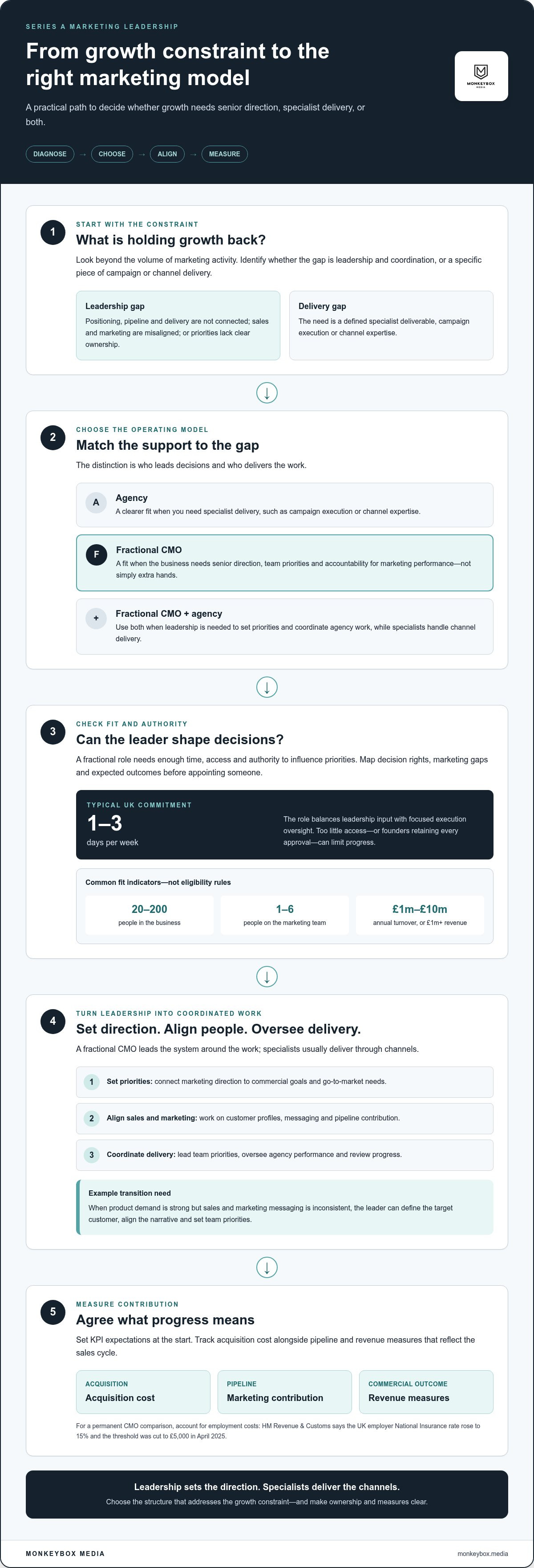
A fractional CMO for Series A can give a company senior marketing leadership without making it a full-time hire. In the UK, the role typically takes 1-3 days a week, with the CMO setting direction and aligning marketing with commercial goals while specialists handle channel delivery. More activity isn’t the same as stronger leadership.
If you’re weighing a fractional CMO for Series A against an agency, the distinction matters: an agency delivers marketing services, while a fractional CMO leads strategy, team priorities and performance. Both can play a role, but the right structure depends on what is holding growth back.
This guide explains what a fractional CMO does at Series A, how the role compares with an agency or full-time hire, and how to assess the commitment and measure marketing returns. You’ll learn what to look for in the operating model, from go-to-market priorities and sales alignment to KPIs that show whether marketing contributes to pipeline and revenue.
Key Takeaways
- Separate the need for senior marketing direction from the need for specialist campaign delivery before choosing a fractional leader, an agency, or both.
- Assess the role beyond strategy: leadership, agency governance, performance measurement, and sales alignment can all shape its impact.
- Distinguish fractional, portfolio, advisory, interim, part-time, and consulting arrangements by their scope and how they engage with the business.
- Set KPI expectations at the start, then track acquisition cost alongside pipeline and revenue measures that reflect your sales cycle.
- Compare the full employment cost of a permanent CMO with the scope and commitment of fractional support; according to HM Revenue & Customs, the UK employer National Insurance rate rose to 15% in April 2025.
Should I hire a fractional CMO or outsource to a marketing agency?
Choose a fractional leader when growth needs senior direction but not a full-time executive. When assessing candidates, test their experience against your positioning and commercial priorities, and clarify the authority they’ll hold.
Growth Stages and Transition Needs
A fractional CMO for Series A brings senior marketing leadership when the next phase of growth demands sharper focus. This can matter when a founder-led approach no longer connects positioning, pipeline and delivery. After funding, before entering a new market, or when changing the go-to-market model, a fractional CMO can help reset priorities. The work should address the transition itself, not simply add campaigns.
Authority, Time Commitment, and Business Fit
Business fit depends on whether the leader has enough authority and time to shape decisions. This matters because recommendations cannot move growth forward if founders retain every approval or the role receives too little access. A UK fractional CMO typically works 1-3 days per week, balancing leadership input with focused execution oversight.
Typical candidates include businesses with 20 to 200 people and a marketing team of one to six. Fractional support also commonly fits businesses with £1m and £10m annual turnover, or those with £1m+ revenue. These are useful indicators, not automatic eligibility rules. Simply counting employees misses the key issue: whether the business needs an accountable marketing leader.
An agency usually provides specialist delivery, such as campaign execution or channel expertise. A fractional CMO sets priorities, connects that work to commercial goals and oversees performance across internal teams and external partners. If you need a defined campaign delivered, an agency may be the clearer fit. If several activities lack direction, leadership may be the missing layer. The models can also work together.
Consider a Series A business with a capable agency but weak sales alignment. The agency can execute briefs, but it cannot replace internal authority over positioning, budget decisions and team priorities. A fractional CMO can lead those decisions while coordinating agency work. Conversely, a company seeking one specialist deliverable may not need executive leadership.
Permanent hiring also changes the employment-cost equation. HM Revenue & Customs says the UK employer National Insurance rate rose to 15% in April 2025. HM Revenue & Customs also says the UK employer National Insurance threshold was cut to £5,000 in April 2025. Include these changes when comparing an employee role with flexible leadership support.
Before appointing someone, map decision rights, current marketing gaps and the outcomes expected from the role. Then assess candidates’ leadership experience, relevant market knowledge and ability to work with your sales team. A fractional arrangement fits when the business needs sustained executive ownership, while specialist delivery remains with the marketing team or agency.
Does a Fractional CMO only create the strategy?
No. For a Series A startup, a fractional CMO leads marketing strategy, team leadership, agency oversight, performance frameworks and sales-marketing alignment. They set direction and remain accountable for progress, while specialists usually handle channel delivery.
Role and Core Responsibilities
The role combines senior marketing leadership with practical oversight of the organisation’s work. That matters when strategy needs to connect board priorities, team activity and commercial performance. A fractional CMO may join leadership meetings, review pipeline data, coach marketing staff and work with sales on customer profiles, messaging or conversion issues.
Responsibilities also include analysing customer and market insight, shaping go-to-market plans, supporting recruitment and reviewing agency performance. For example, if sales reports that qualified prospects misunderstand the product, the CMO can investigate customer feedback, refine positioning with sales and adjust the marketing plan. They can also recommend budget or resource changes when performance suggests a channel needs a different level of investment.
Strategic Leadership for a Series A Startup
Strategic leadership means turning company goals into clear marketing choices, accountable owners and measurable work. It matters after funding, when teams need to translate growth ambitions into priorities rather than launch disconnected campaigns. The CMO can align sales and marketing around the ideal customer profile, agree on messaging and establish how both teams assess pipeline contribution.
At board level, the fractional CMO reports progress and explains trade-offs, such as whether to prioritise a new segment or strengthen conversion among existing prospects. For a Series A company, this creates a decision framework: connect market evidence to positioning, assign ownership, then review performance against agreed measures. The leader also identifies capability gaps and supports recruitment when the existing team cannot deliver the plan.
Strategic leadership does not mean personally executing every channel task. A fractional CMO can guide specialists, coordinate an agency and remove blockers for internal employees, while channel experts deliver campaigns. This division keeps leadership focused on priorities and accountability. It also clarifies who owns execution, who approves investment and who communicates results to the leadership team.
Use a practical scope to define the engagement: identify the decisions the CMO owns, the teams they lead, and the performance information they review. Then assess experience across the areas your plan requires. A useful benchmark is hands-on experience in at least 8 of 10 marketing areas, covering the relevant mix of strategy, operations, channels, and commercial alignment.
- Leadership: Set priorities and communicate trade-offs to executives and the board.
- Team direction: Coach employees, support recruitment, and coordinate agency delivery.
- Commercial alignment: Work with sales on customer profiles, messaging, and conversion.
- Performance: Review pipeline and marketing results, then recommend resource adjustments.
For a Series A organisation, the right remit gives senior leadership clarity without confusing strategic ownership with channel execution. A defined go-to-market approach can connect customer insight, sales priorities, and marketing activity into one operating plan.
Fractional CMO, portfolio CMO, advisory CMO, interim CMO, part-time CMO, or marketing consultant?
These titles describe different patterns of marketing leadership, not interchangeable job descriptions. Compare the engagement’s duration, authority and expected activity before choosing a model for your organisation.
A fractional CMO provides part-time, ongoing executive leadership, typically working two to three days per week across one or more businesses. The role combines strategic ownership with team direction and accountability. For example, a Series A leadership team might use this model to steer marketing priorities while building internal capability. Fractional describes the share of executive capacity, not a limited list of deliverables.
A portfolio CMO is a senior leader working with multiple organisations, often through fractional engagements. The terms can overlap: “portfolio” highlights a multi-company career, while “fractional” describes the part-time arrangement at a particular company. An advisory CMO usually focuses on guidance, challenge and coaching. A founder seeking input on positioning can use advisory support; a company needing an accountable leader to guide ongoing activity needs a broader remit.
An interim CMO fills a temporary leadership need, such as a vacancy, leave or transition while the company changes direction. The engagement addresses a temporary gap and may require closer day-to-day involvement from the leadership team. A fractional CMO instead provides continuing part-time leadership without necessarily replacing a departing executive. Choose interim cover when continuity in a specific leadership seat is the priority; choose fractional support when the business needs sustained marketing direction with a reduced time commitment.
Part-time CMO is a broader description of working less than full-time. It can refer to an employee with a reduced schedule or an external executive, so the title alone does not establish decision rights or scope. Fractional CMOs typically work two to three days per week across one or more businesses simultaneously. Clarify whether the role leads the team, owns the plan and reports to the leadership team.
A marketing consultant generally takes on defined, project-based work with shorter timelines and specific deliverables. For example, a consultant might assess a launch plan, then hand over recommendations. That differs from ongoing marketing leadership, which includes decisions, coordination and continued accountability. A consultant fits a bounded question; a CMO engagement fits an ongoing leadership need.
- Choose fractional for ongoing part-time executive ownership and team direction.
- Choose interim to cover a temporary leadership vacancy or transition.
- Choose advisory for focused counsel or founder coaching.
- Choose consulting for a defined project and deliverable.
Before agreeing terms, document the business need, reporting line, decision authority, expected activity and intended end point. If the leadership team needs continuity while recruiting a permanent executive, interim cover may fit. If it needs recurring strategic leadership without a full-time post, a fractional engagement is a closer match.
Measuring return on investment and marketing KPIs
Marketing return becomes assessable when the leadership team connects investment to commercial outcomes. Agree KPI expectations at the start of an engagement, then review them against the strategy, budget and sales data. A senior CMO should clarify which measures show progress, who owns execution and when the team will review results.
Start with customer acquisition cost (CAC), a key marketing metric for assessing a fractional CMO’s return on investment. Track the marketing costs associated with acquiring customers, then compare CAC across channels and customer groups. Pair it with pipeline contribution, conversion rates and revenue quality. Together, these measures show whether activity attracts suitable prospects and supports commercial goals, rather than simply generating attention.
Define measurement before campaigns launch. Record the baseline, specify which costs count, and agree how sales and marketing will attribute opportunities. For example, a B2B company could track qualified leads from a campaign through sales acceptance, opportunity creation, and closed revenue. That shared view helps the marketing leader distinguish weak execution from a longer buying process or an offer that misses customer needs.
Budget oversight is another part of the job. A fractional CMO can review agency performance, compare spend with agreed objectives and recommend changes to budget or resources. The agency handles its contracted execution; the CMO assesses whether that work supports positioning, pipeline and commercial priorities. This separates delivery reporting from executive accountability and gives the leadership team a clear basis for deciding whether to continue, adjust or stop an activity.
In complex B2B markets, sales cycles can stretch over many months, so some performance measures take longer to materialise. Use leading indicators, such as qualified pipeline and progression between sales stages, alongside later revenue outcomes. Set review points that match the buying journey. Don’t judge a long-cycle campaign only by immediate closed deals, but don’t let activity continue without evidence of audience fit or pipeline movement.
Scrutinise headline results with the same discipline. If someone claims 500% growth, ask what grew, over what period, from which baseline, and what other factors contributed. A consultant or agency may report channel results, but the senior marketing owner should connect those figures to business performance. Context turns an impressive percentage into evidence the leadership team can use.
- At the outset: Agree KPIs, baselines, cost definitions, owners, and review points.
- During execution: Monitor CAC, qualified pipeline, conversion, agency delivery, and budget use.
- At review: Compare results with commercial goals and adjust activity based on evidence.
This framework gives a fractional CMO and agency distinct roles: one leads strategy, investment and accountability; the other delivers agreed work. Keep both connected to the same commercial measures. That makes budget decisions clearer and prevents marketing activity from being mistaken for return.
Fractional CMO costs compared with full-time CMOs
The cost comparison is about more than salary. For a Series A business, weigh the leadership function required, the time commitment and additional employment costs against the capability needed. A permanent CMO provides full-time capacity; a fractional arrangement provides senior leadership for an agreed part of the working week.
The total cost reflects more than salary alone, so compare the full employment cost with the marketing leadership the business actually needs.
Employer National Insurance also affects the calculation. The UK employer National Insurance rate rose to 15% in April 2025, and the threshold was cut to £5,000 in April 2025. Include these changes when modelling a permanent hire’s cost. They don’t determine the best structure by themselves, but they belong in the same budget comparison as salary and the role’s required capability.
A fractional CMO’s cost depends on the engagement’s scope and time commitment, so compare proposals by responsibilities rather than headline rates. Define the decisions they’ll own, the teams they’ll lead and the outcomes they’ll report. Then assess whether the business needs consistent executive direction or simply additional execution capacity. A marketing consultant may suit a defined project; ongoing marketing leadership serves a different function.
Use a like-for-like comparison. Set out what the permanent role would own, then identify which responsibilities need senior attention now. For example, if the immediate priority is aligning sales and marketing, setting priorities and guiding agency activity, full-time availability may exceed the requirement. If the company needs daily leadership across a growing department, a permanent hire may provide the necessary presence and continuity.
Time period matters, too. A full-time hire may take 6-12 months to get up to speed, while an experienced fractional CMO can typically begin delivering strategic clarity within the first few weeks. Those timelines affect how quickly the business can establish direction, but they don’t replace a clear remit or sound measurement. Compare the transition cost of waiting with the continuity each model provides.
Build the decision around four factors: leadership workload, required decision authority, current team capability and the period the business needs support. A fractional model fits when the organisation needs executive direction without full-time capacity. A permanent CMO fits when the role requires sustained, daily leadership and the business can support that broader function.
Map your CMO responsibilities against the employment-cost model, then identify the leadership gap that needs solving. Discuss fractional CMO leadership to connect the required capability with your Series A growth priorities.
Monkeybox Media: Fractional CMO
Monkeybox Media helps B2B organisations connect marketing leadership with go-to-market priorities through Fractional CMO support and GTM Strategy. Turn to this approach when your Series A team needs clear ownership of marketing direction, stronger alignment between sales and marketing, or a focused plan for the next stage of growth.
When execution depends on stronger systems, Marketing Ops and Marketing Automation can support a more structured marketing function. The right focus depends on the gap: strategic direction, operational processes or automation within existing workflows. Each should connect to commercial priorities and measurable performance, not activity for its own sake.
If these are the challenges your team is working through, contact Monkeybox Media to discuss your marketing priorities.
Set Your Next Growth Phase in Motion
Your next marketing decision should create a clearer path from company ambition to accountable action. Choosing a fractional CMO for Series A growth is an opportunity to define the leadership and operating capabilities your organisation needs next, rather than add activity without a clear owner.
Monkeybox Media offers Fractional CMO leadership, GTM Strategy, and Marketing Automation to help B2B teams strengthen that connection. Start by identifying the growth priorities that need executive direction, then consider how strategy and systems can support the work. A focused conversation can help turn those priorities into a practical next step.
Contact Monkeybox Media to discuss your marketing priorities and move forward with greater clarity.
Frequently Asked Questions
What is a fractional CMO?
A fractional CMO is a senior marketing leader who works with a business part-time rather than taking a full-time post. They can help founders turn company objectives into marketing priorities, guide internal teams and assess whether activity supports commercial goals. For example, a Series A company preparing to enter a new market may use fractional leadership to coordinate its launch plan without creating a permanent executive role.
What is the difference between a fractional CMO and a CMO employed on a fixed-term contract?
A fractional CMO provides part-time leadership, while a fixed-term CMO is employed for a defined period and may work full-time. The distinction affects availability, organisational integration and the nature of the appointment. A business covering a planned leadership absence may need an employed replacement for continuity. A company that needs ongoing senior direction but not a full-time executive role may prefer a fractional arrangement.
Can a Fractional CMO manage an existing marketing team?
Yes, a fractional CMO can lead an existing marketing team when the role includes clear management authority. They can set priorities, review work, coach employees and connect team objectives to the wider business plan. For example, they might help a content marketer and demand-generation specialist coordinate around the same target customer. Agree reporting lines and decision rights upfront so staff know who sets priorities and approves work.
What Does the Role Look Like Day To Day?
Day-to-day work moves between leadership decisions and practical team coordination. A fractional CMO might review campaign performance, meet sales to discuss lead quality, coach a marketing employee and prepare options for an upcoming leadership meeting. They may also assess customer feedback or agency work. The specific rhythm depends on business priorities, but a useful working pattern links each meeting or review to a decision, an owner or a next action.
What is a Fractional Chief Marketing Officer (CMO)?
A Fractional Chief Marketing Officer is the expanded title for a fractional CMO: an executive who leads marketing on a part-time basis. “Chief” signals the function’s seniority, not a promise of a particular job title within every company. In practice, the role can connect market positioning, team capability and commercial planning. For a founder, the key question is whether this person has authority to lead, not merely advise.
When Isn’t It The Right Model?
A fractional arrangement is a poor fit if the business needs someone available every working day to manage urgent execution or a large team. It may also fall short when leadership will not share decision authority, or when the only requirement is a specific deliverable. For example, a company needing one campaign asset may need project-based support rather than executive leadership. Match the engagement to the actual work and management load.
When should a Series A company hire a fractional CMO?
A Series A company should consider fractional leadership when founders can no longer coordinate marketing decisions alongside their other responsibilities. The trigger may be an unclear market position, inconsistent sales messaging or a team that needs direction across several activities. For example, if product launches and sales outreach tell different stories, a fractional CMO can establish shared priorities and ownership before the mismatch affects more customer conversations.
What should a fractional CMO deliver in the first 90 days?
In the first 90 days, agree on a practical baseline, clarify priorities, and set a working plan with named owners. Early outputs might include a review of current marketing activity, an agreed target customer profile, refined messaging, and a reporting framework tied to business goals. The CMO should also identify execution bottlenecks and recommend what to continue, change, or pause. These deliverables create a clear starting point for later performance reviews.