
Hiring a permanent CMO may be the wrong move when your tech business needs senior marketing direction but not a full-time executive. A fractional CMO for tech companies can own positioning, go-to-market priorities, team direction and performance on a part-time basis. It is not a substitute for full-time leadership when the work requires continuous executive ownership. The decision depends on the responsibility you need covered, not just the contract label.
Experienced leadership can be valuable before your business is ready to add a permanent executive role. Part-time leadership works best when the remit is clear and the CMO has the authority and capacity to move priorities forward. Without that clarity, strategy can stall while the CEO continues to resolve every marketing decision.
This article explains who benefits from fractional leadership, how it differs from an agency, and when interim, fixed-term or permanent support may be a better fit. It also covers decision rights, team capacity and outcomes that help you assess whether the arrangement is working. The aim is to help you choose a model suited to your stage of growth.
Key Takeaways
- Choose leadership when the gap is ownership of marketing direction; choose an agency when you need delivery against a defined scope.
- Before a permanent hire, clarify the business problem, decision rights, delivery capacity and what a successful handoff looks like.
- Set the engagement’s scope and operating cadence around your growth priorities, then track whether marketing and sales are working in alignment.
- Separate fractional support from interim and fixed-term cover by identifying whether you need ongoing part-time direction or leadership for a defined transition.
- Match the model to your business stage and workload. Part-time leadership is not a fit when you expect one person to cover a full-time executive remit.
Should I hire a fractional CMO or outsource to a marketing agency?
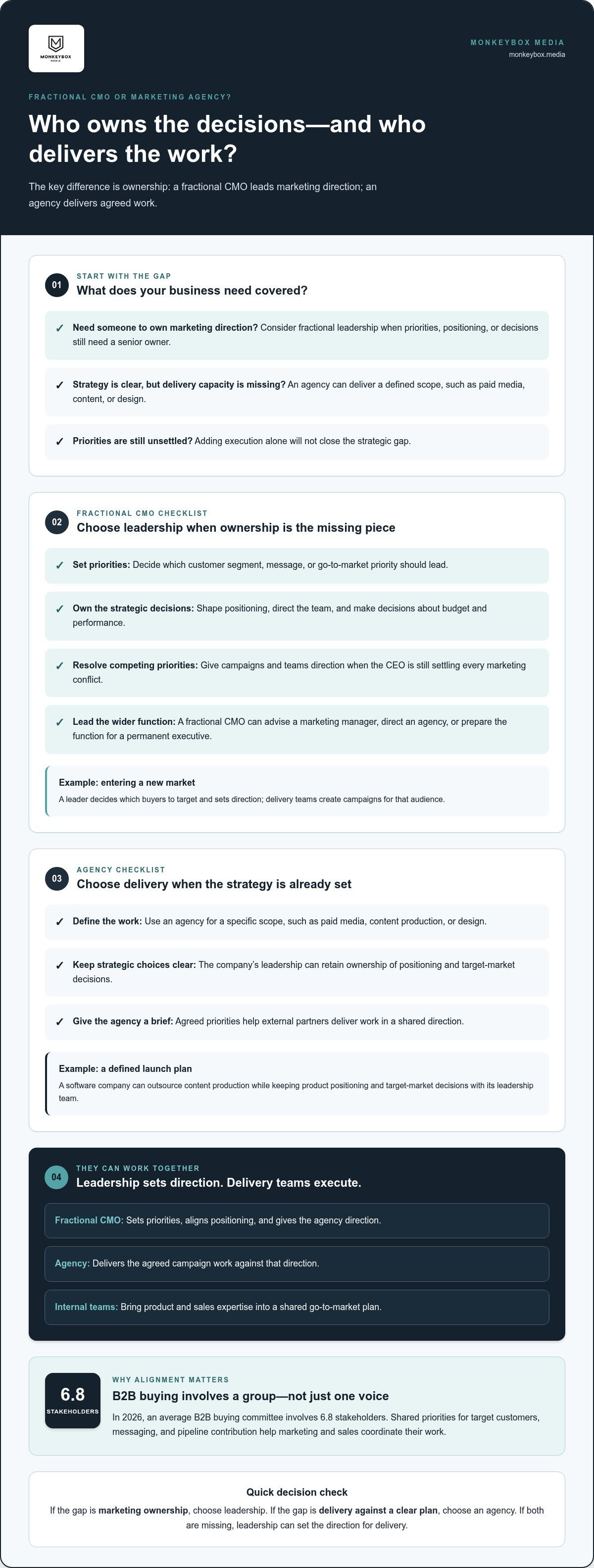
Choose a fractional CMO when your tech business needs someone to own marketing direction. Choose an agency when the strategy is set and you need delivery against a defined scope, such as paid media, content or design.
The distinction is ownership. A fractional marketing leader sets priorities, shapes positioning, directs the team and makes decisions about budget and performance. An agency typically delivers agreed work as an external partner. For example, a SaaS business entering a new market might need a leader to decide which buyers to target, while an agency produces campaign assets for that audience.
A fractional CMO for tech companies can also lead an agency, advise an existing marketing manager or prepare the function for a permanent executive. This leadership is useful when campaigns compete for attention but the CEO still resolves every priority conflict. The fractional CMO sets direction, and delivery teams execute against it.
An agency can be the right choice when your strategy is clear and a specific capability is missing. A software company with a defined launch plan might outsource content production while keeping product positioning and target-market decisions within its leadership team. If priorities are still unsettled, adding delivery capacity alone will not close the strategic gap.
Strategic Leadership for Growing Tech Businesses
Strategic marketing leadership owns the decisions that connect a technology company’s offer to its chosen market. This includes positioning, go-to-market priorities, team direction, budget allocation and performance. It matters when a growing business has campaigns underway but no senior marketing leader deciding which customer segment or message should lead. A clear strategy gives internal teams and agency partners a shared direction.
Marketing, Sales, and Organisational Alignment
Marketing and sales alignment means setting shared priorities for target customers, messaging and pipeline contribution. A marketing leader can bring sales feedback into positioning decisions and connect campaign activity with the questions prospects raise. In 2026, an average B2B buying committee involves 6.8 stakeholders, so inconsistent messages can create friction across a complex buying group. Shared priorities help teams coordinate their work.
Consider a B2B software company launching a new platform. Product may focus on technical capability, sales on buyer objections, and marketing on demand generation. A senior leader can bring those inputs into one go-to-market plan, then give an agency a defined campaign brief. Each team retains its expertise, but works towards the same market priorities.
Senior leadership is especially relevant when the CEO must arbitrate between competing campaigns, sales requests and product launches. A fractional arrangement can provide strategic ownership without assuming the company needs a permanent executive immediately. It is less suitable if the business expects part-time support to cover a full-time leadership workload. Ask whether the gap is strategic ownership, specialist delivery or both.
Choosing fractional leadership before a permanent hire
A fractional appointment can give a growing business senior marketing leadership while it clarifies what the role needs to own. It works best when the gap involves direction, decision-making or team capability, rather than simply more hands to run campaigns. Define the business problem first, then agree the remit, decision rights and executive sponsor. This gives the marketing leader a clear mandate rather than an open-ended advisory brief.
The responsibilities should resemble executive leadership, even when the time commitment is part-time. A fractional CMO can set market priorities, direct positioning, allocate marketing budget and assess performance. They may also coach a marketing team, advise a manager or oversee external vendors. For example, a SaaS company entering a new segment could assign one leader to align its message, campaign priorities and supplier work around that market.
Business stage helps determine the right level of experience and capacity. Smaller companies may choose a less-experienced fractional leader who can grow with the organisation, while larger enterprises may seek an experienced veteran. Businesses with turnover over £10 million may not benefit as much from the model. The deciding factor is the scale of leadership work, not turnover alone.
Before work begins, agree what the leader can decide independently and what requires executive approval. Set boundaries for budget, access to sales and product teams, and responsibility for suppliers. If a marketing manager handles daily coordination, the fractional leader can set priorities and review progress without duplicating execution. If there is no internal team, include a plan for building or managing delivery capacity in the remit.
Part-time leadership is a poor fit when the business expects one person to cover a full-time executive workload. It also will not solve a purely tactical capacity gap if the strategy is settled and delivery is the only issue. In that case, additional campaign resources address the need more directly. Match the role to the work that must be owned.
Set marketing KPIs and expectations at the start, then review progress against the business problem. Useful indicators include team capability, sales and marketing alignment, pipeline quality, customer acquisition economics and reduced waste across suppliers, technology and campaigns. Tie the engagement’s duration to its purpose, and define the handoff condition before work starts. A clear leadership remit and handoff plan helps keep the transition focused as the business prepares for its next stage.
Is a Fractional CMO Right for Your IT or Tech Business?
The right fit depends on the leadership decisions your business needs covered and the capacity available to deliver. Define the remit, operating cadence and handoff before comparing engagement models.
Engagement Scope and Operating Cadence
An engagement scope sets the fractional CMO’s responsibilities, decision rights, access, budget boundaries and executive sponsor. It clarifies which marketing strategy decisions the leader owns and which remain with the board or CEO. A regular cadence puts the remit into practice: bi-weekly sprints can manage priorities, while weekly performance reviews connect activity to pipeline metrics and IC milestones.
Monthly reporting should connect marketing spend to revenue and give leaders a consistent view of progress. Define the handoff condition before work begins, such as transferring ownership to an internal marketing executive or preparing the function for a permanent hire. This ties the engagement’s duration to a business outcome, rather than allowing it to continue by default.
CMO Engagement Model Differences
A fractional CMO provides part-time strategic leadership, while a full-time CMO continuously owns the marketing function as a permanent executive. Interim support generally covers a temporary leadership gap; a fixed-term appointment gives the role a defined employment period. The right model depends on whether your technology business needs ongoing part-time direction, continuity during a transition or embedded leadership every working day.
Fractional support can suit a defined project or ongoing strategic guidance. Some engagements provide leadership three days a week, while typical commitments range from 10-25 hours per week for each client. These are different models, not interchangeable promises. Match access and decision-making responsibility to the work that must move forward.
Costs, Terms, and Flexible Engagement
Cost efficiency comes from matching senior leadership time to the actual remit, rather than paying for an entire full-time workload. Compare the commitment, decision rights, delivery budget and exit terms, not just the headline fee. A fractional arrangement can make sense when strategic direction is essential but the organisation does not need continuous executive coverage. Its value depends on whether the time available addresses the business’s main marketing constraint.
For a UK engagement, founders should document the working arrangement, responsibilities, invoicing and tax handling, confidentiality, intellectual property and exit terms. These details clarify how the relationship operates and who owns each obligation. The scope and terms should also explain how the fractional leader works with internal staff and external suppliers.
Engagement Milestones and Duration
Milestones define what should change during the engagement and when a leadership handoff becomes appropriate. A tech company can begin with a three-month engagement as a trial period, then assess whether the remit still fits. Fractional CMO engagements typically last up to two years, but the duration should follow the work and its agreed handoff condition.
Set expectations at the start, then review progress against agreed KPIs. Useful milestones include clearer priority markets, stronger sales and marketing alignment, improved team capability, and more predictable pipeline quality. A handoff may mean transferring an established strategy to an internal leader, or deciding that the business now needs continuous executive ownership. A defined fractional leadership engagement can help structure those decisions.
Business types and growth situations suited to fractional support
Fractional support often suits B2B technology businesses with turnover between £1m and £10m. It’s particularly relevant when growth demands senior marketing leadership before a permanent executive role fits the business.
Consider a SaaS company moving from founder-led sales to a repeatable go-to-market motion. The founders may know the product deeply but lack senior marketing insight into market selection, positioning and team priorities. A fractional leader can establish direction, then help the business build or manage the delivery function needed to execute it. This model is useful when the leadership gap is real but the workload does not yet require continuous executive ownership.
Signals often show up in operating decisions, not job titles. A technology business may be entering a new market while its campaigns still target the original customer segment. Sales may attract different buyers from those product teams prioritise. If leaders cannot agree which segment matters most, an external executive perspective can help connect customer evidence with commercial priorities.
International growth can create another trigger. A UK software company expanding into new regions must decide whether its existing positioning, channels and sales materials fit each market. Companies operating globally may value a fractional leader’s seasoned insight and fresh perspective. The role can also guide decisions about generative AI in marketing, such as where automation supports the team’s workflow and where human review remains essential.
Choose a technology-focused leader by matching experience and remit to the business challenge. A typical technology-industry marketing leadership job description may require at least 10 years of marketing leadership experience. Yet tenure alone won’t resolve a mismatch. For a product launch, prioritise go-to-market and positioning experience; for a fragmented marketing function, focus on team leadership and operational decision-making.
Define success before the engagement begins. A founder preparing to delegate marketing can assess whether the team gains clearer priority markets and customer segments. A business with inconsistent sales handovers can examine alignment between sales and marketing. A company facing inefficient campaign spend can assess whether waste across suppliers, technology and campaigns is reduced. These outcomes make leadership impact visible without assuming growth follows automatically.
Fractional support may be less suitable for businesses with turnover over £10 million, which may not benefit as much from the model. It’s also a poor fit if the company expects part-time leadership to manage a full-time executive workload. For example, a business requiring constant oversight across several teams may need permanent ownership. Match the flexible arrangement to the actual decisions, access and accountability the function requires.
Comparing fractional, interim and fixed-term CMOs
These models differ in how long leadership stays, how much capacity it provides and which problem it solves. For a technology business, the choice affects decision continuity, internal team support and the pace of customer acquisition. Start with the gap: ongoing strategic direction, temporary leadership cover or a role needed for a defined period.
Fractional: A fractional CMO provides strategic leadership part-time, often while working with multiple companies. Typical commitments range from 10-25 hours per week for each client, and some arrangements provide leadership three days a week. This can suit a B2B software company that needs a consistent senior voice but doesn’t need full-time executive coverage. The value lies in focused leadership, not simply fewer hours.
Fixed-term: A fixed-term CMO fills a role for a defined period. A business launching a product or entering a new market might use this model when it needs concentrated executive ownership for that assignment. It can suit work that requires embedded leadership through a substantial delivery period. Its end point is tied to the agreed term, while a fractional engagement should end according to the work and its handoff condition.
The models are not interchangeable. If a founder needs strategic decisions and consistent direction, fractional leadership may fit. If a sudden vacancy threatens team coordination, interim cover addresses the immediate gap. If a defined launch needs sustained executive ownership, fixed-term support may be more appropriate. A fractional CMO can also provide short-term assistance for a specific project, so compare the remit and expected access, not just the label.
For each option, map four factors: who owns decisions, how the leader works with internal teams, what continuity the business needs and what condition ends the engagement. Then connect the choice to business measures. Pipeline quality, customer acquisition economics and team capability can show whether leadership addresses the actual gap. No model removes uncertainty, but clear responsibilities make the trade-offs visible.
Choose fractional support when the need is senior direction without full-time ownership; choose interim cover for a leadership gap; choose fixed-term support for a defined role and period. If you’re weighing those options, map your marketing leadership needs against the work your business must own.
Monkeybox Media: Fractional CMO
Monkeybox Media helps B2B technology businesses that need senior marketing direction connected to practical go-to-market planning. Its Fractional CMO support can clarify priorities and marketing ownership, while GTM Strategy aligns the plan with the business’s target markets and growth objectives.
When systems and workflows need attention, Marketing Ops and Marketing Automation can help create a more structured marketing function. These services fit when the strategy is in place but execution needs clearer processes, or when leadership must connect campaigns, sales activity and operational capacity.
The right starting point depends on the gap: strategic leadership, go-to-market direction, marketing operations or automation. Share the challenge you want to solve and explore how Monkeybox Media can help. Visit monkeybox.media to start a conversation.
Turn the leadership decision into a growth system
Marketing leadership creates lasting value when teams capture the reasoning behind key choices, the evidence that shaped them and the lessons to carry into future launches. This record helps founders build organisational capability, not just move the current priority forward.
A fractional CMO for tech companies can establish decision-making discipline while connecting market direction to execution. At Monkeybox Media, fractional CMO leadership can work alongside GTM Strategy, with Marketing Automation supporting the systems behind delivery. The right combination depends on the challenge your business needs to address.
Start by identifying the decision that keeps resurfacing: which market to pursue, how to align go-to-market activity or where marketing operations need stronger foundations. Bring that challenge into a conversation with Monkeybox Media and define what progress should look like for your team.
Contact Monkeybox Media to discuss the marketing leadership your tech business needs next. Build the structure to move forward with clarity.
Frequently Asked Questions
Fractional CMO, portfolio CMO, advisory CMO, interim CMO, part-time CMO, or marketing consultant?
These titles describe different arrangements, though usage can overlap. A portfolio CMO works with multiple organisations; a part-time CMO works reduced hours. An advisory CMO primarily gives counsel, while a consultant usually diagnoses a defined issue and recommends a response. Interim leadership covers a temporary vacancy or transition. Clarify whether you need someone accountable for marketing decisions or an adviser who provides recommendations.
How much does a fractional CMO cost?
The fee depends on the engagement and is provided after a quote request. Scope, time commitment, decision-making responsibility, team access and delivery budget all shape the work involved. Compare proposals by these factors and the exit terms, not by the headline fee alone. A business needing strategic direction across several functions has a different remit from one seeking focused guidance on a specific marketing challenge.
What are the key benefits of hiring a Fractional CMO?
A fractional CMO brings senior marketing judgement into decisions without requiring a permanent executive appointment. An outside perspective can help leaders spot conflicting priorities across teams and make a more disciplined case for allocating resources. For example, a founder deciding between customer segments can use structured market and pipeline evidence to guide the choice. This strengthens the basis for decisions, but does not guarantee outcomes.
What is a Fractional Chief Marketing Officer (CMO)?
A fractional CMO is an experienced marketing executive who leads a company’s marketing function part-time or for a time-bounded engagement. For tech companies, the remit can include choosing which market to pursue, shaping positioning and guiding how marketing supports revenue priorities. Unlike task-based support, the role puts executive-level accountability behind decisions that connect product, market and commercial goals.
How do I measure ROI from a fractional CMO?
Agree a baseline and business-linked measures before work begins, then review them consistently. Track customer acquisition cost by channel, pipeline contribution, pipeline quality and predictability, and sales-marketing alignment. If a leader changes channel priorities, for example, compare acquisition economics and qualified pipeline contribution with the previous approach. Also assess whether the internal team can make and explain marketing decisions more effectively.
How do you build dependable revenue projections without a CMO?
Build projections from sales data and explicit assumptions, not a single optimistic growth target. Separate pipeline by customer segment and stage, then use historical conversion patterns, deal values and sales-cycle timing to estimate likely revenue. Record assumptions alongside each forecast and compare actual results with them regularly. If conversion rates change, revise the forecast and investigate the cause.
How do you evaluate a fractional CMO?
Assess whether the person can connect marketing choices to your technology business’s commercial priorities. Look for relevant market experience, clear reasoning about segmentation and positioning, and the ability to lead internal teams and external specialists. Ask for an example of a decision framework they have used, then explore how they would define success and report progress. Focus on judgement and accountability, not impressive terminology.
How long should a fractional CMO stay?
The engagement should last as long as the defined marketing leadership job requires, with the handoff condition agreed at the outset. Fractional CMO engagements commonly last up to two years. A company might conclude the work when a permanent marketing executive is ready to take over, or continue while strategic leadership remains part-time. Review the remit as the business changes instead of extending an engagement without a clear purpose.