
A fractional CMO on the UK market typically costs between £7,500 and £12,000 per month, with the final fee shaped by the scope of the role and level of support. The right fractional CMO pricing models make that spend easier to assess against the leadership and delivery your business actually needs. More days, greater complexity and a broader mandate change the equation.
It’s reasonable to want a clear comparison before committing budget. A monthly retainer can provide ongoing leadership, while day rates, project fees and hourly billing suit different types of work. Compare what each arrangement covers, not just its headline fee.
This guide explains UK cost ranges, billing options and the factors that influence fees. It also compares fractional CMOs with consultants, agencies, marketing managers and full-time executives, so you can choose support that fits your growth stage and priorities.
Key Takeaways
- Match marketing leadership to your growth stage, revenue needs and the complexity of your market, rather than choosing on cost alone.
- Compare fractional leadership with consultants, agencies, marketing managers and full-time CMOs by the responsibility and continuity each provides.
- Choose a retainer, day rate, hourly arrangement or fixed-price project based on the work’s scope and the level of ongoing leadership required.
- Define decision rights, access, budget boundaries and success measures clearly so the engagement has a focused mandate.
- Use the pricing factors in the guide to clarify the support your business needs before choosing a model.
Choosing a CMO model by business revenue and growth stage
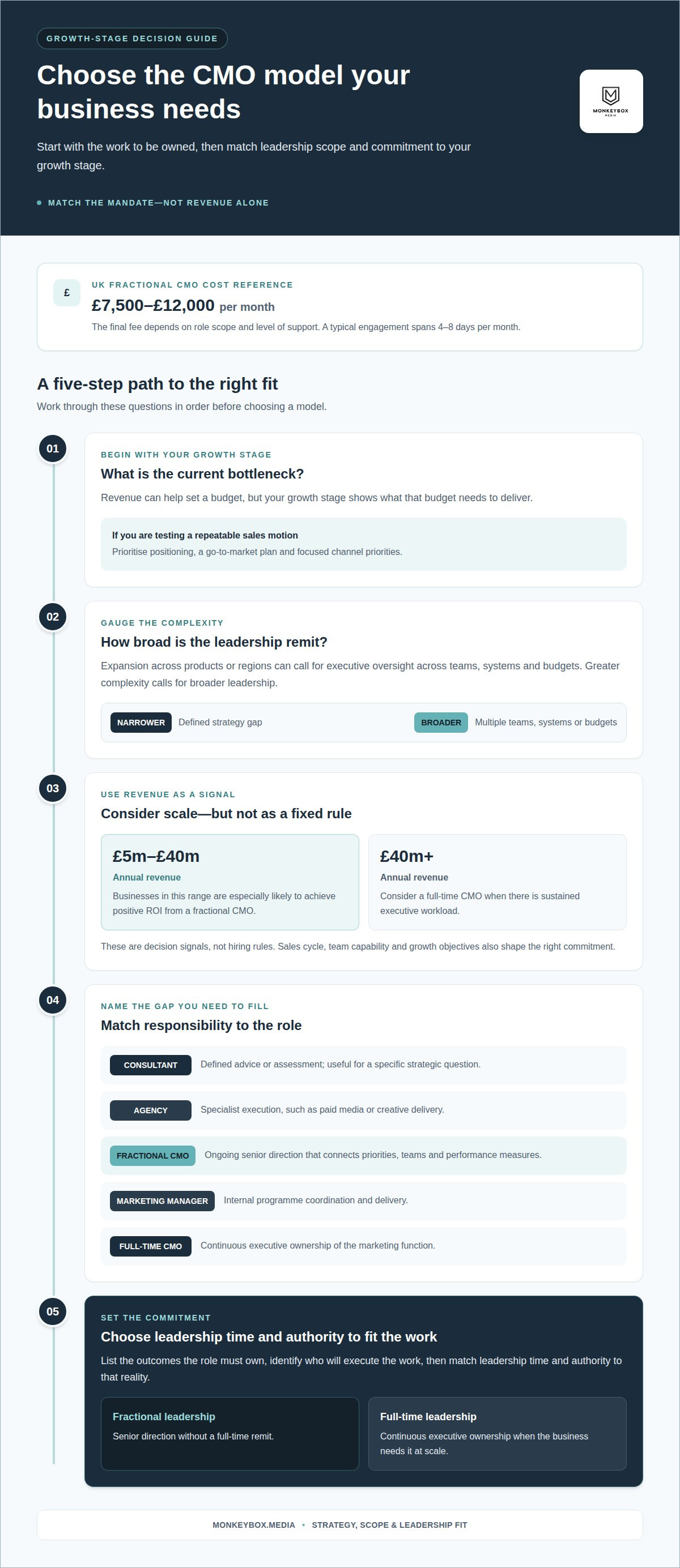
Revenue can help set a budget, but your growth stage shows what that budget needs to deliver.
Treat those ranges as starting points, then match the mandate to your current bottleneck. A company testing its first repeatable sales motion may need positioning, a go-to-market plan and focused channel priorities. A business expanding across products or regions may need executive oversight across teams, systems and budgets. Greater complexity calls for broader leadership.
Annual revenue offers another useful signal. Businesses earning £5m to £40m annually are especially likely to achieve positive ROI from a fractional CMO. That is not a fixed hiring rule: a company’s sales cycle, team capability and growth objectives also shape the right commitment.
Compare the options against the work they must own:
| Option | Best-fit stage or scale | Typical cost or decision signal |
|---|---|---|
| Early-stage fractional CMO | Startup or small business | |
| Focused fractional leadership | Defined strategy gap | Scope the mandate and time commitment |
| Established fractional engagement | Growing business needing ongoing direction | |
| Broader retained leadership | ||
| Complex-market fractional CMO | Large organisation or complex market | |
| Revenue-led fractional model | Business earning £5m to £40m annually | Strong potential for positive ROI |
| Full-time CMO | Business earning £40m or more annually | Consider sustained executive workload |
| Consultant-led support | Specific strategic question | Choose a defined advisory brief |
| Agency or marketing manager | Execution or internal coordination gap | Match delivery needs to team capacity |
These figures reflect different scopes, not interchangeable packages. A lower monthly fee may suit a tightly defined leadership role; broader decision-making and market complexity can require a greater commitment. Don’t choose a model based on revenue alone.
For a practical hiring decision, list the outcomes the role must own, identify who will execute the work, then match leadership time and authority to that reality. Choose fractional leadership when you need senior direction without a full-time remit. Choose a full-time CMO when the business needs continuous executive ownership at scale.
Comparisons with consultants, agencies, marketing managers, and full-time CMOs
These options differ in ownership, continuity and cost structure. Compare who sets direction, who executes and who carries executive accountability.
Consultants and Agencies
A consultant usually tackles a defined problem, such as reviewing positioning or assessing a campaign. An agency typically provides specialist execution, such as paid media or creative delivery. A fractional CMO provides ongoing marketing leadership, connecting priorities, teams and performance measures. For example, a consultant may recommend a channel strategy while an agency runs campaigns against it.
Annual Cost of Full-Time and Fractional CMOs
Recruitment fees can add 20-30% of salary.
Compare the total cost with the leadership capacity and executive ownership each model provides.
Other options solve different gaps. A marketing manager typically coordinates internal programmes and delivery, while a full-time CMO owns the executive function continuously. A fractional CMO can provide senior direction without the same full-time commitment. Full-time recruitment can involve 20-30% fees, and a new CMO may need at least six months of ramp time before meaningful delivery.
| Option | Primary contribution | Cost or commitment comparison |
|---|---|---|
| Consultant | Defined advice or assessment | Focused brief |
| Agency | Specialist campaign execution | Delivery capacity |
| Marketing manager | Internal coordination | Operational team role |
| Fractional CMO | Ongoing senior direction | |
| Full-time CMO | Continuous executive ownership |
To choose, identify the gap first: strategic direction, specialist execution, internal coordination or permanent executive leadership. Then map the responsibility to the role and compare its full cost, including recruitment and ramp time. If the need combines executive direction with operational systems, explore fractional CMO support as a possible fit.
How Much Does a Fractional CMO Cost in the UK?
On the UK market, fractional CMO services typically cost £7,500 to £12,000 per month. Common fractional CMO pricing models include monthly retainers, day rates, hourly billing, fixed-price projects and value-based fees.
A retainer should specify the leadership work, access and reporting it includes. Itemise execution costs, media spend and specialist suppliers separately if they fall outside the agreed scope.
Monthly Pricing and Engagement Days
A monthly retainer provides an agreed level of strategic input and leadership for a recurring fee. A typical engagement spans 4-8 days per month, allowing scheduled time for direction, reviews and key decisions. The fee reflects the agreed scope, not simply calendar days. Set recurring priorities so the available time focuses on decisions with the greatest commercial impact.
Day-based commitments can also coordinate attendance with leadership meetings, planning cycles and campaign reviews. Agree which activities need live participation and which can happen asynchronously. This keeps each day tied to defined responsibilities rather than an unstructured series of meetings.
Scope, Decision Rights, and Commitment
Part-time availability should not create unclear accountability. Before work starts, document the mandate, decision rights, data access, budget boundaries and executive sponsor. Specify which decisions the CMO can make, which need approval and who owns implementation. This gives the role responsibility for its agreed remit despite a limited schedule.
Commitment needs a clear operating rhythm. A recommended minimum is 10 hours per week or 40 hours per month for impactful work. Match that time to priorities, leadership access and internal execution capacity. Strategic direction can stall if the team lacks authority or resources to act.
Retainer Inclusions and Separate Billing
Define the retainer through responsibilities and deliverables, not a vague promise of support. It might cover agreed strategic planning, leadership meetings, performance reviews and team direction. Specify the cadence and outputs. Don’t assume campaign production, media investment, software licences or specialist supplier costs are included.
Set out separate charges and approval boundaries in the engagement terms. For example, if a campaign needs external creative production, clarify whether that work sits outside the CMO’s leadership scope. Clear ownership prevents strategic oversight from being confused with execution resources.
Compare fractional CMO pricing models by matching each fee to its actual scope. Agree objectives, authority, access and reporting, then set review points that connect priorities to decisions and owners. This gives the executive sponsor a practical way to track progress without turning every discussion into a status meeting.
Plan the exit and handoff before work begins. Record ownership of strategy documents, active decisions, campaign context and next steps. Assign each responsibility to an internal owner, then schedule a knowledge-transfer session for the close. A structured handoff protects continuity when the engagement ends or changes.
Day-rate and hourly billing
Project-based fractional CMO pricing means agreeing a specific scope, deliverables and completion point before work starts. The fee covers that project, not ongoing leadership, so any scope changes need clear agreement.
A day rate suits work that needs concentrated senior input without a continuing monthly arrangement. UK engagements may use one to several days per week or month, depending on the brief. A fractional CMO typically works one or two days a week, while total hours can range from 5 to 35 per week. The schedule should reflect the work, not just the available days.
Hourly billing ties the fee to recorded time, making it useful for a tightly defined advisory task or short review. For example, onboarding could include reviewing the current marketing plan, meeting key stakeholders and identifying immediate decisions. Agree the task, expected outputs and approval process first, so the hours support a defined result rather than open-ended activity.
| Billing method | Best suited to | What to define |
|---|---|---|
| Day rate | Scheduled leadership or planning days | Days, responsibilities and meeting cadence |
| Hourly | Specific advice or a short review | Task, time recording and approval boundaries |
| Fixed project fee | Bounded work with clear outputs | Deliverables, milestones and completion criteria |
For a fixed-price project, break the brief into milestones. A go-to-market strategy project, for example, could specify research, strategic recommendations and a final action plan.
Before onboarding, document assumptions, access requirements and who approves each deliverable. Set a process for handling new requests, since extra work can change the effort required. For day-rate arrangements, agree how booked days will be used and whether preparation or follow-up is included. For hourly billing, define how time is reported and approved.
Choose day rates when the workload is best organised into planned leadership days. Choose hourly billing for contained advisory work, and project pricing when the output and finish line are clear. If priorities need to evolve continuously, a project fee may be less suitable than an ongoing arrangement. The deciding factor is how clearly the work can be defined.
Factors that affect fractional CMO pricing
Pricing reflects the mandate, time commitment, company complexity, geography and whether execution resources are included. Each factor changes the leadership time and supporting work required.
The main risks when comparing prices are unclear scope, extra execution costs and gaps in decision-making authority. Define the CMO’s responsibilities, internal team capacity and separately funded resources before comparing proposals.
Mandate: Advising the executive team differs from leading planning, coordinating teams and overseeing delivery. Broader accountability requires more capacity and access to decision-makers.
Time commitment: More working time allows for more reviews, stakeholder alignment and follow-through. A short, defined assignment needs a different schedule from ongoing leadership across several priorities.
Company complexity: Multiple products, markets or teams create additional coordination needs. For example, aligning sales and marketing around one product launch is narrower in scope than managing priorities across several business units.
Geography: The company’s region and operating footprint can shape stakeholder coordination and market context. A business serving several regions may need more planning input than one working within a single market.
Execution resources: Clarify whether the engagement covers leadership only or includes access to people who can implement the plan. If internal capacity is limited, execution may require separately budgeted staff, agencies or specialist suppliers.
Value and targets: Value-based pricing links fees to an agreed commercial objective rather than hours alone. Examples include targeting a 3x ROI on a specific campaign or increasing revenue by 20% within six months. These are target-setting examples, not assured outcomes.
Compare proposals against the same five factors. Ask which decisions the role owns, what work falls outside scope and which resources carry separate costs. Map onboarding needs, reporting access and approval routes, too. Delays in access or approvals can slow execution, even when the leadership brief is clear.
For a practical review, write a one-page mandate covering objectives, responsibilities, decision rights, available resources and success measures. Use it to spot mismatches, such as an ambitious target without delivery capacity or broad accountability without executive access. Agree an exit and handoff plan before work begins, so ownership of active priorities remains clear.
Value-based fees need especially clear measurement rules. Define the baseline, attribution method, time period and factors outside the CMO’s control. For a campaign target such as 3x ROI, specify which spend and revenue count. This makes performance discussions more objective and reduces disputes over how results are calculated.
Map your scope, execution capacity and growth priorities with fractional CMO planning support before comparing engagement proposals.
Monkeybox Media: Fractional CMO
Monkeybox Media provides fractional CMO leadership for B2B organisations that need senior marketing direction without building every capability in-house. Turn to this support when growth priorities lack clear ownership, go-to-market plans need structure, or marketing activity isn’t connected to operational execution.
Monkeybox Media’s GTM Strategy, Marketing Automation and Marketing Ops services connect market planning with the systems and processes that support delivery. The focus is practical alignment: clarify the commercial objective, define decision ownership, then shape marketing work around those priorities.
If you’re assessing the right leadership model, contact Monkeybox Media to discuss your needs, or visit monkeybox.media.
Turn Your Marketing Priorities into a Clear Brief
Turn your growth priorities into a practical engagement brief. Set out the decisions you need owned, the outcomes that matter and the internal capacity available to act. This gives conversations about fractional CMO pricing models a sharper foundation: assess proposed support against the work your business needs, rather than comparing fees in isolation.
Bring your current priorities, constraints and expectations into that discussion. A focused brief helps establish where senior marketing direction can make the biggest difference and how it should connect with your wider growth plans. It also creates a shared starting point for defining responsibilities and measuring progress.
Monkeybox Media can help you shape that next step. Contact Monkeybox Media to discuss your needs and turn your priorities into a clear path forward.
Frequently Asked Questions
How Do You Determine the Number of Hours You Need from Your Fractional CMO?
Start with the decisions and work you expect the role to own, then estimate the time each will need. For example, list leadership meetings, performance reviews, team direction and planning separately. Include preparation and follow-through, not just scheduled calls. Review the workload once the engagement begins and adjust the commitment if priorities shift or internal teams need more support.
Is a fractional CMO a part-time CMO?
Yes. A fractional CMO provides senior marketing leadership on a part-time basis rather than working exclusively for one organisation. Unlike occasional consulting, the role can include ongoing direction and responsibility for an agreed remit. For example, a business might use fractional leadership to guide its marketing team while internal specialists manage daily campaign delivery.
What does “fractional” change?
What should the engagement look like?
A strong engagement starts with a written mandate, a named executive sponsor and agreed access to relevant teams and information. For example, a launch brief should identify who owns positioning decisions, who approves the budget and who carries out campaign tasks. Set review points to assess progress against the mandate, and define the handoff process before the engagement ends or changes.
When is a fractional CMO the wrong choice?
A fractional CMO may be the wrong fit when the business needs someone available every working day or when its main gap is hands-on execution rather than senior direction. For example, a team without the capacity to build campaigns may need delivery resources before adding executive oversight. A full-time CMO suits a sustained, organisation-wide leadership requirement that calls for continuous ownership.
What is the typical hourly rate for a fractional CMO in the UK?
Hourly billing depends on the agreed scope and how the work is structured. Compare the expected hours with the included responsibilities, such as preparation, stakeholder meetings and follow-up, to assess the effective cost against the work delivered.
How much does a fractional CMO retainer cost per month in the UK?
On the UK market, fractional CMO services typically cost £7,500 to £12,000 per month, with a median of about £7,500. The retainer’s scope matters as much as the amount: compare its leadership responsibilities, access and agreed working time. Also separate any execution resources or supplier costs that sit outside the retainer, so your budget reflects the full operating plan.
How are fractional CMO day rates and weekly commitments structured?
A fractional CMO commonly works one or two days a week. Structure the commitment around decision cycles: for example, reserve time for leadership reviews and planning, then allow for follow-up on actions that need coordination between meetings.