
More campaigns won’t fix a growth system that fails to move buyers forward. A high-growth B2B marketing strategy combines data, experimentation and targeted tactics across the customer journey, then analyses results and iterates on what works. In practice, email, automation, personalisation and educational content need to support buyer needs and the decisions a buying group must make.
That takes more than a sequence of emails or a steady stream of articles. B2B buying journeys involve longer sales cycles, multiple stakeholders and research across different sources, so marketing needs to build relevance and trust at each stage. The message should reach the right people with useful information, then give them a clear next step.
This guide explains what a B2B marketing strategy involves and how to connect its moving parts. You’ll see how to structure email campaigns, use automation and personalisation with purpose, and create educational content that answers real buyer questions. The goal is a joined-up growth system, not more activity for its own sake.
Key Takeaways
- Build account-based marketing around ideal accounts and the different priorities of the people involved in each buying decision.
- Equip internal champions with clear, relevant evidence they can share to build confidence across their organisation.
- Use email automation to deliver timely, personalised messages that reflect a prospect’s interests and stage in the buying journey.
- Create educational content around specific buyer questions, then match each format to the job it needs to do.
- Measure performance across the customer journey and use the results to refine your strategy, not simply increase campaign volume.
1. What Is B2B Growth Marketing?
B2B growth marketing combines data, experimentation and targeted tactics across the customer journey. Teams analyse results, then refine what works. A high-growth B2B marketing strategy aligns the offer, message and channels with buyer priorities, rather than treating activity as progress. For example, an engineering lead may need technical evidence, while finance needs a clear business case. Positioning should address both, not force every stakeholder into one generic message.
Market-led positioning starts with buyer insights: the problem prompting a search, the outcome each stakeholder needs, and the barriers delaying a decision. B2B research commonly identifies 3 or 4 behavioural or needs-based segments. FMCG markets commonly have 10, 12 or more segments. Use interviews, sales conversations and customer data to group buyers by needs and behaviour, then adapt messaging to each segment. A go-to-market strategy should account for engineers, procurement, operations, finance and leadership.
Which B2B marketing channels deliver the best ROI in the UK? There’s no single best channel for every business; choose channels by their role in the buying journey. SEO can capture demand during active problem-solving, LinkedIn can build salience across buying groups, and exhibitions can support visibility and early engagement. Match each channel to a defined audience, goal and conversion measure, then compare its contribution to pipeline and revenue.
How do account-based marketing and demand generation compare for B2B growth? Account-based marketing (ABM) aligns marketing and sales around ideal accounts, creating relevant engagement for the people involved in each purchase. Demand generation builds awareness and interest across a broader target market. Use ABM when named accounts and complex stakeholder groups matter; use demand generation to reach potential buyers beyond a fixed account list. They can work together, with demand generation identifying interest and ABM focusing follow-up.
What defines a high-growth B2B marketing strategy? It connects buyer insight, measurable goals, channel roles and ongoing experimentation. ABM gives that system focus: identify ideal accounts, map stakeholder priorities, coordinate marketing and sales, then tailor relevant engagement. Even in the largest B2B companies, it’s not unusual for 100 or fewer customers to account for sales that make a difference. Prioritising those accounts can sharpen execution.
What are the main risks and common mistakes in scaling B2B marketing? Common mistakes include scaling campaigns before validating positioning, treating channels as a disconnected list, and measuring activity without tracking business outcomes. Another risk is ignoring stakeholder differences: a message that addresses procurement may not resolve an engineer’s concerns. Set shared marketing and sales goals, review pipeline progression, and use buyer feedback to adjust targeting. Growth needs a repeatable system, not simply more volume.
2. What is B2B Marketing Strategy?
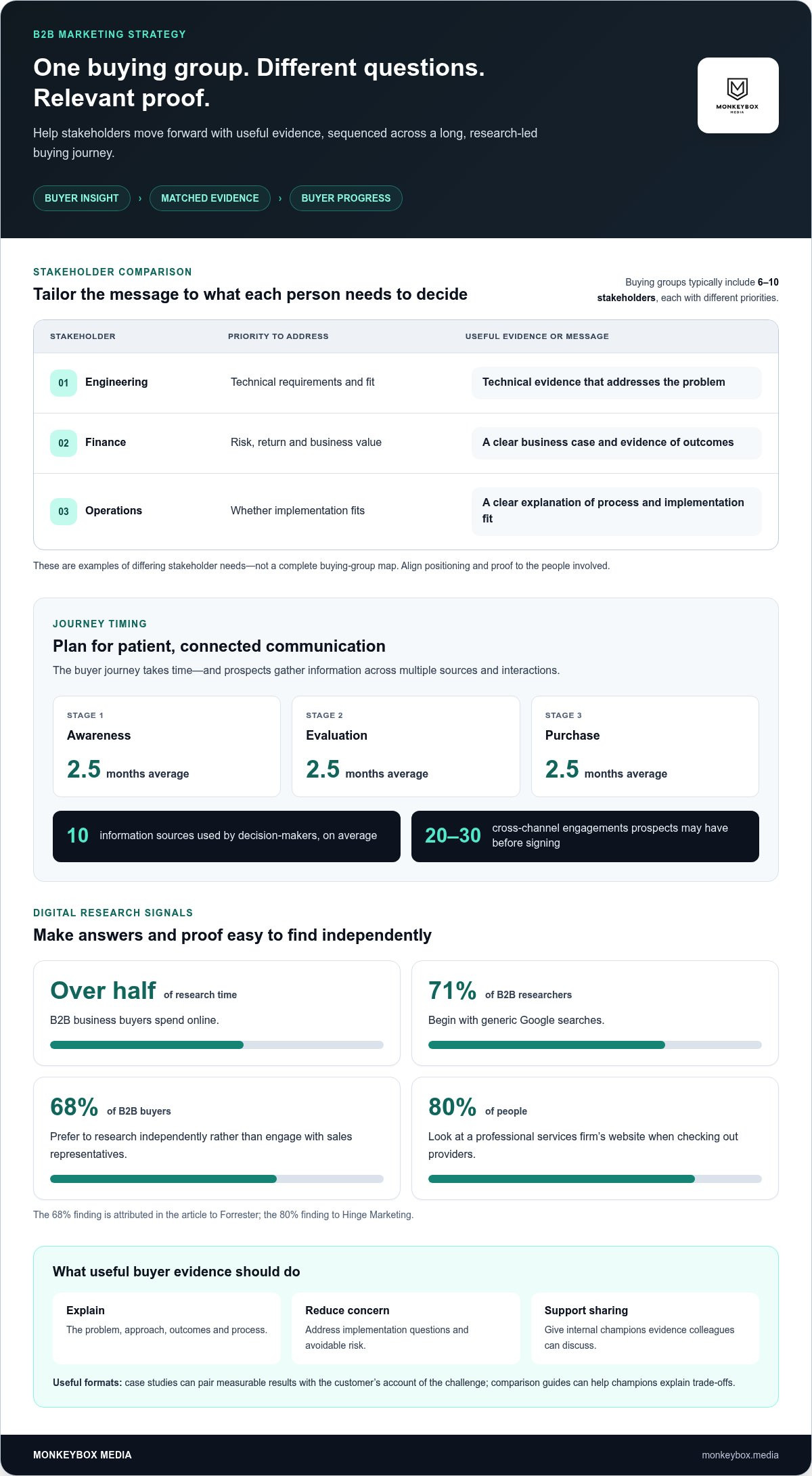
A B2B marketing strategy connects business goals to the buyer journey, from first awareness through evaluation and purchase. It defines the audience, position, proof and channels that help buyers progress. This matters because buying groups typically include six to ten stakeholders, each bringing different priorities. A finance leader may focus on risk and return; an operations manager may need evidence of implementation fit. One message rarely resolves both concerns.
The journey also demands patience and useful evidence. The three stages of the B2B buyer journey each take an average of 2.5 months, and decision-makers use an average of 10 information sources. Prospects may engage with a company 20 to 30 times across channels before signing a contract. A strategy should therefore sequence communications, rather than treating each campaign as an isolated activity. Each interaction must advance understanding or reduce a specific concern.
Buyers need rational proof: a clear explanation of outcomes, process and business impact. They also need confidence that choosing a supplier will not create avoidable risk or undermine their standing internally. A case study can combine measurable results with a customer’s account of the challenge. A comparison guide can help an internal champion explain trade-offs to colleagues. These assets make decisions easier to discuss, not just easier to discover.
What are the steps to build an effective B2B demand-generation funnel? Define the target buyer and problem, attract relevant visitors with search-led or educational content, and offer a useful next step. Then nurture interest with evidence matched to buyer needs, qualify engagement against clear criteria, and equip sales with context for a relevant follow-up. Track movement between stages, not just initial responses.
A practical strategy also reflects non-linear buying behaviour. In industrial B2B markets, buyers can pause, revisit earlier questions, consult colleagues and change direction. Build routes back to helpful content, and give internal champions material they can share at each decision point. A focused GTM strategy can help connect audience priorities, messaging and channel roles into one coherent plan.
3. Email campaigns, automation and personalisation
Email works best as a sequence that helps buyers make progress, rather than a run of disconnected announcements. Segment by role, expressed interest and journey stage, then send material that fits each signal. For example, someone who downloads a technical guide could receive an implementation email, while a finance contact gets a business-case summary. Personalisation should make each message more useful, not merely add a first name.
Marketing automation turns those decisions into repeatable workflows. Connect your CRM to campaign activity so sales and marketing can see engagement, source and next action in one place. Set triggers around meaningful behaviour, such as requesting a demonstration or returning to a product page. Add suppression rules and ownership steps so a sales conversation pauses automated messaging instead of competing with it. Review workflows when buyer behaviour or the offer changes.
Lead nurturing matters in long B2B sales cycles. Businesses that focus on lead nurturing make 50% more B2B sales and achieve a 33% lower cost. Treat those figures as a reason to build sustained, relevant follow-up, not as a forecast for any individual campaign. A practical nurture path can share an educational insight, answer a common objection, then invite a suitable next step. Stop or adjust messages when engagement indicates a different need.
What UK GDPR and PECR rules affect B2B marketing campaigns? UK GDPR and PECR should inform how campaigns collect, use and act on contact data, including email and tracking activity. Build privacy review, audience permissions, clear preferences and suppression processes into campaign operations before sending.
Automation should support agile marketing, not lock teams into a fixed plan. Run a focused test on one variable, such as subject line, audience segment or content offer, then review the result against a defined objective. Use the learning to update the next campaign. BCG was cited as reporting that AI-powered targeting, predictive analytics and automation can cut customer acquisition cost by up to 40%; apply AI to sharpen prioritisation, while keeping human review over messaging and decisions.
How should B2B marketing align with sales to improve pipeline and revenue growth? Agree shared definitions for qualified leads, hand-off timing and follow-up ownership, then use CRM records to give sales context on each prospect’s interests. Review lead-to-opportunity progression together and feed objections back into email content, segmentation and automation. That creates a working loop: marketing engages, sales responds, and both teams refine what is driving pipeline.
CRM discipline makes that loop measurable. The research reports that 63% of marketers use the same CRM system, but a shared platform only helps when teams maintain consistent fields, stages and records. Track engagement alongside pipeline movement, then use Marketing Ops practices to keep data and workflows usable. Strong automation connects the system; clear ownership keeps it useful.
4. Content marketing and educational content
Educational content earns attention by solving a defined buyer problem. B2B growth marketing can use blog articles, whitepapers, ebooks, videos and webinars to attract, engage and educate target audiences. Start with questions heard in sales calls, then select a format that answers each question clearly. For example, a technical webinar can explain integration choices, while an ebook can help buyers compare approaches. Useful content builds a relationship before a sales conversation begins.
Plan content around campaign goals, audience needs and the next action. For each asset, define its target role, buyer question, distribution channels and follow-up. A procurement checklist might support evaluation, while an explainer article can attract interest during early research. Coordinate publishing with email and sales activity so buyers encounter a coherent message. A calendar helps maintain cadence, but buyer relevance should determine what gets published.
Inbound marketing gives potential buyers useful information before they speak with sales. At any given time, only 5% of B2B buyers are in-market, so content should also build familiarity with those not ready to purchase. A practical sequence might pair an evergreen guide with a later case study and webinar invitation. That creates multiple paths back to the business when priorities shift, without making every interaction a hard sell.
Strong B2B content addresses a specific challenge for a specific audience. An operations leader may need a process guide, while an engineer needs technical detail. Build each asset around one question, use plain language, and make the evidence easy to assess. Case studies become more persuasive when they include real figures and testimonials. Explain the original challenge, the approach taken and the outcome, so an internal champion can share a credible story with colleagues.
How should B2B companies set marketing goals and KPIs for rapid growth? Tie each goal to a business priority, then select measures that show progress towards it. For example, a team might target a 15% increase in sales in the next quarter, then track qualified enquiries, lead-to-opportunity conversion and pipeline contribution. Review performance regularly and adjust topics, formats or distribution when the evidence shows a gap.
Effective content programmes connect publishing to learning. Track which articles attract relevant buyers, which resources support sales conversations and which questions remain unanswered. Use those insights to refine the next campaign, rather than repeating topics just to maintain output. A webinar that surfaces recurring implementation concerns, for instance, can inform a follow-up guide and sales materials. Each asset needs a clear purpose, audience and measurable next step.
Technical webinars can align engineers and procurement. B2B businesses that implemented inbound marketing before the pandemic were less affected by lockdowns and continued to receive leads.
5. B2B growth marketing definition
B2B growth marketing combines data, experimentation and targeted tactics across the customer journey. Teams analyse results, then iterate on what works. That makes it an operating discipline, not a campaign label or a collection of growth hacks. For example, a software firm can connect search activity, educational content, sales conversations and customer retention into one measurable system. Each activity should influence a business outcome, not simply increase marketing output.
Start with a business objective and a defined audience. A team might aim to improve qualified pipeline, then investigate where suitable buyers disengage. Consider campaign responses, sales feedback, stage progression and customer behaviour together. If technical prospects engage with product pages but stall before a sales conversation, test a clearer implementation guide. Turn the insight into an experiment, not just another report.
Experimentation means changing a specific part of the system and assessing its effect. Test a revised value proposition with one audience segment, or compare two content approaches against the same objective. Tie measurement to the intended outcome. Click-through rates can indicate message engagement, while customer acquisition costs help assess efficiency. Neither metric tells the full story alone, so connect both to pipeline quality and revenue contribution.
Growth marketing also tests how channels work together. A LinkedIn post, for example, may introduce an operational challenge, while a search article answers it in depth. A follow-up email can then offer a relevant case study. This sequence gives buyers a connected experience and creates useful signals for the team. Review whether the audience progresses, which objections remain and what evidence influences later conversations.
Use a shared measurement framework across marketing and sales. Track deal velocity, stage progression, internal champion activation, objection patterns and evidence use. These indicators show whether campaigns support real buying decisions, beyond lead volume. If prospects repeatedly raise the same concern, create content that addresses it and equip sales with that material. If opportunities progress but stall later, examine the proof and support buyers need at that stage.
Competitive pressure makes iteration valuable, but speed without discipline creates noise. Set a clear hypothesis, identify the audience, choose the measure and document the result. Then scale a tactic only when evidence supports it. B2B growth marketing can take several months to produce significant results, and sustained optimisation supports long-term growth. The takeaway: build a repeatable learning loop that links buyer behaviour to better decisions, then apply it across the journey.
To turn disconnected campaigns into a measurable growth system, build a data-led marketing operation that links strategy, execution and learning.
Monkeybox Media: Fractional CMO
Monkeybox Media provides Fractional CMO leadership for B2B organisations that need strategic direction to connect marketing activity with growth priorities. Turn to this support when campaigns, sales priorities and measurement lack a clear shared plan, or when your team needs senior marketing leadership. GTM Strategy can align audience, positioning and channel choices; Marketing Automation and Marketing Ops can help structure campaign workflows and measurement. The focus is a coherent system, with priorities shaped around your organisation’s goals and current marketing operations. If you’re ready to bring greater strategic alignment to your B2B marketing, visit monkeybox.media to get in touch.
Turn your next growth priority into action
A high-growth B2B marketing strategy gains momentum when a clear priority has an owner, a practical next step and a way to learn from the outcome. Choose one current constraint, such as inconsistent positioning or disconnected campaign workflows, and decide what needs to change first. That focus gives your team a stronger basis for action than adding more activity without a defined purpose.
Monkeybox Media offers Fractional CMO leadership, GTM Strategy and Marketing Automation to help B2B organisations address strategic direction and execution. These offerings can be relevant when your team needs senior marketing leadership, a more coherent go-to-market plan or better-connected automation. The right starting point is the challenge your business needs to solve.
Contact Monkeybox Media to discuss your strategy and identify a practical next step. Your growth system can keep improving as your team learns and acts with greater focus.
Frequently Asked Questions
What is B2B Marketing Strategy?
A B2B marketing strategy is the decision framework that guides how a business attracts, serves and retains organisational buyers. It turns commercial priorities into choices about audiences, propositions, investment and measurement. For example, a business entering a new sector might first validate demand with buyer interviews, then adapt its messaging and sales materials before expanding promotion. A high-growth B2B marketing strategy keeps those decisions connected to business priorities.
What Is B2B Growth Marketing?
B2B growth marketing is a learning-led approach to improving how a business acquires and develops customers. It examines the full relationship, including initial discovery, purchase, adoption and renewal, rather than judging success by lead volume alone. For example, if new customers struggle to use a service, a team can test clearer onboarding content and track whether engagement improves. That insight can guide both marketing and customer experience priorities.
How can B2B companies identify and prioritise ideal customer profiles and target accounts?
Define an ideal customer profile by comparing existing customers across traits such as sector, business model, urgent needs, buying process and fit with your offer. Review sales conversations and customer feedback to identify which traits align with strong engagement and successful delivery. Prioritise target accounts where the problem is relevant, stakeholders are identifiable and your solution has a clear role. Share the criteria with sales, then revisit them as market evidence changes.