
A partner channel drives growth only when the economics work for both sides. A channel partner GTM strategy sets out how a business will use partners to reach target customers, including which partner types to engage, how the commercial model works and how partner activity fits with direct sales. It turns growth goals into a partner-specific plan, not just a list of potential resellers.
Expanding through partners can open new routes to market, but adding partners alone is not a strategy. The model must give partners a reason to sell, make support clear for your sales team and remain sustainable for the business to fund.
This guide explains what a channel partner GTM strategy involves, what you need to launch a programme and how referral, reseller, service and white-label models differ. You’ll learn how to weigh growth potential against operational demands, costs and risks, then choose a partnership motion that fits your market and commercial goals.
Key Takeaways
- Separate direct and partner-led opportunities by customer segment, market access and the value each route adds.
- Set a channel revenue target, then map the pipeline and partner investment needed to support it.
- Choose partnership models based on the role partners can credibly play, from referrals and resale to services or white-label delivery.
- Keep the strategy distinct from the programme: define the growth direction first, then build the terms, enablement and governance to execute it.
- Assess each partnership against shared goals, operating effort and acquisition economics before scaling the model.
What is a channel partner go-to-market strategy?
A channel partner GTM strategy defines how a business uses indirect partners to reach target customers. It translates commercial goals into a partner-specific plan for target markets, sales routes, messaging and measurement.
-
Map Direct and Indirect Sales Segments
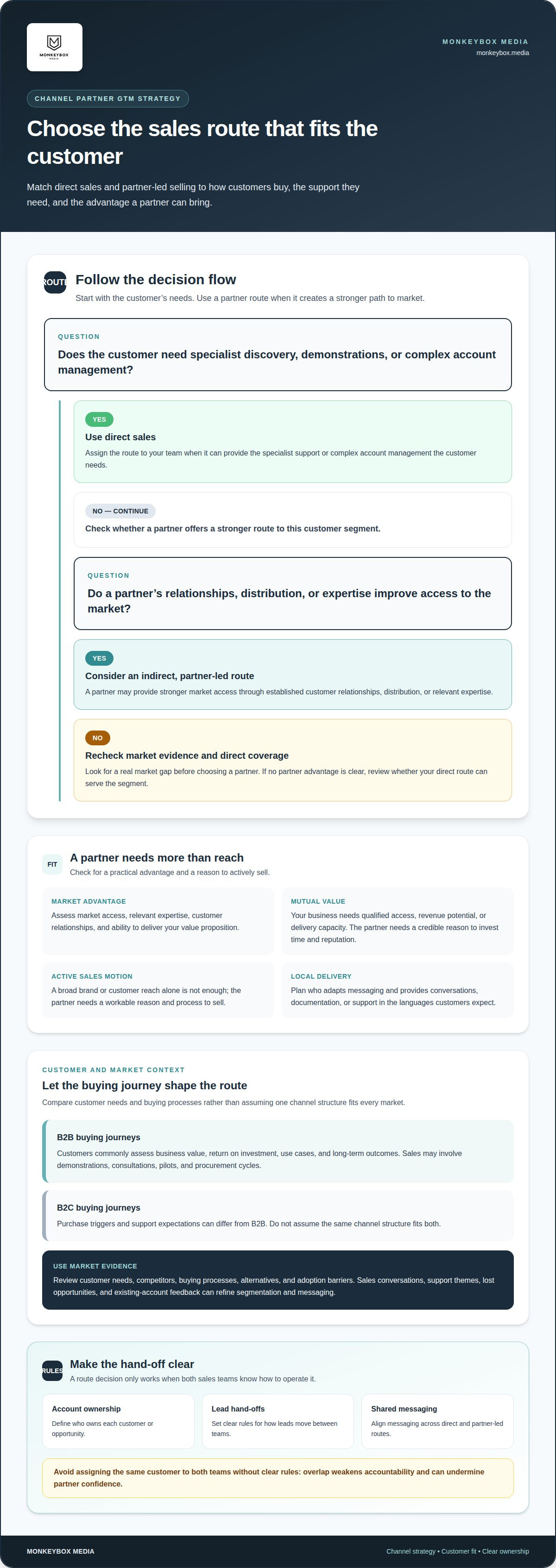
Segment customers by how they buy, where they operate and the support they need. Assign direct sales where your team can provide specialist discovery, demonstrations or complex account management. Use indirect partners where their relationships, distribution or expertise offer a stronger route to market.
For example, a technology business might sell directly to large UK organisations while using resellers to reach a different customer segment. Define account ownership, lead hand-offs and messaging for each route. Avoid assigning the same customer to both teams without clear rules. That overlap weakens accountability and can undermine partner confidence.
Compare B2B and B2C buying journeys before selecting the route. B2B customers commonly assess business value, return on investment, use cases and long-term outcomes. Their sales processes can involve demos, consultations, pilots and procurement cycles. B2C decisions often involve different purchase triggers and support expectations, so don’t assume one channel structure fits both.
-
Assess Partner-Market Fit and Mutual Value
Choose partners with a practical advantage in the customer segment you want to reach. Assess their market access, relevant expertise, customer relationships and ability to deliver your value proposition. Local market knowledge can sharpen positioning by revealing buying expectations, procurement considerations and objections your central team may not have encountered.
Test the commercial case for both sides. Your business needs qualified access, revenue potential or delivery capacity; the partner needs a credible reason to invest time and reputation. Explain how the offer strengthens its customer proposition and helps progress deals. Don’t choose a partner solely for its brand or reach. Reach without an active sales motion rarely creates momentum.
Plan language support for every market served. Materials in one language may suit some customers, while others may expect local-language conversations, documentation or support. Decide who adapts the messaging and how technical meaning will stay consistent. These choices shape partner enablement and the customer experience.
-
Analyse Markets and Customer Understanding
Analyse the target market before choosing a route. Map customer needs, competitors, buying processes, alternatives and adoption barriers, then compare your findings with partner capabilities. A channel partner GTM strategy is stronger when partners address a real market gap, such as limited access, specialist implementation knowledge or established customer trust.
Use customer evidence to refine segmentation and messaging. Review sales conversations, support themes, lost opportunities and feedback from existing accounts. Repeated questions about integration, for example, may point to a need for specialist partner expertise. Lengthy procurement may call for stronger stakeholder support. Avoid treating every market as one customer group.
Account for applicable contract, tax and data protection requirements in each market. Map who handles customer information, payments and delivery, then capture responsibilities in commercial terms. Have contracts, licensing agreements and intellectual property considerations reviewed by a legal team. This makes the channel partner GTM strategy operational, connecting customer insight to partner selection, direct sales and indirect execution.
What do you need to start a channel partner programme?
Start with a commercial model that links partner activity to revenue, pipeline and clear responsibilities. Define targets, investment and enablement needs before recruiting resellers.
Define partner roles by sales task, territories by geography or account ownership, and targets by revenue and pipeline contribution. Set transparent rules for lead hand-offs and direct-sales involvement so teams know who owns each opportunity.
-
Set Channel Revenue Targets and Pipeline Coverage
Translate the channel revenue target into the qualified pipeline needed to support it. Specify the target, required pipeline coverage ratio and partner investment needed to build that pipeline. Set these assumptions by partner type and sales cycle instead of applying one blanket target across the programme.
Connect each target to a measurable stage, such as sourced opportunities, accepted leads or closed revenue. Track pipeline quality as well as volume. A large pipeline with weak qualification can hide a shortfall until revenue misses its target.
-
Define Partner Recruitment and Revenue Expectations
Recruit partners for a defined role, customer segment and route to revenue. Specify whether each partner is expected to generate referrals, resell, deliver services or support co-selling. This gives recruitment a commercial filter: prioritise organisations whose capabilities match the motion, not simply those with broad visibility.
Set expectations for onboarding, enablement and the first opportunities partners should pursue. Build a forecast based on their available sales capacity, relevant customer access and expected deal progression. Don’t promise revenue based on recruitment numbers alone. Signed partners still need a reason and a workable process to sell.
-
Understand Partner Revenue Models and ROI
Model revenue and return on investment across the full partner motion. Include revenue retained by your business, partner payments, enablement effort and operational support required to progress deals. Compare these inputs with the cost of acquiring customers directly, using the same period and attribution rules for each route.
Test how the model performs if deal volume, conversion or partner activity changes. Separate sourced revenue from influenced revenue to avoid counting an opportunity twice. Use the results to adjust recruitment, support and programme investment before scaling.
-
Set Partner Margins and Revenue Sharing
Choose margins that reflect the work and value each partner contributes. SaaS resellers typically receive a margin of 5-10% of first-year ARR. Treat that as a market reference, then assess the partner’s sales role, support needs and impact on your own economics before setting commercial terms.
Document how revenue sharing works for renewals, services, referrals and jointly managed opportunities. Align sales incentives with those terms, and explain how direct sales and resellers receive credit. A structured GTM strategy can connect these revenue assumptions with partner roles and operating requirements.
Referral, reseller, service and white-label partnerships
Choose a partnership model based on its role in the customer journey, not its label. A useful structure clarifies each partner’s responsibilities, commercial position and relationship with your sales team.
-
Compare Referral, Reseller, Service and White-Label Models
Match the model to the work required. Referral partners introduce potential customers and may earn commission on resulting sales; resellers sell your product or service directly. Service partners provide implementation or delivery expertise, while white-label partners sell an offer under their own brand. Each model changes who owns the customer relationship and what sales activities the partner must perform.
Write down what each route involves: lead generation, sales conversations, contracting, delivery, support and renewal. A referral partner might hand a qualified introduction to your sales team, while a reseller manages the sale. A white-label arrangement needs clear ownership of customer messaging and support. Don’t combine these roles in one agreement without defining responsibility at every stage.
-
Distinguish Resellers, VARs, Referral and Agency Partners
Set expectations around the actual work, rather than assuming all partners sell in the same way. A VAR might configure a solution for a customer’s operating process, while a referral partner passes an opportunity to your sales team. SaaS VARs typically receive a margin of 20-30% of first-year ARR. Use this as a reference when assessing the value they add, not as a default for every partnership.
-
Define Responsibilities and Commercial Position
Document how the partner and your sales team coordinate each opportunity. Specify who qualifies leads, presents the offer, negotiates terms, manages delivery and handles customer questions. For a UK agency referral, for example, set out how introductions are recorded and when a referral commission applies. Clear rules protect the relationship and reduce disputes over account ownership.
Connect incentives to measurable contributions. A reseller that manages sales and customer support has different responsibilities from a partner that only introduces prospects. Review margins, service commitments and renewal roles together. Value-added resellers can help businesses reach niche markets with specialist knowledge, but their contribution depends on customer fit and delivery capability. Keep the model simple enough for partners to explain and execute.
Channel GTM strategy versus partner programme
A channel GTM strategy sets the commercial direction; the partner programme turns that direction into repeatable operating rules. Keep the distinction clear so every programme activity supports a defined growth objective.
-
Set Programme Objectives
Define the outcomes the programme must generate before setting tiers or incentives. Objectives might include entering a new market, increasing partner-sourced revenue or extending customer access. For each objective, name the target partner activity and the measure of success. A market-entry objective, for example, could track qualified opportunities from partners in that market.
Connect each objective to the broader channel strategy. The strategy determines which customer segments and routes to market matter; the programme specifies how partners contribute. Avoid objectives such as “increase engagement” without defining the behaviour involved. A useful measure could track training completion, sales-qualified referrals or partner participation in joint campaigns.
-
Design Programme Tiers and Incentives
Build tiers around contribution, capability and the support each partner needs. An entry-level tier might provide sales materials and product training, while a higher tier could require joint planning and regular pipeline reviews. State the entry criteria, benefits and responsibilities for every tier. Partners should understand how performance affects their programme status.
Align incentives with the activity the business needs. If the priority is new customer acquisition, reward eligible sourced sales; if partners must support retention, recognise relevant renewal contributions. Make terms and rules of engagement transparent to direct sales and partners. One compensation approach credits an account executive with 100% of list price, even when the business receives 80% after a 20% partner margin. Clear crediting rules help prevent internal conflict.
-
Pitch and Scale the Partnership Programme
Present the programme as a commercial opportunity for the partner, not as a reflection of your internal structure. Explain the target customers, offer positioning, available support and how the relationship can generate revenue. Use a focused onboarding sequence: introduce the value proposition, provide modular enablement, clarify lead handling and agree on the first joint activity. Partners need a practical route to engagement.
Scale only after the core process works in real partner interactions. Track recruitment, activation, pipeline contribution and partner feedback, then identify friction in onboarding or deal execution. As the programme matures, add governance, consistent reporting and a process for reviewing incentives. Business reviews can assess progress with active partners and adjust plans against shared objectives.
Keep the programme operational, not strategic. Its tiers, commercial terms, enablement, incentives and governance should deliver the channel GTM strategy, not replace it. When engagement stalls, diagnose the specific barrier before adding benefits or recruiting more partners. A disciplined programme scales what works.
Assessing partnership growth, risk and cost
Judge a partner motion by its net contribution, not pipeline alone. Assess customer economics, execution risk and partner commitment before scaling investment.
- Compare partner acquisition economics with direct sales. If acquiring a customer directly costs close to 100% of first-year ACV, a partner that generates that customer for less than half that cost represents favourable economics. Include partner incentives, enablement and operational effort in the comparison. Keep the calculation consistent across channels, and distinguish partner-sourced opportunities from deals merely influenced by a partner.
- Test whether the growth motion can scale without eroding performance. Track partner opportunities through qualification, proposal and close, then compare conversion and deal quality with direct sales. A partner generating many leads but few qualified opportunities, for example, may need sharper positioning or different enablement. Scale the motion that creates revenue and customer fit, not activity for its own sake.
- Assess partner fit beyond market reach. Look for shared goals and compatible ways of working, then establish whether the partner is ready to invest people, time and sales effort. Evidence of commitment could include named ownership of the relationship and participation in joint planning. A partner with strong access but no internal commitment can stall execution and consume support without creating durable growth.
- Map operational and legal risks before expanding into a new market or partner motion. Clarify how customer data is handled, who owns each customer interaction and how intellectual property is used. Have contracts, licensing agreements and intellectual property considerations reviewed by a legal team. Include these responsibilities in the operating model rather than leaving them unresolved between the parties.
- Review active partnerships quarterly. Use each business review to compare revenue, pipeline movement, delivery issues and agreed actions against the partner plan. If performance falls short, identify the cause: weak lead quality, limited enablement, unclear account ownership or insufficient partner investment. Agree a corrective action and owner, then reassess before adding resources or changing the commercial terms.
Use GTM strategy support to connect partner economics, operating risks and growth priorities into a clear plan.
Monkeybox Media: GTM Strategy
Monkeybox Media helps B2B organisations shape go-to-market plans when partner growth needs clearer direction, ownership or commercial alignment. Its GTM Strategy work can connect partner segments, revenue objectives and sales execution into one operating plan.
Turn to Monkeybox Media when you’re selecting a partnership motion, aligning direct and indirect sales, or deciding how to measure channel performance. Fractional CMO leadership provides strategic direction, while Marketing Ops and Marketing Automation support the systems and workflows behind execution. The focus is practical: align the growth plan with the processes needed to deliver it.
Contact Monkeybox Media to discuss your go-to-market priorities.
Turn partner momentum into a growth system
Build the next phase around decisions, not activity. A channel partner GTM strategy should help leaders decide where to deepen investment, refine the motion or redirect effort as customer needs change. Treat each partner initiative as a learning loop: agree on the evidence that matters, use it to guide the next decision, then adapt the plan.
This keeps expansion intentional. Rather than adding complexity by default, connect each new market or partner opportunity to a clear strategic choice. The strongest next step is often the one that makes execution easier for both your team and your partners.
If you’re ready to translate your growth priorities into a focused plan, contact Monkeybox Media to plan your strategy. Take the next step with clarity and purpose.
Frequently Asked Questions
What distinguishes a high-performing channel GTM strategy from a mediocre one?
A high-performing strategy produces repeatable partner-sourced business, not just partner sign-ups. Track activation, opportunity quality, conversion and customer retention by partner cohort, then compare results with the assumptions behind recruitment. If one cohort generates leads but few qualified opportunities, for example, review its positioning and customer fit. Strong performance means the partner motion creates measurable value and partners can explain and sell the offer consistently.
What channel partner types should a UK business consider?
Choose a partner type that matches your route to market and customer needs. Resellers sell your offer; distributors can extend market reach; value-added resellers add services or customisation. Referral and affiliate partners introduce prospects, while service partners support delivery. Technology partners integrate complementary offerings, and strategic alliances combine capabilities towards shared goals. A business can also consider co-marketing, OEM or cloud marketplace co-sell motions when they fit its offer.
How do you choose and recruit channel partners?
Recruit based on evidence of customer access, relevant expertise and willingness to invest in the relationship. Define a partner profile, then assess prospective organisations against real opportunities: customer overlap, sales capability, complementary services and strategic fit. A focused recruitment conversation should clarify the customer problem, partner role, commercial rationale and support required. Prioritise organisations with a credible route to customer conversations, rather than relying on brand recognition alone.
What partner incentives, margins and commission structures are typical in the UK?
No single commercial structure suits every partnership. Common approaches include reseller margin, referral commission, revenue sharing, rebates tied to agreed activity or tier-based benefits. Choose based on the partner’s contribution, such as whether it sources demand, closes sales, provides services or supports customers. Put eligibility, payment triggers, renewals and attribution in writing. The model should motivate the intended behaviour without rewarding activity that creates no qualified business.
How do you enable partners with training, content and sales tools?
Give partners practical assets for active customer conversations. A concise product overview, discovery prompts, approved messaging, objection responses and a demo guide help salespeople explain the offer accurately. Provide role-based learning for sales, technical and delivery teams, then reinforce it with examples from real opportunities. A clear contact path for deal questions matters too: partners need to know where to get help when a customer raises a specific implementation or commercial concern.
How should a business manage and measure channel partner performance?
Use a shared scorecard that connects partner activity to business outcomes. Track sourced and influenced pipeline separately, alongside opportunity progression, closed revenue, customer fit and delivery quality. Review performance by partner type and cohort so a strong result from one motion doesn’t hide a weaker one. Assign an owner to each follow-up action, such as improving lead qualification or updating sales materials, then check whether the change improves the next reporting cycle.
How does a channel partner GTM strategy compare with direct sales?
A channel partner GTM strategy extends market access through another organisation, while direct sales gives your team more control over the customer conversation. Direct selling can suit accounts that require close coordination; partners can contribute established relationships, specialist knowledge or broader reach. Compare routes by customer experience, acquisition effort, sales-cycle requirements and control of account information. Many businesses use both, with transparent ownership rules to prevent duplicated outreach or competing commercial messages.
What are the main risks of channel partner strategies and how can they be mitigated?
Key risks include channel conflict, inconsistent messaging, weak partner engagement and dependence on a small number of relationships. Reduce them with clear account ownership, consistent sales materials, defined service responsibilities and regular communication. Monitor customer feedback as well as revenue: a partner may close deals while creating delivery or expectation problems. Establish a route for escalating disputes, and diversify the partner mix where concentration could leave the business exposed if a relationship changes.