
A product launch is one phase of a go-to-market strategy, not the strategy itself. A go-to-market strategy for a new product launch defines the customers the product serves, the value it offers, how it reaches the market and how the team will measure success. The launch makes the product available to customers; the strategy connects that moment to the decisions and work that make it commercially meaningful.
It’s easy to focus on the launch date, campaign or announcement. Those matter, but they work best when product, marketing, sales and customer success align on the audience, message, timing and ownership. Without that alignment, activity can outpace the plan.
This guide shows you how to build the strategy step by step: define the market and ideal customer, shape the offer and positioning, choose sales and distribution channels, and set measures that support learning after launch. You’ll also see how the approach can differ across B2B, SaaS and international markets, so you can make deliberate decisions rather than simply generate launch noise.
Key Takeaways
- Choose a sales motion that fits how customers evaluate and buy, then align distribution with that decision.
- Define ideal customer profiles and buyer personas around the problems, priorities and triggers that drive action.
- Connect product positioning to each stage of the buyer journey, so the message stays consistent from discovery to purchase.
- Adapt launch plans to the market: international expansion, B2B sales and SaaS products each demand different execution choices.
- Treat launch as one phase of the wider go-to-market plan, with clear team ownership, timing and measures for learning after release.
Sales and distribution channels
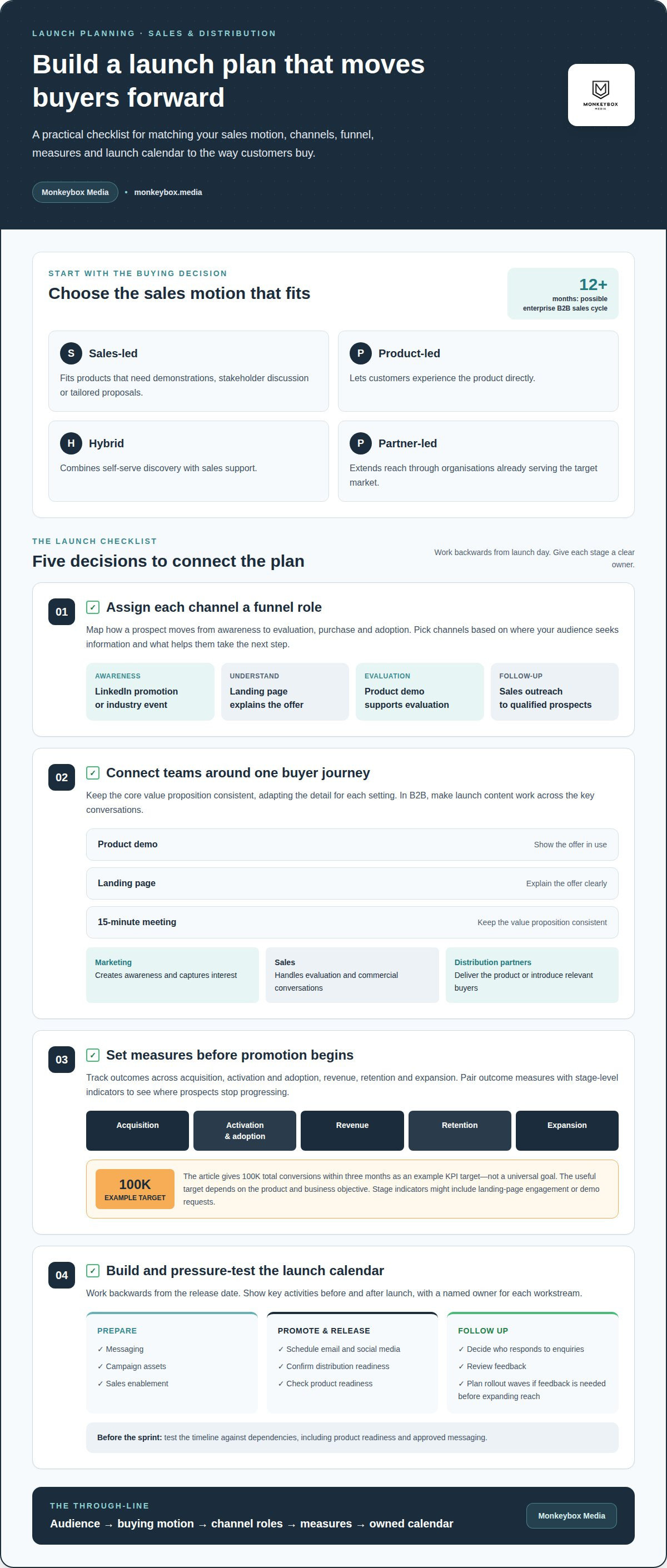
Build the product launch marketing plan by defining the target audience, matching channels to how buyers make decisions, and assigning an owner to each stage. Work backwards from launch day, setting milestones for preparation, promotion and follow-up. The launch calendar should show key dates and activities leading up to and following release.
- Choose the sales motion that fits the buying decision. A sales-led motion suits products that need demonstrations, stakeholder discussion or tailored proposals. A product-led motion lets customers experience the product directly, while a hybrid motion combines self-serve discovery with sales support. Partner-led distribution can extend reach through organisations already serving the target market. For enterprise B2B products, plan for sales cycles that can last 12 or more months.
- Give every channel a defined role in the funnel. Map how a prospect moves from awareness to evaluation, purchase and adoption. For example, a LinkedIn promotion or industry event can build awareness, a landing page can explain the offer, and a product demo can support evaluation. Sales outreach can follow up with qualified prospects. Choose channels based on where your target audience seeks information and what will help them take the next step.
- Connect marketing, sales and distribution around one buyer journey. In B2B, design launch content to work across a product demo, landing page and 15-minute meeting. Keep the core value proposition consistent, while adapting the detail to each setting. Marketing can create awareness and capture interest; sales can handle evaluation and commercial conversations; distribution partners can help deliver the product or introduce it to relevant buyers.
- Set KPIs for each funnel stage before promotion begins. Track measures for acquisition, activation and adoption, revenue, retention and expansion. A KPI target might be 100K total conversions within three months, but the useful target depends on the product and business objective. Pair the outcome measure with stage-level indicators, such as landing-page engagement or demo requests, to identify where prospects stop progressing.
- Build and pressure-test the launch calendar. Work backwards from the release date, assigning owners to messaging, campaign assets, sales enablement and distribution readiness. Schedule promotion across channels, including email and social media, and decide who will respond to enquiries after launch. Before the sprint begins, test the timeline against dependencies such as product readiness and approved messaging. Organise the rollout in waves if the team needs feedback before expanding reach.
Target audiences, ideal customer profiles, and buyer personas
Define the audience before choosing launch messages: identify which organisations need the product, who influences buying, and what prompts action. Common risks include weak market need, unclear positioning and support teams unprepared for launch. CB Insights reports that 35% of startups fail because there is no market need for their product or service.
-
Gather Market and Customer Intelligence
Start with customer conversations, sales feedback and market behaviour. Compare what prospective buyers say they need with the problems they actively try to solve. Review competitor positioning to find unmet expectations, not just gaps in feature lists. For example, if buyers struggle to connect existing tools, test whether integration matters more than adding another standalone feature.
-
Identify Target Customers and Personas
Define an ideal customer profile using firm characteristics such as sector, size, operating model and business need. Then create buyer and user personas for the people involved. The average B2B purchase involves 6.8 people in its buying centre, so map decision-makers, evaluators and day-to-day users separately. Record each persona’s goals, concerns, triggers and preferred evidence.
- Analyse customers, your company and the competition together. Create a simple comparison for each priority segment: the customer problem, your product’s relevant capability and the alternatives buyers already consider. A segment is stronger when the problem is urgent, your offer clearly addresses it and your business can serve it effectively. Don’t define the audience solely by job title; buying triggers and operating context often reveal intent more clearly.
- Validate assumptions through a focused mini-launch. Invite a small, relevant audience to try the core offer, then track their questions, activation and points of friction. Brief customer service before invitations go out, with clear product information, escalation routes and answers to common concerns. If users repeatedly misunderstand the same feature, revise onboarding or messaging before widening promotion.
- Turn evidence into a launch priority. Rank segments by problem fit, buying readiness, access through chosen channels and the team’s ability to support customers. Set a specific success measure for each audience, such as qualified evaluations or active use, and review feedback after the mini-launch. If customer insight and launch decisions need a stronger operating structure, explore structured launch planning.
What is a go-to-market strategy?
A go-to-market strategy translates business goals into clear market and customer choices, then connects product positioning with sales, marketing and launch execution. For a UK launch, check applicable local and international laws, including data protection regulations, before using customer information. Include product-specific requirements in the plan.
-
Set Product Positioning
Position the product by defining the customer problem, intended audience and value proposition. Then compare that proposition with the alternatives buyers already consider. For example, a project-management product might stand out through simpler team handovers, not a longer feature list. Check that the stated benefit reflects what the product delivers, and avoid claims the team cannot support.
-
Develop Key Messaging
Turn the positioning into a core message, supported by proof points and audience-specific detail. A useful structure names the problem, explains the product’s response and makes the value clear. For example, a finance team may need evidence of better reporting, while technical evaluators need implementation details. Keep the central message consistent across both conversations.
-
Map Messaging to the Buyer Journey
Map each message to the buyer’s next decision. At awareness, explain the problem and why it matters; during evaluation, show how the product works; near purchase, clarify the offer and next step. A SaaS landing page can introduce the value proposition, while a demo can answer practical questions. Make every touchpoint move the buyer journey forward.
-
Prepare Launch Content
Build content around the same message, adapting format to the channel. A B2B launch should make its story work across a product demo, landing page and 15-minute meeting. Draft the launch announcement, sales materials and customer-facing explanations, then vet the messaging and brief the full team. This alignment helps prevent conflicting claims across channels.
- Test the message before wider promotion. Use a small audience or a customer conversation to check whether people understand the problem, benefit and next step. Record recurring questions, confusion and objections. If buyers interpret a feature differently from the team, revise the wording before expanding campaign activity.
Examples of international, B2B and SaaS launches
B2B and B2C launches differ in their audiences, buying processes and campaign design. B2B planning must support multiple stakeholders and longer sales cycles; B2C messaging usually addresses individual customers and broader demand. Use each example as a way to test your own target market, proposition and expansion choices.
- Turn each example into a reusable template. Record the target market, customer problem, value proposition, channels, launch sequence and measures. Then identify the conditions that made the approach relevant. A template should guide decisions, not copy another company’s campaign. For instance, compare an international expansion with a focused SaaS release before deciding which elements fit your product.
- Study Oatly’s US expansion as a market-entry case. Oatly entered the US market in 2017, and its revenue grew ten-fold between 2017 and 2018. Treat those figures as context, not a forecast for another launch. Build a case study around the proposition, target market and route to customers, then identify which assumptions your team would need to validate before expanding.
- Use a B2B example to map committee buying. For a hypothetical analytics platform, separate the economic buyer’s business case from the technical evaluator’s implementation questions and the user’s daily workflow. Give each audience relevant proof points, while keeping the core proposition consistent. This makes the campaign useful across a considered buying journey rather than dependent on one broad message.
- Use a SaaS example to test activation and adoption. For a new subscription tool, map the path from first awareness to account creation, first meaningful use and continued adoption. A product-led approach may invite users to experience the product; a sales-led approach may rely on guided evaluation. A hybrid plan can pair self-serve discovery with sales support when buyers need both.
- Interrogate named examples instead of copying them. Use Fitbit or Apple’s iMac G3 as case-study prompts: identify the launch audience, proposition, campaign choices and evidence of success. Separate documented facts from assumptions before drawing lessons. Oatly’s international growth is one confirmed example here; the same analysis framework helps teams assess other launches without treating different markets as interchangeable.
- Adapt the plan to the market before scaling. For a UK launch, assess whether the product, sales motion and distribution channels match local customer expectations. Define the first market, choose a manageable launch wave and track customer response before expanding reach. A strong example becomes useful only when its decision points translate into actions your own team can test.
How a product launch fits into a go-to-market strategy
A product launch is the phase when a product becomes available to customers; the wider go-to-market strategy sets the decisions and coordination behind it. From planning through launch, align product, marketing, sales and customer success around shared timing, tools, responsibilities and measures.
- Translate the strategy into launch decisions. Set the release scope, target audience, value proposition and selected market before building the execution plan. For a new B2B module, decide which existing customer problem it addresses and whether the launch focuses on current accounts, new prospects or both. These choices define the work that follows.
- Confirm market readiness before setting the release date. Product readiness means having a working offer and clear information about its purpose. Marketing needs approved messaging and prepared content; sales needs relevant materials and a way to handle buyer questions. Customer success needs product context for onboarding and retention. Treat readiness as a shared decision, not a single team’s sign-off.
- Assign ownership across teams. Name owners for product decisions, launch messaging, sales execution and customer support. Give each owner a clear hand-off, such as marketing passing qualified interest to sales, then sales sharing customer context with customer success. A responsibility map reduces gaps between announcement, purchase and adoption.
- Pressure-test the timeline before the launch sprint. Work backwards from the intended release and list dependencies, including product readiness, messaging review, sales enablement and campaign production. Decide what action follows if a milestone slips. This exposes sequencing conflicts early, such as promotion starting before sales can explain the offer.
- Build a calendar for launch and follow-through. Schedule key dates and activities before and after release, including the announcement, campaign activity, sales outreach and customer communications. The announcement might combine a press release, interviews, and website or social media updates. Assign an owner and approval point to every activity to keep execution coordinated.
- Choose a launch event that supports product understanding. An event can bring stakeholders and interested parties together to learn about the product. Run it in person or virtually, with a live demonstration or industry experts where relevant. Give sales a follow-up action, such as sharing tailored information with attendees who need further evaluation.
- Measure the full customer path, not announcement activity alone. Define metrics for acquisition, activation and adoption, revenue, retention and expansion. If social media drives awareness, connect that activity to meaningful next steps, such as product evaluations or customer adoption. Review performance after launch and assign owners to investigate where potential customers stop progressing.
- Use post-launch evidence to decide the next wave. Compare results with the launch goal, review customer feedback and identify changes to messaging, onboarding or channel execution. A wave-based rollout lets the team apply early learning before widening reach. If you need strategic leadership to align launch decisions and execution, explore GTM strategy support.
Monkeybox Media: Fractional CMO
Monkeybox Media helps B2B organisations turn launch plans into coordinated market action. Its Fractional CMO leadership can help when strategic ownership or alignment across teams is needed; GTM Strategy supports decisions on audience, positioning, channels and launch execution.
When the strategy is sound but operational delivery is fragmented, Marketing Ops and Marketing Automation can help structure workflows, systems and campaign processes. The right next step depends on where the launch is stuck: direction, execution or the connection between them.
To discuss your launch priorities, contact Monkeybox Media or visit monkeybox.media.
Turn your launch plan into the next growth move
A go-to-market strategy for a new product launch should create a clear route from decision to action. Identify the strategic choice most likely to unlock progress: sharpen the audience, resolve an execution gap or align leadership around the launch. Give that priority an owner and make it part of the operating plan.
For B2B teams, strong launch execution depends on connecting strategy with the people, processes and systems that carry it forward. Monkeybox Media can help shape that work around your organisation’s priorities. If you’re ready to discuss your launch, contact Monkeybox Media.
Make the next move deliberate. A focused plan gives your team a stronger foundation for what comes next.
Frequently Asked Questions
Can a GTM strategy be applied to both new and existing products?
Yes. A GTM strategy can support a new product, a major module or an established offer entering a different segment. For an existing product, revisit assumptions that may have changed: customer needs, competitors, sales routes and the reasons buyers choose it. For example, a tool first sold to large organisations might need a different onboarding approach before serving smaller teams.
How much should the product or service cost for each customer group?
There’s no universal price that fits every customer group. Set pricing by weighing customer value, willingness to pay, delivery costs, alternatives and the role of each package. For example, a basic tier might serve smaller teams, while a higher tier could include capabilities larger organisations value. Test whether buyers understand the differences between tiers and whether the price supports the product’s intended position.
What is a go-to-market launch?
A go-to-market launch is the coordinated release of an offer to its intended market. It turns the broader strategy into customer-facing action: making the product available, activating selected channels and equipping teams to respond. A company launching a new analytics module, for example, might first release it to existing customers, gather feedback and then widen promotion to new prospects.
What are the 4 Ps of GTM?
The 4 Ps are product, price, place and promotion. Product covers the offer and its value; price reflects the commercial model; place describes how customers access or buy it; promotion covers how the market learns about it. For a UK software launch, a team might assess the subscription offer, pricing structure, direct sales route and campaign mix together rather than treating each decision separately.
What are the 5 pillars of GTM?
There isn’t one universally fixed set of five pillars. A practical framework is audience, offer, positioning, route to market and measurement. Use audience to define who matters; offer to specify what they receive; positioning to explain why it fits; route to market to determine how it reaches them; and measurement to assess progress. Together, these pillars expose gaps before launch activity begins.
What is the go-to-market model?
A go-to-market model describes how a business delivers, sells and supports an offer for its chosen customers. It may be sales-led, product-led, hybrid or partner-led. For instance, a specialist B2B platform might combine direct sales for complex accounts with self-serve onboarding for smaller customers. The model should reflect buying behaviour, service needs and the organisation’s ability to support each route.
What is a go-to-market strategy for a new product launch?
A go-to-market strategy for a new product launch is a plan for bringing an offer to its intended customers and building a path to adoption. It connects the audience, value proposition, pricing, channels, team responsibilities and success measures. For example, a new business software product needs a clear buyer, a reason to choose it, a way to reach that buyer and a process for learning from early use.
What market research and customer validation should be done before launch?
Start with customer interviews about current workarounds, buying triggers and desired outcomes. Compare what you learn with competitor offers and existing sales or support feedback. Then test a focused product concept or early version with relevant prospective users. For example, ask a finance team to complete a real reporting task and note where they hesitate. Use those observations to refine the offer, onboarding and launch message.