
A scaleup’s go-to-market strategy is the cross-functional plan for reaching the right customers and turning demand into repeatable growth. Effective go-to-market planning for scaleups aligns the target buyer, value proposition, sales channels and product-led, sales-led or hybrid motion. It gives marketing, sales and product teams a shared commercial direction.
Growth can expose gaps: the buyer definition is too broad, the message fails to explain the offer’s value, or the sales motion does not match how customers buy. More activity will not fix a poor fit. A sharper plan can.
This guide explains how to define your ideal customer and value proposition, assess direct, self-service and partner channels, and choose a motion that fits your product and sales process. It also shows how to turn those decisions into a practical plan your teams can execute, measure and refine as the business scales.
Key Takeaways
- Set a clear commercial objective and align marketing, sales and product around the same go-to-market plan.
- Define ideal customers by shared needs and buying behaviour, then use those insights to sharpen your segments and personas.
- Make your value proposition specific: connect the problem you solve to the outcomes buyers care about.
- Choose sales channels based on how customers discover, evaluate and purchase your offer.
- Match your product-led, sales-led or hybrid motion to product complexity and the support buyers need to make a decision.
What is a Go-To-Market strategy for startups?
A go-to-market strategy coordinates how a business reaches buyers, delivers value and generates revenue. For a scaleup, build it around four decisions: objectives, customers, routes to market and measures of progress.
-
Define the Strategy and Its Objectives
Start with the commercial objective, then define the market, offer and route to revenue. A go-to-market (GTM) strategy is the cross-functional plan for introducing a product or service and winning customers. It accounts for buyers, company capabilities and market competition, aligning product, sales and marketing around a shared launch or growth objective.
Tie the objective to a specific business decision, such as entering a new segment or increasing adoption of an existing offer. Check that the target market matches your ability to serve it. A plan focused on revenue alone can overlook delivery capacity, customer retention and competitive responses.
-
Distinguish GTM from Marketing Strategy
Treat the GTM strategy as the wider commercial plan, then use it to shape the marketing strategy. Marketing covers activities such as positioning, campaigns and lead generation. GTM connects those activities with product readiness, sales responsibilities, pricing decisions and the customer experience.
Check that every marketing choice supports the broader plan’s buyer, value proposition and sales route. A campaign may generate interest, for example, but the GTM plan must also determine who follows up, how prospects evaluate the offer and how customers receive ongoing value. Treating the plans as interchangeable leaves execution gaps.
-
Plan Acquisition, Retention, and Expansion
Map the customer journey in three stages: acquire the right buyers, retain them through delivered value, then expand suitable accounts. Choose channels that reach your target segment, and define how sales and marketing pass qualified prospects between teams. For B2B buyers, demos, consultations, pilots and procurement can shape the path from interest to purchase.
Plan onboarding and customer success alongside acquisition. A scaleup that prioritises new leads but neglects adoption risks weakening retention and future expansion. For a UK launch, include a review of GDPR and advertising rules in campaign planning. Map the personal data each channel collects, why it is collected and how marketing claims are substantiated. Assign approval ownership before lead forms, email nurture or paid advertising go live.
-
Select Metrics and Benchmarks
Choose measures that show where buyers progress or drop out. Track qualified leads, stage conversion, sales-cycle movement, customer acquisition cost, retention and expansion revenue. Review funnel metrics regularly and link each measure to a team action. If demo-to-purchase conversion falls, for instance, examine the demo, buyer fit and follow-up process.
Benchmark against your own segment, offer and past performance rather than treating one figure as universal. Establish a baseline, assign an owner to each metric and record the decisions made at each review. Repeat the GTM planning cycle at least once a quarter, updating assumptions when customer feedback or funnel evidence changes. The aim is a working market strategy, not a static launch document.
Ideal customer profiles, segmentation and buyer personas
Build customer definitions from evidence, not assumptions about who might buy. Use early launch feedback to sharpen your target, value proposition and support plan.
-
Define Customer Profiles and Segments
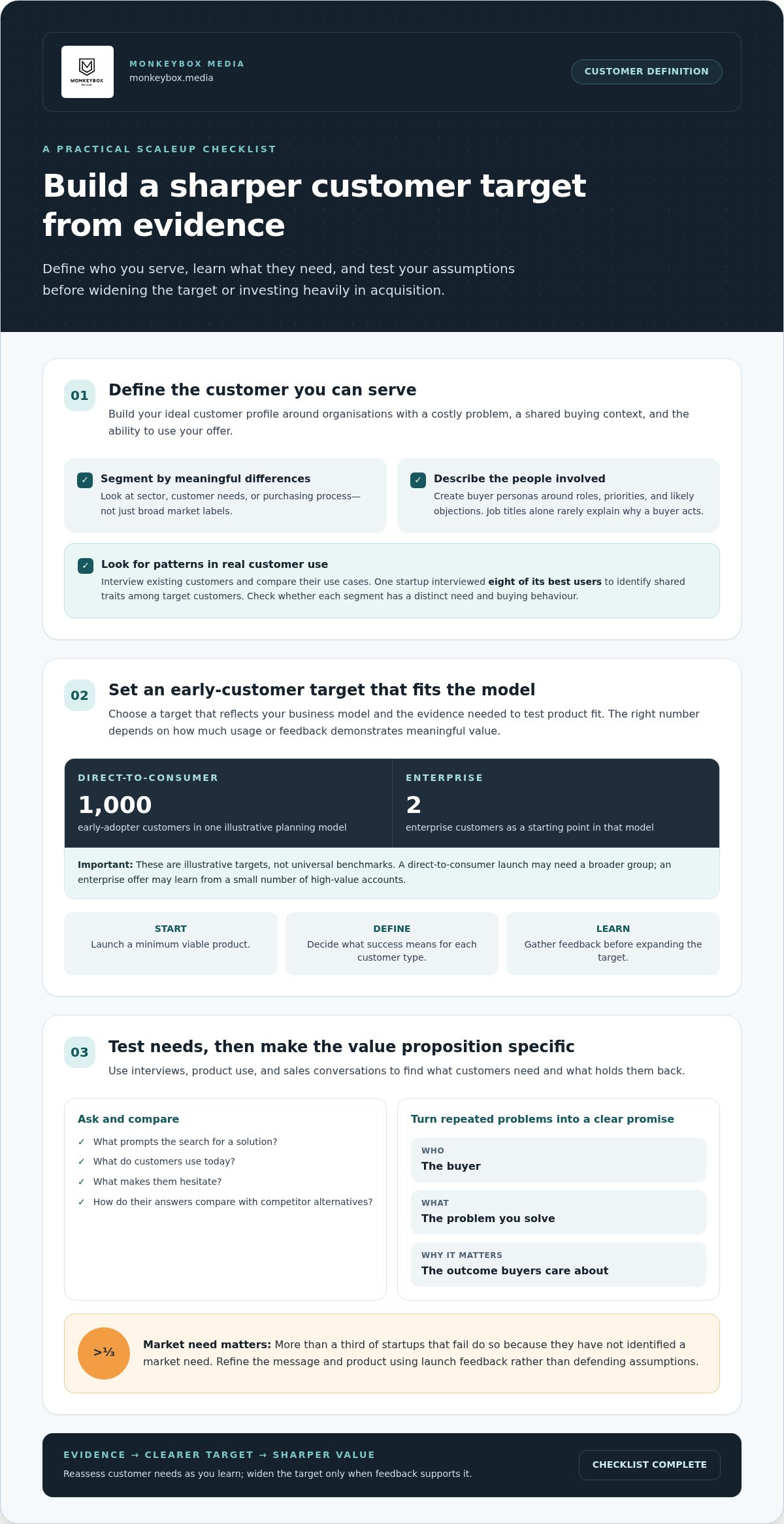
Define your ideal customer profile around organisations with a costly problem, a shared buying context and the ability to use your offer. Segment the market by meaningful differences, such as sector, customer needs or purchasing process. Then develop buyer personas that describe the roles involved, their priorities and likely objections.
Interview existing customers and look for patterns across their use cases. One startup interviewed eight of its best users to identify common traits among target customers. Check whether each proposed segment has a distinct need and buying behaviour. Avoid building personas around job titles alone; titles rarely explain why a buyer acts.
-
Adapt Early-Customer Targets
Set an early-customer target that reflects your business model and the evidence needed to test product fit. A direct-to-consumer launch may need a broader group of early adopters, while an enterprise offer may learn from a small number of high-value accounts. The right target depends on how much usage or feedback demonstrates meaningful value.
For example, one planning model uses 1,000 early-adopter customers for a direct-to-consumer business, but two enterprise customers as a starting point. Treat these as illustrative targets, not universal benchmarks. Launch a minimum viable product, define what success looks like for each customer type, and gather feedback before widening the target or investing heavily in acquisition.
-
Research Needs and Value Propositions
Test customer needs through interviews, product use and sales conversations. Ask what prompts the search for a solution, what customers use today and what makes them hesitate. Compare their answers with competitor alternatives, then identify the gap your offer can credibly fill. More than a third of startups that fail do so because they have not identified a market need.
Translate repeated customer problems into a value proposition that states the buyer, the problem and the outcome. Use launch feedback to refine the message and product, rather than defending assumptions. Build support into the plan: assign ownership for onboarding questions, route recurring issues to product, and set milestones for reviewing adoption, feedback and changes. Reassess customer needs and product fit every 3-12 months, adapting the cadence to technology and company maturity. A structured GTM planning process can help turn these findings into clear launch priorities.
Differentiating a product and defining its value proposition
Turn customer evidence into a clear position buyers can distinguish from alternatives. Then connect that value proposition to messaging and pricing decisions.
-
Map Competitive Positioning and Value
Compare your offer with competitors on the outcomes buyers value, not just the number of features. Use a simple value map to plot customer priorities against each option’s strengths, such as implementation effort, expertise or measurable business impact.
Review customer feedback, product claims and market performance, then organise your findings with SWOT or PEST analysis. Look for an underserved need your offer can credibly address. Avoid claiming uniqueness based only on a feature competitors can quickly match.
-
Develop Positioning and Messaging
Write a positioning statement that names the target buyer, their problem, your solution and the outcome. For a B2B product, connect the value proposition to return on investment, relevant use cases, expertise and long-term outcomes.
Build a message hierarchy from that position: lead with the customer’s priority, support it with evidence, then explain how the product delivers. A finance team, for example, may care more about reducing manual reconciliation than about a list of software functions. Keep the core message consistent across sales materials and campaigns.
-
Set Pricing Around Delivered Value
Choose a pricing approach that reflects the value buyers receive, the alternatives they compare and the cost of delivering the offer. Value-based pricing starts with the customer’s perceived outcome, then tests whether the price fits the target segment and commercial model.
Use early-adopter discounts only as a deliberate launch tool, not as a substitute for a strong value proposition. Define the purpose, eligibility and end point of any discount before promoting it. An illustrative running-shoe example prices the product 20% below similar products, showing how relative price can signal positioning without proving superior value.
-
Validate the Value Proposition
Test the message with target buyers before scaling campaigns. Ask prospects to describe the problem, explain what they understand about your offer and say what would make them choose it over an alternative. Compare their answers with sales objections and product usage.
Use the results to refine your message, evidence and pricing logic. If buyers respond to a different outcome than expected, adjust the position rather than forcing the original claim. A useful framework links each message to a buyer need, a proof point and a next action, giving sales and marketing a consistent basis for testing.
Direct, self-service and partner sales channels
Choose channels based on how buyers discover, evaluate and purchase your product or service. Match each route to customer effort, sales complexity and the support your team can provide.
-
Select Sales and Distribution Channels
Map the buyer’s route from first contact to purchase, then select channels for each stage. Direct sales suit considered B2B purchases involving demos, consultations, pilots or procurement. Self-service fits offers buyers can understand, assess and adopt independently. A partner can extend distribution when they already reach your target market or add relevant expertise.
For example, a B2B startup might use LinkedIn to build awareness, then route qualified prospects to a salesperson for a demo. A simpler product could guide visitors from a product page to self-service sign-up. Avoid adding channels simply to increase coverage; each route adds operational effort and needs a clear owner.
-
Set Pricing and Channel Mix
Align pricing with the service each channel requires. Self-service needs clear packaging and an easy purchase path, while direct sales can support tailored discussions, pilots and complex buying processes. Partner distribution also needs a commercial structure that recognises the partner’s role without confusing buyers about the offer.
Compare the full effort required for each route, including sales time, onboarding, customer support and campaign activity. Then assess whether expected revenue can support that delivery model. If a high-touch sales process accompanies a low-value offer, simplify the journey or revise the channel mix rather than assuming volume will fix the mismatch.
- Connect marketing channels to sales routes. Give each channel a defined job, audience and next action. LinkedIn can support B2B discovery, while a focused landing page can explain the offer and capture interest. Direct outreach, partner referrals and self-service content should reinforce the same value proposition, not create disconnected buyer journeys.
Set a budget for each channel objective and review what happens after engagement. A campaign that generates form submissions but few qualified conversations needs a different response from one that produces strong demo interest. Track lead progression alongside sales feedback, so marketing investment follows channels that reach relevant buyers.
- Test the channel mix before expanding it. Start with the routes that best match your customer evidence and team capacity. For example, use direct sales to learn from complex enterprise conversations while testing self-service for a more standardised offer. Record buyer questions, conversion points and support needs across both routes.
Use those findings to decide where to increase effort, refine hand-offs or involve a partner. Marketing automation and marketing operations can coordinate lead routing and channel reporting as activity grows. Keep the system focused: add a channel when it serves a distinct buyer need and your team can execute it consistently.
Choosing product-led, sales-led or hybrid motions
Choose a motion that matches how your target market evaluates and buys. Structure sales, marketing and customer success around shared goals, clear hand-offs and ongoing customer value.
- Match the motion to the buying experience. Product-led growth suits a simple, self-service product with low average contract value, where customers can recognise value through use. Sales-led motions fit complex offers that require demos, consultations, pilots or procurement. A hybrid motion combines product access with sales support, such as a trial that prompts a specialist conversation when a buyer needs guidance.
Check whether your audience can reach value independently. If setup, risk or stakeholder coordination requires explanation, a purely self-service route may add friction. If customers can adopt without assistance, a high-touch sales process may create unnecessary effort.
- Align sales, marketing and product around one motion. Set shared goals and messaging so marketing attracts the right audience, sales advances suitable opportunities and product supports the promised experience. For a sales-led motion, agree on what qualifies a lead and what information passes from marketing to sales. For product-led growth, connect product engagement signals to relevant follow-up.
Define customer success responsibilities at the hand-off, too. Sales can establish the customer’s goals, while customer success guides onboarding, adoption and ongoing value. Keep product informed about recurring customer needs. Clear ownership prevents prospects and customers from repeating the same information across teams.
- Test the motion before expanding the team. Track buyer progression through the steps that matter: acquisition, activation, sales conversations, conversion and retention. Review where prospects stall, then change the process or message based on evidence. Hiring three SDRs in month one does not prove a motion; it may simply add activity while the team is still guessing.
Run a focused test to learn whether customers self-serve, need sales assistance or move between both. Compare lead quality, sales feedback and product usage. Do not scale headcount or channel distribution until the motion shows a repeatable path from first contact to customer value.
- Build reporting and operations around the chosen model. Give each team a shared view of stage definitions, hand-off criteria and customer outcomes. Marketing operations can connect campaign activity with lead progression, while automation can route relevant signals to sales or customer success. Keep the system aligned with the actual buying journey, not internal reporting preferences.
Review the motion when product complexity, customer behaviour or sales requirements change. For example, a self-service product adding enterprise procurement needs may require sales support and a more structured customer-success hand-off. Build a scalable go-to-market motion with clear team alignment and operational processes.
Monkeybox Media: Fractional CMO
Monkeybox Media can help B2B scaleups turn GTM decisions into a coordinated plan and execution rhythm. Its Fractional CMO leadership provides strategic direction when the business needs senior marketing leadership without building every capability in-house. Use GTM Strategy to clarify priorities and align teams; Marketing Ops and Marketing Automation can support the processes and systems that keep execution organised as activity grows.
This is a practical next step when your buyer, value proposition or sales motion is defined, but ownership and delivery remain fragmented. It can also help when marketing activity lacks a clear link to pipeline and customer outcomes. Bring your current priorities and execution challenges into the conversation. Contact Monkeybox Media to discuss your go-to-market needs.
Put your next growth move into motion
Turn strategy into a focused operating rhythm. Choose the decision that will unlock progress now, assign an owner and agree how the team will assess the result. Keep the plan responsive to customer evidence and changing priorities. This discipline keeps go-to-market planning for scaleups connected to execution, rather than leaving it as a document teams set aside.
If your business needs senior marketing leadership to drive this work, Monkeybox Media offers Fractional CMO support and GTM Strategy. Marketing Automation can help coordinate repeatable workflows as your go-to-market activity develops. Start with the challenge currently slowing your team down.
Contact Monkeybox Media to discuss your GTM plan, and take the next growth move with clear priorities and ownership.
Frequently Asked Questions
What are the five elements to include in a go-to-market plan?
Include a target market, value proposition, route to market, commercial motion and measurement plan. Make each element operational: name the buyer group, state the outcome your offer delivers, assign channel ownership, define how prospects become customers and decide what evidence will inform changes. For example, record assumptions beside each choice so teams can distinguish validated decisions from open questions during execution.
What is a go-to-market strategy for a scaleup?
A scaleup go-to-market strategy is the operating approach for bringing an offer to a defined market and growing demand without losing commercial focus. It links customer choices to product, sales and marketing execution while accounting for the organisation’s ability to deliver. Effective go-to-market planning for scaleups turns growth priorities into accountable work, such as assigning a team to test a new segment before committing broader resources.
What are the key steps in a scaleup go-to-market plan?
Move from evidence to execution in a deliberate sequence. First, analyse customer and market signals, then select the segment and outcome to pursue. Shape the offer, set the channel and sales motion, and assign delivery owners. Finally, define the measures and review points that will trigger a change. The plan should identify dependencies, such as product readiness before campaigns generate demand.
How should scaleups define their ideal customer profile and target segments?
Define the profile using traits that predict need and ability to adopt, not just broad demographics. For a B2B scaleup, compare accounts by the problem’s urgency, existing workarounds, decision process and fit with product capabilities. Validate the pattern through customer conversations and observed usage. Then prioritise segments where the same message and delivery approach can serve multiple accounts without extensive customisation.
How should a scaleup choose between direct sales, partnerships and self-serve channels?
Choose channels according to buyers’ preferred purchasing paths and the support they need to reach value. Direct sales can suit purchases requiring tailored evaluation; self-service works when buyers can understand and start using the offer independently. Partnerships can extend reach or add relevant expertise. Pilot a channel with a defined audience, then compare lead quality, conversion friction, delivery effort and customer feedback before expanding distribution.
How much does go-to-market planning and customer acquisition typically cost for scaleups?
There is no standard cost: spending depends on the target segment, sales complexity, channel mix, team capacity and acquisition efficiency. Separate internal planning time, campaign investment, sales effort, onboarding and technology costs to understand the full picture. The price of a specific planning service depends on the case and is provided after a quote request; scope, delivery needs and implementation requirements shape the cost.
What are the main go-to-market risks for scaleups and how can they be mitigated?
Common risks include choosing a market with weak demand, spreading teams across too many channels and scaling acquisition before delivery can support new customers. Reduce exposure by documenting assumptions, testing them with buyers and reviewing customer feedback alongside pipeline evidence. Assign an owner to each major risk, such as product readiness or lead follow-up, and set a clear trigger for pausing, adjusting or increasing investment.
How can scaleups test and validate a go-to-market strategy before investing heavily?
Run focused experiments that answer one commercial question at a time. Test a message with a specific buyer group, trial a channel with a limited campaign or offer a pilot to learn where evaluation stalls. Set the success signal before launch, such as qualified conversations or repeated product use, and capture objections systematically. Use the findings to refine the offer and process before committing more resources.