
An international go-to-market strategy is a plan for launching a product or service in a new market and connecting its value proposition with a defined audience. Unlike a domestic launch, it must account for local buyer priorities, cultural expectations, regulation and competition. It also aligns market-entry goals, budget, resources and sales and marketing channels.
Expanding from the UK can create a new growth path, but copying your domestic playbook rarely provides enough direction. Buyers may describe the same problem differently, favour different channels and expect different support. Your plan needs to preserve what makes the offer valuable while adapting how you present and deliver it.
This guide explains how to assess a target market, test demand, set launch milestones and allocate resources before committing to a full rollout. You’ll learn how to select channels, adapt your value proposition for local buyers, measure performance and identify where international and domestic strategies call for different decisions.
Key Takeaways
- Prioritise one promising market, then map milestones, budget and team capacity before committing to a wider launch.
- Test readiness through focused conversations with local prospects and potential partners before scaling investment.
- Choose direct sales, partnerships or digital marketing based on how buyers in the target market evaluate and purchase.
- Adapt messaging to local buyer priorities and language rather than translating domestic materials word for word.
- Plan for longer sales cycles, higher early-stage costs and locally informed execution when comparing an international launch with domestic growth.
Launch planning, budgets and resource allocation
Allocate Budgets and Resources
Prioritise activities that can prove demand, such as prospect research, local messaging, sales enablement and channel testing. Link each budget and staffing decision to a milestone, such as completing buyer interviews or generating qualified pipeline. Avoid dividing resources evenly across markets before comparing their potential. A focused launch roadmap makes trade-offs visible and gives each team a clear role.
Reduce Launch Costs and Time
Begin with a structured pilot and a small number of conversations with qualified prospects. Use their responses to test whether the audience recognises the problem, understands the offer and would consider buying. This helps define what to do before a wider launch. Research local regulatory requirements and licensing early, so readiness issues surface before they disrupt operations or timelines.
Plan Launch Operations
Assign owners and define hand-offs for lead capture, qualification, sales follow-up, customer onboarding and support. Prepare the systems and messaging teams need to guide a prospect from first contact to purchase. Set up local feedback routes so customer experience issues reach the team responsible for resolving them. A launch plan needs clear operating responsibilities, not just a release date.
- Set the launch gates. Define what must be true before each investment decision, including evidence of prospect interest, delivery readiness and channel capacity. If early conversations show that buyers describe the problem differently, refine the messaging before expanding outreach.
- Assign measurable targets. Set goals for market penetration, customer acquisition and revenue growth. Track customer acquisition cost, conversion rate and sales-cycle length against projected targets. Add leading indicators, such as qualified opportunities progressing through sales stages, alongside lagging commercial outcomes.
- Review performance on a fixed cadence. At 30, 60, or 90 days post-launch, assess whether the sales team is reaching revenue and sales targets. Compare results with the launch plan, then use customer feedback to identify friction in the buying or onboarding experience.
- Adjust the next allocation. Shift resources towards channels and activities producing qualified demand, while investigating weak conversion or slow progression. Keep a record of each change and its rationale. This creates a practical decision trail for expanding, revising or pausing the launch.
Sales, partnership and digital marketing channels
Choose channels based on how target customers discover, evaluate and buy your offer. Align promotion, sales and distribution so every route carries a clear message into the market.
Map Distribution Channels
Plan Sales and Partnerships
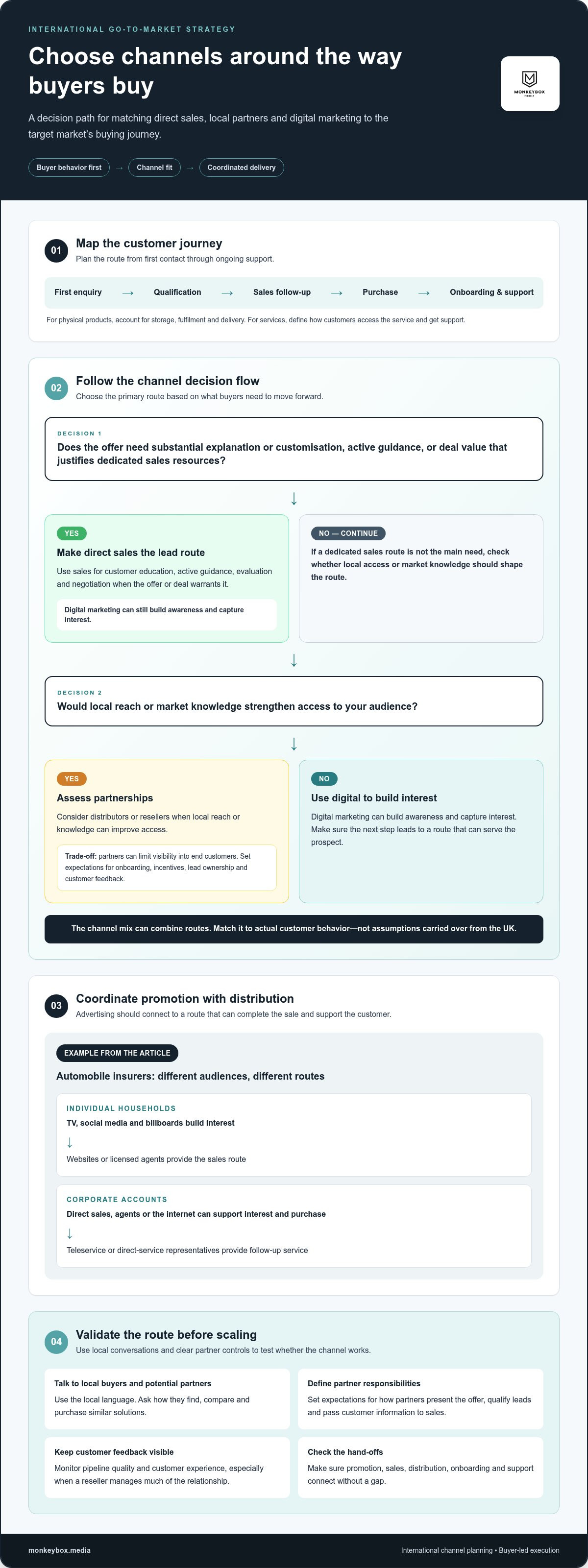
Choose direct sales when your offer needs substantial explanation or customisation, or when deal value justifies dedicated sales resources. For more repeatable routes, assess distributors and resellers, bearing in mind that they can limit your visibility into end customers. Set expectations for partner onboarding, incentives, lead ownership and customer feedback. Test demand through direct outreach to local buyers or potential partners, using the local language.
- Match the channel to the buying journey. A sales-led approach suits complex B2B products that require customer education and active guidance. Digital marketing can build awareness and capture interest, while direct sales can handle evaluation and negotiation. Use partnerships when local reach or market knowledge strengthens access. The channel mix should reflect actual customer behaviour, not assumptions carried over from the UK.
- Coordinate promotion with distribution. Ensure that advertising and digital campaigns direct prospects to a route that can serve them. For example, automobile insurers targeting individual households might build interest through television, social media and billboards, then sell through websites or licensed agents. Corporate accounts may use direct sales, agents or the internet for both interest and purchase, followed by teleservice or direct-service representatives.
- Set partner controls before scaling. Define how partners present the offering, qualify leads and pass customer information to sales teams. Agree how the business will monitor pipeline quality and customer experience. Keep a direct feedback route open, especially where a reseller manages much of the relationship. Review whether the chosen arrangement supports effective distribution and clear post-sale communication.
- Test channels with local conversations. Speak with prospective buyers and channel partners before committing to a broad campaign. Ask how they currently find, compare and purchase similar solutions. Their answers help shape messaging, identify useful digital touchpoints and expose gaps in the sales process. A focused GTM strategy can connect those choices to coordinated execution.
How do you adapt your value proposition for an unfamiliar audience?
Local culture, language and buying behaviour influence which benefits buyers value, how they assess risk and how they prefer to purchase. Use conversations with local prospects to adapt your message, commercial terms and payment experience instead of translating UK materials word for word.
Study Local Buying Behaviour
Interview prospective buyers in the target market and note the words they use to describe their problems. Compare their priorities, decision processes and preferred channels with your existing customer profile. For example, buyers may value implementation support more than a feature highlighted in UK messaging. Avoid treating a national audience as uniform: segment by shared needs and buying behaviour.
Localise the Value Proposition
Shape your value proposition around the outcomes local buyers prioritise, then test it in prospect conversations. Keep the core offer consistent, but adapt examples, proof points and terminology when they do not resonate. A direct translation can preserve the words but miss the buyer’s intended meaning. Use local feedback to sharpen each claim and make your competitive advantage clear.
- Map the buyer’s decision. Document who identifies the need, who evaluates options and who approves a purchase. Compare these roles with the UK buying process, then adapt sales materials to answer the target audience’s actual concerns. Local conversations can reveal unfamiliar objections or decision criteria before they become conversion barriers.
- Set market-specific pricing logic. Review how buyers compare alternatives, assess value and expect to pay. Account for the offer’s delivery costs, local competitive position and commercial terms when setting prices. Present the rationale clearly, and avoid simply converting a UK price into another currency. A price must make sense within the target market’s buying context.
- Design payment around the market. Identify the payment methods customers expect and the financial infrastructure required to accept them. Cross-border payments may need local payment rails; examples include SEPA in Europe and ACH in the US. Match the payment experience to the market served, and make currency, invoicing and payment terms clear before purchase.
- Adapt the promotion plan. Choose messages and formats that fit local expectations, then connect each campaign to a relevant next step. A digital advertisement should lead to a market-appropriate page, offer and sales conversation. Test language and calls to action with local prospects, then compare response and conversion to identify which message earns attention.
- Validate before wider rollout. Use prospect feedback to refine the value proposition, pricing presentation and customer journey together. If buyers understand the benefit but hesitate at payment terms, fix the commercial friction rather than rewriting the entire message. Keep the national strategy consistent in direction, while adapting execution to local evidence.
What is a global go to market strategy?
A global go-to-market strategy aligns a product or service with target customers across markets. It sets the customer, positioning and sales approach, then adapts them to local evidence.
Research Target Customers
Define your target market by identifying organisations or buyers with a shared need, ability to buy and reason to act. Build an ideal customer profile from patterns among existing customers, then test it with local prospects. For example, compare the industries, needs and purchasing triggers of your current customers with those of potential buyers abroad. Don’t assume the same profile will transfer unchanged across borders.
Build Regional Buyer Personas
Build a regional buyer persona from interviews, sales conversations and customer feedback in the market. Record the buyer’s role, objectives, concerns, decision criteria and preferred information sources. A profile based on UK customers might reflect familiar procurement practices; local interviews can reveal what needs revising. Segment by shared needs, not nationality alone, and distinguish decision-makers from users.
Analyze Customers, Company and Competition
Compare customer demand with your company’s strengths and the local alternatives. Review competitor positioning, customer opinions and gaps in existing offers; a SWOT or PEST analysis can help organise your findings. Competitors and substitutes can signal demand, but they also show where buyers already have options. Assess whether your product or service can solve a relevant problem in a distinctive way.
Identify Customer Pain Points
Ask prospects to describe the problem in their own words, its impact on their work and how they address it now. Note recurring frustrations, costly workarounds and events that prompt them to seek alternatives. For example, if buyers repeatedly mention slow implementation, test whether faster deployment matters more than a feature highlighted in UK materials. Use the evidence to refine your target.
- Choose a segment. Prioritise buyers with a clear need and a plausible reason to consider your offer.
- Validate the profile. Compare assumptions with local conversations, customer evidence and observed competitor gaps.
- Align the proposition. Connect the buyer’s stated pain point to a benefit your organisation can deliver.
- Set the market position. Clarify why the offer is relevant and how it differs from local alternatives.
Differences between international and domestic go-to-market strategies
Keep your commercial objective consistent, but don’t copy a UK launch plan into another market. International entry often involves longer sales cycles and higher early-stage costs. Local customer expectations, competition and support needs can also change how you execute.
- Reassess the customer profile. A domestic ideal customer profile is a starting point, not a guaranteed match abroad. Compare purchasing power, cultural attitudes and buying priorities in the target market. For example, the same business role may hold different decision-making authority across regions. Validate who evaluates, approves and uses your product before carrying over UK sales assumptions.
- Adapt the customer experience. Localisation means adjusting content to regional norms, values and expectations, not translating words alone. Review campaign examples, terminology, product explanations and calls to action with local buyers. Then adapt post-launch support so customers can receive clear, professional help in their preferred language. A translated website without an adapted support journey leaves a critical gap.
- Rebuild the resource model. Longer sales cycles can change how quickly international activity converts into revenue. Map the additional work involved in local research, market-specific messaging and customer support. Compare that workload with your domestic plan, then assign clear ownership. Avoid treating early international spending as a simple extension of the UK budget; entry requires its own milestones and resource decisions.
- Pair central direction with local execution. Keep central oversight for shared positioning, objectives and performance measures, while embedding execution close to the market. Local teams or partners can surface buyer feedback and cultural nuances; central teams can maintain strategic alignment. Set decision rights early. For example, define which campaign elements local teams can adapt and which require central approval.
- Account for competitive and operational differences. Research local competitors, substitutes and customer opinions before assuming your domestic advantage will transfer. Existing alternatives may reveal demand while shaping buyer expectations. International entry also involves operational and financial planning, including pricing, logistics, regulatory compliance and treasury management. Assess these alongside promotion, rather than treating the launch as a marketing-only task.
- Measure each market on its own terms. Set comparable objectives, but interpret results against local sales-cycle length, channel performance and customer feedback. A slower sales process may require different pipeline milestones from a UK launch. Review leading indicators and commercial outcomes together, then adjust local execution without losing the shared strategic direction. This creates a disciplined basis for deciding where to deepen investment.
Build a launch model that connects central priorities with local market evidence. Plan your cross-market GTM strategy to align those decisions.
Monkeybox Media: Fractional CMO
Monkeybox Media provides Fractional CMO leadership and GTM Strategy for B2B organisations planning international growth. Turn to this support when market-entry decisions need senior marketing direction, clear ownership and coordinated execution. A Fractional CMO can help align audience research, positioning, channel choices and launch priorities into a practical plan. Marketing Ops and Marketing Automation can support the systems and workflows needed to manage activity across markets, while keeping performance visible to the team.
For UK businesses considering a new market, the next step is to connect strategy with the people and processes responsible for delivery. Contact Monkeybox Media to discuss how its GTM strategy and fractional CMO leadership can support your expansion plans.
Turn market insight into your next move
International expansion works best as a sequence of informed decisions, not a one-off launch. Treat your international go-to-market strategy as a working system: use what you learn in the market to sharpen priorities, strengthen execution and decide where to build next. The goal isn’t to make every market identical. It’s to set a clear direction while responding to local evidence.
Choose the next action that removes your biggest obstacle to progress. That could mean aligning leadership on a market-entry decision, turning research into an executable plan or connecting marketing activity to a more consistent operating model. A focused discussion can clarify where strategic direction or implementation support would make the greatest difference.
Explore your next market-entry move with Monkeybox Media, and take the next step with a clear plan and the confidence to keep moving.
Frequently Asked Questions
How do you assess whether a foreign market is actually ready for your product?
Look for evidence that target buyers recognise the problem, can access a route to purchase and will engage in a sales conversation. During a pilot, record whether prospects agree to a next step, who controls the buying decision and which objections recur. Distinguish polite interest from intent: requests for a proposal or technical review are stronger readiness signals than general curiosity.
How do you measure whether your international GTM strategy is working?
Measure how prospects move through the sales process and whether that activity leads to commercial progress. Compare qualified opportunities with proposals, wins and revenue, then investigate where prospects stall. Track customer acquisition cost, conversion rates, sales-cycle length and customer lifetime value against your plan. Review results by market and channel so strong overall performance doesn’t conceal weak results in a particular segment.
What are the main market entry models and when should you use each?
Direct sales gives you closer control of buyer conversations and suits complex offers that need explanation or customisation. Distributors and resellers can extend your reach but usually reduce direct visibility into end customers. Partnerships can provide access to local relationships or expertise. Compare the models based on deal complexity, customer access, required control and the support your team can sustain. A pilot can show which route works before you expand.
What sections should you include in a GTM strategy?
Include a market and customer profile, positioning, competitive analysis, pricing approach, channel plan, sales process, launch roadmap, resource ownership and measurement framework. Add assumptions and decision gates so teams know what evidence should trigger a change in investment or execution. For example, specify how sales will record prospect objections and how marketing will use them to refine campaign messaging. Connect strategic choices to accountable actions.
Why does a solid go-to-market framework matter?
A framework gives teams a shared way to make decisions, coordinate work and identify gaps before they disrupt execution. Without one, marketing may optimise lead volume while sales focuses on deal quality, leaving no common view of progress. Agree on definitions for qualified leads, pipeline stages and launch readiness. This shared operating language helps teams resolve disagreements with evidence and focus effort on the same commercial objective.
What is an international go-to-market strategy?
An international go-to-market strategy is the plan for taking a product or service into a market beyond the company’s home market and turning its value into customer demand. It connects the intended audience with positioning, sales routes and the practical work needed to serve buyers. For a UK B2B firm, the plan should distinguish what remains consistent globally from what needs market-specific execution.
What are the key steps to build an international go-to-market strategy?
Start with a market hypothesis and define what evidence would disprove it. Research prospective buyers, alternatives and purchasing processes, then test the offer through direct conversations. Choose an entry route and assign owners for sales, marketing and customer support. Set success measures before launch, and agree who can change messaging or spending when the evidence shifts. This makes market entry a sequence of decisions, not a one-off campaign.
How do you choose which international markets to enter?
Compare candidate markets using the same criteria: customer need, reachable buyers, competitive intensity, fit with your offer and ability to serve customers. Include the effort needed to adapt sales, marketing and support. A market with visible demand may still be a poor first choice if access is difficult or the offer needs major changes. Prioritise the strongest fit, then validate it through buyer conversations before committing more resources.