
For a UK SME, marketing leadership as a service provides senior marketing direction flexibly, often through a fractional CMO or Marketing Director embedded in the business for 1-3 days per week. They set priorities, connect marketing activity to commercial goals and lead work through the existing team and agencies, without requiring a full-time executive hire. The focus is leadership and alignment, not adding activity for its own sake.
When growth plateaus, the issue may not be a lack of campaigns. It could be unclear positioning, a go-to-market plan that misses business goals, or marketing that isn’t contributing to the sales pipeline. You may need experienced direction without the cost and commitment of a permanent senior hire.
This guide explains how marketing leadership as a service works, when it can suit an SME, and how to assess whether it can connect strategy with execution. It covers the factors that shape the investment, including scope, leadership time and execution support, with pricing provided after a quote request. You’ll also learn how to identify growth bottlenecks, align marketing and sales around priorities, and turn go-to-market strategy into a practical plan.
Key Takeaways
- Use flexible senior leadership to set direction and coordinate your existing team and agencies, rather than adding activity without clear priorities.
- Match the level of marketing support to your business stage, internal capability and need for specialist execution.
- Connect marketing plans to commercial goals by aligning sales and marketing around shared priorities and meaningful performance measures.
- Assess the investment by considering leadership scope, time commitment and the operational support needed, not just the role title.
- When growth stalls, examine your go-to-market strategy and identify where positioning, execution or marketing operations are holding progress back.
What Is Marketing Leadership as a Service?
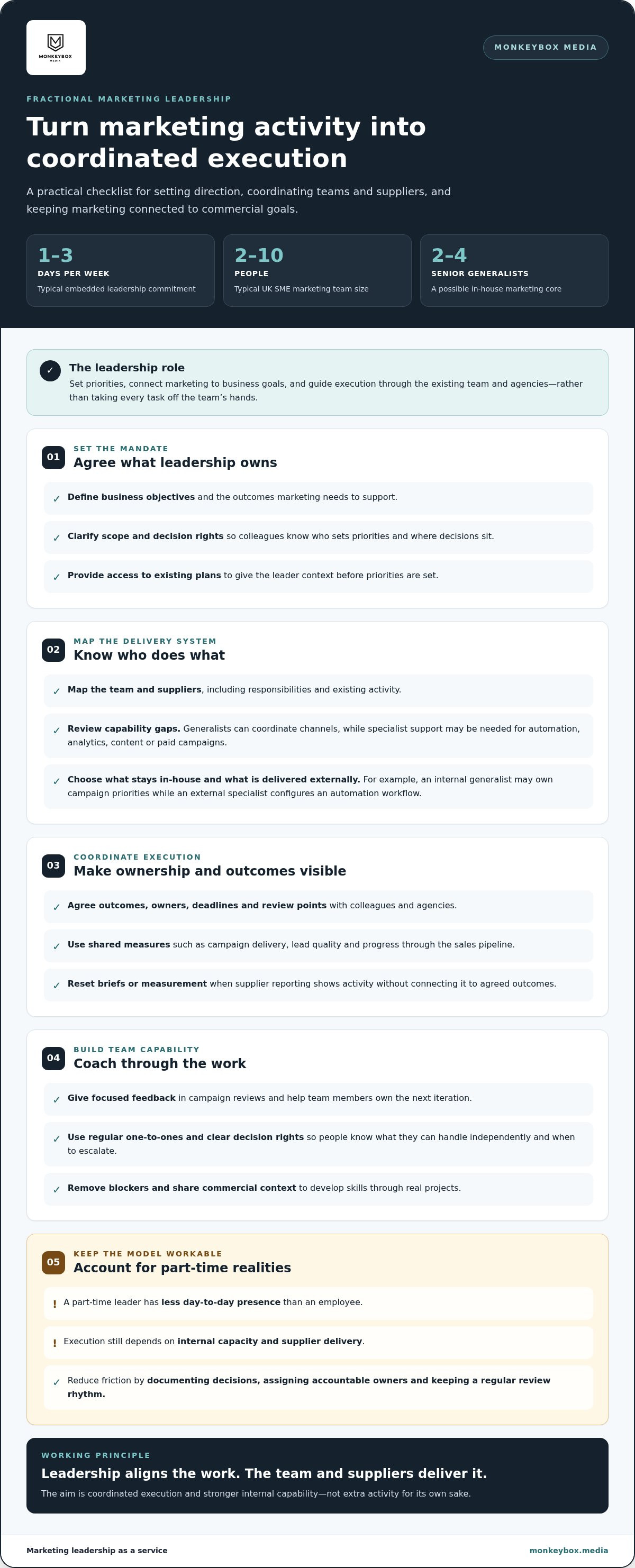
Marketing leadership as a service gives an SME senior direction without a full-time appointment. A fractional leader sets priorities, connects marketing to commercial goals and guides execution through the existing team. Agencies and specialist suppliers can remain in place, with their work managed, measured and aligned to the business plan. The leader enables the team to succeed rather than taking every task off its hands.
Team structure determines where that leadership adds value. UK SMEs typically have marketing teams of 2-10 people, while an in-house core may consist of 2-4 senior generalists. That core can coordinate activity across channels, but may need specialist support for areas such as marketing automation, analytics, content or paid campaigns. The leader identifies which capabilities belong inside the business and which are better delivered externally. For example, an SME’s generalist might own campaign priorities while an external specialist configures its automation workflow.
Oversight brings separate suppliers into one coordinated system. The marketing leader agrees outcomes, owners, deadlines and review points with colleagues and agencies. A shared framework might track campaign delivery, lead quality and progress through the sales pipeline. If an agency reports activity without connecting it to agreed outcomes, the leader can reset the brief, refine measurement or change priorities. This makes the value of execution easier to assess.
Leadership also means coaching the people doing the work. A marketing generalist can bring a campaign plan to a review, get focused feedback and own the next iteration. Regular one-to-ones and clear decision rights help team members know what they can handle independently and when to escalate. The leader removes blockers, shares commercial context and develops skills through real projects. The aim is to strengthen internal capability, not create dependence on an outside adviser.
Start onboarding a fractional marketing leader by agreeing business objectives, scope, decision rights and access to existing plans. Next, map the team and suppliers, review current activity, and set priorities, owners and review sessions.
Outsourced leadership has limits: a part-time leader has less day-to-day presence than an employee, while execution still depends on internal capacity and supplier delivery. Reduce friction by documenting decisions, assigning accountable owners and keeping a regular review rhythm.
Flexible senior marketing leadership for startups, scale-ups and SMEs
Founder-led UK businesses with £1m-£20m in revenue can use a flexible senior marketing leader as growth demands change. The model suits organisations that need commercial direction but aren’t ready to build a full executive function. A startup may need help defining its market and first acquisition priorities. A scale-up may need tighter coordination across campaigns, sales and delivery.
The commitment can be structured around the work. Marketing Leadership as a Service typically embeds a senior leader for 1-3 days per week. Those days might cover leadership meetings, team coaching, campaign reviews and planning with sales. A business can use that time to focus on a defined set of outcomes, then adjust priorities as its needs evolve. The value comes from clear ownership, not simply hours on a calendar.
For a startup, the first priority may be choosing a target customer and building a coherent route to market. The senior leader can help founders translate product knowledge into positioning, messaging and a practical marketing plan. For example, a team launching into a new B2B segment can align its sales narrative, campaign themes and lead-handling process before scaling activity. That establishes direction before execution expands.
At scale-up stage, the challenge often shifts from creating activity to coordinating it. A senior marketing leader can connect planning across functions, establish decision-making rhythms and identify gaps between strategy and delivery. If sales receives leads that don’t match its target accounts, the leader can review audience definitions, campaign briefs and feedback loops. Each adjustment should support an agreed business outcome.
Embedded leadership means working within the organisation’s actual operating context, not producing a plan in isolation. The leader joins relevant discussions, learns how decisions are made and works directly with colleagues. A practical starting point is a focused review of objectives, current marketing activity, team responsibilities and reporting. This provides a working picture before priorities are set.
A fractional model can also provide direction before a permanent appointment is made. Rather than waiting through a six-month hiring process, a business can bring in a leader to set priorities and guide the team through an immediate planning cycle, while founders retain visibility over decisions. This doesn’t replace every specialist or internal owner; it gives their work strategic coordination.
To make the arrangement effective, define the business outcomes, decision rights and working cadence at the outset. Then identify the first priorities, agree who owns each action and set regular reviews to assess progress. This structure keeps senior marketing leadership connected to execution without blurring accountability. If you’re mapping that operating model, explore flexible marketing leadership as a way to connect priorities with delivery.
Marketing strategy aligned with business goals
A marketing plan needs clear commercial direction, not a disconnected list of campaigns. Start with the business goal: entering a new market, improving customer retention or increasing qualified pipeline. Then identify the audience, offer and actions most likely to support it. For example, a B2B firm pursuing larger accounts might prioritise account fit and sales conversations over broad lead volume. This perspective helps teams choose opportunities deliberately and allocate effort against the outcomes leadership values.
Build the strategy with finance and sales, not in isolation. A marketing leader can ask the CFO or finance business partner how the organisation generates revenue and which financial outcomes matter. That clarifies the commercial context behind campaign targets. Sales can explain buyer objections, deal progression and lead quality. Marketing can use these insights to shape messaging and channel choices, while sales shares what happens after a lead enters its process.
Alignment needs a repeatable operating rhythm. Use weekly sprint reviews to discuss active work, blockers and sales feedback, then hold monthly leadership sessions to assess priorities and progress. For example, sales might flag that prospects misunderstand a product feature. Marketing can adjust campaign messaging and check whether sales conversations improve. The monthly session gives leaders time to reassess direction, resourcing and whether activity still supports business goals.
- Agree the objective: define the business outcome marketing should support.
- Set shared measures: select pipeline contribution, lead quality or conversion rates.
- Assign ownership: name who handles campaign delivery, lead follow-up and reporting.
- Review evidence: compare campaign results with sales feedback and commercial priorities.
These steps make alignment practical. If marketing reports lead volume while sales reports poor fit, agree on a shared definition of a qualified lead. If pipeline contribution is the priority, decide how to track and review marketing’s contribution. Customer acquisition cost and growth efficiency can also inform decisions, alongside conversion rates at relevant stages. Measures should guide action, not become reporting for its own sake.
A clear mission and direction help teams manage marketing’s many moving parts. A focused strategy gives specialists a reason for each brief and helps leaders spot work that no longer supports the goal. It also offers a useful decision test: does this opportunity advance the agreed commercial priority, or divert capacity from it? When evidence changes, revise the plan in weekly and monthly reviews. This keeps sales and marketing focused on shared priorities, with visible progress and accountable next steps.
Fractional CMO costs and value
The right engagement balances senior input, execution capacity and measurable business priorities. Compare leadership models by scope and accountability, not title alone.
Comparing Leadership, Full-Time Hiring, and Agencies
A full-time CMO provides dedicated leadership within the organisation, with ongoing involvement in decisions and team development. A fractional CMO brings senior direction for an agreed engagement, while an agency typically delivers defined work such as campaign execution. Identify the gap first: leadership, specialist delivery or both.
Pricing depends on scope and is provided after a quote request. Key factors include leadership time, responsibilities, team maturity and execution support. Compare proposals by reviewing included work, decision-making authority, reporting cadence and how success will be assessed. An engagement without clear ownership may leave strategic gaps; a broader remit should spell out its additional responsibilities.
Before choosing, map your current needs against three questions:
- Does the business need strategic direction or mainly specialist execution?
- Who will manage internal contributors and agency relationships?
- Which commercial measures should guide priorities and reviews?
If the challenge is disconnected activity, leadership can align existing suppliers. If the main need is a specific deliverable, a focused agency brief may be more direct. Some businesses need both: a senior leader to set the framework and agencies to deliver defined work.
Expected Results and KPIs
Set expectations around better decision-making, clearer ownership and stronger alignment between marketing activity and business goals. Track pipeline contribution, lead quality, customer acquisition cost, conversion rates and growth efficiency. Choose measures that fit the objective: lead quality matters when sales follow-up is the constraint, while conversion rates can reveal friction between stages.
Agree a baseline, reporting owner and review rhythm before work begins. For example, if the priority is improving qualified pipeline, marketing and sales should define what qualifies, record contribution consistently and review lead progression together. This makes performance discussions actionable. A dashboard without shared definitions can create conflicting interpretations instead of useful decisions.
Separate leading indicators from commercial outcomes. Campaign delivery and response offer early signals; pipeline contribution and customer acquisition cost show how activity connects with business performance. Review trends alongside sales feedback, then adjust targeting, messaging or execution when evidence points to a gap. A fractional CMO should make decisions visible and assign owners and next steps.
Growth plateaus and go-to-market strategy
A plateau often signals a mismatch between the offer, audience, sales process or channel mix. UK businesses commonly consider senior marketing leadership when turnover crosses £2-5m and marketing spend approaches £100k+ per year. These thresholds can prompt a closer look, but the practical question is where growth is getting stuck. More campaigns won’t fix a proposition that buyers don’t understand.
Start with the customer journey, from first contact through sales conversations and repeat business. Review where prospects disengage, what objections sales hears, and whether the offer addresses a priority problem. If enquiries come in but few progress, for example, compare lead fit, response handling and campaign messaging. This helps distinguish a targeting issue from a sales follow-up or positioning challenge.
A focused go-to-market review can follow four steps:
- Recheck the audience: identify the customer groups with the clearest need and strongest fit.
- Sharpen the offer: make the value and differentiation clear in buyer language.
- Map the journey: connect campaign messages to sales conversations and next actions.
- Prioritise channels: concentrate effort where the team can reach and convert suitable buyers.
Then test the strategy against commercial evidence. Compare lead quality, conversion rates, pipeline contribution and sales feedback to find friction. If a channel attracts attention but not qualified opportunities, revisit its audience or role before increasing activity. If sales conversations reveal the same misunderstanding, update the positioning and campaign brief. Each change should address a specific constraint, not simply refresh the marketing calendar.
Three or more recognised signs can prompt a closer look at the need for senior marketing leadership. The next step is to identify which symptoms share a cause. Weak conversion, inconsistent messaging and unclear campaign ownership may all point to a fragmented go-to-market approach. A leader can turn these signals into a prioritised plan, align work with business objectives and assign owners for execution.
Keep the plan operational: define the target segment, value proposition, sales hand-off and channel priorities. Review progress with sales, then adjust based on what buyers do and say. This creates a feedback loop, rather than a one-off strategy document. When the central challenge is market entry, positioning or stalled pipeline, explore a focused GTM Strategy to connect the market opportunity with a clear execution plan.
The author says highly paid business strategy firms may take six months to reach two conclusions about growth strategy, underscoring the value of focused decisions.
Monkeybox Media: Fractional CMO
Monkeybox Media helps B2B organisations that need senior marketing direction connected to practical execution. Its Fractional CMO leadership can set priorities and guide marketing activity, while GTM Strategy supports businesses refining their route to market or addressing a growth plateau.
Consider this model when marketing work lacks clear ownership, sales and marketing priorities have drifted apart, or systems are slowing execution. Monkeybox Media’s Marketing Automation and Marketing Ops services can support consistent workflows and stronger operational alignment. The focus is on connecting strategy, team activity and business objectives, rather than adding disconnected campaigns.
To discuss how this approach could support your growth priorities, contact Monkeybox Media or visit monkeybox.media.
Turn marketing priorities into your next move
Start by defining the business change you need marketing to support. Identify the current bottleneck, the decision that needs senior ownership and the evidence you’ll use to assess progress. This gives a leadership engagement a clear starting point and keeps activity tied to commercial priorities.
For SMEs that need flexible direction, marketing leadership as a service can bring clearer ownership and more focused action. Monkeybox Media provides Fractional CMO leadership, GTM Strategy and Marketing Automation. These services address needs ranging from senior oversight to market planning and more structured marketing workflows. The right starting point depends on where your growth plan needs stronger leadership or execution.
Bring your priorities and current challenge into the conversation, then explore how they could translate into a practical plan. Contact Monkeybox Media to discuss your next step. A clearer direction starts with a focused decision.
Frequently Asked Questions
What services can a flexible marketing leader provide?
A provider of marketing leadership as a service typically supplies senior marketing direction, planning and oversight, with the scope shaped around the business’s needs. For example, Monkeybox Media offers Fractional CMO leadership, GTM Strategy, Marketing Automation and Marketing Ops. These capabilities can help a B2B team define its market approach, improve workflows or strengthen operational coordination. Agree which decisions the leader owns and which activities stay with internal colleagues or specialist suppliers.
How does outsourced marketing leadership work for UK businesses?
An external senior leader takes an agreed role in planning and decision-making, while the business retains its team and supplier relationships. Start by sharing business objectives, current plans and relevant performance information. The leader can then set priorities with decision-makers and establish a review process. For example, leadership reviews can resolve competing campaign requests and assign clear owners for follow-up.
How is the cost of an external marketing leader determined in the UK?
The cost of marketing leadership as a service depends on the scope and is provided after a quote request. Key factors include leadership responsibilities, time commitment, organisational complexity and any operational or execution support required. Strategic oversight differs from guidance across marketing systems and delivery. Define responsibilities and desired outcomes first, so the proposed engagement reflects the organisation’s needs.
Which businesses are best suited to flexible marketing leadership?
It can suit B2B businesses with marketing activity underway but no senior owner connecting it to commercial priorities. For instance, a company whose founder approves every campaign may need clearer decision-making as its team takes on more responsibility. The model can also help a business preparing a new offer or entering a customer segment. It’s less suitable when the need is only a discrete execution task without a strategic leadership gap.