
A bigger MarTech stack doesn’t prove your go-to-market operation is mature. A marketing operations maturity model assesses how well your strategy, processes, technology, data and people work together to support business goals. Teams often score each dimension on a five-level scale, from ad hoc to optimised, to identify strengths and capability gaps.
When campaign workflows feel slow or reporting lacks clarity, it’s easy to focus on software. But a MarTech audit examines the tools, while a maturity assessment takes a wider view of how teams use data, manage processes and coordinate their work. The distinction matters: replacing platforms won’t fix unclear ownership or inconsistent measurement.
This article explains what a maturity model measures, how to assess your current state and why the highest possible score isn’t always the right target. You’ll also learn how to set a useful goal around your organisation’s priorities, resources and GTM plans, then turn the gap between today’s capabilities and your desired future state into a focused improvement roadmap.
Key Takeaways
- Assess capabilities and business alignment, not just the tools in your marketing stack.
- Set maturity targets around your strategy, resources and business milestones rather than aiming for the top level everywhere.
- Map ownership across Marketing, Analytics, Revenue Operations and Finance to expose hand-off gaps and reduce rework.
- Build trustworthy data foundations with shared metric definitions, governance and useful reporting before pursuing advanced analytics.
- Turn assessment findings into a prioritised roadmap that sequences improvements by value, complexity and available capacity.
How is a maturity assessment different from a MarTech audit?
A maturity assessment evaluates how marketing strategy, execution, data and GTM alignment work together. A MarTech audit focuses more narrowly on technology, its management and its fit with organisational goals.
Maturity Assessment Scope
A maturity assessment scores capabilities across planning, process design, technology, support, administration and business intelligence. It matters because a team’s tools alone can’t show whether its decisions support customer value or GTM priorities. For example, documented campaign workflows with little automation can indicate maturity level 3, despite limited platform sophistication.
Assessment Approaches and Evidence
Teams can assess maturity internally, externally or through a combination of both approaches. Evidence may include documented workflows, planning processes, data definitions, reporting and team responsibilities. Comparing these sources can expose differences between stated strategy and daily execution. For instance, a dashboard may exist even when teams lack consistent definitions for the metrics guiding their decisions.
A MarTech audit examines one part of that picture. It can review vendor relationships and contracts, how technology aligns with organisational goals, and whether teams manage and use selected tools effectively. A maturity assessment also examines processes, governance, people and data. If a platform works as intended but campaign hand-offs repeatedly stall, the underlying gap may be ownership or process design, not software.
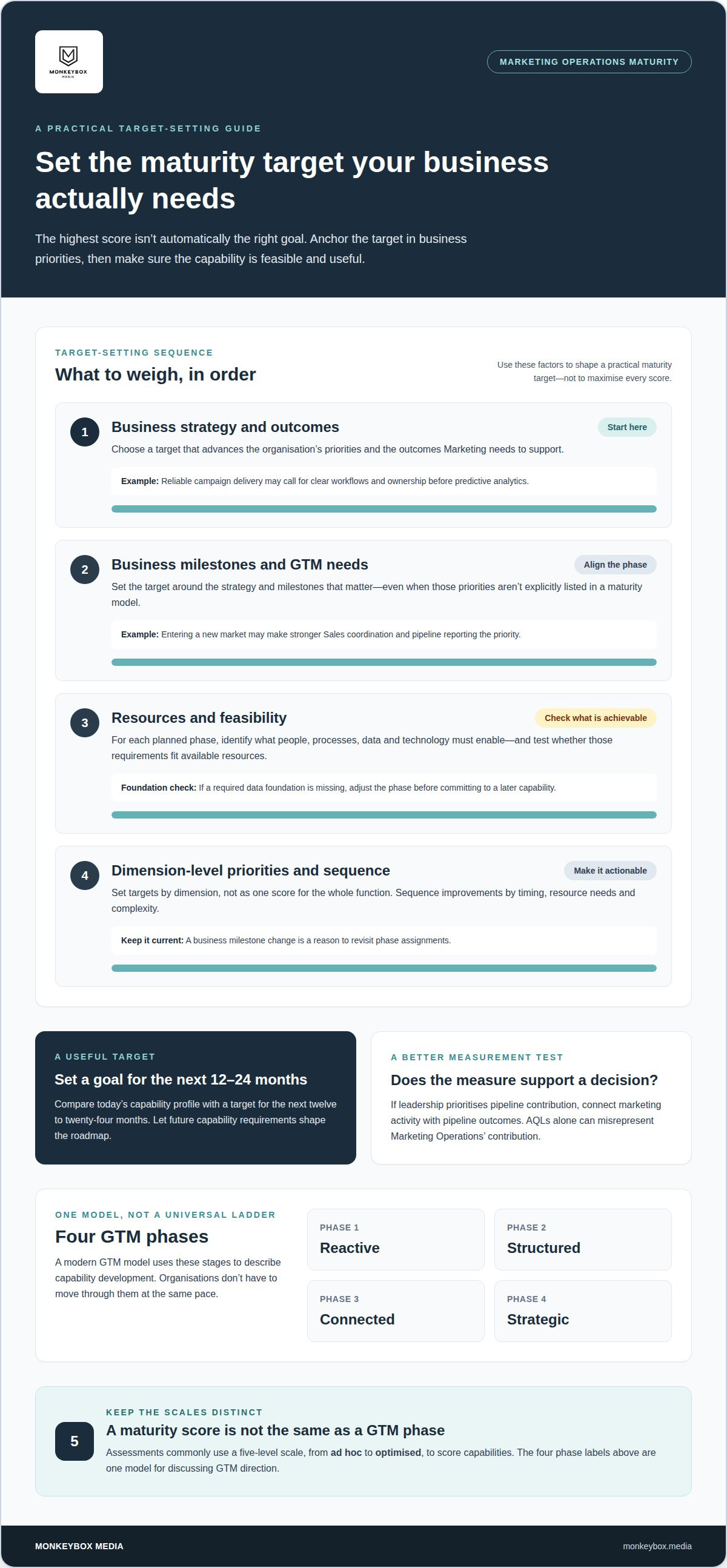
Assess each dimension using evidence of capability, rather than treating a product list as a maturity score. One common approach uses a five-level scale, from ad hoc to optimised, and records the current state. Teams can compare that profile with a target for the next twelve to twenty-four months. The result shows where strategy, execution and GTM alignment diverge.
Future capability requirements should shape the roadmap, not sit in an isolated wish list. For each planned phase, document what people, processes, data and technology must enable. Then assess whether those requirements are feasible with available resources. If a required data foundation is missing, adjust the phase before committing to a later capability.
An assessment’s cost depends on its scope, the functions involved, the evidence required and the complexity of the operating model. The price is provided after a quote request.
Is the highest maturity level always the goal?
No. Choose a target that advances business priorities instead of maximising every score. The right maturity phase depends on strategy, milestones, resources and the outcomes marketing needs to support.
Maturity Phases and Business Goals
Maturity phases describe how marketing capabilities develop in relation to business goals. One modern GTM model uses four stages: Reactive, Structured, Connected and Strategic. The labels help teams discuss their direction, but they aren’t a universal ladder that every organisation must climb at the same pace.
For example, a business focused on reliable campaign delivery may prioritise clear workflows and ownership before investing in predictive analytics. A company entering a new market may instead need stronger sales coordination and pipeline reporting. Align phases with the organisation’s strategy and relevant business milestones, even if those priorities aren’t explicitly included in the model.
Measurement and Business Goals
Measurement maturity is the ability to assess and optimise marketing activity using appropriate methods, data, tools and expertise. It matters when reports need to inform decisions, not just describe activity. Assess whether data integration, analytics tools and measurement models connect to the business goals they’re intended to track.
For instance, if leadership prioritises pipeline contribution, reporting should connect marketing activity with pipeline outcomes. AQLs alone can misrepresent Marketing Operations’ performance and contribution. Pair activity indicators with measures that reflect the organisation’s priorities, then check that teams use them consistently in planning and reviews.
Investment decisions should follow the same logic. An advanced capability is useful only when it supports a defined outcome and the organisation can act on its results. If the priority is improving efficiency, first examine where processes create avoidable rework. If it’s forecasting, assess whether available data and measurement methods can support that decision.
Alignment with Sales and enablement also affects which target makes sense. Marketing, Sales and enablement teams can share context to reduce rework and shorten feedback loops. For example, when sales feedback on lead quality informs campaign planning, teams can focus investment on changes that support shared goals, rather than optimising disconnected departmental measures.
Set targets by dimension, not as a single score for the whole function. A team might prioritise stronger reporting in one area while maintaining simpler processes elsewhere. Sequence planned capabilities by timing, resource needs and complexity, then revisit the phase assignments when a business milestone changes. For a strategy-led review of automation priorities, explore marketing automation aligned with business outcomes.
Connected GTM data and cross-functional coordination
Connected GTM data links campaign activity with customer journeys and business outcomes across channels. Without clear integration, Marketing, Sales and Finance can use different metrics and make conflicting decisions. The goal is a shared foundation for planning, measurement and follow-through, not simply moving more data between platforms.
At the building stage, organisations begin integrating channel data and using conversion tracking or customer journey mapping, but insights may remain fragmented. For example, a campaign report might show engagement while a separate sales report records opportunities, with no consistent way to connect the two. That gap limits the organisation’s ability to understand which activities contribute to outcomes.
At the leading stage, teams can attribute business outcomes across channels, predict campaign performance and align media strategies with business goals. Reaching this level depends on appropriate data, analytics and expertise. A practical assessment examines whether marketing can access collected data, dashboards support decisions, and teams use metrics consistently for personalisation and forecasting across channels and the pipeline.
Cross-functional collaboration makes these measures useful. Marketing Operations works with other marketers and stakeholders, so its performance can’t be assessed in isolation. A Revenue Operations partner may own pipeline definitions, Analytics may manage measurement methods, and Finance may validate business reporting. A RACI matrix can clarify responsibilities across Marketing Operations, Analytics, Revenue Operations and Finance.
This division of effort prevents a familiar failure: teams debate numbers because each function defines performance differently. A shared metric catalogue gives Marketing, Finance and Revenue Operations a common vocabulary. For example, agreeing on what counts as a qualified lead or pipeline contribution makes campaign reviews more consistent. Data contracts, standardised metric definitions and formal change control can reinforce that foundation as systems evolve.
Validate priorities with a cross-functional team before committing resources. Marketing can identify campaign needs, Sales can surface hand-off friction, Analytics can assess measurement feasibility, and Finance can test reporting implications. This review checks whether a proposed capability addresses an organisation-wide need or merely shifts work to another team. It also reveals dependencies, such as inconsistent source data undermining an integration project.
For advanced measurement, prepare model-ready datasets with the right grain, features and historical context for marketing mix modelling or multi-touch attribution. These methods need inputs suited to the decision being made. A useful maturity review therefore assesses data availability, metric consistency and stakeholder ownership together. Connected systems matter, but coordinated decisions turn integration into operational value.
What is marketing maturity?
Marketing maturity describes how effectively an organisation develops and uses its marketing capabilities. Strong data foundations make analytics more consistent and give a maturity assessment practical evidence for its roadmap.
Data Foundations and Identity Resolution
Data foundations are the structured processes and systems that make marketing information usable across channels. They matter because fragmented records can obscure how customer interactions connect with sales outcomes. At an emerging measurement stage, organisations may track basic impressions and clicks while channel data remains siloed. Greater maturity involves building integration and identity resolution, helping teams connect records around customer activity.
Identity resolution can support a clearer view of customer journeys when information comes from different channels. A data clean room may help establish a measurement foundation at the developing stage. The aim isn’t to collect every available field. It’s to make relevant, appropriately governed data usable for decisions such as campaign planning and performance analysis.
Data pipelines need defined processes for handling incoming records, normalisation and backfills. For example, a pipeline can standardise campaign names before combining records from separate channels. A backfill can bring earlier records into the same structured format, giving analysts useful historical context. Without these steps, reports may compare inconsistent labels or incomplete periods.
A governed data warehouse can provide a controlled foundation for shared analysis. Teams can align around a metric catalogue that defines measures consistently across Marketing, Finance and Revenue Operations. Data contracts and formal change control help preserve those definitions as systems or reporting requirements change. This creates a more stable basis for analytics and forecasting.
Data Quality and Observability
Data quality and observability describe how teams govern, monitor and assess the reliability of marketing data. They matter because inaccurate or poorly governed analytics can distort decisions and undermine a roadmap. An assessment can examine whether marketing analytics are trusted, accurate and governed, alongside the priority given to cleaning and appending data.
Build quality checks into the data flow. For example, teams can flag missing campaign identifiers, inconsistent date formats or unexpected gaps before those issues reach a dashboard. Observability makes changes and failures visible, so owners can trace a reporting problem to its source. Clear ownership turns detection into action.
Governance also needs shared definitions and controlled changes. If Marketing changes a campaign classification, Finance and Revenue Operations need to understand how that affects their reports. Standardised metric definitions and documented change control reduce conflicting interpretations. They also help explain why a figure changed, rather than leaving stakeholders to reconcile separate spreadsheets.
Build the roadmap around the data capability needed for the next business decision. If channel reporting is fragmented, prioritise reliable integration and consistent definitions before advanced analytics. If forecasts drive planning, first assess data availability, historical context and governance. This sequence ties investment to usable evidence, not just new infrastructure.
Marketing operations maturity model purpose and components
A marketing operations maturity model turns capabilities into a structured view of current performance and future priorities. Its value lies in showing where operational progress can support growth, campaigns and better decisions.
Leading models differ in their dimensions and stage labels. Some score capabilities on a five-level scale, typically from ad hoc to optimised; another operations model uses Basic, Managed, Strategic and Foresight. A modern GTM model uses Reactive, Structured, Connected and Strategic. Compare the capabilities behind each model, not just their names.
To build a model, first define what it covers and excludes. Use swim lanes to group areas such as strategy, process, data, technology and support. Then document the current state for each area, including observable capabilities and supporting evidence. This gives teams a shared starting point instead of a score driven by opinion.
Next, set a target profile around business goals and milestones. The model should show the desired future state, not serve as a delivery plan by itself. Record what each future phase requires, including people, processes, data and technology. Planned campaigns or use cases can then be grouped by timing, resource needs and complexity.
To improve maturity, identify capability gaps, prioritise those tied to business outcomes, and sequence funded initiatives into a roadmap. Assign owners and define how progress will be measured. Reassess every six to twelve months, or after a significant organisational change, to check whether priorities and phase assignments still fit the marketing operations maturity model.
Common risks include scoring capabilities without evidence, setting targets beyond available resources, and treating technology adoption as progress by itself. For example, launching a new platform won’t resolve unclear ownership or a process that teams don’t follow. A cross-functional review can test feasibility, identify dependencies and keep investment connected to outcomes.
For UK organisations, treat the model as a business framework, not a compliance standard. Set internal benchmarks from documented capabilities and use peer comparisons only when they draw on validated frameworks and documented results. This keeps assessments grounded in the organisation’s own strategy and operating context.
Use the model to calculate category scores as checkpoints, not as a substitute for examining individual capabilities. A high average can hide a weak point in data readiness or campaign orchestration. Strong progress is visible in specific improvements: clearer ownership, more consistent execution, and insights that support decisions. For a roadmap that connects marketing operations priorities with GTM execution, discuss your marketing operations roadmap.
Monkeybox Media
Monkeybox Media helps B2B organisations turn maturity findings into focused GTM priorities and practical operational improvements. If your assessment has exposed gaps in ownership, campaign processes or data use, its GTM Strategy and Marketing Ops can help connect those priorities to business goals and day-to-day execution.
When marketing leadership needs strategic direction, Fractional CMO support can help set priorities and align teams. Marketing Automation can support workflows once the underlying processes and requirements are clear. The right starting point depends on the gap you need to address, not on adding technology for its own sake.
Contact Monkeybox Media to discuss your marketing operations priorities and next steps.
Turn your assessment into forward momentum
A useful assessment should change how decisions get made, not sit untouched in a presentation. Give the findings a clear owner, connect priorities to upcoming business plans, and make progress part of regular leadership conversations. That creates a route from analysis to action without turning every opportunity into a new project.
Use your marketing operations maturity model as a reference for deciding what deserves attention next. Revisit the assumptions behind each priority as your GTM strategy evolves. If market conditions, team capacity or business direction shift, adjust the roadmap rather than continuing work that no longer serves the organisation.
When you’re ready to translate assessment findings into practical priorities, contact Monkeybox Media to discuss your marketing operations. Bring the challenges you want to resolve and the outcomes your organisation needs to support. A focused conversation can help clarify a sensible next move.
Build with intent, keep decisions connected to business needs, and make every step count.
Frequently Asked Questions
What Is a Maturity Model?
A maturity model is a framework for describing how consistently an organisation performs a set of capabilities. It gives teams shared language for distinguishing informal practices from repeatable, strategically aligned work. For example, a marketing team can use stages to discuss whether campaign approvals depend on individual knowledge or follow an agreed process. The model helps frame development decisions, but doesn’t prescribe one route for every organisation.
How often should a team reassess maturity?
Plan a full assessment annually or after a major organisational change, such as a restructure or shift in GTM strategy. Use lighter quarterly check-ins to surface new blockers and confirm ownership. A six-to-twelve-month comparison can show whether capabilities have advanced against the original baseline. Keep the cadence useful: reassess sooner when a significant change makes earlier findings or priorities irrelevant.
Should a maturity assessment be done internally or externally?
Either approach can work, and a combined assessment can balance organisational knowledge with an independent perspective. Internal teams understand how decisions and processes operate day to day. An external assessor can challenge assumptions or help resolve differing interpretations across functions. For example, internal owners might document a campaign hand-off, then an external facilitator can compare that process with stakeholder experience and available evidence.
What dimensions does a maturity assessment cover?
Most assessments examine people, process, technology and data, while broader frameworks also cover strategy, planning, administration and business intelligence. The exact dimensions depend on the assessment’s purpose. A team investigating inconsistent campaign results might include measurement, data governance and reporting. A team focused on execution could examine workflow ownership, approvals and operational support. Define the scope first so scores reflect relevant capabilities.
Who should conduct the assessment?
A cross-functional group should lead or validate the assessment, with a clear owner responsible for coordinating evidence and decisions. Include Marketing Operations and representatives from marketing, Analytics, Revenue Operations and Finance where their responsibilities affect the work. For example, Finance can clarify how campaign outcomes appear in business reporting, while Sales can explain where lead hand-offs create friction. This grounds ratings in more than one viewpoint.
What is a marketing operations maturity model?
A marketing operations maturity model is a structured framework for evaluating how effectively marketing operations supports organisational goals. It can help a team distinguish isolated activity from repeatable capabilities, then identify where development would be most useful. For example, a model might assess whether campaign planning, measurement and operational support work together. Its score is a decision aid, not a performance result by itself.
Which capabilities are assessed in a marketing operations maturity model?
Capability areas can include campaign orchestration, data governance, technology management, reporting, process design and operational support. Some assessments also examine whether teams can handle quarterly business reviews, attribution measurement and incoming support requests efficiently. Choose capabilities that reflect the organisation’s operating priorities. For example, if marketers struggle to get help with campaign issues, assess ticket handling and support processes alongside campaign execution.
How do you assess marketing operations maturity?
Start by defining the scope, then document current capabilities using evidence such as workflow records, reporting definitions and completed campaign examples. Score each area against clear descriptions, rather than relying on impressions. Compare the results with a target tied to business priorities, then record gaps, owners and dependencies. For example, a slow campaign approval process may require clearer decision rights before automation can help.